
Verwandte Artikel zu Molecular Solar Fuels (Rsc Energy and Environment,...
Inhaltsangabe
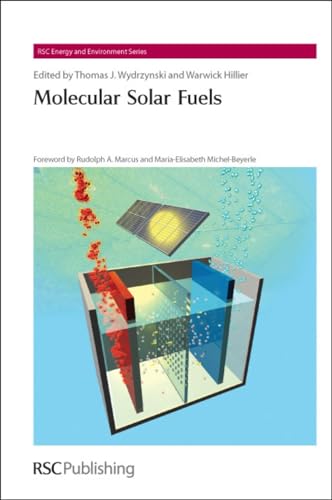
World demand for energy is rapidly increasing and finding sufficient supplies of clean energy for the future is one of the major scientific challenges of today. This book presents the latest knowledge and chemical prospects in developing hydrogen as a solar fuel. Using oxygenic photosynthesis and hydrogenase enzymes for bio-inspiration, it explores strategies for developing photocatalysts to produce a molecular solar fuel. The book begins with perspective of solar energy utilization and the role that synthetic photocatalysts can play in producing solar fuels. It then summarizes current knowledge with respect to light capture, photochemical conversion, and energy storage in chemical bonds. Following chapters on the natural systems, the book then summarizes the latest developments in synthetic chemistry of photo- and reductive catalysts. Finally, important future research goals for the practical utilization of solar energy are discussed. The book is written by experts from various fields working on the biological and synthetic chemical side of molecular solar fuels to facilitate advancement in this area of research.
Die Inhaltsangabe kann sich auf eine andere Ausgabe dieses Titels beziehen.
Über die Autorin bzw. den Autor
Tom Wydrzynski is a Professor and Head of the Photobioenergetics Group at the ANU (Australian National University) School of Biology where he conducts research on natural and artificial photosynthesis. He is on the Editorial Boards of Photosynthesis Research and Biochimica et Biophysica Acta - Bioenergetics. Professor Wydrzynski received his BA in Biology from the University of Missouri at St. Louis and a PhD in Plant Biology from the University of Illinois at Urbana-Champaign. He subsequently held research posts at the Max Volmer Institute for Biophysical and Physical Chemistry in Berlin, the Standard Oil Company of Indiana (AMOCO Corporation) in Illinois, and the Lawrence Berkeley Laboratory in California.
Associate Professor Hillier has authored over forty journal articles, book chapters and conference proceedings. He has also presented his work at a variety of international conferences. Warwick Hillier has a PhD from the ANU and has been a visiting scientist at the National Renewable Energy Laboratory in Golden, USA and a NIH Postdoctoral Research Associate in the Deptartment of Chemistry at Michigan State University. Warwick Hillier is currently an Associate Professor at the ANU (Australian National University) School of Biology. He works on natural and artificial photosynthesis using spectroscopy and molecular biology to study basic problems in electron and proton transfer reactions.
Von der hinteren Coverseite
The US Department of Energy Basic Sciences Workshops in 2005 on 'Solar Energy Utilization' and in 2007 on 'Catalysis for Energy' identified the development of solar fuels as a key, carbon-neutral, energy resource for the future. Hydrogen is a promising example as the harmless waste product, on combustion with oxygen, is water. The energy released can be coupled to electrical current generation or the reduction of carbon compounds such as carbon dioxide. If hydrogen could be readily produced from water using solar energy, then an ideal fuel cycle would be possible. The main aim of the book is to present the latest knowledge and chemical prospects in developing hydrogen as a solar fuel. Using oxygenic photosynthesis and hydrogenase enzymes for bio-inspiration, this book presents the strategies for developing photocatalysts to produce a molecular solar fuel. Topics covered include the molecular mechanisms for the capture of light, photochemical conversion to chemical potential, and the storage of energy in chemical bonds, both in the natural systems and the synthetic chemical systems. The book is written by experts from various fields working on the biological and synthetic chemical side of molecular solar fuels to facilitate advancement in this area of research.
Auszug. © Genehmigter Nachdruck. Alle Rechte vorbehalten.
Molecular Solar Fuels
By Thomas J. Wydrzynski, Warwick HillierThe Royal Society of Chemistry
Copyright © 2012 Royal Society of Chemistry
All rights reserved.
ISBN: 978-1-84973-034-1All rights reserved.
Contents
Chapter 1 Harvesting Solar Energy through Natural or Artificial Photosynthesis: Scientific, Social, Political and Economic Implications A. W. D. Larkum, 1,
Chapter 2 Solar Energy Utilisation Ron Pace and Elmars Krausz, 20,
Chapter 3 Converting Photons to Electron and Proton Shifts from Water for Fuel Production Christian Herrero, Cyrille Costentin and Ally Aukauloo, 39,
Chapter 4 Photosynthetic Light-Harvesting Complexes Aaron M. Collins, Jianzhong Wen and Robert E. Blankenship, 85,
Chapter 5 Structure and Function of Photosynthetic Reaction Centres Joanna Kargul and James Barber, 107,
Chapter 6 Photophysics of Photosynthetic Reaction Centres Thomas Renger, 143,
Chapter 7 Photosynthetic O2 Evolution Johannes Messinger, Takumi Noguchi and Junko Yano, 163,
Chapter 8 Substrate and Product Channels in Photosystem II Felix M. Ho, 208,
Chapter 9 Energy from Photosystem II: Manganese Water Oxidation Catalysts Robin Brimblecombe, G. Charles Dismukes, Gerhard F. Swiegers and Leone Spiccia, 249,
Chapter 10 Molecular Ru and Ir Complexes Capable of Acting as Water Oxidation Catalysts X. Sala, L. Escriche and A. Llobet, 273,
Chapter 11 Structure and Function of Hydrogenase Enzymes Wolfgang Lubitz, Hideaki Ogata, Eduard Reijerse and Yoshiki Higuchi, 288,
Chapter 12 Metal Complex of Hydrogenase Active Sites Joe Dawson, Fabio Ghiotto, Jonathan McMaster and Martin Schröder, 326,
Chapter 13 Theoretical Studies of O–O and H–H Bond Formation in Enzymes Per E. M. Siegbahn, 387,
Chapter 14 Redox Active Protein Maquettes: Multi-functional "Green Enzymes" James Murray, 408,
Chapter 15 Light-activated Bioconjugate Complexes David Hvasanov, Daniel C Goldstein and Pall Thordarson, 426,
Chapter 16 Synthetic Photo-catalytic Proteins – a Model of Photosystem II Brendon Conlan, Warwick Hillier and Tom Wydrzynski, 448,
Chapter 17 Wired Reaction Centers Carolyn E. Lubner, Donald A. Bryant and John H. Golbeck, 464,
Chapter 18 Future Perspectives on Solar Fuels T. A. Faunce, 506,
Subject Index, 529,
CHAPTER 1
Harvesting Solar Energy through Natural or Artificial Photosynthesis: Scientific, Social, Political and Economic Implications
A. W. D. LARKUM
School of Biological Sciences, University of Sydney, NSW 2006, Australia
1.1 Introduction
Humans are facing some difficult choices in the near future. It seems highly probable that greenhouse gas emissions will lead to significant global warming over the next 50 years. This will in turn lead to an increasing constraint on use of carbon-based fuels, especially fossil fuels, for transportation, heating, etc. On the other hand solar energy provides our planet with a plenitude of energy, which at the present time is barely utilised by humans. This is a source of energy that is being heralded as the future supply of energy on our planet. And indeed it is clearly a possible source. On the other hand it is important to grasp that this source is not without its own problems, at a number of levels.
Solar energy can be captured and turned into electrical energy by photovoltaic solar panels or by thermal heating systems, with an efficiency of 10% or more. This would displace areas of land or sea used for other purposes or not used at all. Land designated for this purpose would also compete with attempts to use cyanobacteria, algae and plants, ancient photosynthetic organisms on the Earth's surface, to capture solar energy and convert it into bioenergy in the form of stores of organic carbon, albeit by a mechanism with only 0.01–1% efficiency. Nevertheless, this ancient process of photosynthesis is the major driving force for life on our planet. Fortunately, the land or sea needed by photovoltaic/solar thermal systems would be quite small compared with the overall size of our planet: an area of land the size of Egypt or Colombia and slightly larger than that of France would be needed. Much larger areas would be required (>10 fold) if natural photosynthesis were used in the place of photovoltaic solar panels. Furthermore, the use of land for solar harvesting poses ethical problems, which will be discussed below. For example, the use of cropland to produce biofuels has already raised the price of food around the world, even at the moderate levels now applied; so without proper planning very serious ethical problems could arise. Finally, the use of natural photosynthesis to sequester stores of organic carbon for bioenergy is less attractive than it might seem in terms of a carbon and solar footprints, as discussed below.
Use of marginal land to produce lignocellulose products that could form the basis for biofuel production has been an unrealised goal for many years. How realistic is this goal and what are the alternatives? The use of algae in ponds and photobioreactors has also been proposed over recent years. Such systems have a rather large solar footprint and their carbon footprint is not as attractive as it might appear at first sight. Thus it is important to recognise these limitations and plan accordingly.
Of course, another strategy is to re-engineer natural photosynthesis by completely artificial means (see later chapters in this book). As discussed in this chapter, natural photosynthesis is hampered by the fact that the basic mechanisms have evolved over the last 2.5–3 billion years and the ability for retro-engineering has been very limited – and will probably continue to be so even under selection by humans. Therefore, artificial photosynthesis or some form of hydrogen generation, involving photosynthesis, has future potential, despite being in an early stage of development. Such developments have the attraction that they hold out the promise of both small carbon and solar footprints.
1.2 Solar Energy Input to the Earth, and Current and Future Energy Usage by Society
The amount of energy reaching the surface of the Earth has been known for many years and, despite refinement to show decadal variation, the values have remained much the same. The annual value for the amount of energy reaching the Earth's surface is ~2 500 000 ExaJoules (EJ, where EJ = 5 × 10²⁰ Joules yr-1). Discarding the near infra-red wavelengths that are not available to photosynthetic pigments this leaves ~2 200 000 EJ of the available energy per year.
Values for the amount of solar energy at many points on the Earth's surface are available for many sites (e.g., ref. 10). It is also now possible to make good models for any point at the Earth's surface at any time and to compute daily, seasonal, and annual irradiation levels, both for a horizontal surface and for a surface perpendicular to the sun's rays. Perhaps surprisingly, on a cloudless day, the temperate zones offer good levels of solar energy, even though the season is shorter (Table 1.1).
World energy use is approximately 500 EJ per year (based on values for 2008). Of this total, 80–90% is derived from fossil fuels. In equivalent units, this is an average consumption of 16 TeraWatts (1.6 × 10¹³ W). In comparison with 1980, this represented an approximate doubling of energy use over the previous 25 years. Further, it is calculated to double again by 2040, with China and India accounting for the greatest increases.
On the basis of the Earth's surface area...
„Über diesen Titel“ kann sich auf eine andere Ausgabe dieses Titels beziehen.
Suchergebnisse für Molecular Solar Fuels (Rsc Energy and Environment,...

Beispielbild für diese ISBN
MOLECULAR SOLAR FUELS (HB 2012)
Anbieter: Basi6 International, Irving, TX, USA
Verkäuferbewertung 5 von 5 Sternen

Zustand: Brand New. New. US edition. Expediting shipping for all USA and Europe orders excluding PO Box. Excellent Customer Service. Bestandsnummer des Verkäufers ABEOCT25-221575
Beispielbild für diese ISBN
MOLECULAR SOLAR FUELS (HB 2012)
Anbieter: Romtrade Corp., STERLING HEIGHTS, MI, USA
Verkäuferbewertung 5 von 5 Sternen
Zustand: New. This is a Brand-new US Edition. This Item may be shipped from US or any other country as we have multiple locations worldwide. Bestandsnummer des Verkäufers ABBB-59753
Beispielbild für diese ISBN
Molecular Solar Fuels
Anbieter: Basi6 International, Irving, TX, USA
Verkäuferbewertung 5 von 5 Sternen
Zustand: Brand New. New. US edition. Expediting shipping for all USA and Europe orders excluding PO Box. Excellent Customer Service. Bestandsnummer des Verkäufers ABEOCT25-221576
Beispielbild für diese ISBN
Molecular Solar Fuels (Energy and Environment Series, Volume 5)
Verlag:
Royal Society of Chemistry, 2011
ISBN 10: 1849730342
ISBN 13: 9781849730341
Gebraucht
Hardcover
Anbieter: Phatpocket Limited, Waltham Abbey, HERTS, Vereinigtes Königreich
Verkäuferbewertung 5 von 5 Sternen
Zustand: Good. Your purchase helps support Sri Lankan Children's Charity 'The Rainbow Centre'. Ex-library, so some stamps and wear, but in good overall condition. Our donations to The Rainbow Centre have helped provide an education and a safe haven to hundreds of children who live in appalling conditions. Bestandsnummer des Verkäufers Z1-I-031-01884
Gebraucht kaufen
EUR 83,60
EUR 12,46 Versand
Versand von Vereinigtes Königreich nach USA
Versand von Vereinigtes Königreich nach USA
Anzahl: 1 verfügbar
Beispielbild für diese ISBN
MOLECULAR SOLAR FUELS (HB 2012)
Anbieter: SMASS Sellers, IRVING, TX, USA
Verkäuferbewertung 4 von 5 Sternen

Zustand: New. Brand New Original US Edition. Customer service! Satisfaction Guaranteed. Bestandsnummer des Verkäufers SNTA-59753
Beispielbild für diese ISBN
Molecular Solar Fuels
Anbieter: Basi6 International, Irving, TX, USA
Verkäuferbewertung 5 von 5 Sternen
Zustand: Brand New. New. US edition. Expediting shipping for all USA and Europe orders excluding PO Box. Excellent Customer Service. Bestandsnummer des Verkäufers ABEOCT25-221577
Beispielbild für diese ISBN
Molecular Solar Fuels
Anbieter: Romtrade Corp., STERLING HEIGHTS, MI, USA
Verkäuferbewertung 5 von 5 Sternen
Zustand: New. This is a Brand-new US Edition. This Item may be shipped from US or any other country as we have multiple locations worldwide. Bestandsnummer des Verkäufers ABBB-137279
Beispielbild für diese ISBN
Molecular Solar Fuels
Anbieter: Basi6 International, Irving, TX, USA
Verkäuferbewertung 5 von 5 Sternen
Zustand: Brand New. New. US edition. Expediting shipping for all USA and Europe orders excluding PO Box. Excellent Customer Service. Bestandsnummer des Verkäufers ABEOCT25-221578
Beispielbild für diese ISBN
Molecular Solar Fuels
Anbieter: Romtrade Corp., STERLING HEIGHTS, MI, USA
Verkäuferbewertung 5 von 5 Sternen
Zustand: New. This is a Brand-new US Edition. This Item may be shipped from US or any other country as we have multiple locations worldwide. Bestandsnummer des Verkäufers ABBB-35752
Beispielbild für diese ISBN
Molecular Solar Fuels
Anbieter: SMASS Sellers, IRVING, TX, USA
Verkäuferbewertung 4 von 5 Sternen
Zustand: New. Brand New Original US Edition. Customer service! Satisfaction Guaranteed. Bestandsnummer des Verkäufers SNTA-35752