
Verwandte Artikel zu Chemical Information for Chemists: A Primer
Inhaltsangabe
While it is not difficult to find data in many cases, what advice can you get on the quality of the data retrieved? Chemical Information for Chemists could help with this problem and more. This book is a chemical information book aimed specifically at practicing chemists. Written and edited by experts in the field, it is ideal for chemists who lack a chemical information professional able to teach basic and intermediate techniques in retrieving and evaluating information using the unique entry points of the chemical literature, including structure, formula, substructure, and sequence. Aimed at students on undergraduate and graduate courses, it could also be a useful guide to new information specialists who are facing the challenging diversity of chemical literature.
Die Inhaltsangabe kann sich auf eine andere Ausgabe dieses Titels beziehen.
Von der hinteren Coverseite
While it is not difficult to find data in many cases, what advice can you get on the quality of the data retrieved? Chemical Information for Chemists could help with this problem and more. This book is a chemical information book aimed specifically at practicing chemists. Written and edited by experts in the field, it is ideal for chemists who lack a chemical information professional able to teach basic and intermediate techniques in retrieving and evaluating information using the unique entry points of the chemical literature, including structure, formula, substructure, and sequence. Aimed at students on undergraduate and graduate courses, it could also be a useful guide to new information specialists who are facing the challenging diversity of chemical literature.
Aus dem Klappentext
While it is not difficult to find data in many cases, what advice can you get on the quality of the data retrieved? Chemical Information for Chemists could help with this problem and more. This book is a chemical information book aimed specifically at practicing chemists. Written and edited by experts in the field, it is ideal for chemists who lack a chemical information professional able to teach basic and intermediate techniques in retrieving and evaluating information using the unique entry points of the chemical literature, including structure, formula, substructure, and sequence. Aimed at students on undergraduate and graduate courses, it could also be a useful guide to new information specialists who are facing the challenging diversity of chemical literature.
Auszug. © Genehmigter Nachdruck. Alle Rechte vorbehalten.
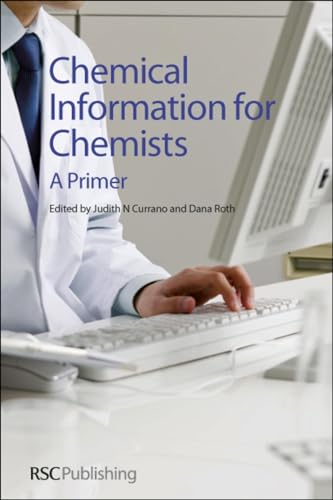
Chemical Information for Chemists
A Primer
By Judith N. Currano, Dana L. RothThe Royal Society of Chemistry
Copyright © 2014 The Royal Society of Chemistry
All rights reserved.
ISBN: 978-1-84973-551-3All rights reserved.
Contents
I. Introduction,
Chapter 1 Introduction to the Chemical Literature Leah McEwen,
II. The Primary Literature,
Chapter 2 Non-Patent Primary Literature: Journals, Conference Papers, Reports, Abstracts and Preprints Dana L. Roth,
Chapter 3 Chemical Patents Michael J. White,
III. The Secondary Literature and Specialized Search Techniques,
Chapter 4 Searching Using Text: Beyond Web Search Engines Andrea Twiss-Brooks,
Chapter 5 Searching by Structure and Substructure Judith N. Currano,
Chapter 6 Physical Properties and Spectra A. Ben Wagner,
Chapter 7 Commercial Availability, Safety, and Hazards Dana L. Roth,
Chapter 8 Searching For Polymers Donna T. Wrublewski,
Chapter 9 Reaction Searching Judith N. Currano,
Chapter 10 A Practical Primer to BLAST Sequence Similarity Searching Diane C. Rein,
Subject Index,
CHAPTER 1
Introduction to the Chemical Literature
LEAH MCEWEN
Cornell University, Physical Sciences Library, 283 Clark Hall, Ithaca, NY 14853-2501, US
Email: lrm1@cornell.edu
1.1 CHEMICAL INFORMATION THREE WAYS: THE BIG PICTURE OF BIG INFORMATION
I recently welcomed a new group of chemistry graduate students with an orientation to the library at Cornell University. We started with a discussion of the role of literature in research, focused on the scope of specific library resources and services available, and highlighted a few key things the students could do right away to get started with their research. The idea was to funnel the vast world of chemistry-related literature into something bite-sized and immediately useful while not losing sight of how much is possible and how important robust literature research is to chemistry. We hope this book will accomplish something similar: provide a highly useful volume for a broad range of information-related needs across the chemistry research process. In this introduction, we hope to cover both the big picture of how information fits into the chemical enterprise and a few useful things to keep in mind when delving into the literature.
To begin, we will consider the ways in which literature is involved in the research process, how scientists are involved in the production and consumption of this literature, and the role of information providers and the library. The scholarly communication cycle is at the core of the scientific endeavor for both research and teaching purposes and is standard practice across the disciplines. Published literature is the lasting product of scientific research. It captures and documents the ideas, methods, results, implications and applications of projects and makes this information available to the broader research community and society to further research developments, grants, products, marketing, competitive advantage, etc. It is important for researchers to determine exactly when in their research process to disseminate their findings to the community and which of the many available avenues of communication is most appropriate. These decisions are influenced by place of work (academic, government, industry), job level, and practices in various chemistry sub-disciplines. The resulting published literature in chemistry is as varied and complex as the science it represents, and includes articles, patents, technical reports, conference proceedings, book chapters, and data sets.
„Über diesen Titel“ kann sich auf eine andere Ausgabe dieses Titels beziehen.
Suchergebnisse für Chemical Information for Chemists: A Primer

Beispielbild für diese ISBN
Chemical Information for Chemists: A Primer
Verlag:
Royal Society of Chemistry, 2013
ISBN 10: 1849735514
ISBN 13: 9781849735513
Gebraucht
Paperback
Anbieter: ThriftBooks-Atlanta, AUSTELL, GA, USA
Verkäuferbewertung 5 von 5 Sternen

Paperback. Zustand: Good. No Jacket. Pages can have notes/highlighting. Spine may show signs of wear. ~ ThriftBooks: Read More, Spend Less. Bestandsnummer des Verkäufers G1849735514I3N00
Gebraucht kaufen
EUR 11,33
Versand gratis
Versand innerhalb von USA
Versand innerhalb von USA
Anzahl: 1 verfügbar
Beispielbild für diese ISBN
Chemical Information for Chemists : A Primer
Verlag:
Royal Society of Chemistry, The, 2013
ISBN 10: 1849735514
ISBN 13: 9781849735513
Gebraucht
Softcover
Anbieter: Better World Books, Mishawaka, IN, USA
Verkäuferbewertung 5 von 5 Sternen
Zustand: Very Good. Former library copy. Pages intact with possible writing/highlighting. Binding strong with minor wear. Dust jackets/supplements may not be included. Includes library markings. Stock photo provided. Product includes identifying sticker. Better World Books: Buy Books. Do Good. Bestandsnummer des Verkäufers 1581913-75
Gebraucht kaufen
EUR 11,33
Versand gratis
Versand innerhalb von USA
Versand innerhalb von USA
Anzahl: 1 verfügbar
Beispielbild für diese ISBN
Chemical Information for Chemists
Anbieter: Majestic Books, Hounslow, Vereinigtes Königreich
Verkäuferbewertung 4 von 5 Sternen

Zustand: New. pp. 250. Bestandsnummer des Verkäufers 53991489
Neu kaufen
EUR 24,17
EUR 7,71 Versand
Versand von Vereinigtes Königreich nach USA
Versand von Vereinigtes Königreich nach USA
Anzahl: 4 verfügbar
Beispielbild für diese ISBN
Chemical Information for Chemists
Verlag:
Royal Society of Chemistry RSC, 2013
ISBN 10: 1849735514
ISBN 13: 9781849735513
Neu
Softcover
Anbieter: Books Puddle, Woodside, NY, USA
Verkäuferbewertung 4 von 5 Sternen
Zustand: New. pp. 250. Bestandsnummer des Verkäufers 2654552478
Neu kaufen
EUR 29,38
EUR 3,56 Versand
Versand innerhalb von USA
Versand innerhalb von USA
Anzahl: 4 verfügbar
Beispielbild für diese ISBN
Chemical Information for Chemists: A Primer
Verlag:
Royal Society of Chemistry, 2013
ISBN 10: 1849735514
ISBN 13: 9781849735513
Gebraucht
Paperback
Anbieter: WorldofBooks, Goring-By-Sea, WS, Vereinigtes Königreich
Verkäuferbewertung 5 von 5 Sternen
Paperback. Zustand: Very Good. The book has been read, but is in excellent condition. Pages are intact and not marred by notes or highlighting. The spine remains undamaged. Bestandsnummer des Verkäufers GOR008733141
Gebraucht kaufen
EUR 27,14
EUR 6,65 Versand
Versand von Vereinigtes Königreich nach USA
Versand von Vereinigtes Königreich nach USA
Anzahl: 1 verfügbar
Beispielbild für diese ISBN
Chemical Information for Chemists
Anbieter: Biblios, Frankfurt am main, HESSE, Deutschland
Verkäuferbewertung 4 von 5 Sternen
Zustand: New. pp. 250. Bestandsnummer des Verkäufers 1854552468
Neu kaufen
EUR 24,47
EUR 9,95 Versand
Versand von Deutschland nach USA
Versand von Deutschland nach USA
Anzahl: 4 verfügbar
Beispielbild für diese ISBN
CHEMICAL INFORMATION FOR CHEMISTS A PRIMER (PB 2014)
Anbieter: Basi6 International, Irving, TX, USA
Verkäuferbewertung 5 von 5 Sternen
Zustand: Brand New. New. US edition. Expediting shipping for all USA and Europe orders excluding PO Box. Excellent Customer Service. Bestandsnummer des Verkäufers ABEOCT25-222083
Beispielbild für diese ISBN
CHEMICAL INFORMATION FOR CHEMISTS A PRIMER (PB 2014)
Anbieter: Romtrade Corp., STERLING HEIGHTS, MI, USA
Verkäuferbewertung 5 von 5 Sternen
Zustand: New. This is a Brand-new US Edition. This Item may be shipped from US or any other country as we have multiple locations worldwide. Bestandsnummer des Verkäufers ABBB-59820
Beispielbild für diese ISBN
Chemical Information for Chemists: A Primer
Anbieter: Basi6 International, Irving, TX, USA
Verkäuferbewertung 5 von 5 Sternen
Zustand: Brand New. New. US edition. Expediting shipping for all USA and Europe orders excluding PO Box. Excellent Customer Service. Bestandsnummer des Verkäufers ABEOCT25-222084
Beispielbild für diese ISBN
Chemical Information for Chemists
Anbieter: PBShop.store UK, Fairford, GLOS, Vereinigtes Königreich
Verkäuferbewertung 5 von 5 Sternen
PAP. Zustand: New. New Book. Shipped from UK. Established seller since 2000. Bestandsnummer des Verkäufers CW-9781849735513
Neu kaufen
EUR 36,73
EUR 4,94 Versand
Versand von Vereinigtes Königreich nach USA
Versand von Vereinigtes Königreich nach USA
Anzahl: 15 verfügbar