
Verwandte Artikel zu Soft Nanoparticles for Biomedical Applications (RSC...
Inhaltsangabe
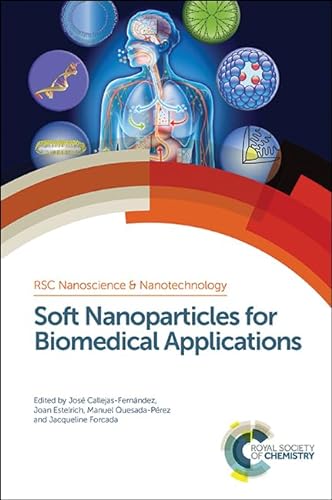
Nanoparticles are attractive for many biomedical applications such as imaging, therapeutics and diagnostics. This new book looks at different soft nanoparticles and their current and potential uses in medicine and health including magnetoliposomes, micro/nanogels, polymeric micelles, DNA particles, dendrimers and bicelles.
Each chapter provides a description of the synthesis of the particles and focus on the techniques used to characterize the size, shape, surface charge, internal structure, and surface microstructure of the nanoparticles together with modeling and simulation methods. By giving a strong physical-chemical approach to the topic, readers will gain a good background into the subject and an overview of recent developments.
The multidisciplinary point of view makes the book suitable for postgraduate students and researchers in physics, chemistry, and biology interested in soft matter and its uses.
Die Inhaltsangabe kann sich auf eine andere Ausgabe dieses Titels beziehen.
Auszug. © Genehmigter Nachdruck. Alle Rechte vorbehalten.
Soft Nanoparticles for Biomedical Applications
By José Callejas-Fernández, Joan Estelrich, Manuel Quesada-Pérez, Jacqueline ForcadaThe Royal Society of Chemistry
Copyright © 2014 The Royal Society of Chemistry
All rights reserved.
ISBN: 978-1-84973-811-8All rights reserved.
Contents
Chapter 1 Introductory Aspects of Soft Nanoparticles Joan Estelrich, Manuel Quesada-Pérez, Jacqueline Forcada and José Callejas-Fernández, 1,
Chapter 2 Experimental Techniques Used for the Characterization of Soft Nanoparticles J. Callejas-Fernández, J. Ramos, O. Sanz, J. Forcada, J. L. Ortega-Vinuesa, A. Martín-Molina, M. A. Rodríguez-Valverde, M. Tirado-Miranda, A. Schmitt, B. Sierra-Martin, A. Maldonado-Valdivia, A. Fernández-Barbero, R. Pons, L. F. Capitán-Vallvey, A. Salinas-Castillo, A. Lapresta-Fernández, B. Vázquez, M. R. Aguilar and J. San Román, 19,
Chapter 3 The Original Magnetoliposomes: from the Physicochemical Basics to Theranostic Nanomedicine Marcel De Cuyper, 109,
Chapter 4 Nanogels for Drug Delivery: the Key Role of Nanogel–Drug Interactions Jose Ramos, Miguel Pelaez-Fernandez, Jacqueline Forcada and Arturo Moncho-Jorda, 133,
Chapter 5 Polymeric Micelles P. Taboada, S. Barbosa, A. Concheiro and C. Alvarez-Lorenzo, 157,
Chapter 6 DNA Particles M. Carmen Morán, 216,
Chapter 7 Dendrimers A. J. Perisé-Barrios, D. Sepúlveda-Crespo, D. Shcharbin, B. Rasines, R. Gómez, B. Klajnert-Maculewicz, M. Bryszewska, F. J. de la Mata and M. A. Muñoz-Fernández, 246,
Chapter 8 Bicellar Systems: Characterization and Skin Applications Gelen Rodríguez, Lucyanna Barbosa-Barros, Mercedes Cócera, Laia Rubio, Carmen López-Iglesias, Alfons de la Maza and Olga López, 280,
Chapter 9 Soft Hybrid Nanoparticles: from Preparation to Biomedical Applications Talha Jamshaid, Mohamed Eissa, Nadia Zine, Abdelhamid Errachid El-Salhi, Nasir M. Ahmad and Abdelhamid Elaissari, 312,
Chapter 10 Computer Simulations of Soft Nanoparticles and Their Interactions with DNA-Like Polyelectrolytes Serge Stoll, 342,
Subject Index, 372,
CHAPTER 1
Introductory Aspects of Soft Nanoparticles
JOAN ESTELRICH, MANUEL QUESADA-PÉREZ, JACQUELINE FORCADA AND JOSÉ CALLEJAS-FERNÁNDEZ
1.1 Nanoparticles
Nanotechnology is the science that deals with matter at the scale of 1 billionth of a metre (i.e. 10-9 m = 1 nm) and is also the study of manipulating matter at the atomic and molecular scale. A nanoparticle is the most fundamental component in the fabrication of a nanostructure and is far smaller than the world of everyday objects that are described by Newton's laws of motion, but larger than an atom or a simple molecule that are governed by quantum mechanics.
According to the definition of the International Organization for Standardization (ISO), a nanoparticle is a particle whose size spans the range between 1 and 100 nm. Metallic nanoparticles have different physical and chemical properties from bulk metals (e.g. lower melting points, higher specific surface areas, specific optical properties, mechanical strengths and magnetizations), properties that might prove attractive in various industrial applications. However, how a nanoparticle is viewed and is defined depends very much on the specific application. In this regard, for biomedical applications, structures and objects up to 1000 nm in size are included as nanostructured materials used in medicine.
Of particular importance, optical properties are among the fundamental attractions and characteristics of a nanoparticle. For example, a 20 nm gold nanoparticle has a characteristic wine-red colour, a silver nanoparticle is yellowish grey and platinum and palladium nanoparticles are black. Not surprisingly, the optical characteristics of nanoparticles have been used for centuries in sculptures and paintings even before the fourth century AD. The most famous example is the Lycurgus cup (fourth century AD). This cup, at present in the British Museum in London, is the only complete historical example of a special type of glass, known as dichroic glass, that changes colour when held up to the light. When it is looked at in reflected light or daylight, it appears green. However, when light is shone into the cup and transmitted through the glass, it changes colour to red. This property puzzled scientists for decades and the mystery was not solved until 1990, when researchers in England scrutinized broken fragments under a microscope and discovered that Roman artisans were nanotechnology pioneers: they had impregnated the glass with a very small quantity of minute (~70 nm) colloidal silver and gold in an approximate molar ratio of 14:1, which gives it these unusual optical properties.
Gold suspensions were familiar to alchemists in the Middle Ages and the reputation of soluble gold was based mostly on its fabulous curative powers against various diseases, for example, heart and venereal diseases, dysentery, epilepsy and tumours. Metallic nanoparticles were used in mediaeval stained glasses. The mediaeval artisans trapped gold nanoparticles in the glass matrix in order to generate ruby-red colour in windows. They also trapped silver nanoparticles, which gave the glass a deep-yellow colour. Beautiful examples of these applications can be found in glass windows of many Gothic European cathedrals.
In the seventeenth century, the so-called Purple of Cassius was highly popular. It was a colloid made by reducing a soluble gold salt with stannous chloride. It was used as a colorant and to determine the presence of gold as a chemical test. The first scientific study of gold particles was carried out by Faraday in 1857. He observed that gold suspensions with a ruby-coloured appearance, made by reducing an aqueous solution of chloroaurate (AuCl4-) with phosphorus in CS2 (a two-phase system), changed their colour from red to blue upon heating or addition of salt. Faraday correctly attributed the colour change to an increase in the effective particle size caused by aggregation. Since that pioneering work, thousands of scientific papers have been published on the synthesis, modification, properties and assembly of metal nanoparticles, using a wide variety of solvents and other substrates. Nowadays, the most widely used nanotechnology product in the field of in vitro diagnostics is colloidal gold in lateral flow assays, which is used in rapid tests for pregnancy, ovulation, human immunodeficiency virus (HIV) and other indications. Gold nanoparticles were introduced into these tests in the late 1980s because gold conjugates have particularly high stability, which is critical for avoiding false positives.
In 1959, Richard Feynman gave a talk entitled 'There's plenty of room at the bottom', where he predicted the new things and new opportunities that one could expect in the very small world. Norio Taniguchi of Tokyo University of Science was the first to propose in 1974 the term 'nanotechnology'. The age of nanotechnology had begun.
The activity in the field of the nanotechnology has grown exponentially worldwide during the past three decades, becoming a major interdisciplinary area of research. This growth has been driven to a great extent by the integration of nanotechnology into the field of medical science, since nanostructured materials have unique medical effects. The control of materials in the nanometric range not only results in new medical effects but also requires novel, scientifically demanding chemistry and manufacturing...
„Über diesen Titel“ kann sich auf eine andere Ausgabe dieses Titels beziehen.
Suchergebnisse für Soft Nanoparticles for Biomedical Applications (RSC...

Beispielbild für diese ISBN
Soft Nanoparticles for Biomedical Applications: Volume 34 (Nanoscience & Nanotechnology Series)
Verlag:
Royal Society of Chemistry, 2014
ISBN 10: 1849738114
ISBN 13: 9781849738118
Gebraucht
Paperback
Anbieter: WorldofBooks, Goring-By-Sea, WS, Vereinigtes Königreich
Verkäuferbewertung 5 von 5 Sternen

Paperback. Zustand: Very Good. The book has been read, but is in excellent condition. Pages are intact and not marred by notes or highlighting. The spine remains undamaged. Bestandsnummer des Verkäufers GOR007813330
Gebraucht kaufen
EUR 6,49
EUR 6,53 Versand
Versand von Vereinigtes Königreich nach USA
Versand von Vereinigtes Königreich nach USA
Anzahl: 2 verfügbar
Beispielbild für diese ISBN
Soft Nanoparticles for Biomedical Applications (RSC Nanoscience & Nanotechnology)
Anbieter: AwesomeBooks, Wallingford, Vereinigtes Königreich
Verkäuferbewertung 5 von 5 Sternen
Hardcover. Zustand: Very Good. Soft Nanoparticles for Biomedical Applications (RSC Nanoscience & Nanotechnology) This book is in very good condition and will be shipped within 24 hours of ordering. The cover may have some limited signs of wear but the pages are clean, intact and the spine remains undamaged. This book has clearly been well maintained and looked after thus far. Money back guarantee if you are not satisfied. See all our books here, order more than 1 book and get discounted shipping. Bestandsnummer des Verkäufers 7719-9781849738118
Gebraucht kaufen
EUR 8,43
EUR 4,81 Versand
Versand von Vereinigtes Königreich nach USA
Versand von Vereinigtes Königreich nach USA
Anzahl: 2 verfügbar
Beispielbild für diese ISBN
Soft Nanoparticles for Biomedical Applications (RSC Nanoscience & Nanotechnology)
Verlag:
Royal Society of Chemistry 01/l /18 J, 2014
ISBN 10: 1849738114
ISBN 13: 9781849738118
Gebraucht
Hardcover
Anbieter: Bahamut Media, Reading, Vereinigtes Königreich
Verkäuferbewertung 4 von 5 Sternen

Hardcover. Zustand: Very Good. Shipped within 24 hours from our UK warehouse. Clean, undamaged book with no damage to pages and minimal wear to the cover. Spine still tight, in very good condition. Remember if you are not happy, you are covered by our 100% money back guarantee. Bestandsnummer des Verkäufers 6545-9781849738118
Gebraucht kaufen
EUR 10,36
EUR 8,14 Versand
Versand von Vereinigtes Königreich nach USA
Versand von Vereinigtes Königreich nach USA
Anzahl: 1 verfügbar
Beispielbild für diese ISBN
Soft Nanoparticles For Biomedical Applications
Anbieter: Basi6 International, Irving, TX, USA
Verkäuferbewertung 5 von 5 Sternen
Zustand: Brand New. New. US edition. Expediting shipping for all USA and Europe orders excluding PO Box. Excellent Customer Service. Bestandsnummer des Verkäufers ABEOCT25-222379
Beispielbild für diese ISBN
SOFT NANOPARTICLES FOR BIOMEDICAL APPLICATIONS
Anbieter: Romtrade Corp., STERLING HEIGHTS, MI, USA
Verkäuferbewertung 5 von 5 Sternen
Zustand: New. This is a Brand-new US Edition. This Item may be shipped from US or any other country as we have multiple locations worldwide. Bestandsnummer des Verkäufers ABBB-3945
Beispielbild für diese ISBN
SOFT NANOPARTICLES FOR BIOMEDICAL APPLICATIONS
Anbieter: SMASS Sellers, IRVING, TX, USA
Verkäuferbewertung 4 von 5 Sternen
Zustand: New. Brand New Original US Edition. Customer service! Satisfaction Guaranteed. Bestandsnummer des Verkäufers SNTA-3945
Beispielbild für diese ISBN
Soft Nanoparticles for Biomedical Applications: RSC (Nanoscience, Volume 34)
Verlag:
Royal Society of Chemistry RSC, 2014
ISBN 10: 1849738114
ISBN 13: 9781849738118
Neu
Hardcover
Anbieter: Books Puddle, Woodside, NY, USA
Verkäuferbewertung 4 von 5 Sternen
Zustand: New. 1st edition NO-PA29JULT2014-KAP. Bestandsnummer des Verkäufers 26128430098
Neu kaufen
EUR 112,58
EUR 3,52 Versand
Versand innerhalb von USA
Versand innerhalb von USA
Anzahl: 4 verfügbar
Beispielbild für diese ISBN
Soft Nanoparticles for Biomedical Applications: RSC (Nanoscience, Volume 34)
Anbieter: Majestic Books, Hounslow, Vereinigtes Königreich
Verkäuferbewertung 4 von 5 Sternen
Zustand: New. Bestandsnummer des Verkäufers 131076045
Neu kaufen
EUR 113,27
EUR 7,58 Versand
Versand von Vereinigtes Königreich nach USA
Versand von Vereinigtes Königreich nach USA
Anzahl: 4 verfügbar
Beispielbild für diese ISBN
RSC Nanoscience & Nanotechnology SOFT NANOPARTICLES FOR BIOMEDICAL APPLICATIONS
Anbieter: a2zbooks, Burgin, KY, USA
Verkäuferbewertung 5 von 5 Sternen
Hardcover. Zustand: Very Good. Edition Unstated. Text appears to be clean. This book has stamp on page block. Sticker on the front cover. Cover has some wear and corner bumps. Spine is in very good condition. Quantity Available: 1. Shipped Weight: Under 1 kilo. Category: Education; ISBN: 1849738114. ISBN/EAN: 9781849738118. Pictures of this item not already displayed here available upon request. Inventory No: 1561049922. Bestandsnummer des Verkäufers 1561049922
Gebraucht kaufen
EUR 172,57
EUR 7,27 Versand
Versand innerhalb von USA
Versand innerhalb von USA
Anzahl: 1 verfügbar
Beispielbild für diese ISBN
Soft Nanoparticles for Biomedical Applications
Anbieter: PBShop.store US, Wood Dale, IL, USA
Verkäuferbewertung 5 von 5 Sternen
HRD. Zustand: New. New Book. Shipped from UK. Established seller since 2000. Bestandsnummer des Verkäufers CX-9781849738118
Neu kaufen
EUR 235,72
Versand gratis
Versand innerhalb von USA
Versand innerhalb von USA
Anzahl: 15 verfügbar