
Verwandte Artikel zu Green Materials from Plant Oils (RSC Green Chemistry,...
Green Materials from Plant Oils (RSC Green Chemistry, 29, Band 29) - Hardcover
Buch 23 von 61: Green Chemistry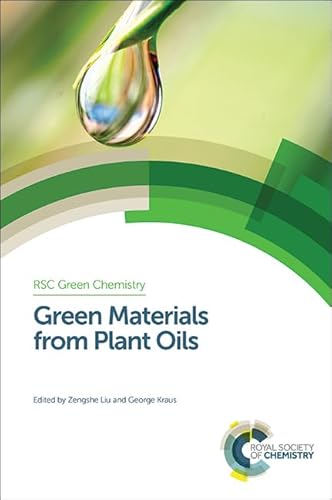
Inhaltsangabe
Today, plant oils are important renewable raw materials for the chemical industry and are heavily used for surfactants, cosmetic products and lubricants. This book covers the green chemistry of products and intermediates synthesised from plant oils. Photo-initiated polymerisation and polymerization of vegetable oils in environmental media are covered as well as click reactions to chemically modify vegetable oils. Useful products from plant oils such as polymers, biomaterials, biofibres and lubricants, as well as their further applications, are described. This book will be a valuable resource for researchers in academia and industry, biomass producers and suppliers and manufacturers of end-products.
Die Inhaltsangabe kann sich auf eine andere Ausgabe dieses Titels beziehen.
Über die Autorin bzw. den Autor
Zengshe Liu has worked in the areas of green chemistry and green materials at the US Department of Agriculture for more than 14 years.
George Kraus has worked on catalysis and green chemistry for more than 30 years at Iowa State University.
Von der hinteren Coverseite
Finding alternatives to fossil feedstocks is increasing in importance with the challenges of global warming, increasing oil prices and depleting fossil fuel reserves that we currently face. Today, plant oils are important renewable raw materials for the chemical industry and are heavily used for surfactants, cosmetic products and lubricants.
This book covers the green chemistry of products and intermediates synthesised from plant oils. Photo-initiated polymerisation and polymerization of vegetable oils in environmental media are covered as well as click reactions to chemically modify vegetable oils. Useful products from plant oils such as polymers, biomaterials, biofibres and lubricants, as well as their further applications, are described.
This book is a valuable resource for researchers in academia and industry, biomass producers and suppliers and manufacturers of end-products.
Aus dem Klappentext
Finding alternatives to fossil feedstocks is increasing in importance with the challenges of global warming, increasing oil prices and depleting fossil fuel reserves that we currently face. Today, plant oils are important renewable raw materials for the chemical industry and are heavily used for surfactants, cosmetic products and lubricants.
This book covers the green chemistry of products and intermediates synthesised from plant oils. Photo-initiated polymerisation and polymerization of vegetable oils in environmental media are covered as well as click reactions to chemically modify vegetable oils. Useful products from plant oils such as polymers, biomaterials, biofibres and lubricants, as well as their further applications, are described.
This book is a valuable resource for researchers in academia and industry, biomass producers and suppliers and manufacturers of end-products.
Auszug. © Genehmigter Nachdruck. Alle Rechte vorbehalten.
Green Materials from Plant Oils
By Zengshe Liu, George KrausThe Royal Society of Chemistry
Copyright © 2015 The Royal Society of Chemistry
All rights reserved.
ISBN: 978-1-84973-901-6All rights reserved.
Contents
Chapter 1 Photo-cured Materials from Vegetable Oils Yanchang Gan and Xuesong Jiang, 1,
Chapter 2 Chemical Synthesis of Carbonates, Esters, and Acetals from Soybean Oil Kenneth M. Doll, 28,
Chapter 3 Preparation of Bio-polymers from Plant Oils in Green Media Zengshe Liu, 41,
Chapter 4 Thiol-ene and H-Phosphonate-ene Reactions for Lipid Modification Grigor B. Bantchev, Steven C. Cermak, Girma Biresaw, Michael Appell, James A. Kenar and Rex E. Murray, 59,
Chapter 5 Plant-oil-based Polymeric Materials and their Applications Fei Liu and Jin Zhu, 93,
Chapter 6 Green Polyurethanes and Bio-fiber-based Products and Processes Ruijun Gu and Mohini Sain, 127,
Chapter 7 Production of Low-cost Polyesters by Microwaving Heating of Carboxylic Acids and Polyol Blends Brent Tisserat and Zengshe Liu, 147,
Chapter 8 Development of Bio-based Unsaturated Polyester Resins from Natural Oils or their Derivates Chengguo Liu and Yonghong Zhou, 163,
Chapter 9 Towards Green: A Review of Recent Developments in Bio-renewable Epoxy Resins from Vegetable Oils Rongpeng Wang and Thomas Schuman, 202,
Chapter 10 Lubricity Characteristics of Seed Oils Modified by Acylation Rogers E. Harry-O'kuru and Girma Biresaw, 242,
Chapter 11 The Potential of Vegetable Oils for Lubricants Brajendra K. Sharma, Zengshe Liu and Sevim Z. Erhan, 269,
Chapter 12 Utilization of Green Materials for Coating Applications Shailesh N. Shah, Sharathkumar K. Mendon and Shelby F. Thames, 293,
Subject Index, 305,
CHAPTER 1
Photo-cured Materials from Vegetable Oils
YANCHANG GAN AND XUESONG JIANG
School of Chemistry & Chemical Engineering, Shanghai Jiao Tong University, Shanghai 200240, People's Republic of China
1.1 Introduction
Photo-curing is one of the most effective processes for the rapid transformation of liquid multifunctional monomer resins to cross-linked polymer networks. Photo-curing technology has found an increasing number of industrial applications over the past decade due to its unique benefits, for example solvent-free formulations, and high-speed and room-temperature processing. Photo-curing technology has become attractive, especially in the paint, ink, adhesive, optical disk, photo-lithography and coating industries due to its very low consumption of energy and its low emissions of volatile organic compounds.
The raw materials for photo-curing technology such as monomer resins, photo-initiators and functional additives, are usually produced from fossil oil. However, due to the growing demand for petroleum-based products and the resulting negative impact on the environment, there has been a growing interest in the utilization of renewable resources as an alternative to petroleum-based polymers. The replacement of petroleum-based raw materials with renewable resources constitutes a major contemporary challenge in terms of both economical and environmental aspects.
Vegetable oils are inexpensive, environmentally friendly, renewable, naturally raw materials with low toxicity and functional groups such as hydroxy, epoxy, carboxyl and C=C. Vegetable oils are extracted primarily from the seeds of oilseed plants. Their competitive cost, worldwide availability, and built-in functionality make them attractive. In recent years, there has been a growing trend in using vegetable oils as renewable resources, especially in oleochemical products. Several derivatives of vegetable oils are used as polymerizable monomers in radiation-curable systems due to their environmentally friendly character and low cost. For example, the long fatty acid chains of vegetable oils provide some brittle resin systems such as epoxy, urethane and polyester resins, which have good flexibility and toughness. Vegetable oils exhibit many excellent properties which can be utilized in preparing valuable polymeric materials such as polyester amide, epoxy, polyurethane, alkyd polymers and have many applications in other areas. Epoxidized vegetable oils, such as soybean oil and epoxidized palm oil have been used in UV-curable coating systems. Vernonia oil contains epoxide groups, which means it can be utilized as a polymerizable monomer directly in cationic UV-cured coatings. In this chapter, we summarize the photocured materials that can be obtained from vegetable oils including photocurable monomers, photo-initiator systems and the photo-curing approach.
1.2 Photo-curable Monomers Derived from Vegetable Oils
Vegetable oils consist of mainly triglycerides formed between glycerol and various fatty acids, which have a three-armed star structure (Figure 1.1). Triglycerides are comprised of three fatty acids joined at a glycerol junction. Most of the common oils contain fatty acids that vary from 14 to 22 carbons in length, with 0 to 3 double bonds per fatty acid. Table 1.1 summarizes the most common fatty acids present in vegetable oils. As shown in Table 1.1, most fatty acids are long straight-chain compounds with an even number of carbons, and the double bonds in most of these unsaturated fatty acids possess a cis configuration.
Because the internal double bonds in the triglyceride structure are not sufficiently reactive for various polymerization processes, the vegetable oils must be modified with efficient photo-polymerizable groups such as acrylate or epoxy when being used as photo-curing monomers.
The triglycerides contain several reactive positions, as shown in Figure 1.1: ester groups (a); C=C double bonds (b); acrylic positions (c); and the a-position of ester groups (d) can act as the starting points in different reactions. The C=C double bond reactive positions are usually used as the starting points for introducing highly efficient reactive groups. The general modification pathway is shown in Figure 1.2.
1.2.1 Epoxy Monomers based on Vegetable Oils
Epoxidation is one of the most important functionalization reactions involving C=C double bonds, and epoxidized vegetable oils show excellent promise as inexpensive, renewable monomers for photo-curing industrial applications. Some raw vegetable oil such as vernonia oil already contain large numbers of epoxide groups. The vernonia oil is extracted from the seeds of Vernonia galamensis with petroleum ether or hexane after the seeds are lipase-deactivated and coarse ground, and yields of up to 42% have been reported. One unique characteristic of vernonia oil is that about 80% of the oil is the triglyceride of vernolic acid. The structure is shown in Figure 1.3. Vernonia oil can be utilized as a polymerizable monomer directly in cationic UV-curing coating due to its high content of epoxy groups.
Most of the multifunctional epoxy monomers for photo-curing based on vegetable oils are prepared from the epoxidation of unsaturated fatty acids or triglycerides. The epoxidation of triglycerides or unsaturated fatty acids can be achieved in a straightforward fashion by reaction with molecular oxygen, hydrogen peroxide, or by chemo-enzymatic reactions. The chemistry of the Prileshajev epoxidation of unsaturated fatty compounds is well known. A short-chain peroxy acid, usually peracetic acid, is prepared from hydrogen peroxide (H2O2) and the corresponding acid either in a separate step or in situ (Figure 1.4).
This process is performed industrially on large scale, and more research is currently...
„Über diesen Titel“ kann sich auf eine andere Ausgabe dieses Titels beziehen.
Suchergebnisse für Green Materials from Plant Oils (RSC Green Chemistry,...

Beispielbild für diese ISBN
Green Materials from Plant Oils (Green Chemistry Series)
Verlag:
Royal Society of Chemistry, 2014
ISBN 10: 1849739013
ISBN 13: 9781849739016
Gebraucht
Hardcover
Erstausgabe
Anbieter: Henffordd Books, Herefordshire, Vereinigtes Königreich
Verkäuferbewertung 5 von 5 Sternen

Hardcover. Zustand: Near Fine. 1st Edition. Slight rubbing to edges otherwise in excellent condition. Next day dispatch by Royal Mail in sturdy, recyclable packaging. 1000's of satisfied customers! Please contact us with any enquiries. Bestandsnummer des Verkäufers 014119
Gebraucht kaufen
EUR 48,37
EUR 23,53 Versand
Versand von Vereinigtes Königreich nach USA
Versand von Vereinigtes Königreich nach USA
Anzahl: 10 verfügbar
Beispielbild für diese ISBN
GREEN MATERIALS FROM PLANT OIL - HB
Anbieter: Romtrade Corp., STERLING HEIGHTS, MI, USA
Verkäuferbewertung 5 von 5 Sternen
Zustand: New. This is a Brand-new US Edition. This Item may be shipped from US or any other country as we have multiple locations worldwide. Bestandsnummer des Verkäufers ABBB-203874
Beispielbild für diese ISBN
Green Materials From Plant Oils
Anbieter: Basi6 International, Irving, TX, USA
Verkäuferbewertung 5 von 5 Sternen
Zustand: Brand New. New. US edition. Expediting shipping for all USA and Europe orders excluding PO Box. Excellent Customer Service. Bestandsnummer des Verkäufers ABEOCT25-222472
Beispielbild für diese ISBN
Green Materials From Plant Oils
Anbieter: Romtrade Corp., STERLING HEIGHTS, MI, USA
Verkäuferbewertung 5 von 5 Sternen
Zustand: New. This is a Brand-new US Edition. This Item may be shipped from US or any other country as we have multiple locations worldwide. Bestandsnummer des Verkäufers ABBB-191342
Beispielbild für diese ISBN
GREEN MATERIALS FROM PLANT OILS
Anbieter: Basi6 International, Irving, TX, USA
Verkäuferbewertung 5 von 5 Sternen
Zustand: Brand New. New. US edition. Expediting shipping for all USA and Europe orders excluding PO Box. Excellent Customer Service. Bestandsnummer des Verkäufers ABEOCT25-222473
Beispielbild für diese ISBN
Green Materials from Plant Oils (Rsc Green Chemistry)
Verlag:
Royal Society of Chemistry RSC, 2014
ISBN 10: 1849739013
ISBN 13: 9781849739016
Neu
Hardcover
Anbieter: Books Puddle, Woodside, NY, USA
Verkäuferbewertung 4 von 5 Sternen

Zustand: New. Bestandsnummer des Verkäufers 26134104950
Neu kaufen
EUR 123,19
EUR 3,55 Versand
Versand innerhalb von USA
Versand innerhalb von USA
Anzahl: 1 verfügbar
Beispielbild für diese ISBN
Green Materials from Plant Oils (Rsc Green Chemistry)
Anbieter: Majestic Books, Hounslow, Vereinigtes Königreich
Verkäuferbewertung 4 von 5 Sternen
Zustand: New. Bestandsnummer des Verkäufers 126482601
Neu kaufen
EUR 125,30
EUR 7,65 Versand
Versand von Vereinigtes Königreich nach USA
Versand von Vereinigtes Königreich nach USA
Anzahl: 1 verfügbar
Beispielbild für diese ISBN
Green Materials from Plant Oils (Rsc Green Chemistry)
Anbieter: Biblios, Frankfurt am main, HESSE, Deutschland
Verkäuferbewertung 4 von 5 Sternen
Zustand: New. Bestandsnummer des Verkäufers 18134104956
Neu kaufen
EUR 123,03
EUR 9,95 Versand
Versand von Deutschland nach USA
Versand von Deutschland nach USA
Anzahl: 1 verfügbar
Foto des Verkäufers
Green materials from plant oils
Verlag:
Royal Society of Chemistry, 2015
ISBN 10: 1849739013
ISBN 13: 9781849739016
Neu
Hardcover
Erstausgabe
Anbieter: Acanthophyllum Books, Holywell, FLINT, Vereinigtes Königreich
Verkäuferbewertung 2 von 5 Sternen

Pictorial hard covers. Zustand: New. No Jacket. 1st edition. xv, 323 pp. Weight: 1 Language: English. Bestandsnummer des Verkäufers 14501
Neu kaufen
EUR 109,08
EUR 25,83 Versand
Versand von Vereinigtes Königreich nach USA
Versand von Vereinigtes Königreich nach USA
Anzahl: 1 verfügbar
Foto des Verkäufers
Green Materials from Plant Oils
Verlag:
Royal Society of Chemistry, GB, 2014
ISBN 10: 1849739013
ISBN 13: 9781849739016
Neu
Hardcover
Anbieter: Rarewaves USA, HEBRON, KY, USA
Verkäuferbewertung 5 von 5 Sternen
Hardback. Zustand: New. Finding alternatives to fossil feedstocks is increasing in importance with the challenges of global warming, increasing oil prices and depleting fossil fuel reserves that we currently face. Today, plant oils are important renewable raw materials for the chemical industry and are heavily used for surfactants, cosmetic products and lubricants.This book covers the green chemistry of products and intermediates synthesised from plant oils. Photo-initiated polymerisation and polymerization of vegetable oils in environmental media are covered as well as click reactions to chemically modify vegetable oils. Useful products from plant oils such as polymers, biomaterials, biofibres and lubricants, as well as their further applications, are described.This book is a valuable resource for researchers in academia and industry, biomass producers and suppliers and manufacturers of end-products. Bestandsnummer des Verkäufers LU-9781849739016