
Verwandte Artikel zu Turing's Connectionism: An Investigation Of Neural...
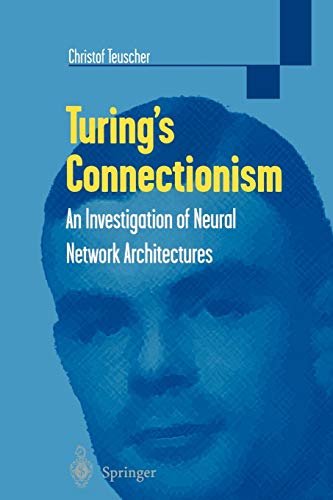
Turing's Connectionism: An Investigation Of Neural Network Architectures (Discrete Mathematics and Theoretical Computer Science) - Softcover
Inhaltsangabe
Alan Mathison Turing (1912-1954) was the first to carry out substantial re search in the field now known as Artificial Intelligence (AI). He was thinking about machine intelligence at least as early as 1941 and during the war cir culated a typewritten paper on machine intelligence among his colleagues at the Government Code and Cypher School (GC & CS), Bletchley Park. Now lost, this was undoubtedly the earliest paper in the field of AI. It probably concerned machine learning and heuristic problem-solving; both were topics that Turing discussed extensively during the war years at GC & CS, as was mechanical chess [121]. In 1945, the war in Europe over, Turing was recruited by the National Physical Laboratory (NPL)! in London, his brief to design and develop an electronic stored-program digital computer-a concrete form of the universal Turing machine of 1936 [185]. Turing's technical report "Proposed Electronic 2 Calculator" , dating from the end of 1945 and containing his design for the Automatic Computing Engine (ACE), was the first relatively complete spec ification of an electronic stored-program digital computer [193,197]. (The document "First Draft of a Report on the EDVAC", produced by John von Neumann and the Moore School group at the University of Pennsylvania in May 1945, contained little engineering detail, in particular concerning elec tronic hardware [202].
Die Inhaltsangabe kann sich auf eine andere Ausgabe dieses Titels beziehen.
Von der hinteren Coverseite
Alan Mathison Turing (1912-1954) was the first to carry out substantial re search in the field now known as Artificial Intelligence (AI). He was thinking about machine intelligence at least as early as 1941 and during the war cir culated a typewritten paper on machine intelligence among his colleagues at the Government Code and Cypher School (GC & CS), Bletchley Park. Now lost, this was undoubtedly the earliest paper in the field of AI. It probably concerned machine learning and heuristic problem-solving; both were topics that Turing discussed extensively during the war years at GC & CS, as was mechanical chess [121]. In 1945, the war in Europe over, Turing was recruited by the National Physical Laboratory (NPL)! in London, his brief to design and develop an electronic stored-program digital computer-a concrete form of the universal Turing machine of 1936 [185]. Turing's technical report "Proposed Electronic 2 Calculator" , dating from the end of 1945 and containing his design for the Automatic Computing Engine (ACE), was the first relatively complete spec ification of an electronic stored-program digital computer [193,197]. (The document "First Draft of a Report on the EDVAC", produced by John von Neumann and the Moore School group at the University of Pennsylvania in May 1945, contained little engineering detail, in particular concerning elec tronic hardware [202].
„Über diesen Titel“ kann sich auf eine andere Ausgabe dieses Titels beziehen.
Suchergebnisse für Turing's Connectionism: An Investigation Of Neural...

Beispielbild für diese ISBN
Turing's Connectionism: An Investigation of Neural Network Architectures
Anbieter: Phatpocket Limited, Waltham Abbey, HERTS, Vereinigtes Königreich
Verkäuferbewertung 5 von 5 Sternen

Zustand: Good. Your purchase helps support Sri Lankan Children's Charity 'The Rainbow Centre'. Ex-library, so some stamps and wear, but in good overall condition. Our donations to The Rainbow Centre have helped provide an education and a safe haven to hundreds of children who live in appalling conditions. Bestandsnummer des Verkäufers Z1-B-017-02063
Gebraucht kaufen
EUR 74,46
EUR 12,71 Versand
Versand von Vereinigtes Königreich nach USA
Versand von Vereinigtes Königreich nach USA
Anzahl: 1 verfügbar
Foto des Verkäufers
Turing¿s Connectionism
Print-on-DemandAnbieter: BuchWeltWeit Ludwig Meier e.K., Bergisch Gladbach, Deutschland
Verkäuferbewertung 5 von 5 Sternen
Taschenbuch. Zustand: Neu. This item is printed on demand - it takes 3-4 days longer - Neuware -Alan Mathison Turing (1912-1954) was the first to carry out substantial re search in the field now known as Artificial Intelligence (AI). He was thinking about machine intelligence at least as early as 1941 and during the war cir culated a typewritten paper on machine intelligence among his colleagues at the Government Code and Cypher School (GC & CS), Bletchley Park. Now lost, this was undoubtedly the earliest paper in the field of AI. It probably concerned machine learning and heuristic problem-solving; both were topics that Turing discussed extensively during the war years at GC & CS, as was mechanical chess [121]. In 1945, the war in Europe over, Turing was recruited by the National Physical Laboratory (NPL)! in London, his brief to design and develop an electronic stored-program digital computer-a concrete form of the universal Turing machine of 1936 [185]. Turing's technical report 'Proposed Electronic 2 Calculator' , dating from the end of 1945 and containing his design for the Automatic Computing Engine (ACE), was the first relatively complete spec ification of an electronic stored-program digital computer [193,197]. (The document 'First Draft of a Report on the EDVAC', produced by John von Neumann and the Moore School group at the University of Pennsylvania in May 1945, contained little engineering detail, in particular concerning elec tronic hardware [202]. 228 pp. Englisch. Bestandsnummer des Verkäufers 9781852334758
Neu kaufen
EUR 139,09
EUR 23,00 Versand
Versand von Deutschland nach USA
Versand von Deutschland nach USA
Anzahl: 2 verfügbar
Foto des Verkäufers
Turing s Connectionism
Print-on-DemandAnbieter: moluna, Greven, Deutschland
Verkäuferbewertung 5 von 5 Sternen
Zustand: New. Dieser Artikel ist ein Print on Demand Artikel und wird nach Ihrer Bestellung fuer Sie gedruckt. Contains a Foreword by B. Jack Copeland and D. ProudfootDevelops Turing s ideas, by building his machines and training them using evolutionary algorithmsGoes beyond Turing s ideas, and proposes new machinesChristof Teuscher revives, analyzes, an. Bestandsnummer des Verkäufers 4289583
Neu kaufen
EUR 118,61
EUR 48,99 Versand
Versand von Deutschland nach USA
Versand von Deutschland nach USA
Anzahl: Mehr als 20 verfügbar
Beispielbild für diese ISBN
Turing's Connectionism: An Investigation of Neural Network Architectures
Anbieter: Ria Christie Collections, Uxbridge, Vereinigtes Königreich
Verkäuferbewertung 5 von 5 Sternen
Zustand: New. In English. Bestandsnummer des Verkäufers ria9781852334758_new
Neu kaufen
EUR 159,07
EUR 11,19 Versand
Versand von Vereinigtes Königreich nach USA
Versand von Vereinigtes Königreich nach USA
Anzahl: Mehr als 20 verfügbar
Beispielbild für diese ISBN
Turing's Connectionism: An Investigation of Neural Network Architectures
Anbieter: BennettBooksLtd, Los Angeles, CA, USA
Verkäuferbewertung 5 von 5 Sternen
Paperback. Zustand: New. In shrink wrap. Looks like an interesting title! Bestandsnummer des Verkäufers Q-1852334754
Neu kaufen
EUR 183,61
EUR 6,23 Versand
Versand innerhalb von USA
Versand innerhalb von USA
Anzahl: 1 verfügbar
Foto des Verkäufers
Turing's Connectionism | An Investigation of Neural Network Architectures
Print-on-DemandAnbieter: preigu, Osnabrück, Deutschland
Verkäuferbewertung 5 von 5 Sternen
Taschenbuch. Zustand: Neu. Turing's Connectionism | An Investigation of Neural Network Architectures | Christof Teuscher | Taschenbuch | xxiv | Englisch | 2001 | Springer London | EAN 9781852334758 | Verantwortliche Person für die EU: Springer Verlag GmbH, Tiergartenstr. 17, 69121 Heidelberg, juergen[dot]hartmann[at]springer[dot]com | Anbieter: preigu Print on Demand. Bestandsnummer des Verkäufers 104774934
Neu kaufen
EUR 123,00
EUR 70,00 Versand
Versand von Deutschland nach USA
Versand von Deutschland nach USA
Anzahl: 5 verfügbar
Foto des Verkäufers
Turing's Connectionism : An Investigation of Neural Network Architectures
Anbieter: AHA-BUCH GmbH, Einbeck, Deutschland
Verkäuferbewertung 5 von 5 Sternen
Taschenbuch. Zustand: Neu. Druck auf Anfrage Neuware - Printed after ordering - Alan Mathison Turing (1912-1954) was the first to carry out substantial re search in the field now known as Artificial Intelligence (AI). He was thinking about machine intelligence at least as early as 1941 and during the war cir culated a typewritten paper on machine intelligence among his colleagues at the Government Code and Cypher School (GC & CS), Bletchley Park. Now lost, this was undoubtedly the earliest paper in the field of AI. It probably concerned machine learning and heuristic problem-solving; both were topics that Turing discussed extensively during the war years at GC & CS, as was mechanical chess [121]. In 1945, the war in Europe over, Turing was recruited by the National Physical Laboratory (NPL)! in London, his brief to design and develop an electronic stored-program digital computer-a concrete form of the universal Turing machine of 1936 [185]. Turing's technical report 'Proposed Electronic 2 Calculator' , dating from the end of 1945 and containing his design for the Automatic Computing Engine (ACE), was the first relatively complete spec ification of an electronic stored-program digital computer [193,197]. (The document 'First Draft of a Report on the EDVAC', produced by John von Neumann and the Moore School group at the University of Pennsylvania in May 1945, contained little engineering detail, in particular concerning elec tronic hardware [202]. Bestandsnummer des Verkäufers 9781852334758
Neu kaufen
EUR 159,92
EUR 35,00 Versand
Versand von Deutschland nach USA
Versand von Deutschland nach USA
Anzahl: 1 verfügbar
Foto des Verkäufers
Turing's Connectionism
Verlag:
Springer London, Springer London Sep 2001, 2001
ISBN 10: 1852334754
ISBN 13: 9781852334758
Neu
Taschenbuch
Anbieter: buchversandmimpf2000, Emtmannsberg, BAYE, Deutschland
Verkäuferbewertung 5 von 5 Sternen
Taschenbuch. Zustand: Neu. This item is printed on demand - Print on Demand Titel. Neuware -Alan Mathison Turing (1912-1954) was the first to carry out substantial re search in the field now known as Artificial Intelligence (AI). He was thinking about machine intelligence at least as early as 1941 and during the war cir culated a typewritten paper on machine intelligence among his colleagues at the Government Code and Cypher School (GC & CS), Bletchley Park. Now lost, this was undoubtedly the earliest paper in the field of AI. It probably concerned machine learning and heuristic problem-solving; both were topics that Turing discussed extensively during the war years at GC & CS, as was mechanical chess [121]. In 1945, the war in Europe over, Turing was recruited by the National Physical Laboratory (NPL)! in London, his brief to design and develop an electronic stored-program digital computer-a concrete form of the universal Turing machine of 1936 [185]. Turing's technical report 'Proposed Electronic 2 Calculator' , dating from the end of 1945 and containing his design for the Automatic Computing Engine (ACE), was the first relatively complete spec ification of an electronic stored-program digital computer [193,197]. (The document 'First Draft of a Report on the EDVAC', produced by John von Neumann and the Moore School group at the University of Pennsylvania in May 1945, contained little engineering detail, in particular concerning elec tronic hardware [202].Springer Verlag GmbH, Tiergartenstr. 17, 69121 Heidelberg 228 pp. Englisch. Bestandsnummer des Verkäufers 9781852334758
Neu kaufen
EUR 139,09
EUR 60,00 Versand
Versand von Deutschland nach USA
Versand von Deutschland nach USA
Anzahl: 1 verfügbar
Beispielbild für diese ISBN
Turing's Connectionism
Anbieter: Books Puddle, Woodside, NY, USA
Verkäuferbewertung 4 von 5 Sternen

Zustand: New. pp. 230. Bestandsnummer des Verkäufers 26322755
Neu kaufen
EUR 201,53
EUR 3,58 Versand
Versand innerhalb von USA
Versand innerhalb von USA
Anzahl: 4 verfügbar
Beispielbild für diese ISBN
Turing's Connectionism
Print-on-DemandAnbieter: Majestic Books, Hounslow, Vereinigtes Königreich
Verkäuferbewertung 4 von 5 Sternen
Zustand: New. Print on Demand pp. 230 Illus. Bestandsnummer des Verkäufers 7557916
Neu kaufen
EUR 213,26
EUR 7,77 Versand
Versand von Vereinigtes Königreich nach USA
Versand von Vereinigtes Königreich nach USA
Anzahl: 4 verfügbar