
Verwandte Artikel zu Robust Autonomous Guidance: An Internal Model Approach...
Robust Autonomous Guidance: An Internal Model Approach (Advances in Industrial Control) - Hardcover
Buch 81 von 167: Advances in Industrial Control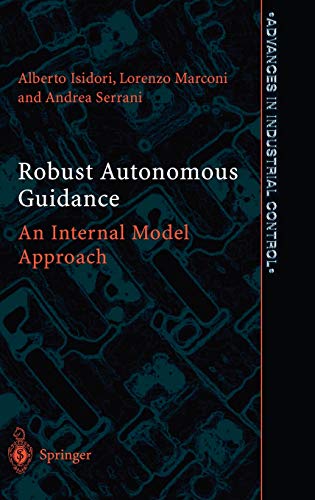
Inhaltsangabe
Plant control systems are subject to the undesirable influence of exogenous commands and disturbances. To track and reject these the authors have designed a feedback control system based on embedding a model of them within the controller itself - the "internal model".
From a review of the principles of internal-model-based feedback control design, this book moves on to expound recent enhancements to such designs and then to their implementation in systems operating under conditions of great uncertainty.
The case studies presented involve control systems coping with a high degree of nonlinear behaviour. The key issues addressed in each are the design of an adaptive internal model for the specific tracking task and of stabilizing control capable of steering the tracking error to zero while keeping all internal states bounded for any arbitrarily large but bounded envelope of initial data and uncertain parameters. Nested saturated controls form the basis of novel tools for asymptotic analysis and design.
Die Inhaltsangabe kann sich auf eine andere Ausgabe dieses Titels beziehen.
Über die Autorin bzw. den Autor
Alberto Isidori was born in Rapallo, Italy. He graduated in electrical engineering from the University of Rome in 1965. In 1969 he obtained a degree equivalent to a doctorate in automatic control from the University of Rome. Since 1975, he has been Professor of Automatic Control at the University of Rome "La Sapienza". Since 1989, he has also held a position of rofessor (on a half-time basis) at the Department of Systems Science and Mathematics, Washington University, St. Louis, Missouri. He has held visiting positions at several academic institutions, including the University of Illinois (Urbana, Il.), the University of California (Berkeley, Ca.) and the ETH (Zurich, Switzerland). His research interests are primarily focused on mathematical control theory and control engineering. In 1979, Alberto Isidori initiated a research program aimed at the extension of so-called "geometric theory" of multivariable linear systems, pioneered in the early 1970s by various authors,to linear systems. Linear algebra and linear geometric methods were replaced in nonlinear systems by the methods of differential geometry, whose usefulness in the study of controllability, observability, and minimality of nonlinear systems had been demonstrated in the early 70s. The main intuition of Isidori was to use differential geometric methods in the synthesis of feedback laws for nonlinear systems, more or less in the same way as linear geometric methods were used in the synthesis of feedback laws for linear systems. The result of this seminal work was the development of systematic methods addressing outstanding design problems like feedback linearization, noninteracting control, disturbance decoupling, and model matching. From 1985 to 1990 Isidori's research concentrated on the development of the "nonlinear analogue" of the notion of the "zero" of a transfer function. Taking as a point of departure the "geometric" interpretation of this notion, the concept of nonlinear zero dynamics was introduced, studied, and applied. As a result, it was shown that most of the features of the notion of zeros of the transfer function of a linear system are actually manifestations of more general principles. Remarkable examples of application of this theory consisted in the study and the solution of the nonlinear equivalent of the so-called "servomechanism problem" of linear system theory and in the characterization of the conditions for feedback equivalence to a nonlinear passive system. Since the 90s, Isidori has focused his research interests on problems of disturbance attenuation and robust stabilization of nonlinear systems. Professional Activities -President of the European Union Control Association (1995-1997). -Member of the IFAC Council (1993-1996). -President-elect of IFAC (three-year term to begin following IFAC World Congress in Seoul 2008) -On the Editorial Board of: European Journal of Control (since 1995), Automatica (since 1990), IEEE Transactions on Automatic Control (since 1990), International Journal of Control (since 1990), International Journal of Robust and Nonlinear Control (since 1991), Journal of Mathematical Systems, Estimation and Control (since 1991), Mathematics of Control, Signals and Systems (1987-89), Applied Stochastic Models and Data Analysis (since 1985), Systems and Control Letters (1981-88). Awards and Honors -Georgio Quazza Medal of IFAC, for ?pionering and fundamental contributions to the theory of nonlinear control,? 1996. -Fellow of the Institute of Electrical and Electronic Engineers, for ?fundamental contributions to nonlinear control theory?, 1987. -Outstanding Paper Award for papers published on IEEE Transactions on Automatic Control, in 1981 and in 1990. -Outstanding Paper Award a paper published on Automatica in1991. Selected Publications Nonlinear Control Systems (3rd
Von der hinteren Coverseite
A typical plant control system will be subject to the undesirable influence of exogenous commands and disturbances. In order to track and reject these Professor Isidori and his co-authors have designed a feedback control system based on embedding a model of these disturbances within the controller itself - the so-called "internal model".
Beginning with a review of the fundamental principles of internal-model-based feedback control design, Robust Autonomous Guidance moves on to expound recent enhancements to such designs and then to their implementation in systems operating under conditions of great uncertainty.
The three case studies presented: attitude control of a low-Earth-orbit satellite and the landing of fixed- and rotary-winged aircraft on a ship involve control systems coping with a high degree of nonlinear behaviour. The key issues addressed in each case study are the design of an adaptive internal model for the specific tracking task and of stabilizing control capable of steering the tracking error to zero while keeping all internal states bounded for any arbitrarily large but bounded envelope of initial data and uncertain parameters. Nested saturated controls form the basis of novel tools for asymptotic analysis and design.
Robust Autonomous Guidance will be of great interest to academic and industrial researchers working with nonlinear control systems and to engineers involved in the design of aerospatial guidance systems. It will also be a useful reference for graduate students working with non-linear systems.
Advances in Industrial Control aims to report and encourage the transfer of technology in control engineering. The rapid development of control technology has an impact on all areas of the control discipline. The series offers an opportunity for researchers to present an extended exposition of new work in all aspects of industrial control.
„Über diesen Titel“ kann sich auf eine andere Ausgabe dieses Titels beziehen.
Suchergebnisse für Robust Autonomous Guidance: An Internal Model Approach...

Beispielbild für diese ISBN
Robust Autonomous Guidance: An Internal Model Approach
Anbieter: ThriftBooks-Atlanta, AUSTELL, GA, USA
Verkäuferbewertung 5 von 5 Sternen

Hardcover. Zustand: Very Good. No Jacket. May have limited writing in cover pages. Pages are unmarked. ~ ThriftBooks: Read More, Spend Less. Bestandsnummer des Verkäufers G1852336951I4N00
Gebraucht kaufen
EUR 41,33
Versand gratis
Versand innerhalb von USA
Versand innerhalb von USA
Anzahl: 1 verfügbar
Beispielbild für diese ISBN
Robust Autonomous Guidance: An Internal Model Approach (Advances in Industrial Control)
Anbieter: BennettBooksLtd, Los Angeles, CA, USA
Verkäuferbewertung 5 von 5 Sternen
Hardcover. Zustand: New. In shrink wrap. Looks like an interesting title! Bestandsnummer des Verkäufers Q-1852336951
Neu kaufen
EUR 107,86
EUR 5,99 Versand
Versand innerhalb von USA
Versand innerhalb von USA
Anzahl: 1 verfügbar
Foto des Verkäufers
Robust autonomous guidance. An internal model approach.
Anbieter: Antiquariat Bookfarm, Löbnitz, Deutschland
Verkäuferbewertung 5 von 5 Sternen
Hardcover. Zustand: Gut. 229 S. Ehem. Bibliotheksexemplar mit Bib.-Signatur und Stempel in GUTEM Zustand. Kaum Gebrauchsspuren. 9781852336950 Sprache: Englisch Gewicht in Gramm: 550. Bestandsnummer des Verkäufers 2140164
Gebraucht kaufen
EUR 107,97
EUR 40,00 Versand
Versand von Deutschland nach USA
Versand von Deutschland nach USA
Anzahl: 1 verfügbar
Beispielbild für diese ISBN
Robust Autonomous Guidance: An Internal Model Approach (Advances in Industrial Control)
Anbieter: Ria Christie Collections, Uxbridge, Vereinigtes Königreich
Verkäuferbewertung 5 von 5 Sternen
Zustand: New. In. Bestandsnummer des Verkäufers ria9781852336950_new
Neu kaufen
EUR 190,25
EUR 13,17 Versand
Versand von Vereinigtes Königreich nach USA
Versand von Vereinigtes Königreich nach USA
Anzahl: Mehr als 20 verfügbar
Foto des Verkäufers
Robust Autonomous Guidance
Print-on-DemandAnbieter: moluna, Greven, Deutschland
Verkäuferbewertung 5 von 5 Sternen
Gebunden. Zustand: New. Dieser Artikel ist ein Print on Demand Artikel und wird nach Ihrer Bestellung fuer Sie gedruckt. Shows the reader how to apply nonlinear design techniques to three important and widely used case studiesDemonstrates how nonlinear control can be adapted to take account of the severe uncertainties and complex nonlinear dynamics typical of applic. Bestandsnummer des Verkäufers 4289721
Neu kaufen
EUR 162,51
EUR 48,99 Versand
Versand von Deutschland nach USA
Versand von Deutschland nach USA
Anzahl: Mehr als 20 verfügbar
Foto des Verkäufers
Robust Autonomous Guidance
Print-on-DemandAnbieter: BuchWeltWeit Ludwig Meier e.K., Bergisch Gladbach, Deutschland
Verkäuferbewertung 5 von 5 Sternen
Buch. Zustand: Neu. This item is printed on demand - it takes 3-4 days longer - Neuware -Plant control systems are subject to the undesirable influence of exogenous commands and disturbances. To track and reject these the authors have designed a feedback control system based on embedding a model of them within the controller itself - the 'internal model'.From a review of the principles of internal-model-based feedback control design, this book moves on to expound recent enhancements to such designs and then to their implementation in systems operating under conditions of great uncertainty.The case studies presented involve control systems coping with a high degree of nonlinear behaviour. The key issues addressed in each are the design of an adaptive internal model for the specific tracking task and of stabilizing control capable of steering the tracking error to zero while keeping all internal states bounded for any arbitrarily large but bounded envelope of initial data and uncertain parameters. Nested saturated controls form the basis of novel tools for asymptotic analysis and design. 248 pp. Englisch. Bestandsnummer des Verkäufers 9781852336950
Neu kaufen
EUR 192,59
EUR 23,00 Versand
Versand von Deutschland nach USA
Versand von Deutschland nach USA
Anzahl: 2 verfügbar
Foto des Verkäufers
Robust Autonomous Guidance
Verlag:
Springer London, Springer London Okt 2003, 2003
ISBN 10: 1852336951
ISBN 13: 9781852336950
Neu
Hardcover
Anbieter: buchversandmimpf2000, Emtmannsberg, BAYE, Deutschland
Verkäuferbewertung 5 von 5 Sternen
Buch. Zustand: Neu. This item is printed on demand - Print on Demand Titel. Neuware -Plant control systems are subject to the undesirable influence of exogenous commands and disturbances. To track and reject these the authors have designed a feedback control system based on embedding a model of them within the controller itself - the 'internal model'.From a review of the principles of internal-model-based feedback control design, this book moves on to expound recent enhancements to such designs and then to their implementation in systems operating under conditions of great uncertainty.The case studies presented involve control systems coping with a high degree of nonlinear behaviour. The key issues addressed in each are the design of an adaptive internal model for the specific tracking task and of stabilizing control capable of steering the tracking error to zero while keeping all internal states bounded for any arbitrarily large but bounded envelope of initial data and uncertain parameters. Nested saturated controls form the basis of novel tools for asymptotic analysis and design.Springer Verlag GmbH, Tiergartenstr. 17, 69121 Heidelberg 248 pp. Englisch. Bestandsnummer des Verkäufers 9781852336950
Neu kaufen
EUR 192,59
EUR 60,00 Versand
Versand von Deutschland nach USA
Versand von Deutschland nach USA
Anzahl: 1 verfügbar
Beispielbild für diese ISBN
Robust Autonomous Guidance
Anbieter: Books Puddle, New York, NY, USA
Verkäuferbewertung 4 von 5 Sternen

Zustand: New. pp. 248. Bestandsnummer des Verkäufers 26290517
Neu kaufen
EUR 251,94
EUR 3,44 Versand
Versand innerhalb von USA
Versand innerhalb von USA
Anzahl: 4 verfügbar
Beispielbild für diese ISBN
Robust Autonomous Guidance
Print-on-DemandAnbieter: Majestic Books, Hounslow, Vereinigtes Königreich
Verkäuferbewertung 4 von 5 Sternen
Zustand: New. Print on Demand pp. 248 Illus. Bestandsnummer des Verkäufers 7590154
Neu kaufen
EUR 262,52
EUR 7,58 Versand
Versand von Vereinigtes Königreich nach USA
Versand von Vereinigtes Königreich nach USA
Anzahl: 4 verfügbar
Beispielbild für diese ISBN
Robust Autonomous Guidance
Print-on-DemandAnbieter: Biblios, Frankfurt am main, HESSE, Deutschland
Verkäuferbewertung 4 von 5 Sternen
Zustand: New. PRINT ON DEMAND pp. 248. Bestandsnummer des Verkäufers 18290527
Neu kaufen
EUR 267,56
EUR 9,95 Versand
Versand von Deutschland nach USA
Versand von Deutschland nach USA
Anzahl: 4 verfügbar