
Verwandte Artikel zu Myanmar (Burma) - Culture Smart!: The Essential Guide...
Inhaltsangabe
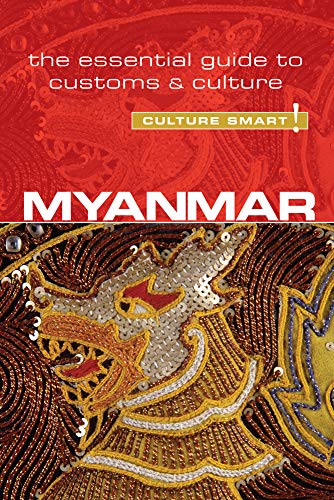
Myanmar, as Burma is now known, is strategically situated between the world's two most populous nations-China and India-and its distinctive ancient culture shares some traditions with both countries. Hidden away from the eyes of the world for half a century by its military rulers' policy of self-isolation, "the Burmese Way to Socialism," with a new democratic parliament and civilian government Myanmar is undergoing important changes as it approaches its next elections in 2015. Its most famous political detainee, Aung San Suu Kyi, the Nobel peace laureate, has been released after nearly twenty years of house arrest. The present administration faces teething problems in politics, governance, education, its dealings with over a hundred ethnic groups, and its society. At the same time, progress has been made with the emergence of a free press, the release of political prisoners, and the reemergence of the long-lost voice of the man and woman on the street. The country is opening up to tourism and business.
The Burmese people are by nature friendly and polite, and are traditionally easy-going and peaceable. Most are devout Buddhists, and there are pagodas and meditation centers all over the country. They are also great lovers of fun, entertainments, and festivals-in fact, there is a festival for each Myanmar calendar month
Culture Smart! Myanmar provides much needed information about a country taking its first steps to becoming an important player on the world stage. It offers invaluable insights into the inner life of the Burmese, their history, traditions, attitudes, and work ethic, and gives practical advice on what to expect and how to behave in different circumstances. While their hosts may be naturally polite and accommodating, foreign visitors will have to go through a steep learning curve to understand the dos and don'ts of Burmese social customs. This book serves as an essential guide for Western tourists and entrepreneurs who are interested in visiting or doing business in this beautiful, enigmatic, and resource-rich country.
Die Inhaltsangabe kann sich auf eine andere Ausgabe dieses Titels beziehen.
Über die Autorin bzw. den Autor
Kyi Kyi May was born and brought up Myanmar, where she attended Rangoon Arts and Science University and gained a M.Sc. in Zoology. She became a print journalist before joining the BBC Burmese Service in London as a producer and gained a BA (Hons) degree in Politics, Philosophy and History at Birkbeck College, University of London. As a BBC producer, a field reporter, and later as head of the Burmese Service, she has written and broadcast many current affairs and feature programs for Burmese listeners of all ages.
Auszug. © Genehmigter Nachdruck. Alle Rechte vorbehalten.
Myanmar (Burma)
By Kyi Kyi May, Nicholas NugentBravo Ltd
Copyright © 2015 Kuperard
All rights reserved.
ISBN: 978-1-85733-697-9All rights reserved.
Contents
Cover,
Title Page,
Copyright,
About the Authors,
Map of Myanmar,
Introduction,
Key Facts,
Chapter 1: LAND AND PEOPLE,
Chapter 2: VALUES AND ATTITUDES,
Chapter 3: RELIGION, FESTIVALS, AND TRADITIONS,
Chapter 4: MAKING FRIENDS,
Chapter 5: AT HOME,
Chapter 6: TIME OUT,
Chapter 7: TRAVEL, HEALTH, AND SAFETY,
Chapter 8: BUSINESS BRIEFING,
Chapter 9: COMMUNICATING,
Further Reading,
Acknowledgments,
CHAPTER 1
LAND & PEOPLE
GEOGRAPHY
Myanmar is situated on the west of the Southeast Asian peninsula, bordering India on the northwest and China on the northeast. Bangladesh lies to the west and Thailand and Laos to the east. The country has a 1,770-mile (2,832-km) coastline that faces west and borders the Bay of Bengal and the Andaman Sea.
The country used to be known as Burma. Following a military coup, the military rulers ordained in 1989 that it should in future be known internationally as Myanmar, which is close to its Burmese-language name, Myanma. This reflects the fact that the land is populated by many different peoples, not just the Burmese who make up the overwhelming majority. "Bama" continues to be used in Burmese as the country's colloquial name, and internationally "Burma" remains in common use. The word "Burmese" is widely used to describe both the dominant language and Myanmar's inhabitants — not totally accurately in the second instance. The adjective "Myanmarese," is, in any case, rather unwieldy in English.
The names in English of several of the country's cities have also changed. For example, the main commercial city and former capital, Rangoon, is now known as Yangon in both Burmese and English; the historical city of Pagan is now usually written as Bagan, while Pegu, another historical city, is written as Bago. Mandalay, the former royal capital in the heart of the country, has retained its original name. In 2005 the newly built city of Naypyidaw in the central plain became Myanmar's new capital.
Myanmar is roughly the size of the state of Texas, and larger than any European country, excluding Russia, with an area of 261,228 square miles (678,500 sq. km). It is the largest country in mainland Southeast Asia, but is also one of the poorest. Its shape resembles that of a kite, with a long tail drifting down the peninsula toward Malaysia.
Myanmar's most prominent geographical feature is the 1,350-mile (2,170-km) Irrawaddy River, or Ayeyarwaddy, flowing north to south, which Rudyard Kipling famously called "the Road to Mandalay." Other important rivers nourishing this rice-growing land are the Salween and the Chindwin. The rivers serve as Myanmar's arteries, while the mountain ranges of East Yoma, Bago Yoma, and West Yoma stand like sentries on guard duty. Myanmar's highest peak, Hkakabo Razi in Kachin State, reaches 19,295 feet (5,881 m). Snow-capped mountain ranges mark Myanmar's northernmost frontier with China.
The Shan plateau has its famous natural attraction, Inle Lake, situated 2,900 feet (880 m) above sea level. A freshwater lake, where the inhabitants live in stilted homes surrounded by floating islands, Inle Lake is nearly fourteen miles (22.4 km) long and more than six miles (10.2 km) across at its widest point. A unique feature of the lake is the way the people who live on its shores, the Inthas, use their legs to paddle their boats.
CLIMATE
Myanmar stretches from the sparsely populated mountainous north, where it borders China, to the tropical south, and there are huge variations in climate. In the extreme north winters can be bitterly cold, but the inhabited parts of the country never experience extreme cold.
There are three seasons a year. Most of the country lies within the tropics and enjoys a hot season from March to mid-May, with temperatures reaching 95°F (35°C). The rainy season begins from the third week of May, when monsoon rains envelop the country. The rains are heaviest during July and August, and taper off in October. The cool months are from November to February. While temperatures at this time dip below the freezing point in the north, for Yangon and other big cities in central Myanmar it is pleasantly warm, around 68–77°F (20–25°C).
THE PEOPLE
Myanmar's population of more than fifty million is made up of about 135 indigenous races spread all over the country. The largest group is the Bama, or Burmese, race, which constitutes about 69 percent of the population. The next most numerous are the Shan (about 9 percent), the Kayin, or Karen (7 percent), and the Rakhine, Mon, Chin, Kachin, and Kayah. Less numerous groups include the Salon, Kaman, Mio, Jingphaw, Lisu, Paye, Po, Sakaw, Pa-O, Kokang, Danu, and Palaung, who live mostly in the northern hilly areas or the southern part of the country. The largest nonindigenous race is the Chinese, believed to constitute around 3.5 percent of the population, many of whom have arrived recently. A significant number of people of Indian origin arrived in colonial times, when Burma came under British-ruled India. The largest concentration of people lives in Yangon, which has a population of six million, and the nearby Irrawaddy Delta.
STATES AND REGIONS
Myanmar is divided into seven states and seven regions. Each state and region has an assembly, or hluttaw, and a state or regional government led by its own prime minister.
The states are ethnically based: Kachin, Kayah, Kayin (Karen), Chin, Mon, Rakhine (formerly Arakan), and the largest, Shan State.
The remainder of the country is divided into regions, of which Yangon, the most populous, is the business hub. The historical region of Mandalay is renowned for its traditional crafts and arts. Its inhabitants are proud of their culture and traditions. The other regions are Ayeyarwaddy, Sagaing, Magway, Bago, and Tanintharyi.
As a Myanmar saying has it, Mandalay is known for its sagar (words), Yangon for its ah-kywar (boast), and Mawlamyine, the capital of Mon, for its ah-sar (food).
Until 2005 Yangon, formerly known as Rangoon, was Myanmar's capital. It remains the largest and most heavily populated city and the country's main commercial center. With its neat colonial architecture, it used to be a fairly quiet backwater compared to other Southeast Asian capitals. Nowadays, with the relaxation of international sanctions, it has become a bustling business center with an ever-expanding population and has several satellite towns or suburbs. Besides business and, at least for now, foreign embassies, Yangon is a center of learning and a transport hub from which trains and buses connect with all parts of the country. It is also home to the golden Shwedagon Pagoda, the most sacred Buddhist structure in Myanmar, which gave the city its earlier name, Dagon.
The new capital, Naypyidaw, two hundred miles north of Yangon, was built only ten years ago and boasts six-lane-wide roads, a new parliament, various government ministries, housing for government staff, a replica of the Shwedagon Pagoda, a zoological garden, many big hotels, and a huge shopping mall for its residents. It is vast, but looks rather like a ghost town because the ministries are quite far from one another and there is very little traffic on the roads. Apart from government workers, families have been reluctant to uproot themselves and...
„Über diesen Titel“ kann sich auf eine andere Ausgabe dieses Titels beziehen.
Suchergebnisse für Myanmar (Burma) - Culture Smart!: The Essential Guide...

Beispielbild für diese ISBN
Myanmar - Culture Smart!: The Essential Guide to Customs & Culture
Anbieter: Half Price Books Inc., Dallas, TX, USA
Verkäuferbewertung 5 von 5 Sternen

paperback. Zustand: Very Good. Connecting readers with great books since 1972! Used books may not include companion materials, and may have some shelf wear or limited writing. We ship orders daily and Customer Service is our top priority! Bestandsnummer des Verkäufers S_461823768
Gebraucht kaufen
EUR 2,63
EUR 3,22 Versand
Versand innerhalb von USA
Versand innerhalb von USA
Anzahl: 1 verfügbar
Beispielbild für diese ISBN
Myanmar - Culture Smart!: The Essential Guide to Customs & Culture
Anbieter: Your Online Bookstore, Houston, TX, USA
Verkäuferbewertung 5 von 5 Sternen
paperback. Zustand: Good. Bestandsnummer des Verkäufers 1857336976-3-36614203
Gebraucht kaufen
EUR 5,97
Versand gratis
Versand innerhalb von USA
Versand innerhalb von USA
Anzahl: 1 verfügbar
Beispielbild für diese ISBN
Myanmar - Culture Smart!: The Essential Guide to Customs & Culture
Anbieter: ThriftBooks-Dallas, Dallas, TX, USA
Verkäuferbewertung 5 von 5 Sternen
Paperback. Zustand: Good. No Jacket. Pages can have notes/highlighting. Spine may show signs of wear. ~ ThriftBooks: Read More, Spend Less. Bestandsnummer des Verkäufers G1857336976I3N00
Gebraucht kaufen
EUR 6,18
Versand gratis
Versand innerhalb von USA
Versand innerhalb von USA
Anzahl: 1 verfügbar
Beispielbild für diese ISBN
Myanmar - Culture Smart! : The Essential Guide to Customs and Culture
Anbieter: Better World Books, Mishawaka, IN, USA
Verkäuferbewertung 5 von 5 Sternen
Zustand: Very Good. Former library copy. Pages intact with possible writing/highlighting. Binding strong with minor wear. Dust jackets/supplements may not be included. Includes library markings. Stock photo provided. Product includes identifying sticker. Better World Books: Buy Books. Do Good. Bestandsnummer des Verkäufers 38952914-6
Gebraucht kaufen
EUR 6,33
Versand gratis
Versand innerhalb von USA
Versand innerhalb von USA
Anzahl: 2 verfügbar
Beispielbild für diese ISBN
Myanmar - Culture Smart! : The Essential Guide to Customs and Culture
Anbieter: Better World Books, Mishawaka, IN, USA
Verkäuferbewertung 5 von 5 Sternen
Zustand: Very Good. Pages intact with possible writing/highlighting. Binding strong with minor wear. Dust jackets/supplements may not be included. Stock photo provided. Product includes identifying sticker. Better World Books: Buy Books. Do Good. Bestandsnummer des Verkäufers 50708300-6
Gebraucht kaufen
EUR 6,33
Versand gratis
Versand innerhalb von USA
Versand innerhalb von USA
Anzahl: 1 verfügbar
Foto des Verkäufers
Myanmar (Burma) - Culture Smart!: The Essential Guide to Customs & Culture
Anbieter: WeBuyBooks, Rossendale, LANCS, Vereinigtes Königreich
Verkäuferbewertung 5 von 5 Sternen
paperback. Zustand: Very Good. Most items will be dispatched the same or the next working day. A copy that has been read, but is in excellent condition. Pages are intact and not marred by notes or highlighting. The spine remains undamaged. Bestandsnummer des Verkäufers rev3964844803
Gebraucht kaufen
EUR 1,67
EUR 5,92 Versand
Versand von Vereinigtes Königreich nach USA
Versand von Vereinigtes Königreich nach USA
Anzahl: 1 verfügbar
Beispielbild für diese ISBN
Myanmar (Burma) - Culture Smart!: The Essential Guide to Customs & Culture
Anbieter: WorldofBooks, Goring-By-Sea, WS, Vereinigtes Königreich
Verkäuferbewertung 5 von 5 Sternen
Paperback. Zustand: Very Good. The book has been read, but is in excellent condition. Pages are intact and not marred by notes or highlighting. The spine remains undamaged. Bestandsnummer des Verkäufers GOR008431547
Gebraucht kaufen
EUR 2,28
EUR 6,52 Versand
Versand von Vereinigtes Königreich nach USA
Versand von Vereinigtes Königreich nach USA
Anzahl: 6 verfügbar
Beispielbild für diese ISBN
Myanmar - Culture Smart! : The Essential Guide to Customs and Culture
Anbieter: Better World Books Ltd, Dunfermline, Vereinigtes Königreich
Verkäuferbewertung 5 von 5 Sternen
Zustand: Good. Pages intact with minimal writing/highlighting. The binding may be loose and creased. Dust jackets/supplements are not included. Stock photo provided. Product includes identifying sticker. Better World Books: Buy Books. Do Good. Bestandsnummer des Verkäufers 56134576-20
Gebraucht kaufen
EUR 5,60
EUR 5,82 Versand
Versand von Vereinigtes Königreich nach USA
Versand von Vereinigtes Königreich nach USA
Anzahl: 1 verfügbar
Foto des Verkäufers
Myanmar (Burma) - Culture Smart!
Anbieter: Rarewaves USA, HEBRON, KY, USA
Verkäuferbewertung 5 von 5 Sternen
Paperback. Zustand: New. Culture Smart guides help travellers have a more meaningful and successful time abroad through a better understanding of the local culture. Chapters on values, attitudes, customs, and daily life will help you make the most of your visit, while tips on etiquette and communication will help you navigate unfamiliar situations and avoid faux pas. Bestandsnummer des Verkäufers LU-9781857336979
Foto des Verkäufers
Myanmar Burma : The Essential Guide to Customs & Culture
Anbieter: GreatBookPrices, Columbia, MD, USA
Verkäuferbewertung 5 von 5 Sternen
Zustand: New. Bestandsnummer des Verkäufers 20886166-n
Neu kaufen
EUR 11,12
EUR 2,27 Versand
Versand innerhalb von USA
Versand innerhalb von USA
Anzahl: Mehr als 20 verfügbar