
Verwandte Artikel zu Classical Music: The Rough Guide:Second Edition (Rough...
Inhaltsangabe
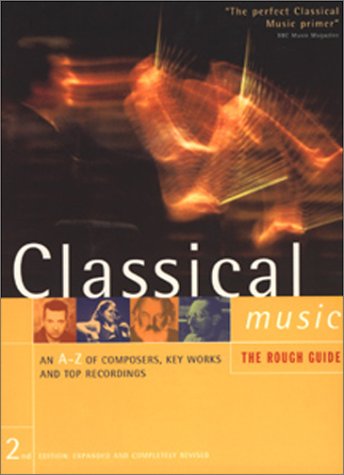
A guide to classical music and the lives of composers, both well-known and obscure, this text provides an A-Z of composers and key recordings.
Die Inhaltsangabe kann sich auf eine andere Ausgabe dieses Titels beziehen.
Über die Autorin bzw. den Autor
Jonathan Buckley was editorial director at Rough Guides, where he wrote several guidebooks, including for Tuscany and Umbria, Florence, and Venice. He has also contributed to The Rough Guide to Classical Music and The Rough Guide to Opera. Buckley published his first novel, The Biography of Thomas Lang, in 1997, and has written several more, including the critically acclaimed Xerxes and The River Is the River.
Joe Staines is a freelance writer and the author of The Rough Guide to Classical Music and The Rough Guide to Classical Music: 100 Essential CDs, and the coauthor of Exploring Rural Portugal. BBC Music Magazine called Staines’s The Rough Guide to Classical Music, "The perfect classical music primer."
Auszug. © Genehmigter Nachdruck. Alle Rechte vorbehalten.
How this book works
Immediately after this introduction you'll find a list of all the composers covered in the guide, arranged chronologically, so you can see at a glance who fits where. If you find you like the music of Palestrina, you could check the list and decide to listen to Byrd, his contemporary. Things are more complicated with the stylistically diverse twentieth century: Xenakis and Arnold may have been born just a year apart but their music seems to come from different worlds. When a musical connection does exist, as in the case of Schoenberg and Berg, or Part and Tavener, a cross-reference in the text will point you in the right direction. At the end of the book there's a detailed glossary, defining all the technical terms we've used.
Between lies the bulk of the guide, an A to Z of composers from John Adams to Alexander Zemlinsky. Each entry starts with an introduction to the composer's music, usually with an outline biography. (Many composers were too busy writing music to lead interesting lives, but if there's a story to tell we tell it.) That's followed by a run-through of the main compositions, with subheadings for individual works that need detailed discussion. These subheadings follow the same basic order, moving from largest-scale works down to the smallest: thus operas precede symphonies and concertos, which in turn precede chamber works and solo instrumental music. With the most important figures - such as Haydn, Mozart and Beethoven - we've generally grouped the music under generic headings (eg "Symphonies"), giving an introduction to each composer's work in that genre before going on to the most important individual pieces, which are then arranged chronologically.
Under each heading you'll find a short discussion of the piece or pieces to which the heading refers, followed by recommended recordings of those pieces, and a review of each CD. The CD details conform to a regular format: soloist first; then orchestra (and/or choir); then conductor, with the record company and serial number in parenthesis. (The serial number is generally the same in Europe as in North America, except that the -2 suffix is usually dropped in North America.) You'll have to get your store to order many of the CDs we've recommended, as most stores stock just the best sellers and the new releases. What's more, some of the major companies have begun targeting what they regard as non-mainstream material at a specific audience. Thus the EMI recording of Samson Francois playing Ravel will be easily available in France but only available as a special import in Britain and the US. Ordering should not be a problem, however, and you should be able to get hold of eighty percent of our recommendations within ten days of asking for them, with imports taking perhaps a week longer. Should you find that a listed CD is not in your store's catalogue, get them to check that the performance has not been repackaged under a different serial number - the major companies are pretty quick to delete slow-moving items, before eventually reissuing them, either at a lower price or combined with different music.
Each CD listing in the book is preceded by a symbol indicating the price of the CD, as in the following examples of recordings of Vivaldi's Four Seasons:
r Freiburg Baroque Orchestra; Goltz (Deutsche Harmonia Mundi 05472 77384-2; with Violin Concertos Op. 8, Nos. 5 & 6) = over #10 or $13.
M Raglan Baroque Players; Kraemer (VER 5 61172-2; with Violin Concertos Op. 8, Nos. 5, 6, 10 & 11) = #7-10 or $8-13.
c English Chamber Orchestra; Garcia (ASV CDQS 148; with other Vivaldi concertos) = under #7 or $8.
The pricing of CDs is a contentious subject. The difference between prices in North America and Britain is explained by differences in taxation and mark-up margins, but you'll come across the argument that top-price CDs are still overpriced in both markets. Certainly some CDs are too expensive - occasionally a label will recycle a best-selling vinyl disc as a full-price CD with little more than half an hour's music on it. That said, the vast majority of CDs are good value. The catalogues of the multinationals are bursting with CDs that pack the contents of two former LPs onto a single eighty-minute disc, often at mid-price or lower. As well as this you'll find that big stores often have special promotions, while many smaller outlets can beat the average prices of the megastores, and there are plenty of mail-order companies selling CDs at a discount.
On top of all this, in recent years there's been an explosion of budget labels, led by Naxos. Don't think that a CD can't be any good if it hasn't got a famous face on the cover - the commitment you get on many of the budget-label performances often outweighs the finesse of the major-league players, and in several instances they win on all fronts. The success of these relative newcomers has spurred the big companies to put more effort into their own budget-price series - every big company now has a range of CDs costing less than half the top price, and two-for-the-price-of-one packages are increasingly popular. All in all, the CD format has made it easier than ever to accumulate a classical collection at moderate cost and, though alternative recording technologies do surface from time to time (such as the short-lived DAT), for the foreseeable future the CD will remain the dominant format.
„Über diesen Titel“ kann sich auf eine andere Ausgabe dieses Titels beziehen.
Suchergebnisse für Classical Music: The Rough Guide:Second Edition (Rough...

Beispielbild für diese ISBN
The Rough Guide to Classical Music
Anbieter: World of Books (was SecondSale), Montgomery, IL, USA
Verkäuferbewertung 5 von 5 Sternen

Zustand: Good. Item in good condition. Textbooks may not include supplemental items i.e. CDs, access codes etc. Bestandsnummer des Verkäufers 00095090974
Gebraucht kaufen
EUR 4,80
Versand gratis
Versand innerhalb von USA
Versand innerhalb von USA
Anzahl: 2 verfügbar
Beispielbild für diese ISBN
The Rough Guide to Classical Music
Anbieter: Greenworld Books, Arlington, TX, USA
Verkäuferbewertung 5 von 5 Sternen
Zustand: good. Fast Free Shipping â" Good condition. It may show normal signs of use, such as light writing, highlighting, or library markings, but all pages are intact and the book is fully readable. A solid, complete copy that's ready to enjoy. Bestandsnummer des Verkäufers GWV.1858282578.G
Gebraucht kaufen
EUR 4,81
Versand gratis
Versand innerhalb von USA
Versand innerhalb von USA
Anzahl: 1 verfügbar
Beispielbild für diese ISBN
The Rough Guide to Classical Music
Verlag:
Rough Guides (edition 2nd), 1998
ISBN 10: 1858282578
ISBN 13: 9781858282572
Gebraucht
Paperback
Anbieter: BooksRun, Philadelphia, PA, USA
Verkäuferbewertung 5 von 5 Sternen
Paperback. Zustand: Very Good. 2nd. It's a well-cared-for item that has seen limited use. The item may show minor signs of wear. All the text is legible, with all pages included. It may have slight markings and/or highlighting. Bestandsnummer des Verkäufers 1858282578-11-1
Gebraucht kaufen
EUR 4,92
Versand gratis
Versand innerhalb von USA
Versand innerhalb von USA
Anzahl: 1 verfügbar
Beispielbild für diese ISBN
The Rough Guide to Classical Music
Verlag:
Rough Guides (edition 2nd), 1998
ISBN 10: 1858282578
ISBN 13: 9781858282572
Gebraucht
Paperback
Anbieter: BooksRun, Philadelphia, PA, USA
Verkäuferbewertung 5 von 5 Sternen
Paperback. Zustand: Very Good. 2nd. It's a well-cared-for item that has seen limited use. The item may show minor signs of wear. All the text is legible, with all pages included. It may have slight markings and/or highlighting. Bestandsnummer des Verkäufers 1858282578-8-1
Gebraucht kaufen
EUR 5,04
Versand gratis
Versand innerhalb von USA
Versand innerhalb von USA
Anzahl: 1 verfügbar
Beispielbild für diese ISBN
The Rough Guide to Classical Music
Anbieter: ThriftBooks-Reno, Reno, NV, USA
Verkäuferbewertung 5 von 5 Sternen
Paperback. Zustand: Very Good. No Jacket. May have limited writing in cover pages. Pages are unmarked. ~ ThriftBooks: Read More, Spend Less. Bestandsnummer des Verkäufers G1858282578I4N00
Gebraucht kaufen
EUR 5,90
Versand gratis
Versand innerhalb von USA
Versand innerhalb von USA
Anzahl: 1 verfügbar
Beispielbild für diese ISBN
The Rough Guide to Classical Music
Anbieter: ThriftBooks-Dallas, Dallas, TX, USA
Verkäuferbewertung 5 von 5 Sternen
Paperback. Zustand: Very Good. No Jacket. May have limited writing in cover pages. Pages are unmarked. ~ ThriftBooks: Read More, Spend Less. Bestandsnummer des Verkäufers G1858282578I4N00
Gebraucht kaufen
EUR 5,90
Versand gratis
Versand innerhalb von USA
Versand innerhalb von USA
Anzahl: 1 verfügbar
Beispielbild für diese ISBN
The Rough Guide to Classical Music
Anbieter: ThriftBooks-Dallas, Dallas, TX, USA
Verkäuferbewertung 5 von 5 Sternen
Paperback. Zustand: Fair. No Jacket. Readable copy. Pages may have considerable notes/highlighting. ~ ThriftBooks: Read More, Spend Less. Bestandsnummer des Verkäufers G1858282578I5N00
Gebraucht kaufen
EUR 5,90
Versand gratis
Versand innerhalb von USA
Versand innerhalb von USA
Anzahl: 1 verfügbar
Beispielbild für diese ISBN
The Rough Guide to Classical Music
Anbieter: ThriftBooks-Atlanta, AUSTELL, GA, USA
Verkäuferbewertung 5 von 5 Sternen
Paperback. Zustand: Very Good. No Jacket. May have limited writing in cover pages. Pages are unmarked. ~ ThriftBooks: Read More, Spend Less. Bestandsnummer des Verkäufers G1858282578I4N00
Gebraucht kaufen
EUR 5,90
Versand gratis
Versand innerhalb von USA
Versand innerhalb von USA
Anzahl: 1 verfügbar
Beispielbild für diese ISBN
Classical Music
Verlag:
Dorling Kindersley Publishing, Incorporated, 1998
ISBN 10: 1858282578
ISBN 13: 9781858282572
Gebraucht
Softcover
Anbieter: Better World Books, Mishawaka, IN, USA
Verkäuferbewertung 5 von 5 Sternen
Zustand: Very Good. Former library copy. Pages intact with possible writing/highlighting. Binding strong with minor wear. Dust jackets/supplements may not be included. Includes library markings. Stock photo provided. Product includes identifying sticker. Better World Books: Buy Books. Do Good. Bestandsnummer des Verkäufers 38786162-6
Gebraucht kaufen
EUR 6,40
Versand gratis
Versand innerhalb von USA
Versand innerhalb von USA
Anzahl: 1 verfügbar
Beispielbild für diese ISBN
Classical Music
Verlag:
Dorling Kindersley Publishing, Incorporated, 1998
ISBN 10: 1858282578
ISBN 13: 9781858282572
Gebraucht
Softcover
Anbieter: Better World Books, Mishawaka, IN, USA
Verkäuferbewertung 5 von 5 Sternen
Zustand: Very Good. Pages intact with possible writing/highlighting. Binding strong with minor wear. Dust jackets/supplements may not be included. Stock photo provided. Product includes identifying sticker. Better World Books: Buy Books. Do Good. Bestandsnummer des Verkäufers GRP26703343
Gebraucht kaufen
EUR 6,40
Versand gratis
Versand innerhalb von USA
Versand innerhalb von USA
Anzahl: 2 verfügbar