
Verwandte Artikel zu Words That Work in Business: A Practical Guide to Effective...
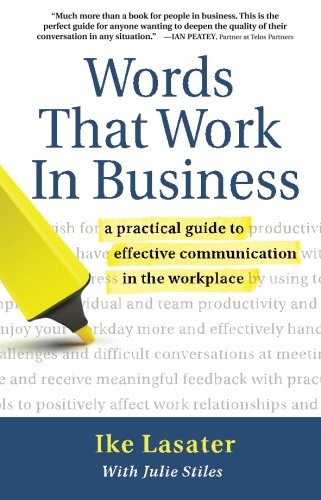
Words That Work in Business: A Practical Guide to Effective Communication in the Workplace - Softcover
Inhaltsangabe
Addressing the most common workplace relationship challenges, this manual shows how to use the principles of Nonviolent Communication to improve the workplace atmosphere. Offering practical tools that match recognizable work scenarios, this guide can help all employees positively affect their work relationships and company culture, regardless of their position. This handbook displays proven communication skills for effectively handling difficult conversations, reducing workplace conflict and stress, improving individual and team productivity, having more effective meetings, and giving and receiving meaningful feedback, thereby creating a more enjoyable work environment.
Die Inhaltsangabe kann sich auf eine andere Ausgabe dieses Titels beziehen.
Über die Autorin bzw. den Autor
Ike Lasater is a cofounder of Words That Work, a consulting and training firm that helps organizations achieve results through better communication and collaboration, and a cofounder of Yoga Journal magazine. He is a former board member for the Center for Nonviolent Communication and for the Association for Dispute Resolution of Northern California. He lives in San Francisco. Julie Stiles completed a Master's degree in Consciousness Studies at John F. Kennedy University. She has a background in education and technology, and currently works as a writer helping professionals articulate and shape their ideas for publication. She also has completed a manuscript on the process of transformation of consciousness. Julie has studied Nonviolent Communication through JFKU as well as with Marshall Rosenberg, Ike Lasater, and John Kinyon.
Auszug. © Genehmigter Nachdruck. Alle Rechte vorbehalten.
Words that Work In Business
A Practical Guide to Effective Communication in the Workplace
By Ike Lasater, Julie Stiles, Kyra FreestarPuddleDancer Press
Copyright © 2010 Ike Lasater
All rights reserved.
ISBN: 978-1-892005-01-4All rights reserved.
Contents
Preface,
Introduction,
CHAPTER 1 How to Begin: Silent NVC Practices,
CHAPTER 2 The Learning Cycle: Celebrating Progress, Mourning Mistakes,
CHAPTER 3 Practice: Building Confidence and Competence,
CHAPTER 4 Powerful Requests: Asking for What You Want,
CHAPTER 5 Suggestions for Addressing Common Workplace Communication Challenges,
Conclusion,
Appendices,
A: Training Wheels Sentence,
B: Feelings List,
C: Feelings Versus Evaluations Masquerading as Feelings,
D: Needs List,
Index,
The Four-Part Nonviolent Communication Process,
Some Basic Feelings and Needs We All Have,
About Nonviolent Communication,
About PuddleDancer Press,
About the Center for Nonviolent Communication,
Trade Books From PuddleDancer Press,
About the Author,
CHAPTER 1
How to Begin: Silent NVC Practices
You may be feeling some trepidation about using Nonviolent Communication in the workplace. Perhaps you imagine that co-workers will respond negatively if you attempt to introduce a new way of communicating. Yet there is almost nothing a person can say or do that cannot be responded to either with empathy or with some form of self-connected expression, or a combination of the two. When you begin to trust that you will predictably have the skills and presence to respond with empathy or expression, you'll have more trust in your ability to interact in ways that are in alignment with your values. Often, however, people see this as a chicken-and-egg problem: How do I get the skills if I'm afraid to use them? How do I use them without having the skills? A powerful way to develop NVC skills is through silent practice. This section covers three silent practices — awareness of blocking connection, self-empathy, and silent empathy — and suggests when and how you might use them.
There are several benefits to silent NVC practice: you can practice in ways less likely to be noticed by others in your workplace; you can practice and develop your skills of self-empathy and silent empathy until you feel more confident trying the out loud skills of empathy and expression; and finally, whatever you do say after silent practice will more probably be something you like.
The inner work of NVC can be done without anyone knowing. Though silent, these practices produce empathic connection with yourself and with others. When connected in this way, you will be a different person, and you will be more likely to enjoy your conduct. In addition, what you say and how you say it will be affected, even though you are not yet intending to use out loud NVC. These subtle changes create a gradual process that will help you transition to using out loud skills with co-workers who might otherwise react to a sudden change in your communication.
Becoming Aware of Blocking Connection
Many of the ways we have learned to communicate result in blocking connection with others. If you intend to use Nonviolent Communication to create connection with yourself or others, we encourage you to become aware, simultaneously, of what you are doing that blocks that connection. To gain this self-awareness, we suggest a two-step process.
* * *
First, notice the times when you feel less than connected while speaking with someone. You might notice a vague feeling of discomfort, realize you do not enjoy what you or they are saying, or feel angry or impatient. (See Example 1 on facing page.)
Second, when you notice you are not feeling as connected as you would like, determine whether either of you are doing any of the following: defending a position, explaining, moralistically judging, diagnosing others, blaming, seeking to punish, or "needing" to be right. Any internal sense of wanting the other to feel guilt or shame also tends to generate disconnection.
Your awareness of blocking connection will come over time as you look at the results from your communication. One thing to watch for is that you do not, in the process of gaining this awareness, continue to block connection by judging or blaming or punishing yourself for not having communicated "right." In a learning process, there is no "right" or "wrong"; there is only learning — inquiry that leads to trying something else designed to better meet your needs. Likewise, we warn against using your developing awareness to name what those around you are doing. For instance, if you can, refrain from saying things like "There you go again, defending your position" or "Stop trying to guilt-trip me." Instead, trust that as your awareness grows, you will be able to use your expanding out loud NVC skills of empathy or expression to respond to what others say.
Awareness is always the first part of a learning process, and the silent practice of becoming aware of blocking connection is crucial for learning to quickly recognize the patterns of communication you hope to change.
Using Self-Empathy — Recognizing Your Triggers
We often get triggered while interacting with others. The stimulus may arise from something someone else said, or something we did or said ourselves. Without awareness, a trigger leads us into habitual reaction. From the moment of awareness, however, we can choose to intervene, to create an alternative to the habitual. With time, if we prefer the outcomes from this alternative and continue to reinforce them, we will develop new reaction habits. The intervention we suggest is self-empathy. (See Example 2 on facing page.)
* * *
In self-empathy, we practice the basics of NVC within ourselves — silently. We identify what was actually said or done — the Observation of the situation — and distinguish that from our judgment of it. Then we identify how we feel about it, and what need was or was not met by the words or actions. In my work as a trainer and mediator, I use self-empathy all the time. I find it essential for maintaining my sense of well-being and wholeness.
For instance, not long ago I was facilitating a workshop. There had been several joking exchanges between myself and people I knew well from previous workshops. One of the participants who was new to this group then said, "I'm really uncomfortable with all this joking; it's not at all what I consider to be NVC, and my understanding is that this is supposed to be an NVC workshop."
As soon as I heard her say this, I immediately noticed that I felt de-energized and that I was thinking thoughts like "Well, you're a real party-pooper." Realizing these two things prompted me to ask myself what need I was seeking to meet with a thought like that. What occurred to me was that I wanted to have the freedom to be myself and for that to be OK. I also wanted to have companionship in my fun and play. With this awareness, I felt a shift within me to a sense of compassion in myself and for her. From this shift, I was able to respond to her with care and understanding about what might have prompted her to say what she said.
There are often a number of different ways to proceed with self-empathy. For instance, in the story above, I could have started with either the observation of what the participant said or the observation of the judgment I heard in my mind. I began with my judgment, to give myself...
„Über diesen Titel“ kann sich auf eine andere Ausgabe dieses Titels beziehen.
Suchergebnisse für Words That Work in Business: A Practical Guide to Effective...

Beispielbild für diese ISBN
Words That Work In Business: A Practical Guide to Effective Communication in the Workplace (Nonviolent Communication Guides)
Anbieter: World of Books (was SecondSale), Montgomery, IL, USA
Verkäuferbewertung 5 von 5 Sternen

Zustand: Good. Item in good condition and has highlighting/writing on text. Used texts may not contain supplemental items such as CDs, info-trac etc. Bestandsnummer des Verkäufers 00106718404
Gebraucht kaufen
EUR 4,52
Versand gratis
Versand innerhalb von USA
Versand innerhalb von USA
Anzahl: 1 verfügbar
Beispielbild für diese ISBN
Words That Work In Business: A Practical Guide to Effective Communication in the Workplace (Nonviolent Communication Guides)
Anbieter: World of Books (was SecondSale), Montgomery, IL, USA
Verkäuferbewertung 5 von 5 Sternen
Zustand: Good. Item in good condition. Textbooks may not include supplemental items i.e. CDs, access codes etc. Bestandsnummer des Verkäufers 00096584201
Gebraucht kaufen
EUR 4,85
Versand gratis
Versand innerhalb von USA
Versand innerhalb von USA
Anzahl: 2 verfügbar
Beispielbild für diese ISBN
Words That Work In Business: A Practical Guide to Effective Communication in the Workplace (Nonviolent Communication Guides)
Anbieter: World of Books (was SecondSale), Montgomery, IL, USA
Verkäuferbewertung 5 von 5 Sternen
Zustand: Very Good. Item in very good condition! Textbooks may not include supplemental items i.e. CDs, access codes etc. Bestandsnummer des Verkäufers 00085965845
Gebraucht kaufen
EUR 4,85
Versand gratis
Versand innerhalb von USA
Versand innerhalb von USA
Anzahl: 1 verfügbar
Beispielbild für diese ISBN
Words That Work In Business: A Practical Guide to Effective Communication in the Workplace (Nonviolent Communication Guides)
Verlag:
PuddleDancer Press (edition ), 2010
ISBN 10: 1892005018
ISBN 13: 9781892005014
Gebraucht
Paperback
Anbieter: BooksRun, Philadelphia, PA, USA
Verkäuferbewertung 5 von 5 Sternen
Paperback. Zustand: Very Good. It's a well-cared-for item that has seen limited use. The item may show minor signs of wear. All the text is legible, with all pages included. It may have slight markings and/or highlighting. Bestandsnummer des Verkäufers 1892005018-11-1
Gebraucht kaufen
EUR 4,86
Versand gratis
Versand innerhalb von USA
Versand innerhalb von USA
Anzahl: 2 verfügbar
Beispielbild für diese ISBN
Words That Work in Business : A Practical Guide to Effective Communication in the Workplace
Anbieter: Better World Books: West, Reno, NV, USA
Verkäuferbewertung 5 von 5 Sternen
Zustand: Very Good. Pages intact with possible writing/highlighting. Binding strong with minor wear. Dust jackets/supplements may not be included. Stock photo provided. Product includes identifying sticker. Better World Books: Buy Books. Do Good. Bestandsnummer des Verkäufers 4556192-6
Gebraucht kaufen
EUR 6,03
Versand gratis
Versand innerhalb von USA
Versand innerhalb von USA
Anzahl: 1 verfügbar
Beispielbild für diese ISBN
Words That Work in Business : A Practical Guide to Effective Communication in the Workplace
Anbieter: Better World Books, Mishawaka, IN, USA
Verkäuferbewertung 5 von 5 Sternen
Zustand: Good. Pages intact with minimal writing/highlighting. The binding may be loose and creased. Dust jackets/supplements are not included. Stock photo provided. Product includes identifying sticker. Better World Books: Buy Books. Do Good. Bestandsnummer des Verkäufers 4979573-6
Gebraucht kaufen
EUR 6,03
Versand gratis
Versand innerhalb von USA
Versand innerhalb von USA
Anzahl: 1 verfügbar
Beispielbild für diese ISBN
Words That Work in Business : A Practical Guide to Effective Communication in the Workplace
Anbieter: Better World Books: West, Reno, NV, USA
Verkäuferbewertung 5 von 5 Sternen
Zustand: Good. Former library copy. Pages intact with minimal writing/highlighting. The binding may be loose and creased. Dust jackets/supplements are not included. Includes library markings. Stock photo provided. Product includes identifying sticker. Better World Books: Buy Books. Do Good. Bestandsnummer des Verkäufers 4844020-75
Gebraucht kaufen
EUR 6,03
Versand gratis
Versand innerhalb von USA
Versand innerhalb von USA
Anzahl: 1 verfügbar
Beispielbild für diese ISBN
Words That Work in Business: A Practical Guide to Effective Communication in the Workplace
Anbieter: ThriftBooks-Dallas, Dallas, TX, USA
Verkäuferbewertung 5 von 5 Sternen
Paperback. Zustand: As New. No Jacket. Pages are clean and are not marred by notes or folds of any kind. ~ ThriftBooks: Read More, Spend Less. Bestandsnummer des Verkäufers G1892005018I2N00
Gebraucht kaufen
EUR 6,22
Versand gratis
Versand innerhalb von USA
Versand innerhalb von USA
Anzahl: 1 verfügbar
Beispielbild für diese ISBN
Words that Work in Business
Anbieter: World of Books Inc, Montgomery, IL, USA
Verkäuferbewertung 2 von 5 Sternen

Paperback. Zustand: Good. Addressing the most common workplace relationship challenges, this manual shows how to use the principles of Nonviolent Communication to improve the workplace atmosphere. Offering practical tools that match recognizable work scenarios, this guide can help all employees positively affect their work relationships and company culture, regardless of their position. This handbook displays proven communication skills for effectively handling difficult conversations, reducing workplace conflict and stress, improving individual and team productivity, having more effective meetings, and giving and receiving meaningful feedback, thereby creating a more enjoyable work environment. Bestandsnummer des Verkäufers CIN1892005018G
Gebraucht kaufen
EUR 6,64
Versand gratis
Versand innerhalb von USA
Versand innerhalb von USA
Anzahl: 3 verfügbar
Beispielbild für diese ISBN
Words that Work in Business
Anbieter: World of Books Inc, Montgomery, IL, USA
Verkäuferbewertung 2 von 5 Sternen
Paperback. Zustand: Very Good. Addressing the most common workplace relationship challenges, this manual shows how to use the principles of Nonviolent Communication to improve the workplace atmosphere. Offering practical tools that match recognizable work scenarios, this guide can help all employees positively affect their work relationships and company culture, regardless of their position. This handbook displays proven communication skills for effectively handling difficult conversations, reducing workplace conflict and stress, improving individual and team productivity, having more effective meetings, and giving and receiving meaningful feedback, thereby creating a more enjoyable work environment. Bestandsnummer des Verkäufers CIN1892005018VG
Gebraucht kaufen
EUR 6,64
Versand gratis
Versand innerhalb von USA
Versand innerhalb von USA
Anzahl: 1 verfügbar