
Verwandte Artikel zu Surviving and Thriving on the Land: How to Use Your...
Surviving and Thriving on the Land: How to Use Your Spare Time and Energy to Run a Successful Smallholding: How to Use Your Time and Energy to Run a Successful Smallholding - Softcover
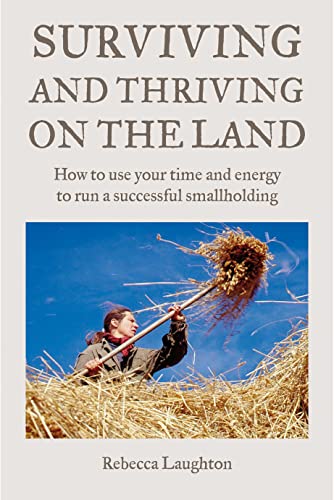
Inhaltsangabe
It's a dream come true when you finally get a piece of land or join an eco-community and start to plan your sustainable land-based enterprise. But all too often the dream is spoiled by lack of money, stress, exhaustion, and poor time management, and your work and future plans can dissolve into discord, illness, and poverty. Smallholdings provide food, home, fuel, and employment for those who run them and local, seasonal, often organic and ethical food and timber for an expanding market.
Surviving and Thriving on the Land looks at ways in which projects can be designed that care for the people involved in them as well as the earth that they are trying to protect. If land-based ecological projects are to offer a realistic solution to the problems we face in the twenty-first century, it is imperative that they be sustainable in terms of human energy. This book offers a framework, backed up by real-life examples, of issues to consider when setting up a new project or for overcoming human-energy-based problems in existing projects.
Die Inhaltsangabe kann sich auf eine andere Ausgabe dieses Titels beziehen.
Über die Autorin bzw. den Autor
Rebecca Laughton lived for four years at Tinker?s Bubble, an ecological community in Somerset where the residents manage 40 acres of land without the use of fossil fuels. Whilst researching her book, she travelled around France and the UK visitingother land-based projects and found that the subject of human energy use within ecological projects had not really been addressed. Rebecca studied Geography at Newcastle University and has an MSc in Sustainable Agriculture from Wye College, University of London.
Auszug. © Genehmigter Nachdruck. Alle Rechte vorbehalten.
Surviving and Thriving on the Land
How to Use Your Time and Energy to Run a Successful Smallholding
By Rebecca LaughtonGreen Books Ltd
Copyright © 2008 Rebecca Laughton
All rights reserved.
ISBN: 978-1-900322-28-7All rights reserved.
Contents
Introduction,
1. The Human Energy Equation,
2. Energy Use Through the Ages,
3. The Role of the Modern Smallholder,
4. Land-based Livelihoods and Low-impact Lifestyles,
5. Energy-efficient Design,
6. Wise Choice of Tools,
7. Domestic Energy,
8. Livelihood Strategies,
9. Living and Working Together,
10. Together or Alone?,
11. The Seven Ages of Men and Women,
12. Siestas and Fiestas: Balancing work, rest and celebration,
13. Surviving or Thriving?,
Appendix 1: Interview questions,
Appendix 2: Resources,
References,
Index,
CHAPTER 1
The Human Energy Equation
A new generation of small-scale, land-based initiatives is establishing itself throughout the United Kingdom. These include smallholdings, organic farms, land-based communities, forestry initiatives, permaculture projects and community-supported agriculture schemes. The people starting these initiatives are usually driven by a desire to address some of the pressing environmental problems of the twenty-first century, such as climate change, biodiversity loss and soil erosion. Often those wishing to work on the land see their domestic arrangements as part of an integrated endeavour to minimise their personal environmental impact. Alongside organic farming or forestry, they choose to build energy-efficient homes from local or recycled materials; harvest rainwater from their roofs; generate electricity using wind generators, solar panels or hydroelectric turbines and use firewood for cooking and heating their homes. Some smallholders wish to meet the growing demand for food which has been produced locally to high environmental standards. Others are motivated by the belief that their quality of life will improve if their own basic needs are met directly by living and working on the land. Their food will be fresher and taste better, their water cleaner, their environment more pleasant, they will be able to work from home and spend more time with their families, and they will have the freedom to choose how to use their time.
The price of bucolic bliss
Such an idyllic rural existence is entirely achievable, but it comes at a price – hard work. To generate a livelihood from the land in modern Britain, whilst minimising your environmental impact, is demanding. Firstly, for the aspiring self-sufficient or commercial smallholder, finding an affordable property is a challenge. Buying a bare land holding, let alone a house with enough land to grow your own vegetables and keep a few chickens, is an expensive business, unless you have large reserves of capital or a well-paid job. Secondly, despite the recent increase in demand for local and organic food, it is still hard for farmers to charge prices that realistically value their time as well as covering the cost of production. The establishment of a successful agricultural enterprise requires skill and efficiency, imaginative marketing skills and the willingness to work extremely long hours for very low pay. Thirdly, government bureaucracy and manifold regulations – including DEFRA paperwork, organic certification, planning laws and environmental health legislation – result in time-consuming and sometimes expensive extra work. Without some forethought and care, the rural idyll can turn into a slog through a never-ending list of chore
„Über diesen Titel“ kann sich auf eine andere Ausgabe dieses Titels beziehen.
Suchergebnisse für Surviving and Thriving on the Land: How to Use Your...

Beispielbild für diese ISBN
Surviving and Thriving on the Land: How to Use Your Spare Time and Energy to Run a Successful Smallholding
Anbieter: World of Books (was SecondSale), Montgomery, IL, USA
Verkäuferbewertung 5 von 5 Sternen

Paperback. Zustand: Good. Surviving and Thriving on the Land looks at ways in which projects can be designed that care for the people involved in them as well as the Earth that they are trying to protect. It's a dream come true when you finally get a piece of land or join an eco-community, and start to plan your sustainable land-based enterprise; but all too often the dream is spoiled by lack of money, stress, exhaustion, and poor time management, and your work and future plans can dissolve into discord, illness, and poverty. Smallholdings provide food, home, fuel, and employment for those who run them, and local, seasonal, often organic and ethical food and timber for an expanding market. If land-based ecological projects are to offer a realistic solution to the problems of the 21st century, it is imperative that they should be sustainable in terms of human energy. This book offers a framework of issues to consider, backed up by real life examples, when setting up a new project, or for overcoming human-energy-based problems in existing projects. Bestandsnummer des Verkäufers 00109813367
Gebraucht kaufen
EUR 4,56
Versand gratis
Versand innerhalb von USA
Versand innerhalb von USA
Anzahl: 1 verfügbar
Beispielbild für diese ISBN
Surviving and Thriving on the Land: How to Use Your Spare Time and Energy to Run a Successful Smallholding
Anbieter: Evergreen Goodwill, Seattle, WA, USA
Verkäuferbewertung 5 von 5 Sternen
paperback. Zustand: Good. Bestandsnummer des Verkäufers mon0000692097
Gebraucht kaufen
EUR 4,47
EUR 3,50 Versand
Versand innerhalb von USA
Versand innerhalb von USA
Anzahl: 1 verfügbar
Foto des Verkäufers
Surviving and Thriving on the Land: How to Use Your Spare Time and Energy to Run a Successful Smallholding
Anbieter: WeBuyBooks, Rossendale, LANCS, Vereinigtes Königreich
Verkäuferbewertung 5 von 5 Sternen
paperback. Zustand: Good. Most items will be dispatched the same or the next working day. A copy that has been read but remains in clean condition. All of the pages are intact and the cover is intact and the spine may show signs of wear. The book may have minor markings which are not specifically mentioned. Ex library copy with usual stamps & stickers. Bestandsnummer des Verkäufers rev9071995387
Gebraucht kaufen
EUR 1,83
EUR 8,69 Versand
Versand von Vereinigtes Königreich nach USA
Versand von Vereinigtes Königreich nach USA
Anzahl: 1 verfügbar
Beispielbild für diese ISBN
Surviving and Thriving on the Land : How to Use Your Spare Time and Energy to Run a Successful Smallholding
Verlag:
Bloomsbury Publishing Plc, 2008
ISBN 10: 1900322285
ISBN 13: 9781900322287
Gebraucht
Softcover
Anbieter: Better World Books Ltd, Dunfermline, Vereinigtes Königreich
Verkäuferbewertung 5 von 5 Sternen
Zustand: Good. Pages intact with minimal writing/highlighting. The binding may be loose and creased. Dust jackets/supplements are not included. Stock photo provided. Product includes identifying sticker. Better World Books: Buy Books. Do Good. Bestandsnummer des Verkäufers 17142318-6
Gebraucht kaufen
EUR 5,66
EUR 5,81 Versand
Versand von Vereinigtes Königreich nach USA
Versand von Vereinigtes Königreich nach USA
Anzahl: 1 verfügbar
Beispielbild für diese ISBN
Surviving and Thriving on the Land: How to Use Your Spare Time and Energy to Run a Successful Smallholding
Anbieter: WorldofBooks, Goring-By-Sea, WS, Vereinigtes Königreich
Verkäuferbewertung 5 von 5 Sternen
Paperback. Zustand: Very Good. The book has been read, but is in excellent condition. Pages are intact and not marred by notes or highlighting. The spine remains undamaged. Bestandsnummer des Verkäufers GOR001894112
Gebraucht kaufen
EUR 5,06
EUR 6,51 Versand
Versand von Vereinigtes Königreich nach USA
Versand von Vereinigtes Königreich nach USA
Anzahl: 5 verfügbar
Beispielbild für diese ISBN
Surviving and Thriving on the Land: How to Use Your Spare Time and Energy to Run a Successful Smallholding
Anbieter: Sell Books, Elland, YORKS, Vereinigtes Königreich
Verkäuferbewertung 5 von 5 Sternen
paperback. Zustand: Good. Our good condition books are generally good for reading but not for gifting or collecting. They could have imperfections such as creasing, fanning, inscriptions, margin notes, yellowing, staining on edge or cover or pages, bumps, scuffs, etc etc (sometimes multiple of these). It's a wide category that encompasses anything that isn't almost-new down to anything that is slightly better than poor. We would NOT recommend gifting Good books - these should be considered reading copies. Our books are dispatched from a Yorkshire former cotton mill. We list via barcode/ISBN so please note that the images are stock images and may not be the exact copy you receive, furthermore the details about edition and year might not be accurate as many publishers reuse the same ISBN for multiple editions and as we simply scan a barcode or enter an ISBN we do not check the validity of the edition data when listing. If you're looking for an exact edition please don't order (at least not without checking with us first, although we don't always have time to check). We aim to dispatch prompty, the service used will depend on order value and book size. We can ship to most countries, see our shipping policies. Payment is via Abe only. Bestandsnummer des Verkäufers mon0000027883
Gebraucht kaufen
EUR 2,09
EUR 14,13 Versand
Versand von Vereinigtes Königreich nach USA
Versand von Vereinigtes Königreich nach USA
Anzahl: 1 verfügbar
Beispielbild für diese ISBN
Surviving and Thriving on the Land: How to Use Your Spare Time and Energy to Run a Successful Smallholding
Anbieter: GoldBooks, Denver, CO, USA
Verkäuferbewertung 5 von 5 Sternen
Paperback. Zustand: new. New Copy. Customer Service Guaranteed. Bestandsnummer des Verkäufers 96Q30_96_1900322285
Neu kaufen
EUR 49,29
EUR 4,83 Versand
Versand innerhalb von USA
Versand innerhalb von USA
Anzahl: 1 verfügbar
Beispielbild für diese ISBN
Surviving and Thriving on the Land: How to Use Your Spare Time and Energy to Run a Successful Smallholding
Anbieter: Cronus Books, Carson City, NV, USA
Verkäuferbewertung 5 von 5 Sternen
paperback. Zustand: New. ~ NEW Inside and Out! Clean & Crisp Pages. (E-mail for more info./pics). Bestandsnummer des Verkäufers 250517005