
Verwandte Artikel zu Fruit: Edible, Inedible, Incredible (Seeds / Pollen...
Inhaltsangabe
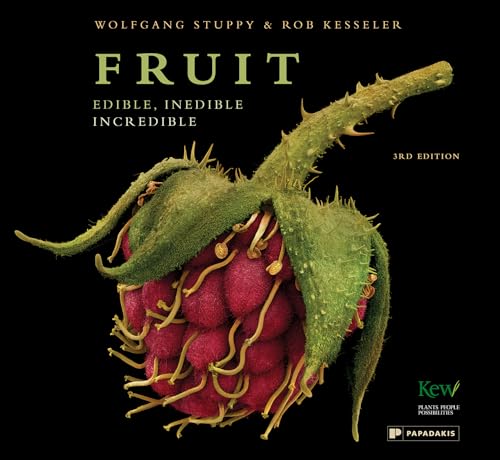
Fruit. The word itself conjures up mouthwatering memories of crunchy apples, luscious strawberries, sweet bananas, succulent melons and juicy pineapples, to which we can add the splendid tropical fruits on our supermarket shelves. They are one of nature’s most wonderful gifts but providing us with a healthy source of food is not the reason that plants produce such delicious fruits. It is therefore quite legitimate to ask what fruits are, and why they exist. As will be revealed, the true nature of fruits is concealed in what is buried in their core: their seeds. The key role that both play in the survival of each species explains the manifold strategies and ruses that plants have developed for the dispersal of their seeds. Whether these involve wind, water, humans, animals or the plant’s own explosive triggers, they are reflected in the many colours, shapes and sizes of the fruits that protect the seeds and in the extraordinary way that some fruits have adapted to the animals that disperse their seeds, and the animals to the fruits they relish. In this pioneering collaboration, visual artist Rob Kesseler and seed morphologist Wolfgang Stuppy use scanning electronmicroscopy to obtain astonishing images of a variety of fruits and the seeds they protect. Razor-sharp cross-sections reveal intricate interiors, nuts and other examples of botanical architecture and reproductive ingenuity. The black and white microscope images have been sumptuously coloured by Rob Kesseler highlighting the structure and functioning of the minuscule fruit and seeds some almost invisible to the naked eye and in so doing creating a work of art. Larger fruits, flowers and seeds have been especially photographed. The formation, development and demise of the fruits are described their vital role in the preservation of the biodiversity of our planet explained. Fruits are the keepers of the precious seeds that ensure our future; some are edible, others inedible and many, quite simply, incredible.
Die Inhaltsangabe kann sich auf eine andere Ausgabe dieses Titels beziehen.
Über die Autorin bzw. den Autor
Wolfgang Stuppy is the seed morphologist for the Millennium Seed Bank Project at the Royal Botanic Gardens, Kew. At the heart of this large international project, which collects and stores seeds and fruits from all over the world, Dr. Stuppy has found the ideal environment to feed his passion for research into the astonishing diversity of seeds and fruits. Rob Kesseler is a visual artist and Professor of Ceramic Art & Design at Central Saint Martins College of Art & Design. Collaborating with scientists, his work inhabits a territory where design, fine art and applied art overlap. From 2001–2004 he was NESTA Fellow at Kew and continues to work with Wolfgang Stuppy on an examination of microscopic plant material. He is a Fellow of the Linnean Society and of the Royal Society of Arts. In 2010 he was appointed Research Fellow at the Gulbenkian Science Institute. His work has been exhibited around the world.
„Über diesen Titel“ kann sich auf eine andere Ausgabe dieses Titels beziehen.
Suchergebnisse für Fruit: Edible, Inedible, Incredible (Seeds / Pollen...

Beispielbild für diese ISBN
Fruit (compact edition) /anglais
Anbieter: HPB-Movies, Dallas, TX, USA
Verkäuferbewertung 5 von 5 Sternen

hardcover. Zustand: Fine. Bestandsnummer des Verkäufers D_00000000000010310496
Gebraucht kaufen
EUR 13,44
EUR 3,26 Versand
Versand innerhalb von USA
Versand innerhalb von USA
Anzahl: 1 verfügbar
Beispielbild für diese ISBN
Fruit (compact edition) /anglais
Anbieter: HPB-Blue, Dallas, TX, USA
Verkäuferbewertung 5 von 5 Sternen
hardcover. Zustand: Fine. Connecting readers with great books since 1972! May contain remainder marks. We ship orders daily and Customer Service is our top priority! Bestandsnummer des Verkäufers D_00000000000010310496
Gebraucht kaufen
EUR 14,34
EUR 3,26 Versand
Versand innerhalb von USA
Versand innerhalb von USA
Anzahl: 1 verfügbar
Beispielbild für diese ISBN
Fruit: Edible, Inedible, Incredible (Seeds / Pollen / Fruit)
Anbieter: WorldofBooks, Goring-By-Sea, WS, Vereinigtes Königreich
Verkäuferbewertung 5 von 5 Sternen
Paperback. Zustand: Very Good. The book has been read, but is in excellent condition. Pages are intact and not marred by notes or highlighting. The spine remains undamaged. Bestandsnummer des Verkäufers GOR008627125
Gebraucht kaufen
EUR 12,28
EUR 6,53 Versand
Versand von Vereinigtes Königreich nach USA
Versand von Vereinigtes Königreich nach USA
Anzahl: 4 verfügbar
Beispielbild für diese ISBN
Fruit: Edible, Inedible, Incredible (Seeds / Pollen / Fruit)
Anbieter: WorldofBooks, Goring-By-Sea, WS, Vereinigtes Königreich
Verkäuferbewertung 5 von 5 Sternen
Paperback. Zustand: Fine. Bestandsnummer des Verkäufers GOR006645721
Gebraucht kaufen
EUR 12,28
EUR 6,53 Versand
Versand von Vereinigtes Königreich nach USA
Versand von Vereinigtes Königreich nach USA
Anzahl: 1 verfügbar
Beispielbild für diese ISBN
Fruit
Anbieter: Postscript Books, Newton Abbot, DEVON, Vereinigtes Königreich
Verkäuferbewertung 5 von 5 Sternen
Hardcover. Zustand: New. Wolfgang Stuppy's explanation of the formation, development and demise of fruit is accompanied by specially created images by Rob Kesseler, who uses electron microscopy to reveal the intricacy of their interiors, pods, pouches, keys, nuts and seeds. In addition to exploring the structure and functioning of fruit and seeds, the text also discusses their role in preserving biodiversity. Please note that the glue between the signatures has dried out but the stitching remains secure. Bestandsnummer des Verkäufers 533809
Neu kaufen
EUR 13,20
EUR 12,83 Versand
Versand von Vereinigtes Königreich nach USA
Versand von Vereinigtes Königreich nach USA
Anzahl: 18 verfügbar
Foto des Verkäufers
Fruit : Edible, Inedible, Incredible
Anbieter: GreatBookPrices, Columbia, MD, USA
Verkäuferbewertung 5 von 5 Sternen
Zustand: New. Bestandsnummer des Verkäufers 20222884-n
Neu kaufen
EUR 24,35
EUR 2,30 Versand
Versand innerhalb von USA
Versand innerhalb von USA
Anzahl: 5 verfügbar
Beispielbild für diese ISBN
Fruit: Edible, Inedible, Incredible (compact edition) (Seeds / Pollen / Fruit)
Anbieter: Aardvark Rare Books, Presteigne, HEREF, Vereinigtes Königreich
Verkäuferbewertung 5 von 5 Sternen
hardcover. Zustand: New. **HARDBACK**. Bestandsnummer des Verkäufers mon0000679152
Neu kaufen
EUR 12,37
EUR 16,33 Versand
Versand von Vereinigtes Königreich nach USA
Versand von Vereinigtes Königreich nach USA
Anzahl: 1 verfügbar
Beispielbild für diese ISBN
Fruit
Anbieter: PBShop.store UK, Fairford, GLOS, Vereinigtes Königreich
Verkäuferbewertung 5 von 5 Sternen
HRD. Zustand: New. New Book. Shipped from UK. Established seller since 2000. Bestandsnummer des Verkäufers CW-9781906506421
Neu kaufen
EUR 20,15
EUR 8,90 Versand
Versand von Vereinigtes Königreich nach USA
Versand von Vereinigtes Königreich nach USA
Anzahl: 15 verfügbar
Beispielbild für diese ISBN
Fruit: Edible, Inedible, Incredible (compact edition) (Seeds / Pollen / Fruit)
Anbieter: Chiron Media, Wallingford, Vereinigtes Königreich
Verkäuferbewertung 5 von 5 Sternen
hardcover. Zustand: New. Brand new book, sourced directly from publisher. Dispatch time is 24-48 hours from our warehouse. Book will be sent in robust, secure packaging to ensure it reaches you securely. Bestandsnummer des Verkäufers 6666-GRD-9781906506421
Neu kaufen
EUR 20,49
EUR 8,73 Versand
Versand von Vereinigtes Königreich nach USA
Versand von Vereinigtes Königreich nach USA
Anzahl: 1 verfügbar
Foto des Verkäufers
Fruit
Anbieter: Rarewaves.com USA, London, LONDO, Vereinigtes Königreich
Verkäuferbewertung 5 von 5 Sternen
Hardback. Zustand: New. Fruit. The word itself conjures up mouthwatering memories of crunchy apples, luscious strawberries, sweet bananas, succulent melons and juicy pineapples, to which we can add the splendid tropical fruits on our supermarket shelves. They are one of nature's most wonderful gifts but providing us with a healthy source of food is not the reason that plants produce such delicious fruits. It is therefore quite legitimate to ask what fruits are, and why they exist. As will be revealed, the true nature of fruits is concealed in what is buried in their core: their seeds. The key role that both play in the survival of each species explains the manifold strategies and ruses that plants have developed for the dispersal of their seeds. Whether these involve wind, water, humans, animals or the plant's own explosive triggers, they are reflected in the many colours, shapes and sizes of the fruits that protect the seeds and in the extraordinary way that some fruits have adapted to the animals that disperse their seeds, and the animals to the fruits they relish. In this pioneering collaboration, visual artist Rob Kesseler and seed morphologist Wolfgang Stuppy use scanning electronmicroscopy to obtain astonishing images of a variety of fruits and the seeds they protect. Razor-sharp cross-sections reveal intricate interiors, nuts and other examples of botanical architecture and reproductive ingenuity. The black and white microscope images have been sumptuously coloured by Rob Kesseler highlighting the structure and functioning of the minuscule fruit and seeds some almost invisible to the naked eye and in so doing creating a work of art. Larger fruits, flowers and seeds have been especially photographed. The formation, development and demise of the fruits are described their vital role in the preservation of the biodiversity of our planet explained. Fruits are the keepers of the precious seeds that ensure our future; some are edible, others inedible and many, quite simply, incredible. Bestandsnummer des Verkäufers LU-9781906506421
Neu kaufen
EUR 32,60
Versand gratis
Versand von Vereinigtes Königreich nach USA
Versand von Vereinigtes Königreich nach USA
Anzahl: Mehr als 20 verfügbar