
Verwandte Artikel zu Bat Conservation: Global evidence for the effects of...
Bat Conservation: Global evidence for the effects of interventions (Synopses of Conservation Evidence, 5, Band 5) - Hardcover
Inhaltsangabe
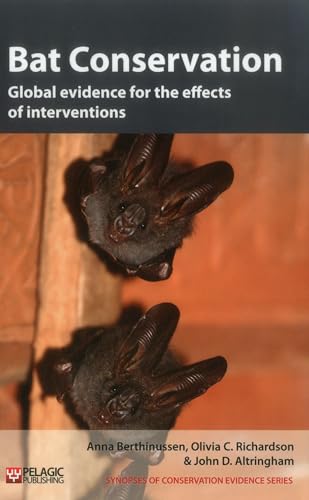
This book brings together scientific evidence and experience relevant to the practical conservation of bats. The authors worked with an international group of bat experts and conservationists to develop a global list of interventions that could benefit bats. For each intervention, the book summarises studies captured by the Conservation Evidence project, where that intervention has been tested and its effects on bats quantified. The result is a thorough guide to what is known, or not known, about the effectiveness of bat conservation actions throughout the world. Bat Conservation is the fifth in a series of Synopses that will cover different species groups and habitats, gradually building into a comprehensive summary of evidence on the effects of conservation interventions for all biodiversity throughout the world. By making evidence accessible in this way, we hope to enable a change in the practice of conservation, so it can become more evidence-based. We also aim to highlight where there are gaps in knowledge. Evidence from all around the world is included. If there appears to be a bias towards evidence from northern European or North American temperate environments, this reflects a current bias in the published research that is available to us. Conservation interventions are grouped primarily according to the relevant direct threats, as defined in the International Union for the Conservation of Nature (IUCN)'s Unified Classification of Direct Threats (www.iucnredlist.org/technical-documents/classification-schemes).
Die Inhaltsangabe kann sich auf eine andere Ausgabe dieses Titels beziehen.
Über die Autorin bzw. den Autor
Anna Berthinussen is a post-doctorate researcher at the University of Leeds, currently working on a Defra-funded study of the interactions between bats and roads. She holds degrees in bat ecology and conservation (PhD) and Zoology (BSc), both from the University of Leeds. She has published several scientific papers and contributed to book chapters on bats, and has a keen interest in wildlife conservation.
Olivia Richardson is a conservation ecologist who has recently been working as a Research Assistant and an ecological consultant. She holds degrees in Biodiversity and Conservation (MSc) and Biology (BSc with Honours), both from the University of Leeds. She is a former British Ecological Society Education, Training and Careers committee member and Undergraduate Fellow alumni. Her
research interests include bat conservation, urban ecology, citizen science and applied ecology and its translation into policy and practice.
John Altringham is Professor of Animal Ecology & Conservation at the University
of Leeds. He works primarily on the ecology and conservation of bats, but has
broad interests in conservation. In the past he has studied animals as diverse
as tunas and tarantulas. He is the author of numerous scientific papers and
reports, and three books on bats, the most recent being Bats, from evolution to
conservation, published by OUP in 2011. He is a scientific advisor to the National
Trust and other conservation organisations.
Auszug. © Genehmigter Nachdruck. Alle Rechte vorbehalten.
Bat Conservation
Global Evidence for the Effects of Interventions
By Anna Berthinussen, Olivia C. Richardson, John D. AltringhamPelagic Publishing
Copyright © 2014 William J. Sutherland
All rights reserved.
ISBN: 978-1-907807-90-9All rights reserved.
Contents
Advisory board, ix,
About the authors, x,
Acknowledgements, xi,
About this book, xiii,
1 Threat: Residential and commercial development, 1,
2 Threat: Agriculture, 6,
3 Threat: Energy production – wind turbines, 16,
4 Threat: Energy production – mining, 24,
5 Threat: Transportation and service corridors, 25,
6 Threat: Biological resource use, 32,
7 Threat: Human disturbance – caving and tourism, 48,
8 Threat: Natural system modification – natural fire and fire suppression, 54,
9 Threat: Invasive species and disease, 58,
10 Threat: Pollution, 63,
11 Providing artificial roost structures for bats, 70,
12 Education and awareness raising, 79,
Index, 81,
CHAPTER 1
Threat: Residential and commercial development
Key messages
Conserve existing roosts within developments
We found no evidence for the effects of interventions to conserve existing roosts within developments.
Retain or relocate access points to bat roosts
We found no evidence for the effects of interventions to retain or relocate access points to bat roosts within developments.
Create alternative roosts within buildings
We found no evidence for the effects of interventions to provide alternative roosts within buildings.
Change timing of building works
We found no evidence for the effects of changing the timing of building works on bats.
Conserve old buildings or structures as roosting sites for bats
We found no evidence for the effects of conserving old buildings or structures as roosting sites for bats.
Maintain bridges and retain crevices for roosting
We found no evidence for the effects of maintaining old bridges and retaining crevices for roosting bats.
Protect brownfield sites
One study in the USA found bat activity within an urban wildlife refuge on an abandoned manufacturing site to be consistent with predictions across North America based on the availability of potential roosts.
Provide foraging habitat in urban areas
One site comparison study in the USA found higher bat activity in restored forest preserves in urban areas than in an unrestored forest preserve. One replicated, controlled, site comparison study in the UK found higher bat activity over green roofs in urban areas than conventional unvegetated roofs.
Retain or replace existing bat commuting routes
We found no evidence for the effects of retaining or replacing the original commuting routes of bats lost to residential or commercial development.
1.1 Conserve existing roosts within developments
• We found no evidence for the effects of interventions to conserve existing roosts within residential or commercial developments.
1.2 Retain or relocate access points to bat roosts
• We found no evidence for the effects of interventions to either retain or relocate access points to bat roosts within developments.
1.3 Create alternative roosts within buildings
• We found no evidence for the effects of interventions to provide alternative roosts within buildings.
1.4 Change timing of building works
• We found no evidence for the effects of changing the timing of building works on bats.
1.5 Conserve old buildings or structures as roosting sites for bats
• We found no evidence for the effects of conserving old buildings or structures as roosting sites for bats.
1.6 Maintain bridges and retain crevices for roosting
• We found no evidence for the effects of interventions to maintain old bridges used as roosts by bats, or to retain crevices within them used as access points.
1.7 Protect brownfield sites
• One study in Denver, USA found that the number and evenness of bat species within an urban wildlife refuge on an abandoned manufacturing site was consistent with predictions across North America based on the availability of potential roosts.
A study in 1997 and 1998 in an urban wildlife refuge on the grounds of a former weapons manufacturing facility near Denver in the USA (1) found that the number and evenness of bat species was consistent with predictions across North America based on the availability of potential roosts. Details of the predictions are not given but the authors state that as expected from the availability of roosts (in a few dead trees and an abundance of buildings), three tree-roosting species and two species known to roost in buildings were captured or recorded, with big brown bats Eptesicus fuscus (common in urban areas) making up 86% of the captures. In total, 176 bats were captured and 955 bat passes were recorded. Activity was more than five times greater in areas of the refuge with tree or water habitat edges than in open prairie. Big brown bats commuted further from roosts in buildings within surrounding urban areas to the refuge (9–19 km) than typically reported for the species elsewhere (1–2 km). Bats were captured over two years from May to August on 53 nights at 18 sites. Mist nets were set up over water or by trees and shrubs within the refuge. Twelve big brown bats were captured and radio-tagged in 1998. Echolocation activity was recorded using bat detectors at eight sites with different habitat types within the refuge. Each site was sampled for a total of 90 minutes on 3–4 nights between June and August 1997. The chemical weapons facility was active up until 1985, and the site was designated and protected as a wildlife refuge with the passing of an Act in 1992. The refuge covers 6,900 ha consisting of grassland with scattered woodland and wetlands. It borders an urban area with a population of two million people, as well as industrial and agricultural land.
1.8 Provide foraging habitat in urban areas
• One site comparison study in the USA found higher bat activity in restored forest preserves in urban areas than in an unrestored forest preserve. Different species responded differently to the changes in forest structure.
• One replicated, controlled, site comparison study in the UK found significantly higher bat activity and more bat feeding events over green roofs in urban areas than conventional unvegetated roofs.
In a site comparison study in 2004–2005 in nine forest preserves within the Chicago metropolitan area, USA (1) the highest bat activity was recorded in two preserves that had undergone restoration with multiple prescribed burns, invasive plant species removal and snag recruitment (average 19 and 16 bat passes/preserve in 2004, average 7 and 18 bat passes/preserve in 2005). The lowest bat activity was recorded in a control site with no restoration (both years average one bat pass in total). Overall bat activity at all sites was positively related to prescribed burning, invasive species removal and small tree density (8–20 cm diameter at breast height) and negatively related to shrub density and clutter at heights of 0–6 m above the ground. Responses to woodland restoration varied among bat species. The eastern red bat Lasiurus borealis was...
„Über diesen Titel“ kann sich auf eine andere Ausgabe dieses Titels beziehen.
Suchergebnisse für Bat Conservation: Global evidence for the effects of...

Foto des Verkäufers
Bat Conservation : Global Evidence for the Effects of Interventions
Anbieter: GreatBookPrices, Columbia, MD, USA
Verkäuferbewertung 5 von 5 Sternen

Zustand: As New. Unread book in perfect condition. Bestandsnummer des Verkäufers 21580702
Gebraucht kaufen
EUR 52,81
EUR 2,26 Versand
Versand innerhalb von USA
Versand innerhalb von USA
Anzahl: Mehr als 20 verfügbar
Beispielbild für diese ISBN
Bat Conservation : Global Evidence for the Effects of Interventions
Anbieter: GreatBookPrices, Columbia, MD, USA
Verkäuferbewertung 5 von 5 Sternen
Zustand: New. Bestandsnummer des Verkäufers 21580702-n
Neu kaufen
EUR 52,86
EUR 2,26 Versand
Versand innerhalb von USA
Versand innerhalb von USA
Anzahl: Mehr als 20 verfügbar
Beispielbild für diese ISBN
BAT CONSERVATION: GLOBAL EVIDENCE VOL 5 Format: Hardcover
Anbieter: INDOO, Avenel, NJ, USA
Verkäuferbewertung 5 von 5 Sternen
Zustand: As New. Unread copy in mint condition. Bestandsnummer des Verkäufers SS9781907807909
Gebraucht kaufen
EUR 55,15
Versand gratis
Versand innerhalb von USA
Versand innerhalb von USA
Anzahl: Mehr als 20 verfügbar
Beispielbild für diese ISBN
BAT CONSERVATION: GLOBAL EVIDENCE VOL 5 Format: Hardcover
Anbieter: INDOO, Avenel, NJ, USA
Verkäuferbewertung 5 von 5 Sternen
Zustand: New. Bestandsnummer des Verkäufers 9781907807909
Neu kaufen
EUR 55,16
Versand gratis
Versand innerhalb von USA
Versand innerhalb von USA
Anzahl: Mehr als 20 verfügbar
Beispielbild für diese ISBN
Bat Conservation
Anbieter: PBShop.store US, Wood Dale, IL, USA
Verkäuferbewertung 5 von 5 Sternen
HRD. Zustand: New. New Book. Shipped from UK. Established seller since 2000. Bestandsnummer des Verkäufers CX-9781907807909
Beispielbild für diese ISBN
Bat Conservation
Anbieter: PBShop.store UK, Fairford, GLOS, Vereinigtes Königreich
Verkäuferbewertung 5 von 5 Sternen
HRD. Zustand: New. New Book. Shipped from UK. Established seller since 2000. Bestandsnummer des Verkäufers CX-9781907807909
Neu kaufen
EUR 56,28
EUR 4,86 Versand
Versand von Vereinigtes Königreich nach USA
Versand von Vereinigtes Königreich nach USA
Anzahl: 15 verfügbar
Beispielbild für diese ISBN
Bat Conservation (Hardcover)
Anbieter: Grand Eagle Retail, Bensenville, IL, USA
Verkäuferbewertung 5 von 5 Sternen
Hardcover. Zustand: new. Hardcover. This book brings together scientific evidence and experience relevant to the practical conservation of bats. The authors worked with an international group of bat experts and conservationists to develop a global list of interventions that could benefit bats.For each intervention, the book summarises studies captured by the Conservation Evidence project, where that intervention has been tested and its effects on bats quantified. The result is a thorough guide to what is known, or not known, about the effectiveness of bat conservation actions throughout the world.Bat Conservation is the fifth in a series of Synopses that will cover different species groups and habitats, gradually building into a comprehensive summary of evidence on the effects of conservation interventions for all biodiversity throughout the world.By making evidence accessible in this way, we hope to enable a change in the practice of conservation, so it can become more evidence-based. We also aim to highlight where there are gaps in knowledge.Evidence from all around the world is included. If there appears to be a bias towards evidence from northern European or North American temperate environments, this reflects a current bias in the published research that is available to us. Conservation interventions are grouped primarily according to the relevant direct threats, as defined in the International Union for the Conservation of Nature (IUCN)s Unified Classification of Direct Threats . This book brings together scientific evidence and experience relevant to the practical conservation of bats. The authors have developed a global list of interventions that could benefit bats. For each intervention, the book summarises studies captured by the Conservation Evidence project. Shipping may be from multiple locations in the US or from the UK, depending on stock availability. Bestandsnummer des Verkäufers 9781907807909
Foto des Verkäufers
Bat Conservation : Global Evidence for the Effects of Interventions
Anbieter: GreatBookPricesUK, Woodford Green, Vereinigtes Königreich
Verkäuferbewertung 5 von 5 Sternen
Zustand: New. Bestandsnummer des Verkäufers 21580702-n
Neu kaufen
EUR 56,26
EUR 17,51 Versand
Versand von Vereinigtes Königreich nach USA
Versand von Vereinigtes Königreich nach USA
Anzahl: Mehr als 20 verfügbar
Beispielbild für diese ISBN
Bat Conservation: Global evidence for the effects of interventions
Anbieter: THE SAINT BOOKSTORE, Southport, Vereinigtes Königreich
Verkäuferbewertung 5 von 5 Sternen
Hardback. Zustand: New. New copy - Usually dispatched within 4 working days. Bestandsnummer des Verkäufers B9781907807909
Neu kaufen
EUR 69,68
EUR 16,72 Versand
Versand von Vereinigtes Königreich nach USA
Versand von Vereinigtes Königreich nach USA
Anzahl: Mehr als 20 verfügbar
Beispielbild für diese ISBN
Bat Conservation: Global evidence for the effects of interventions (Synopses of Conservation Evidence) (Vol)
Anbieter: Ria Christie Collections, Uxbridge, Vereinigtes Königreich
Verkäuferbewertung 5 von 5 Sternen
Zustand: New. In. Bestandsnummer des Verkäufers ria9781907807909_new
Neu kaufen
EUR 74,93
EUR 13,98 Versand
Versand von Vereinigtes Königreich nach USA
Versand von Vereinigtes Königreich nach USA
Anzahl: Mehr als 20 verfügbar