
Verwandte Artikel zu Lessons Not Learned: 10 Steps to Stable Financial Markets
Inhaltsangabe
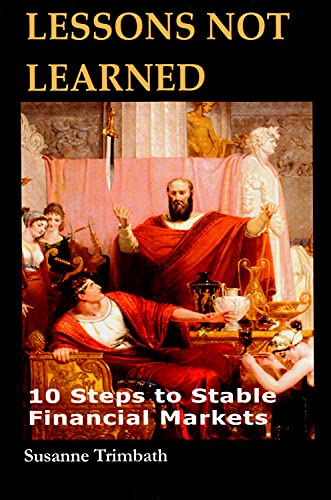
Much has been written and spoken about the lessons learned from the financial crisis of 2009. This book deals with the lessons not learned beforethe financial crisis.
Dr Trimbath demonstrates that an existing framework for regulating financial systems, available since at least 2001, could have prevented the systemic failure in the US that led to the collapse of global credit markets in 2008. Step by step the book guides you through what could have been done to prevent the crisis and what investors can do to protect themselves from the next one, and concludes with a key idea for making financial services businesses stand out from the crowd ensuring future success.
The list of 10 Steps is quite straight-forward and simple.
- Have private, independent rating agencies.
- Provide some government safety net but not so much that banks are not held accountable (""Too Big to Fail"")
- Allow very little government ownership and control of national financial assets.
- Allow banks to reduce the volatility of returns by offering a wide-range of services.
- Require financial market players to register and be authorized.
- Provide information, including setting standards, to enhance market transparency.
- Routinely examine financial institutions to ensure that the regulatory code is obeyed.
- Enforce the code and discipline transgressors.
- Develop policies that keep the regulatory code up to date.
- Encourage the creation of specialized financial institutions.
For each step the reader will find: the legislative and regulatory background on the existing rules; a review of academic research on the theory behind each step; and the facts and data connecting each step to the financial crisis of 2008.
Die Inhaltsangabe kann sich auf eine andere Ausgabe dieses Titels beziehen.
Über die Autorin bzw. den Autor
Susanne Trimbath
holds a Ph.D. in Economics from New York University and received her MBA in Management from Golden Gate University. Prior to forming STP Advisory Services, Dr. Trimbath was Senior Research Economist in Capital Studies at Milken Institute (Santa Monica, CA) and Senior Advisor on the Russian Capital Markets Project (USAID-funded) with KPMG in Moscow and St. Petersburg. She started her career in financial services operations at the Federal Reserve Bank of San Francisco. Since 1989, Dr. Trimbath has taught economics and finance in university graduate and undergraduate programs as adjunct, associate and full-time professor. Dr. Trimbath helped create the Transportation Performance Index for the U.S. Chamber of Commerce (Washington, D.C.) which she used to demonstrate the real economic payoff of investments in infrastructure.
Dr. Trimbath authored, edited and contributed chapters to five books, including Mergers and Efficiency (2002), Beyond Junk Bonds (2003), and Methodological Issues in Accounting Research (2006). Her media credits include appearances on national television and radio programs (CNBC's Power Lunch and NPR's Marketplace) and the Bloomberg report Phantom Shares. Dr. Trimbath's articles appear in the national publications US Banker, The International Economy, and The American Enterprise in addition to academic, peer-reviewed journals. Dr. Trimbath is a contributing editor at NewGeography.com.
„Über diesen Titel“ kann sich auf eine andere Ausgabe dieses Titels beziehen.
Suchergebnisse für Lessons Not Learned: 10 Steps to Stable Financial Markets

Foto des Verkäufers
Lessons Not Learned : 10 Steps to Stable Financial Markets
Anbieter: GreatBookPrices, Columbia, MD, USA
Verkäuferbewertung 5 von 5 Sternen

Zustand: New. Bestandsnummer des Verkäufers 24797528-n
Neu kaufen
EUR 56,76
EUR 2,35 Versand
Versand innerhalb von USA
Versand innerhalb von USA
Anzahl: 2 verfügbar
Foto des Verkäufers
Lessons not Learned
Anbieter: Rarewaves.com USA, London, LONDO, Vereinigtes Königreich
Verkäuferbewertung 5 von 5 Sternen
Hardback. Zustand: New. Much has been written and spoken about the lessons learned from the financial crisis of 2009. This book deals with the lessons not learned before the financial crisis.Dr Trimbath demonstrates that an existing framework for regulating financial systems, available since at least 2001, could have prevented the systemic failure in the US that led to the collapse of global credit markets in 2008. Step by step the book guides you through what could have been done to prevent the crisis and what investors can do to protect themselves from the next one, and concludes with a key idea for making financial services businesses stand out from the crowd ensuring future success.The list of 10 Steps is quite straight-forward and simple.Have private, independent rating agencies.Provide some government safety net but not so much that banks are not held accountable (""Too Big to Fail"")Allow very little government ownership and control of national financial assets.Allow banks to reduce the volatility of returns by offering a wide-range of services.Require financial market players to register and be authorized.Provide information, including setting standards, to enhance market transparency.Routinely examine financial institutions to ensure that the regulatory code is obeyed.Enforce the code and discipline transgressors.Develop policies that keep the regulatory code up to date.Encourage the creation of specialized financial institutions.For each step the reader will find: the legislative and regulatory background on the existing rules; a review of academic research on the theory behind each step; and the facts and data connecting each step to the financial crisis of 2008. Bestandsnummer des Verkäufers LU-9781910151242
Neu kaufen
EUR 59,19
Versand gratis
Versand von Vereinigtes Königreich nach USA
Versand von Vereinigtes Königreich nach USA
Anzahl: 1 verfügbar
Beispielbild für diese ISBN
Lessons not Learned
Anbieter: PBShop.store UK, Fairford, GLOS, Vereinigtes Königreich
Verkäuferbewertung 5 von 5 Sternen
HRD. Zustand: New. New Book. Shipped from UK. Established seller since 2000. Bestandsnummer des Verkäufers FW-9781910151242
Neu kaufen
EUR 55,03
EUR 6,96 Versand
Versand von Vereinigtes Königreich nach USA
Versand von Vereinigtes Königreich nach USA
Anzahl: 2 verfügbar
Beispielbild für diese ISBN
Lessons Not Learned: 10 Steps to Stable Financial Markets
Anbieter: Kennys Bookshop and Art Galleries Ltd., Galway, GY, Irland
Verkäuferbewertung 5 von 5 Sternen
Zustand: New. 2015. Illustrated. hardcover. . . . . . Bestandsnummer des Verkäufers V9781910151242
Neu kaufen
EUR 54,70
EUR 9,50 Versand
Versand von Irland nach USA
Versand von Irland nach USA
Anzahl: 1 verfügbar
Foto des Verkäufers
Lessons Not Learned : 10 Steps to Stable Financial Markets
Anbieter: GreatBookPrices, Columbia, MD, USA
Verkäuferbewertung 5 von 5 Sternen
Zustand: As New. Unread book in perfect condition. Bestandsnummer des Verkäufers 24797528
Gebraucht kaufen
EUR 65,72
EUR 2,35 Versand
Versand innerhalb von USA
Versand innerhalb von USA
Anzahl: 2 verfügbar
Foto des Verkäufers
Lessons not Learned
Anbieter: Rarewaves USA, HEBRON, KY, USA
Verkäuferbewertung 5 von 5 Sternen
Hardback. Zustand: New. Much has been written and spoken about the lessons learned from the financial crisis of 2009. This book deals with the lessons not learned before the financial crisis.Dr Trimbath demonstrates that an existing framework for regulating financial systems, available since at least 2001, could have prevented the systemic failure in the US that led to the collapse of global credit markets in 2008. Step by step the book guides you through what could have been done to prevent the crisis and what investors can do to protect themselves from the next one, and concludes with a key idea for making financial services businesses stand out from the crowd ensuring future success.The list of 10 Steps is quite straight-forward and simple.Have private, independent rating agencies.Provide some government safety net but not so much that banks are not held accountable (""Too Big to Fail"")Allow very little government ownership and control of national financial assets.Allow banks to reduce the volatility of returns by offering a wide-range of services.Require financial market players to register and be authorized.Provide information, including setting standards, to enhance market transparency.Routinely examine financial institutions to ensure that the regulatory code is obeyed.Enforce the code and discipline transgressors.Develop policies that keep the regulatory code up to date.Encourage the creation of specialized financial institutions.For each step the reader will find: the legislative and regulatory background on the existing rules; a review of academic research on the theory behind each step; and the facts and data connecting each step to the financial crisis of 2008. Bestandsnummer des Verkäufers LU-9781910151242
Beispielbild für diese ISBN
Lessons Not Learned 10 Steps to Stable Financial Markets
Anbieter: Revaluation Books, Exeter, Vereinigtes Königreich
Verkäuferbewertung 5 von 5 Sternen
Hardcover. Zustand: Brand New. 264 pages. 9.50x6.50x1.00 inches. In Stock. Bestandsnummer des Verkäufers __1910151246
Neu kaufen
EUR 56,17
EUR 14,82 Versand
Versand von Vereinigtes Königreich nach USA
Versand von Vereinigtes Königreich nach USA
Anzahl: 2 verfügbar
Foto des Verkäufers
Lessons Not Learned : 10 Steps to Stable Financial Markets
Anbieter: GreatBookPricesUK, Woodford Green, Vereinigtes Königreich
Verkäuferbewertung 5 von 5 Sternen
Zustand: New. Bestandsnummer des Verkäufers 24797528-n
Neu kaufen
EUR 60,20
EUR 17,79 Versand
Versand von Vereinigtes Königreich nach USA
Versand von Vereinigtes Königreich nach USA
Anzahl: 2 verfügbar
Beispielbild für diese ISBN
Lessons Not Learned: 10 Steps to Stable Financial Markets
Anbieter: Kennys Bookstore, Olney, MD, USA
Verkäuferbewertung 5 von 5 Sternen
Zustand: New. 2015. Illustrated. hardcover. . . . . . Books ship from the US and Ireland. Bestandsnummer des Verkäufers V9781910151242
Neu kaufen
EUR 71,75
EUR 9,34 Versand
Versand innerhalb von USA
Versand innerhalb von USA
Anzahl: 1 verfügbar
Beispielbild für diese ISBN
Lessons Not Learned: 10 Steps to Stable Financial Markets
Anbieter: THE SAINT BOOKSTORE, Southport, Vereinigtes Königreich
Verkäuferbewertung 5 von 5 Sternen
Hardback. Zustand: New. New copy - Usually dispatched within 4 working days. Bestandsnummer des Verkäufers B9781910151242
Neu kaufen
EUR 64,35
EUR 19,83 Versand
Versand von Vereinigtes Königreich nach USA
Versand von Vereinigtes Königreich nach USA
Anzahl: 3 verfügbar