
Verwandte Artikel zu Inri
Inhaltsangabe
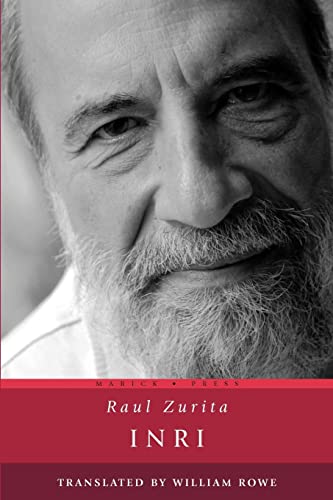
"INRI" responds to the need to find a language for an event that was kept hidden and excluded from official records in Chile: the fact that the bodies of the disappeared were thrown out of helicopters into the mouths of volcanoes and into the sea. In order to bring this event, which was neither seen nor heard, into language, Zurita invents a form and language capable of bringing it into the present. The one place where these unspeakable acts might be registered is in the landscape of Chile: the mountains, desert, and sea. There the event might begin to be touched, heard, and finally seen. When there are no places from which to speak, 'the stones cry out'. "INRI" is written as poetry without regular lines or metre. In the tradition of Whitman or Ginsberg's Howl, it works with long breaths and large blocks of meaning: intensities that overrun the usual measures of speech and syntax. To read it is to experience a strange force pulsing through the language, breaking apart its usual channels, and opening unseen and unheard zones.
Zurita, winner of the Chilean National Poetry Prize, is one of the best known poets of Latin America. His work is part of a revolution in poetic language that began in the 1970s and sought to find new forms of expression, radically different from those of Pablo Neruda. The challenge was to confront the contemporary epoch, with its particular forms of violence, including violence done to language. "INRI" is distinctive in that it does not speak out of individual sorrow, though this is not missing from the text, but seeks, rather, a new space, out of which love might be asserted as prime human reality, a space which might give birth to a different type of society.
Die Inhaltsangabe kann sich auf eine andere Ausgabe dieses Titels beziehen.
Über die Autorin bzw. den Autor
Raul Zurita, winner of the Chilean National Poetry Prize, is one of the best known poets of Latin America. His work is part of a revolution in poetic language, that began in the 1970s and sought to find new forms of expression, radically different from those of Pablo Neruda. The challenge was to confront the contemporary epoch, with its particular forms of violence, including violence done to language.
„Über diesen Titel“ kann sich auf eine andere Ausgabe dieses Titels beziehen.
Suchergebnisse für Inri

Foto des Verkäufers
INRI
Anbieter: GreatBookPrices, Columbia, MD, USA
Verkäuferbewertung 5 von 5 Sternen

Zustand: New. Bestandsnummer des Verkäufers 6903848-n
Neu kaufen
EUR 18,57
EUR 2,36 Versand
Versand innerhalb von USA
Versand innerhalb von USA
Anzahl: Mehr als 20 verfügbar
Foto des Verkäufers
Inri (Paperback or Softback)
Verlag:
Marick Press 4/30/2009, 2009
ISBN 10: 1934851043
ISBN 13: 9781934851043
Neu
Paperback or Softback
Anbieter: BargainBookStores, Grand Rapids, MI, USA
Verkäuferbewertung 5 von 5 Sternen
Paperback or Softback. Zustand: New. Inri. Book. Bestandsnummer des Verkäufers BBS-9781934851043
Foto des Verkäufers
INRI
Anbieter: GreatBookPrices, Columbia, MD, USA
Verkäuferbewertung 5 von 5 Sternen
Zustand: As New. Unread book in perfect condition. Bestandsnummer des Verkäufers 6903848
Gebraucht kaufen
EUR 19,61
EUR 2,36 Versand
Versand innerhalb von USA
Versand innerhalb von USA
Anzahl: Mehr als 20 verfügbar
Beispielbild für diese ISBN
INRI
Anbieter: Revaluation Books, Exeter, Vereinigtes Königreich
Verkäuferbewertung 5 von 5 Sternen
Paperback. Zustand: Brand New. 134 pages. 8.75x6.00x0.50 inches. In Stock. Bestandsnummer des Verkäufers x-1934851043
Neu kaufen
EUR 26,07
EUR 11,80 Versand
Versand von Vereinigtes Königreich nach USA
Versand von Vereinigtes Königreich nach USA
Anzahl: 2 verfügbar
Foto des Verkäufers
INRI
Anbieter: GreatBookPricesUK, Woodford Green, Vereinigtes Königreich
Verkäuferbewertung 5 von 5 Sternen
Zustand: As New. Unread book in perfect condition. Bestandsnummer des Verkäufers 6903848
Gebraucht kaufen
EUR 25,47
EUR 17,70 Versand
Versand von Vereinigtes Königreich nach USA
Versand von Vereinigtes Königreich nach USA
Anzahl: Mehr als 20 verfügbar
Beispielbild für diese ISBN
Inri
Anbieter: Harry Alter, Sylva, NC, USA
Verkäuferbewertung 5 von 5 Sternen
paperback, Zustand: Very Good, Marick Press, c.2009, trade paperbk.prtg., 135pp., NF $. Bestandsnummer des Verkäufers 105156
Gebraucht kaufen
EUR 41,38
EUR 3,53 Versand
Versand innerhalb von USA
Versand innerhalb von USA
Anzahl: 1 verfügbar
Foto des Verkäufers
INRI
Anbieter: GreatBookPricesUK, Woodford Green, Vereinigtes Königreich
Verkäuferbewertung 5 von 5 Sternen
Zustand: New. Bestandsnummer des Verkäufers 6903848-n
Neu kaufen
EUR 32,12
EUR 17,70 Versand
Versand von Vereinigtes Königreich nach USA
Versand von Vereinigtes Königreich nach USA
Anzahl: Mehr als 20 verfügbar
Foto des Verkäufers
INRI
Anbieter: moluna, Greven, Deutschland
Verkäuferbewertung 5 von 5 Sternen
Zustand: New. Über den AutorWilliam Rowe is Anniversary Professor of Poetics at Birkbeck College, University of London, and author of several books on Latin American Poetry.KlappentextA poetic account of an event that . Bestandsnummer des Verkäufers 905854705
Neu kaufen
EUR 22,83
EUR 48,99 Versand
Versand von Deutschland nach USA
Versand von Deutschland nach USA
Anzahl: Mehr als 20 verfügbar