
Verwandte Artikel zu Wintergreen: Rambles in a Ravaged Land
Inhaltsangabe
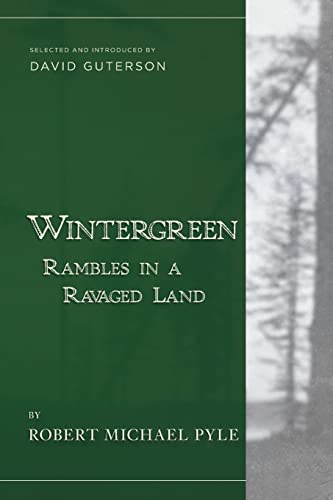
In the Willapa Hills of southwest Washington, both the human community and the forest community are threatened with extinction. Virtually every acre of the hills has been logged, often repeatedly, in the past hundred years, endangering both the land and the people, leaving dying towns as well as a devastated ecosystem. Weaving vivid portraits of the place and its inhabitants—animal, plant, and human—with the story of his own love affair with the hills, Robert Michael Pyle has written a book so even–handed in its passion that it has been celebrated by those who make their living with a chain saw as well as by environmentalists. As he writes, 'My sympathies lie with the people and the woods, but not with the companies that have used them both with equal disregard.
In his vivid portrayal of the land, plants, people and animals of the Willapa Hills of Washington State, Bob Pyle makes the modest patch of land he writes about a metaphor for the world.
Die Inhaltsangabe kann sich auf eine andere Ausgabe dieses Titels beziehen.
Über die Autorin bzw. den Autor
Robert Michael Pyle is the author of fourteen books, including Sky Time in Gray's River, Chasing Monarchs, Where Bigfoot Walks, and Wintergreen, which won the John Burroughs Medal. A Yale–trained ecologist and a Guggenheim fellow, he is a full–time writer living in southwestern Washington.
Auszug. © Genehmigter Nachdruck. Alle Rechte vorbehalten.
Introduction to Wintergreen
Wintergreen: Rambles in a Ravaged Land appeared in 1986—the year of Chernobyl, and a year after the discovery of a gaping ozone hole over Antarctica. A consummate work of natural history, it announced the arrival of a stylist with elan in a field where currents of castigation and warning sometimes give “nature writing” the tincture of sermonology. Wintergreen felt personable, even optimistic. It had no truck with doom and gloom. Its author was possessed—it seemed by nature—of a robust and general enthusiasm, and of a buoyant appreciation for the fact of living. It was easy to imagine Robert Michael Pyle cheerfully rambling in his ravaged land, the Willapa Hills of southwest Washington.
Imagine this I did, in 1986, while devouring Wintergreen cover-to-cover, a binge spurred by affinity and affirmation, or at least by recognition and identification, because here, at last, was a book about home, home as I knew it in my feet, so to speak, home as I loved and understood it. Other readers had described Pyle’s Willapa as a metaphor for global environmental duress—or for something that went unnamed and felt vague—but for me, everything there stood for itself. It fact it was precisely the book’s concrete bona fides—its familiar trilliums, skunk cabbage, and clearcuts—that made reading it feel so companionable.
Wintergreen took a place on my shelf alongside Robert L. Wood’s Olympic Mountains Trail Guide and my Climber’s Guide to the Olympic Mountains. I gave Wood’s guide to a young, lost rambler, the climber’s guide got chewed by voles, and Wintergreen went permanently borrowed. All three books have since been replaced, as has a fourth that, like the others, I pack regularly—Daniel Mathews’ Cascade-Olympic Natural History, a supremely accomplished trailside reference that is out of print but shouldn’t be.
Mathews’ book appeared in 1988, the same year Wintergreen was published in paperback under the sub-title Listening to the Land’s Heart. Listening to the Land’s Heart is no less alliterative then Rambles in a Ravaged Land, but it strikes a more self-consciously poetic note, perilously so—in my opinion—suggesting as it does a preciousness about nature that is entirely absent from the text. Wintergreen is, in its way, poetic, but its poetry is constructed of the raw and tangible, and Pyle, lacking the Romantic impulse, is assiduous in its pages to avoid animism. His Willapa is meaningful to the extent that it is real. Its actual waters run downhill. “Heaven is here,” Pyle has asserted, “angels are butterflies and bats, and the great beyond is the holy compost pile of the ages.”
I came of age in Seattle in the mid-Seventies, an era when it sagged on the bleak edge of null, portal to the North Pacific. “Seattle in the seventies was the nadir of just everything,” the superlative essayist Charles D’Ambrosio has written, and as his contemporary on that peculiar scene, I can attest that he’s hyperbolizing accurately. D’Ambrosio’s answer to the provincial doldrums was to cultivate an inner expatriation and to import his enthusiasms from more sophisticated locales beyond the pale of our rain. Trapped in the veritable outback of nowhere and feeling decidedly marginal, he became, he writes, “clever and scoffing, ironic, deracinated, cold and quick to despise.”
Young white guys in the Seattle of the mid-Seventies, given that they had the luxury, plied one of two pervasive personas—either D’Ambrosio’s Budding Expatriate, or my choice, Wilderness Romantic. I took to the hills whenever possible and eventually expatriated to a logging town where I went to work for the Forest Service in the spirit of Norman Maclean. This was during the heyday of clear-cutting, when mills ran 24 hours a day all over western Washington. I lived in a van, bathed occasionally in a river, read Gary Snyder, Edward Abbey, and John Muir, and while all of this was fundamentally delusional, it did get me rambling in a ravaged land.
For the Forest Service I toiled at “brush disposal,” which meant cleaning up, in nominal and egregious fashion, after gyppo loggers with contracts. They felled, bucked, dragged, loaded, and drove off with whole forests; we burned what they left behind, on the theory that a modulated conflagration was optimum for “reprod.” Our project never flagged. We lit up the sky on summer nights, adding scorched acreage to a running tally and sucking noxious smoke with pride. I fell so thoroughly in love with this folly that before long the Forest Service made me a crew boss. In clearcuts I was steeped, then. On slopes I cut my teeth. Eventually my initiation, with its ancient innocence motif, took me by its roundabout path into once, twice, and thrice logged hills, not the sterile hills inside my head but the living hills that, a decade later, I found again in Wintergreen.
There is a literature of regional affinity, and while its readership is by definition local, its value transcends its raw material. At its best it has a tempered, celebratory quality, or forwards a critique in tones of endearment, or with sad fondness acknowledges the constraints that bind us to provincial lives. Where changes are too much for locals to abide, it provides them with the balm of elegy, and gives what feels like testimony to their losses. I am thinking, here, in canonical terms, of Eudora Welty, Ernest Gaines, Edith Wharton, Hamlin Garland, Willa Cather, and Mari Sandoz—of all those quintessentially American fiction writers whose rootedness in place confirms our sense of home—and of nature writers like Wendell Berry, Terry Tempest Williams, Scott Russell Sanders, and Pyle, who mine home and place with a reach profoundly vertical (as opposed to the horizontal expansiveness of, for example, John Muir, Diane Ackerman, and Peter Matthiesen).
The good God is in the detail—apocryphal Flaubert—is a maxim understood by those nature writers who employ specificity to incite appreciation. A further and perhaps less noted function of the close rendering of the world’s raw facts is the sense it can elicit of a private affirmation—like mine on discovering Wintergreen—the concordance one feels in the presence of fellow travelers sharing one’s particular way-station. The action of this might be peripheral or corollary, but nature writers of the vertical variety nevertheless remind us that we’re not alone—that we share, with others, resonating spheres, internal and external worlds.
Art’s purpose, Tolstoy said, is to transfer feeling from one heart to another, or, as David Foster Wallace put it, “writing, at its best, is a bridge constructed across the abyss of human loneliness.” At the bottom of that abyss looms the three-headed Hydra of distance from “the other,” home, and nature. Wintergreen expressly addresses nature, but implicit in its pages is an address, too, of this tripartite and disabling loneliness.
Prior to Wintergreen, Pyle had published 6 books, all of them about butterflies. Subsequent to it he has published 11 more, including, The Thunder Tree: Lessons from an Urban Wildland, Sky Time in Gray’s River: Living for Keeps in a Forgotten Place, and, most recently, the poetry collection Evolution of the Genus Iris. There have also been more butterfly books, most pressing ambitiously beyond the early field guides, like Nabokov’s Butterflies, which Pyle edited with Brian Boyd. The body of work coheres in the sense that the voice on the page remains affable and the authorial sensibility steadfast; there isn’t much inflection over time....
Wintergreen: Rambles in a Ravaged Land appeared in 1986—the year of Chernobyl, and a year after the discovery of a gaping ozone hole over Antarctica. A consummate work of natural history, it announced the arrival of a stylist with elan in a field where currents of castigation and warning sometimes give “nature writing” the tincture of sermonology. Wintergreen felt personable, even optimistic. It had no truck with doom and gloom. Its author was possessed—it seemed by nature—of a robust and general enthusiasm, and of a buoyant appreciation for the fact of living. It was easy to imagine Robert Michael Pyle cheerfully rambling in his ravaged land, the Willapa Hills of southwest Washington.
Imagine this I did, in 1986, while devouring Wintergreen cover-to-cover, a binge spurred by affinity and affirmation, or at least by recognition and identification, because here, at last, was a book about home, home as I knew it in my feet, so to speak, home as I loved and understood it. Other readers had described Pyle’s Willapa as a metaphor for global environmental duress—or for something that went unnamed and felt vague—but for me, everything there stood for itself. It fact it was precisely the book’s concrete bona fides—its familiar trilliums, skunk cabbage, and clearcuts—that made reading it feel so companionable.
Wintergreen took a place on my shelf alongside Robert L. Wood’s Olympic Mountains Trail Guide and my Climber’s Guide to the Olympic Mountains. I gave Wood’s guide to a young, lost rambler, the climber’s guide got chewed by voles, and Wintergreen went permanently borrowed. All three books have since been replaced, as has a fourth that, like the others, I pack regularly—Daniel Mathews’ Cascade-Olympic Natural History, a supremely accomplished trailside reference that is out of print but shouldn’t be.
Mathews’ book appeared in 1988, the same year Wintergreen was published in paperback under the sub-title Listening to the Land’s Heart. Listening to the Land’s Heart is no less alliterative then Rambles in a Ravaged Land, but it strikes a more self-consciously poetic note, perilously so—in my opinion—suggesting as it does a preciousness about nature that is entirely absent from the text. Wintergreen is, in its way, poetic, but its poetry is constructed of the raw and tangible, and Pyle, lacking the Romantic impulse, is assiduous in its pages to avoid animism. His Willapa is meaningful to the extent that it is real. Its actual waters run downhill. “Heaven is here,” Pyle has asserted, “angels are butterflies and bats, and the great beyond is the holy compost pile of the ages.”
I came of age in Seattle in the mid-Seventies, an era when it sagged on the bleak edge of null, portal to the North Pacific. “Seattle in the seventies was the nadir of just everything,” the superlative essayist Charles D’Ambrosio has written, and as his contemporary on that peculiar scene, I can attest that he’s hyperbolizing accurately. D’Ambrosio’s answer to the provincial doldrums was to cultivate an inner expatriation and to import his enthusiasms from more sophisticated locales beyond the pale of our rain. Trapped in the veritable outback of nowhere and feeling decidedly marginal, he became, he writes, “clever and scoffing, ironic, deracinated, cold and quick to despise.”
Young white guys in the Seattle of the mid-Seventies, given that they had the luxury, plied one of two pervasive personas—either D’Ambrosio’s Budding Expatriate, or my choice, Wilderness Romantic. I took to the hills whenever possible and eventually expatriated to a logging town where I went to work for the Forest Service in the spirit of Norman Maclean. This was during the heyday of clear-cutting, when mills ran 24 hours a day all over western Washington. I lived in a van, bathed occasionally in a river, read Gary Snyder, Edward Abbey, and John Muir, and while all of this was fundamentally delusional, it did get me rambling in a ravaged land.
For the Forest Service I toiled at “brush disposal,” which meant cleaning up, in nominal and egregious fashion, after gyppo loggers with contracts. They felled, bucked, dragged, loaded, and drove off with whole forests; we burned what they left behind, on the theory that a modulated conflagration was optimum for “reprod.” Our project never flagged. We lit up the sky on summer nights, adding scorched acreage to a running tally and sucking noxious smoke with pride. I fell so thoroughly in love with this folly that before long the Forest Service made me a crew boss. In clearcuts I was steeped, then. On slopes I cut my teeth. Eventually my initiation, with its ancient innocence motif, took me by its roundabout path into once, twice, and thrice logged hills, not the sterile hills inside my head but the living hills that, a decade later, I found again in Wintergreen.
There is a literature of regional affinity, and while its readership is by definition local, its value transcends its raw material. At its best it has a tempered, celebratory quality, or forwards a critique in tones of endearment, or with sad fondness acknowledges the constraints that bind us to provincial lives. Where changes are too much for locals to abide, it provides them with the balm of elegy, and gives what feels like testimony to their losses. I am thinking, here, in canonical terms, of Eudora Welty, Ernest Gaines, Edith Wharton, Hamlin Garland, Willa Cather, and Mari Sandoz—of all those quintessentially American fiction writers whose rootedness in place confirms our sense of home—and of nature writers like Wendell Berry, Terry Tempest Williams, Scott Russell Sanders, and Pyle, who mine home and place with a reach profoundly vertical (as opposed to the horizontal expansiveness of, for example, John Muir, Diane Ackerman, and Peter Matthiesen).
The good God is in the detail—apocryphal Flaubert—is a maxim understood by those nature writers who employ specificity to incite appreciation. A further and perhaps less noted function of the close rendering of the world’s raw facts is the sense it can elicit of a private affirmation—like mine on discovering Wintergreen—the concordance one feels in the presence of fellow travelers sharing one’s particular way-station. The action of this might be peripheral or corollary, but nature writers of the vertical variety nevertheless remind us that we’re not alone—that we share, with others, resonating spheres, internal and external worlds.
Art’s purpose, Tolstoy said, is to transfer feeling from one heart to another, or, as David Foster Wallace put it, “writing, at its best, is a bridge constructed across the abyss of human loneliness.” At the bottom of that abyss looms the three-headed Hydra of distance from “the other,” home, and nature. Wintergreen expressly addresses nature, but implicit in its pages is an address, too, of this tripartite and disabling loneliness.
Prior to Wintergreen, Pyle had published 6 books, all of them about butterflies. Subsequent to it he has published 11 more, including, The Thunder Tree: Lessons from an Urban Wildland, Sky Time in Gray’s River: Living for Keeps in a Forgotten Place, and, most recently, the poetry collection Evolution of the Genus Iris. There have also been more butterfly books, most pressing ambitiously beyond the early field guides, like Nabokov’s Butterflies, which Pyle edited with Brian Boyd. The body of work coheres in the sense that the voice on the page remains affable and the authorial sensibility steadfast; there isn’t much inflection over time....
„Über diesen Titel“ kann sich auf eine andere Ausgabe dieses Titels beziehen.
Suchergebnisse für Wintergreen: Rambles in a Ravaged Land

Foto des Verkäufers
Wintergreen: Rambles in a Ravaged Land
Anbieter: Goodwill Books, Hillsboro, OR, USA
Verkäuferbewertung 5 von 5 Sternen

Zustand: acceptable. Fairly worn, but readable and intact. If applicable: Dust jacket, disc or access code may not be included. Bestandsnummer des Verkäufers GICWV.1940436230.A
Gebraucht kaufen
EUR 3,10
EUR 3,55 Versand
Versand innerhalb von USA
Versand innerhalb von USA
Anzahl: 1 verfügbar
Beispielbild für diese ISBN
Wintergreen: Rambles in a Ravaged Land
Anbieter: World of Books (was SecondSale), Montgomery, IL, USA
Verkäuferbewertung 5 von 5 Sternen
Paperback. Zustand: Good. In the Willapa Hills of southwest Washington, both the human community and the forest community are threatened with extinction. Virtually every acre of the hills has been logged, often repeatedly, in the past hundred years, endangering both the land and the people, leaving dying towns as well as a devastated ecosystem. Weaving vivid portraits of the place and its inhabitants-animal, plant, and human-with the story of his own love affair with the hills, Robert Michael Pyle has written a book so even-handed in its passion that it has been celebrated by those who make their living with a chain saw as well as by environmentalists. As he writes, 'My sympathies lie with the people and the woods, but not with the companies that have used them both with equal disregard. In his vivid portrayal of the land, plants, people and animals of the Willapa Hills of Washington State, Bob Pyle makes the modest patch of land he writes about a metaphor for the world. Bestandsnummer des Verkäufers 00099929011
Gebraucht kaufen
EUR 6,74
Versand gratis
Versand innerhalb von USA
Versand innerhalb von USA
Anzahl: 1 verfügbar
Beispielbild für diese ISBN
Wintergreen: Rambles in a Ravaged Land
Anbieter: ThriftBooks-Atlanta, AUSTELL, GA, USA
Verkäuferbewertung 5 von 5 Sternen
Paperback. Zustand: As New. No Jacket. Pages are clean and are not marred by notes or folds of any kind. ~ ThriftBooks: Read More, Spend Less. Bestandsnummer des Verkäufers G1940436230I2N00
Gebraucht kaufen
EUR 6,75
Versand gratis
Versand innerhalb von USA
Versand innerhalb von USA
Anzahl: 1 verfügbar
Beispielbild für diese ISBN
Wintergreen: Rambles in a Ravaged Land
Anbieter: World of Books Inc, Montgomery, IL, USA
Verkäuferbewertung 4 von 5 Sternen

Paperback. Zustand: Good. In the Willapa Hills of southwest Washington, both the human community and the forest community are threatened with extinction. Virtually every acre of the hills has been logged, often repeatedly, in the past hundred years, endangering both the land and the people, leaving dying towns as well as a devastated ecosystem. Weaving vivid portraits of the place and its inhabitants-animal, plant, and human-with the story of his own love affair with the hills, Robert Michael Pyle has written a book so even-handed in its passion that it has been celebrated by those who make their living with a chain saw as well as by environmentalists. As he writes, 'My sympathies lie with the people and the woods, but not with the companies that have used them both with equal disregard. In his vivid portrayal of the land, plants, people and animals of the Willapa Hills of Washington State, Bob Pyle makes the modest patch of land he writes about a metaphor for the world. Bestandsnummer des Verkäufers CIN1940436230G
Gebraucht kaufen
EUR 8,57
Versand gratis
Versand innerhalb von USA
Versand innerhalb von USA
Anzahl: 1 verfügbar
Beispielbild für diese ISBN
Wintergreen : Rambles in a Ravaged Land
Anbieter: Better World Books: West, Reno, NV, USA
Verkäuferbewertung 5 von 5 Sternen
Zustand: Very Good. Pages intact with possible writing/highlighting. Binding strong with minor wear. Dust jackets/supplements may not be included. Stock photo provided. Product includes identifying sticker. Better World Books: Buy Books. Do Good. Bestandsnummer des Verkäufers 5923648-75
Gebraucht kaufen
EUR 10,22
Versand gratis
Versand innerhalb von USA
Versand innerhalb von USA
Anzahl: 1 verfügbar
Beispielbild für diese ISBN
Wintergreen: Rambles in a Ravaged Land
Verlag:
Pharos Editions, Berkeley, California, 2015
ISBN 10: 1940436230
ISBN 13: 9781940436234
Gebraucht
Soft cover
Signiert
Anbieter: The Book Shelf, Salem, OR, USA
Verkäuferbewertung 5 von 5 Sternen
Soft cover. Zustand: Near Fine. Signed by the author on the title-page. New edition with an introduction by David Guterson. Clean unmarked copy, solid binding, close to new. Signed by Author(s). Bestandsnummer des Verkäufers 015864
Gebraucht kaufen
EUR 9,16
EUR 6,22 Versand
Versand innerhalb von USA
Versand innerhalb von USA
Anzahl: 1 verfügbar
Beispielbild für diese ISBN
Wintergreen: Rambles in a Ravaged Land
Anbieter: Lakeside Books, Benton Harbor, MI, USA
Verkäuferbewertung 5 von 5 Sternen
Zustand: New. Brand New! Not Overstocks or Low Quality Book Club Editions! Direct From the Publisher! We're not a giant, faceless warehouse organization! We're a small town bookstore that loves books and loves it's customers! Buy from Lakeside Books! Bestandsnummer des Verkäufers OTF-S-9781940436234
Neu kaufen
EUR 13,15
EUR 3,55 Versand
Versand innerhalb von USA
Versand innerhalb von USA
Anzahl: Mehr als 20 verfügbar
Foto des Verkäufers
Wintergreen : Rambles in a Ravaged Land
Anbieter: GreatBookPrices, Columbia, MD, USA
Verkäuferbewertung 5 von 5 Sternen
Zustand: New. Bestandsnummer des Verkäufers 24670645-n
Neu kaufen
EUR 14,38
EUR 2,35 Versand
Versand innerhalb von USA
Versand innerhalb von USA
Anzahl: Mehr als 20 verfügbar
Foto des Verkäufers
Wintergreen: Rambles in a Ravaged Land (Paperback or Softback)
Verlag:
Pharos Editions 10/13/2015, 2015
ISBN 10: 1940436230
ISBN 13: 9781940436234
Neu
Paperback or Softback
Anbieter: BargainBookStores, Grand Rapids, MI, USA
Verkäuferbewertung 5 von 5 Sternen
Paperback or Softback. Zustand: New. Wintergreen: Rambles in a Ravaged Land. Book. Bestandsnummer des Verkäufers BBS-9781940436234
Foto des Verkäufers
Wintergreen : Rambles in a Ravaged Land
Anbieter: GreatBookPrices, Columbia, MD, USA
Verkäuferbewertung 5 von 5 Sternen
Zustand: As New. Unread book in perfect condition. Bestandsnummer des Verkäufers 24670645
Gebraucht kaufen
EUR 16,55
EUR 2,35 Versand
Versand innerhalb von USA
Versand innerhalb von USA
Anzahl: Mehr als 20 verfügbar