
Verwandte Artikel zu The Four Gospels: Commentary on the Holy Scriptures...
The Four Gospels: Commentary on the Holy Scriptures of the New Testament (1) - Hardcover
Buch 1 von 3: Commentary on the Holy Scriptures of the New Testament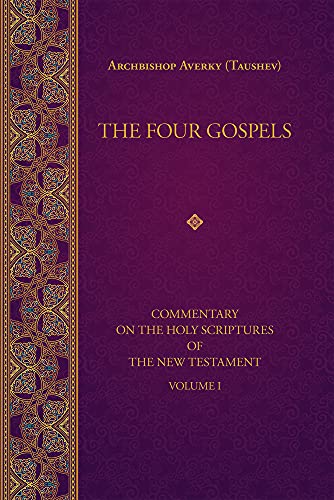
Inhaltsangabe
Writing in the tradition of biblical exegetes, such as St John Chrysostom and Blessed Theophylact of Bulgaria, the work of Archbishop Averky (Taushev) provides a commentary that is firmly grounded in the teaching of the Church, manifested in its liturgical hymnography and the works of the Holy Fathers. Analyzing all four Gospels chronologically and simultaneously, he allows readers to see the life of Christ as an unfolding narrative in accessible, direct language. Using the best of prerevolutionary Russian sources, these writings also remained abreast of developments in Western biblical scholarship, engaging with it directly and honestly. He approaches the Gospels first and foremost not as a literary work of antiquity, but as the revelation of Jesus Christ as God in the flesh. Archbishop Averky’s commentaries on the New Testament have become standard textbooks in Holy Trinity Orthodox Seminary and have been published in Russia to widespread acclaim. This present volume is the first translation of these texts into English and it is an indispensable addition to the library of every student of the Gospels.
Die Inhaltsangabe kann sich auf eine andere Ausgabe dieses Titels beziehen.
Über die Autorin bzw. den Autor
Archbishop Averky (Taushev) (1906–1976) was born in Imperial Russia and taught and served throughout Europe before being assigned to teach at the Holy Trinity Seminary in New York in 1951 and became the abbot of Holy Trinity Monastery in 1960. As abbot and rector, he was heavily involved in the formation of the seminary curriculum and the daily life of the seminarians and monks. He became well known among Orthodox Christians for his staunch defense of his Church's faith and traditions. Nicholas Kotar is a graduate of Holy Trinity Seminary and an assistant editor at Holy Trinity Publications. He is a founding member of Conquering Time, an ensemble of artists inspired by the Inklings that stages original works of storytelling and traditional music and publishes new poetry and prose. He lives in Jordanville, New York.
Auszug. © Genehmigter Nachdruck. Alle Rechte vorbehalten.
The Four Gospels
Commentary on the Holy Scriptures of the New Testament Volume I
By Averky (Taushev), Nicholas KotarHoly Trinity Publications
Copyright © 2015 Holy Trinity Monastery
All rights reserved.
ISBN: 978-1-942699-00-2All rights reserved.
Contents
Preface,
Introduction: The New Testament, the Four Gospels, and a General Explanation,
1. The Coming into the World of the Lord Jesus Christ,
2. The Public Ministry of the Lord Jesus Christ: Events of His Life Before the First Passover,
3. The First Passover of the Public Ministry of the Lord Jesus Christ,
4. The Second Passover of Public Ministry of the Lord Jesus Christ,
5. The Third Passover of the Lord Jesus Christ's Public Ministry,
6. The Last Days of the Earthly Life of the Lord Jesus Christ,
7. The Resurrection of Our Lord Jesus Christ,
Sources,
Notes,
Subject Index,
Scripture Index,
CHAPTER 1
The Coming into the World of the Lord Jesus Christ
The Introduction to the Gospel: Its Veracity and Purpose
(Luke 1:1–4; John 20:31)
One may consider the introduction to the entire four-Gospel corpus to be the first four verses of the first chapter of the Gospel according to Luke, in which the Evangelist speaks of his careful investigation of all the eyewitness accounts and the purpose of writing the Gospel in the first place: that everyone may know the firm foundation of the Christian teaching. St John also adds: "that you may believe that Jesus is the Christ, the Son of God, and that believing you may have life in His name" (John 20:31).
Thus, St Luke began to write his Gospel because there were already several similar accounts written that were not sufficiently authoritative or convincing in their content, and he considered it his duty to write an account of the life of the Lord Jesus Christ that was fully researched, and he considered the words of "eyewitnesses and ministers of the word" in order to uphold the faith of a certain Theophilus, and of course all Christians in general. Since St Luke himself was one of the seventy disciples of Christ, and so could not have been an eyewitness of such events as the birth of John the Baptist, the Annunciation, the birth of Christ, and the meeting of the Lord, he doubtless took a significant part of his Gospel from the words of other eyewitnesses, that is, on the basis of tradition (here we see the importance of tradition, so vehemently denounced by Protestants and other sectarians!). At the same time, it is completely self-evident that the first and most important eyewitness of the early events of the Gospel narrative was the most holy Virgin Mary, about whom St Luke twice mentions, that she treasured the memory of all these events, pondering them in her heart (Luke 2:19, 51).
There can be no doubt that the superiority of Luke's account over all those many written reports that preceded him is in the fact that he wrote only after a great deal of fact checking and in his strict chronological order. The same can be said of the other three Gospels, because two of them (John and Matthew) were written by direct eyewitnesses and "ministers of the Word" (that is, members of the Twelve) and the third, Mark's, was written based on the eyewitness account of one of the nearest disciples of Christ, St Peter.
The purpose indicated by St John is especially vividly seen throughout his own Gospel, which is full of triumphant confirmations of the divinity of the Lord Jesus Christ, but of course, the other three Gospels have the same purpose as well.
The Pre-Eternal Begetting and the Incarnation of the Son of God (John 1:1–14)
While the Evangelists Matthew and Luke tell of the earthly birth of the Lord Jesus Christ, St John begins his Gospel with a summary of the teaching on His pre-eternal begetting and Incarnation, as the only begotten Son of God. The first three Evangelists begin their accounts with events thanks to which the kingdom of God had its beginning within time and space, but St John, like an eagle, rises up to the pre-eternal foundation of this kingdom, contemplating the eternal being of the One Who only in the latter days (Heb 1:1) became man.
The second Person of the Holy Trinity, the Son of God, he names "the Word." It is important to know and remember that this "Word" (logos in Greek) means not only a word already uttered (as in English and Russian) but also the "thought, wisdom, intelligence" expressed by a given word. Thus, by calling the Son of God "the Word," St John is identifying Him with the "Wisdom" of God (Luke 11:49; Matt 23:34). The holy Apostle Paul also calls Christ "The Wisdom of God" (1 Cor 1:24). This teaching on the wisdom of God effectively identifies Christ as the Wisdom of God in the Old Testament wisdom literature, particularly the book of Proverbs (compare the incredible passage in Prov 8:22–30). Considering this, it is strange to insist, as some do, that St John took his teaching on the Logos from Plato and his followers (such as Philo). St John is writing about something that was well-known already in the Old Testament, something he was taught, as the beloved disciple, by his divine Teacher and the Holy Spirit.
"In the beginning was the Word" means that the Word is coeternal with God. Later in the sentence, St John explains that this Word is not separate from God in terms of its being, and that it is consequently one in essence with God, and, finally, he openly calls the Word "God" ("and the Word was God"). Here, the word "God" in Greek is used without the article, and this was used by the Arians and Origen as proof that the Word was not as divine as God the Father. This, however, was a misunderstanding. In fact, the lack of an article actually proves the theological axiom that the Persons of the Holy Trinity should not be confused. The article, in Greek, indicates that the subject of the sentence is identical with the subject that was spoken of previously. Thus, if St John, when speaking of the Word being God, had used an article, then he would have written a theological falsehood — that the Word is equivalent to God the Father. Thus, when he speaks of the Word, the Evangelist calls him merely theos, not ho theos, indicating thus that He is divine, but underlining at the same time that the Word has its own hypostasis, and is in no way to be confused with the hypostasis of God the Father.
As Blessed Theophylact mentions, St John calls the Son of God "the Word," not "the Son," in order to avoid thinking, incorrectly, of the begetting of the Son of God in carnal and passionate terms. "This is why he calls him 'Word,' so that you may know, that as a word is born of the mind without passion, so the Son is begotten of the Father without passion."
"All things were made through Him" does not mean that the Word was merely an instrument in the creation of the world, but that the world came from the First Principle and Cause for all creation (as well as God the Word), God the Father, through the Son, Who of Himself is the source of being for everything that came to be, with the exception of Himself and other Persons of the Godhead.
"In Him was life" — here the word "life" does not presuppose existence in the way we usually mean it, but rather the "spiritual life" that inspires all rational creatures to strive toward the Author of their existence, God. This spiritual life is given only by communion and unity with the hypostatic Word of God.
Thus, the Word is the source of true spiritual life for rational creation.
"And...
„Über diesen Titel“ kann sich auf eine andere Ausgabe dieses Titels beziehen.
Suchergebnisse für The Four Gospels: Commentary on the Holy Scriptures...

Beispielbild für diese ISBN
The Four Gospels
Verlag:
Holy Trinity Publications, 2015
ISBN 10: 194269900X
ISBN 13: 9781942699002
Gebraucht
Hardcover
Anbieter: World of Books (was SecondSale), Montgomery, IL, USA
Verkäuferbewertung 5 von 5 Sternen

Hardback. Zustand: Good. Writing in the tradition of biblical exegetes, such as St John Chrysostom and Blessed Theophylact of Bulgaria, the work of Archbishop Averky (Taushev) provides a commentary that is firmly grounded in the teaching of the Church, manifested in its liturgical hymnography and the works of the Holy Fathers. Analyzing all four Gospels chronologically and simultaneously, he allows readers to see the life of Christ as an unfolding narrative in accessible, direct language. Using the best of prerevolutionary Russian sources, these writings also remained abreast of developments in Western biblical scholarship, engaging with it directly and honestly. He approaches the Gospels first and foremost not as a literary work of antiquity, but as the revelation of Jesus Christ as God in the flesh. Archbishop Averky s commentaries on the New Testament have become standard textbooks in Holy Trinity Orthodox Seminary and have been published in Russia to widespread acclaim. This present volume is the first translation of these texts into English and it is an indispensable addition to the library of every student of the Gospels. Bestandsnummer des Verkäufers 00110443998
Gebraucht kaufen
EUR 28,57
Versand gratis
Versand innerhalb von USA
Versand innerhalb von USA
Anzahl: 1 verfügbar
Beispielbild für diese ISBN
The Four Gospels
Verlag:
Holy Trinity Publications, 2015
ISBN 10: 194269900X
ISBN 13: 9781942699002
Gebraucht
Hardcover
Anbieter: World of Books Inc, Montgomery, IL, USA
Verkäuferbewertung 4 von 5 Sternen

Hardback. Zustand: Good. Writing in the tradition of biblical exegetes, such as St John Chrysostom and Blessed Theophylact of Bulgaria, the work of Archbishop Averky (Taushev) provides a commentary that is firmly grounded in the teaching of the Church, manifested in its liturgical hymnography and the works of the Holy Fathers. Analyzing all four Gospels chronologically and simultaneously, he allows readers to see the life of Christ as an unfolding narrative in accessible, direct language. Using the best of prerevolutionary Russian sources, these writings also remained abreast of developments in Western biblical scholarship, engaging with it directly and honestly. He approaches the Gospels first and foremost not as a literary work of antiquity, but as the revelation of Jesus Christ as God in the flesh. Archbishop Averky s commentaries on the New Testament have become standard textbooks in Holy Trinity Orthodox Seminary and have been published in Russia to widespread acclaim. This present volume is the first translation of these texts into English and it is an indispensable addition to the library of every student of the Gospels. Bestandsnummer des Verkäufers CIN194269900XG
Gebraucht kaufen
EUR 30,41
Versand gratis
Versand innerhalb von USA
Versand innerhalb von USA
Anzahl: 1 verfügbar
Foto des Verkäufers
Four Gospels : Commentary on the Holy Scriptures of the New Testament
Verlag:
Holy Trinity Seminary Press, 2015
ISBN 10: 194269900X
ISBN 13: 9781942699002
Gebraucht
Hardcover
Anbieter: GreatBookPrices, Columbia, MD, USA
Verkäuferbewertung 5 von 5 Sternen
Zustand: As New. Unread book in perfect condition. Bestandsnummer des Verkäufers 23475669
Gebraucht kaufen
EUR 39,10
EUR 2,36 Versand
Versand innerhalb von USA
Versand innerhalb von USA
Anzahl: 2 verfügbar
Beispielbild für diese ISBN
Four Gospels : Commentary on the Holy Scriptures of the New Testament
Anbieter: GreatBookPrices, Columbia, MD, USA
Verkäuferbewertung 5 von 5 Sternen
Zustand: New. Bestandsnummer des Verkäufers 23475669-n
Neu kaufen
EUR 39,29
EUR 2,36 Versand
Versand innerhalb von USA
Versand innerhalb von USA
Anzahl: 2 verfügbar
Beispielbild für diese ISBN
The Four Gospels Format: Hardcover
Anbieter: INDOO, Avenel, NJ, USA
Verkäuferbewertung 5 von 5 Sternen
Zustand: New. Brand New. Bestandsnummer des Verkäufers 9781942699002
Beispielbild für diese ISBN
The Four Gospels
Anbieter: PBShop.store UK, Fairford, GLOS, Vereinigtes Königreich
Verkäuferbewertung 5 von 5 Sternen
HRD. Zustand: New. New Book. Shipped from UK. Established seller since 2000. Bestandsnummer des Verkäufers GB-9781942699002
Neu kaufen
EUR 37,38
EUR 7,01 Versand
Versand von Vereinigtes Königreich nach USA
Versand von Vereinigtes Königreich nach USA
Anzahl: 15 verfügbar
Beispielbild für diese ISBN
The Four Gospels: Commentary on the Holy Scriptures of the New Testament: 1
Verlag:
Independent Publishers Group 2015-08-01, 2015
ISBN 10: 194269900X
ISBN 13: 9781942699002
Neu
Hardcover
Anbieter: Chiron Media, Wallingford, Vereinigtes Königreich
Verkäuferbewertung 5 von 5 Sternen
Hardcover. Zustand: New. Brand new book, sourced directly from publisher. Dispatch time is 24-48 hours from our warehouse. Book will be sent in robust, secure packaging to ensure it reaches you securely. Bestandsnummer des Verkäufers 6666-GRD-9781942699002
Neu kaufen
EUR 34,48
EUR 11,93 Versand
Versand von Vereinigtes Königreich nach USA
Versand von Vereinigtes Königreich nach USA
Anzahl: 20 verfügbar
Foto des Verkäufers
The Four Gospels
Verlag:
Holy Trinity Publications, US, 2015
ISBN 10: 194269900X
ISBN 13: 9781942699002
Neu
Hardcover
Anbieter: Rarewaves USA, HEBRON, KY, USA
Verkäuferbewertung 5 von 5 Sternen
Hardback. Zustand: New. Writing in the tradition of biblical exegetes, such as St John Chrysostom and Blessed Theophylact of Bulgaria, the work of Archbishop Averky (Taushev) provides a commentary that is firmly grounded in the teaching of the Church, manifested in its liturgical hymnography and the works of the Holy Fathers. Analyzing all four Gospels chronologically and simultaneously, he allows readers to see the life of Christ as an unfolding narrative in accessible, direct language. Using the best of prerevolutionary Russian sources, these writings also remained abreast of developments in Western biblical scholarship, engaging with it directly and honestly. He approaches the Gospels first and foremost not as a literary work of antiquity, but as the revelation of Jesus Christ as God in the flesh. Archbishop Averky's commentaries on the New Testament have become standard textbooks in Holy Trinity Orthodox Seminary and have been published in Russia to widespread acclaim. This present volume is the first translation of these texts into English and it is an indispensable addition to the library of every student of the Gospels. Bestandsnummer des Verkäufers LU-9781942699002
Foto des Verkäufers
The Four Gospels
Verlag:
Holy Trinity Publications, US, 2015
ISBN 10: 194269900X
ISBN 13: 9781942699002
Neu
Hardcover
Anbieter: Rarewaves.com USA, London, LONDO, Vereinigtes Königreich
Verkäuferbewertung 5 von 5 Sternen
Hardback. Zustand: New. Writing in the tradition of biblical exegetes, such as St John Chrysostom and Blessed Theophylact of Bulgaria, the work of Archbishop Averky (Taushev) provides a commentary that is firmly grounded in the teaching of the Church, manifested in its liturgical hymnography and the works of the Holy Fathers. Analyzing all four Gospels chronologically and simultaneously, he allows readers to see the life of Christ as an unfolding narrative in accessible, direct language. Using the best of prerevolutionary Russian sources, these writings also remained abreast of developments in Western biblical scholarship, engaging with it directly and honestly. He approaches the Gospels first and foremost not as a literary work of antiquity, but as the revelation of Jesus Christ as God in the flesh. Archbishop Averky's commentaries on the New Testament have become standard textbooks in Holy Trinity Orthodox Seminary and have been published in Russia to widespread acclaim. This present volume is the first translation of these texts into English and it is an indispensable addition to the library of every student of the Gospels. Bestandsnummer des Verkäufers LU-9781942699002
Neu kaufen
EUR 48,51
Versand gratis
Versand von Vereinigtes Königreich nach USA
Versand von Vereinigtes Königreich nach USA
Anzahl: 11 verfügbar
Foto des Verkäufers
The Four Gospels (Hardcover)
Verlag:
Holy Trinity Publications, Jordanville, 2015
ISBN 10: 194269900X
ISBN 13: 9781942699002
Neu
Hardcover
Anbieter: Grand Eagle Retail, Bensenville, IL, USA
Verkäuferbewertung 5 von 5 Sternen
Hardcover. Zustand: new. Hardcover. Writing in the tradition of biblical exegetes, such as St John Chrysostom and Blessed Theophylact of Bulgaria, the work of Archbishop Averky (Taushev) provides a commentary that is firmly grounded in the teaching of the Church, manifested in its liturgical hymnography and the works of the Holy Fathers. Analysing all four Gospels chronologically and simultaneously, he allows readers to see the life of Christ as an unfolding narrative in accessible, direct language. Using the best of prerevolutionary Russian sources, these writings also remained abreast of developments in Western biblical scholarship, engaging with it directly and honestly. He approaches the Gospels first and foremost not as a literary work of antiquity, but as the revelation of Jesus Christ as God in the flesh. Archbishop Averky's commentaries on the New Testament have become standard textbooks in Holy Trinity Orthodox Seminary and have been published in Russia to widespread acclaim. This present volume is the first translation of these texts into English and it is an indispensable addition to the library of every student of the Gospels. AUTHOR: Archbishop Averky (Taushev) (19061976) was born in Imperial Russia. After the Russian Revolution he taught and served in Bulgaria, Czechoslovakia, Yugoslavia, and Germany before being assigned in 1951 to teach at the Holy Trinity Seminary in New York. Nicholas Kotar is a freelance translator from Russian into English, and a conductor of Russian sacred choral music. Dr. Vitaly Permiakov holds a Ph.D. in Theology from the University of Notre Dame. Writing in the tradition of biblical exegetes, such as St John Chrysostom and Blessed Theophylact of Bulgaria, the work of Archbishop Averky (Taushev) provides a commentary that is firmly grounded in the teaching of the Church, manifested in its liturgical hymnography and the works of the Holy Fathers. Shipping may be from multiple locations in the US or from the UK, depending on stock availability. Bestandsnummer des Verkäufers 9781942699002