
Verwandte Artikel zu Lend Me Your Character
Inhaltsangabe
From the author of Baba Yaga Laid an Egg and Thank You for Not Reading
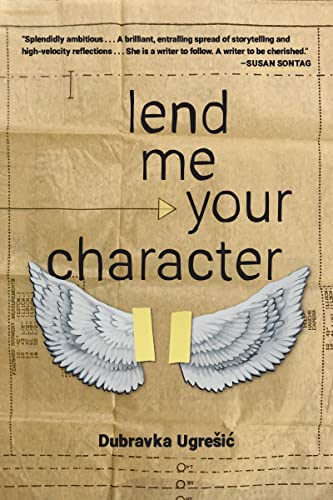
From the story of Steffie Cvek to "The Kharms Case," the pieces in Dubravka Ugresic's collection Lend Me Your Character are always smart and endlessly entertaining. The former story paints a picture of a harassed and vulnerable typist whose life is shaped entirely by cliches. She searches endlessly for an elusive romantic love in a narrative punctuated by threadbare advice from women's magazines and constructed like a sewing pattern. The latter story is one of Ugresic's funniest and is about the strained relationship between a persistent translator and an unresponsive publisher. The stories collected in Lend Me Your Character, the novella "Steffie Cvek in the Jaws of Life," and a collection of short stories entitled "Life Is a Fairy Tale" solidify Ugresic's reputation as one of Eastern Europe's most playful and inventive writers."
Die Inhaltsangabe kann sich auf eine andere Ausgabe dieses Titels beziehen.
Über die Autorinnen und Autoren
Dubravka Ugresic is the author of six works of fiction, including Fox, The Museum of Unconditional Surrender, and Baba Yaga Laid an Egg, along with six essay collections, including the NBCC award finalist, Karaoke Culture. She went into exile from Croatia after being labeled a "witch" for her anti-nationalistic stance during the Yugoslav war. She now resides in the Netherlands. In 2016, she was awarded the Neustadt International Prize for Literature for her body of work.
Celia Hawkesworth has translated The Museum of Unconditional Surrender by Dubravka Ugresic, Omer-Pasha Latas by Nobel Prize winner Ivo Andrić, and several works by Daša Drndić, including EEG, which won the 2020 Best Translated Book Award.
Michael Henry Heim was a professor of Slavic languages at the University of California at Los Angeles. He was an active and prolific translator, and was fluent in Czech, Russian, Serbo-Croatian, Hungarian, Romanian, French, Italian, German, and Dutch.
Ellen Elias-Bursać is a translator of South Slavic literature. Her accolades include the 2006 National Translation Award for her translation of David Albahari's novel Götz and Meyer. She is currently the President of the American Literary Translators Association.
Auszug. © Genehmigter Nachdruck. Alle Rechte vorbehalten.
LEND ME YOUR CHARACTER
Is a pen a symbolic penis?
Relations between Writers
You should never have anything to do with writers. But I’m afraid I did. One day I ran into Petar, a writer. He gave me a friendly thump on the shoulder and invited me for a coffee. “By the way, I read that story of yours,” he said.
“Really?”
“It’s good.”
“You like it?”
“Yeah. Especially the main character. I was wondering . . .”
“Yes?”
“She’s a great character, and I thought. . .”
“You thought what?”
“I’m writing a story, you know, and . . .”
“What is it, for heaven’s sake!” I burst out.
“Can you lend her to me?”
“What?!” I was dumbfounded.
“I need her for my story,” he went on.
“What does my character have to do with your story?”
“I need her, well . . . for coital purposes,” Petar said stupidly.
“Wait, you want my character for some character of yours to screw, is that what you mean?”
“Right,” said Petar.
“Who is he?”
“Who?”
“What do you mean Who? That character of yours!”
“No big deal, just a guy who likes sex.”
I took a deep breath and said decisively:
“No!”
“Why not?”
“Because I’m not going to have my character screwed by some maniac!”
“Actually,” Petar dug in his heels, “a published literary work, whether yours or Shakespeare’s, is public property. Everyone has the right to draw on it. It’s called intertextual relations, you know what intertextual relations are, don’t you? Besides, what I’m writing isn’t erotic really, it’s more fantastic, kind of magic realism.”
“Absolutely not!”
I drank my coffee in a huff, lit a cigarette, and looked at Petar. He was looking back at me with a calm, open face, as if his proposal were the most natural thing in the world.
“Listen,” I said, more gently, “why doesn’t your character get it on with Anna Karenina? What’s my ordinary little character compared to someone like her?”
“Come on now, you’re not as ordinary as all that,” the flatterer replied.
“Okay, it doesn’t have to be Anna Karenina. Why doesn’t he go to bed with Joan of Arc, that would be much more fantastic.”
“I don’t write historical novels,” Petar observed.
“Well, let him screw Mother Goose then!” I snorted. “Why can’t you understand,” said Petar. “A normal, basic character is just what I need. Besides, if you don’t mind my saying so, in your story she’s a bit, how should I put it, neglected?”
“What do you mean?”
“Just that, sexually neglected. You must know what I mean . . .
“Huh! And your little hero’s the one to put that right!” I snorted again.
“Naturally,” Petar said with complete self-assurance.
I said nothing. Perhaps I should have noticed the signal; the little red light that always comes on when I meet certain members of the opposite sex. This time the light on the display panel was warning me that this guy has potential. But as usual I failed to notice it.
“Alright, pal, you can have her,” I blurted out so quickly that I surprised myself. That’s exactly what I said, “pal,” thumping Petar on the shoulder. I never do that and I have no idea why I did it then. But there we were, thumping each other.
And then we parted. It was quite an idea, I had to admit. I was sorry I hadn’t thought of it myself. On the way home I considered possible boyfriends for my heroine. Tom Sawyer? The Scarecrow? Winnie the Pooh? No serious writer would ever have names like this pop into her head. But I had often dreamed of a boyfriend like Winnie the Pooh myself, so I must not be a serious woman either—no serious woman would consider a brainless bear as boyfriend material. A serious woman would think of James Joyce.
Clearly I wasn’t a serious writer. I had written a little book called Alice Comes Home to Ozalj and the only thing I really liked about it was the title. I was proud of that title, I kept pestering people to guess how many other titles it contained. Things might have been better if I was a serious woman but that, as I say, was by no means certain.
The Writer and Life’s Roadblocks
On Saturday I ran out to the nearest kiosk and bought the Evening News. I could hardly wait to get home, settle down, and read Petar’s story.
His story had a promising title: “The Hot Tongue.” Its main characters were named Peter and Ulla. I read the story straight through and it took my breath away. I called Petar immediately.
“Terrible! ” I hissed into the receiver.
“You’ve read the story?”
“Yes. Crap!” I said telegraphically.
“You don’t like it?”
“Total shit.”
“Can I come and see you?”
“Yes, urk,” I gargled into the receiver, and hung up.
Still in shock, I hurried to straighten up my offended appearance a bit. I put on a respectable little black dress, as though dressing for the theater, and placed the Evening News into my left hand, rolled up into a truncheon. Petar appeared at the door with a bunch of flowers. I deliberately didn’t put the flowers in a vase of water, but I did offer Petar a drink and sat down, still holding the Evening News in my hand.
“You didn’t need to borrow her for a piece of trash like this,” I said.
“Why are you using such vulgar language to describe my work?” asked Petar calmly, like an elementary school grammar teacher, not a writer.
“Because my character gives herself to yours after a single . . .”
I opened the Evening News and announced, as though reading out a verdict; “‘After a single moist glance . . .’ Please! Talk about male fantasy!...
„Über diesen Titel“ kann sich auf eine andere Ausgabe dieses Titels beziehen.
Suchergebnisse für Lend Me Your Character

Beispielbild für diese ISBN
Lend Me Your Character
Anbieter: HPB-Movies, Dallas, TX, USA
Verkäuferbewertung 4 von 5 Sternen

paperback. Zustand: Very Good. Connecting readers with great books since 1972! Used books may not include companion materials, and may have some shelf wear or limited writing. We ship orders daily and Customer Service is our top priority! Bestandsnummer des Verkäufers S_480046516
Gebraucht kaufen
EUR 5,52
EUR 3,35 Versand
Versand innerhalb von USA
Versand innerhalb von USA
Anzahl: 1 verfügbar
Beispielbild für diese ISBN
Lend Me Your Character
Anbieter: Better World Books, Mishawaka, IN, USA
Verkäuferbewertung 5 von 5 Sternen

Zustand: Good. Pages intact with minimal writing/highlighting. The binding may be loose and creased. Dust jackets/supplements are not included. Stock photo provided. Product includes identifying sticker. Better World Books: Buy Books. Do Good. Bestandsnummer des Verkäufers 55074356-6
Gebraucht kaufen
EUR 9,01
Versand gratis
Versand innerhalb von USA
Versand innerhalb von USA
Anzahl: 1 verfügbar
Beispielbild für diese ISBN
Lend Me Your Character
Anbieter: ThriftBooks-Dallas, Dallas, TX, USA
Verkäuferbewertung 5 von 5 Sternen
Paperback. Zustand: Very Good. No Jacket. May have limited writing in cover pages. Pages are unmarked. ~ ThriftBooks: Read More, Spend Less. Bestandsnummer des Verkäufers G1948830647I4N00
Gebraucht kaufen
EUR 9,18
Versand gratis
Versand innerhalb von USA
Versand innerhalb von USA
Anzahl: 1 verfügbar
Beispielbild für diese ISBN
Lend Me Your Character
Anbieter: ThriftBooks-Atlanta, AUSTELL, GA, USA
Verkäuferbewertung 5 von 5 Sternen
Paperback. Zustand: Good. No Jacket. Pages can have notes/highlighting. Spine may show signs of wear. ~ ThriftBooks: Read More, Spend Less. Bestandsnummer des Verkäufers G1948830647I3N00
Gebraucht kaufen
EUR 9,18
Versand gratis
Versand innerhalb von USA
Versand innerhalb von USA
Anzahl: 1 verfügbar
Beispielbild für diese ISBN
Lend Me Your Character
Anbieter: Lakeside Books, Benton Harbor, MI, USA
Verkäuferbewertung 5 von 5 Sternen
Zustand: New. Brand New! Not Overstocks or Low Quality Book Club Editions! Direct From the Publisher! We're not a giant, faceless warehouse organization! We're a small town bookstore that loves books and loves it's customers! Buy from Lakeside Books! Bestandsnummer des Verkäufers OTF-S-9781948830645
Neu kaufen
EUR 11,08
EUR 3,56 Versand
Versand innerhalb von USA
Versand innerhalb von USA
Anzahl: Mehr als 20 verfügbar
Foto des Verkäufers
Lend Me Your Character
Anbieter: GreatBookPrices, Columbia, MD, USA
Verkäuferbewertung 5 von 5 Sternen
Zustand: New. Bestandsnummer des Verkäufers 44867120-n
Neu kaufen
EUR 12,31
EUR 2,36 Versand
Versand innerhalb von USA
Versand innerhalb von USA
Anzahl: Mehr als 20 verfügbar
Foto des Verkäufers
Lend Me Your Character (Paperback or Softback)
Verlag:
Open Letter 6/27/2023, 2023
ISBN 10: 1948830647
ISBN 13: 9781948830645
Neu
Paperback or Softback
Anbieter: BargainBookStores, Grand Rapids, MI, USA
Verkäuferbewertung 5 von 5 Sternen
Paperback or Softback. Zustand: New. Lend Me Your Character. Book. Bestandsnummer des Verkäufers BBS-9781948830645
Beispielbild für diese ISBN
Lend Me Your Character
Verlag:
Open Letter June 2023, 2023
ISBN 10: 1948830647
ISBN 13: 9781948830645
Gebraucht
Trade Paperback
Anbieter: Inquiring Minds, Saugerties, NY, USA
Verkäuferbewertung 4 von 5 Sternen
Trade Paperback. Zustand: Used - Like New. Bestandsnummer des Verkäufers 632497
Gebraucht kaufen
EUR 11,94
EUR 5,35 Versand
Versand innerhalb von USA
Versand innerhalb von USA
Anzahl: 1 verfügbar
Beispielbild für diese ISBN
Lend Me Your Character
Anbieter: GreatBookPrices, Columbia, MD, USA
Verkäuferbewertung 5 von 5 Sternen
Zustand: As New. Unread book in perfect condition. Bestandsnummer des Verkäufers 44867120
Gebraucht kaufen
EUR 15,01
EUR 2,36 Versand
Versand innerhalb von USA
Versand innerhalb von USA
Anzahl: Mehr als 20 verfügbar
Foto des Verkäufers
Lend Me Your Character
Anbieter: Rarewaves USA, HEBRON, KY, USA
Verkäuferbewertung 5 von 5 Sternen
Paperback. Zustand: New. Bestandsnummer des Verkäufers LU-9781948830645
Neu kaufen
EUR 18,01
Versand gratis
Versand innerhalb von USA
Versand innerhalb von USA
Anzahl: Mehr als 20 verfügbar