Inhaltsangabe
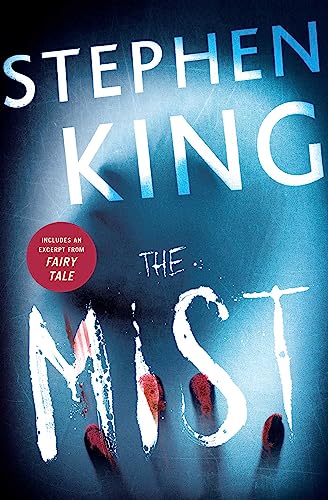
#1 New York Times bestselling author Stephen King’s terrifying novella about a town engulfed in a dense, mysterious mist as humanity makes its last stand against unholy destruction—originally published in the acclaimed short story collection Skeleton Crew and made into a TV series, as well as a feature film starring Thomas Jane and Marcia Gay Harden.
In the wake of a summer storm, terror descends...David Drayton, his son Billy, and their neighbor Brent Norton join dozens of others and head to the local grocery store to replenish supplies following a freak storm. Once there, they become trapped by a strange mist that has enveloped the town. As the confinement takes its toll on their nerves, a religious zealot, Mrs. Carmody, begins to play on their fears to convince them that this is God’s vengeance for their sins. She insists a sacrifice must be made and two groups—those for and those against—are aligned. Clearly, staying in the store may prove fatal, and the Draytons, along with store employee Ollie Weeks, Amanda Dumfries, Irene Reppler, and Dan Miller, attempt to make their escape. But what’s out there may be worse than what they left behind.
This exhilarating novella explores the horror in both the enemy you know—and the one you can only imagine.
Die Inhaltsangabe kann sich auf eine andere Ausgabe dieses Titels beziehen.
Über die Autorin bzw. den Autor
Stephen King is the author of more than sixty books, all of them worldwide bestsellers. His recent work includes Never Flinch, the short story collection You Like It Darker (a New York Times Book Review top ten horror book of 2024), Holly (a New York Times Notable Book of 2023), Fairy Tale, Billy Summers, If It Bleeds, The Institute, Elevation, The Outsider, Sleeping Beauties (cowritten with his son Owen King), and the Bill Hodges trilogy: End of Watch, Finders Keepers, and Mr. Mercedes (an Edgar Award winner for Best Novel and a television series streaming on Peacock). His novel 11/22/63 was named a top ten book of 2011 by The New York Times Book Review and won the Los Angeles Times Book Prize for Mystery/Thriller. His epic works The Dark Tower, It, Pet Sematary, Doctor Sleep, and Firestarter are the basis for major motion pictures, with It now the highest-grossing horror film of all time. He is the recipient of the 2020 Audio Publishers Association Lifetime Achievement Award, the 2018 PEN America Literary Service Award, the 2014 National Medal of Arts, and the 2003 National Book Foundation Medal for Distinguished Contribution to American Letters. He lives in Bangor, Maine, with his wife, novelist Tabitha King.
Auszug. © Genehmigter Nachdruck. Alle Rechte vorbehalten.
Chapter I: The Coming of the Storm I. The Coming of the Storm
This is what happened. On the night that the worst heat wave in northern New England history finally broke—the night of July 19—the entire western Maine region was lashed with the most vicious thunderstorms I have ever seen.
We lived on Long Lake, and we saw the first of the storms beating its way across the water toward us just before dark. For an hour before, the air had been utterly still. The American flag that my father put up on our boathouse in 1936 lay limp against its pole. Not even its hem fluttered. The heat was like a solid thing, and it seemed as deep as sullen quarry-water. That afternoon the three of us had gone swimming, but the water was no relief unless you went out deep. Neither Steffy nor I wanted to go deep because Billy couldn’t. Billy is five.
We ate a cold supper at five-thirty, picking listlessly at ham sandwiches and potato salad out on the deck that faces the lake. Nobody seemed to want anything but Pepsi, which was in a steel bucket of ice cubes.
After supper Billy went out back to play on his monkey bars for a while. Steff and I sat without talking much, smoking and looking across the sullen flat mirror of the lake to Harrison on the far side. A few powerboats droned back and forth. The evergreens over there looked dusty and beaten. In the west, great purple thunderheads were slowly building up, massing like an army. Lightning flashed inside them. Next door, Brent Norton’s radio, tuned to that classical-music station that broadcasts from the top of Mount Washington, sent out a loud bray of static each time the lightning flashed. Norton was a lawyer from New Jersey and his place on Long Lake was only a summer cottage with no furnace or insulation. Two years before, we had a boundary dispute that finally wound up in county court. I won. Norton claimed I won because he was an out-of-towner. There was no love lost between us.
Steff sighed and fanned the top of her breasts with the edge of her halter. I doubted if it cooled her off much but it improved the view a lot.
“I don’t want to scare you,” I said, “but there’s a bad storm on the way, I think.”
She looked at me doubtfully. “There were thunderheads last night and the night before, David. They just broke up.”
“They won’t do that tonight.”
“No?”
“If it gets bad enough, we’re going to go downstairs.”
“How bad do you think it can get?”
My dad was the first to build a year-round home on this side of the lake. When he was hardly more than a kid he and his brothers put up a summer place where the house now stood, and in 1938 a summer storm knocked it flat, stone walls and all. Only the boathouse escaped. A year later he started the big house. It’s the trees that do the damage in a bad blow. They get old, and the wind knocks them over. It’s mother nature’s way of cleaning house periodically.
“I don’t really know,” I said, truthfully enough. I had only heard stories about the great storm of thirty-eight. “But the wind can come off the lake like an express train.”
Billy came back a while later, complaining that the monkey bars were no fun because he was “all sweated up.” I ruffled his hair and gave him another Pepsi. More work for the dentist.
The thunderheads were getting closer, pushing away the blue. There was no doubt now that a storm was coming. Norton had turned off his radio. Billy sat between his mother and me, watching the sky, fascinated. Thunder boomed, rolling slowly across the lake and then echoing back again. The clouds twisted and rolled, now black, now purple, now veined, now black again. They gradually overspread the lake, and I could see a delicate caul of rain extending down from them. It was still a distance away. As we watched, it was probably raining on Bolster’s Mills, or maybe even Norway.
The air began to move, jerkily at first, lifting the flag and then dropping it again. It began to freshen and grew steady, first cooling the perspiration on our bodies and then seeming to freeze it.
That was when I saw the silver veil rolling across the lake. It blotted out Harrison in seconds and then came straight at us. The powerboats had vacated the scene.
Billy stood up from his chair, which was a miniature replica of our director’s chairs, complete with his name printed on the back. “Daddy! Look!”
“Let’s go in,” I said. I stood up and put my arm around his shoulders.
“But do you see it? Dad, what is it?”
“A water-cyclone. Let’s go in.”
Steff threw a quick, startled glance at my face and then said, “Come on, Billy. Do what your father says.”
We went in through the sliding glass doors that give on the living room. I slid the door shut on its track and paused for another look out. The silver veil was three-quarters of the way across the lake. It had resolved itself into a crazily spinning teacup between the lowering black sky and the surface of the water, which had gone the color of lead streaked with white chrome. The lake had begun to look eerily like the ocean, with high waves rolling in and sending spume up from the docks and breakwaters. Out in the middle, big whitecaps were tossing their heads back and forth.
Watching the water-cyclone was hypnotic. It was nearly on top of us when lightning flashed so brightly that it printed everything on my eyes in negative for thirty seconds afterward. The telephone gave out a startled ting! and I turned to see my wife and son standing directly in front of the big picture window that gives us a panoramic view of the lake to the northwest.
One of those terrible visions came to me—I think they are reserved exclusively for husbands and fathers—of the picture window blowing in with a low hard coughing sound and sending jagged arrows of glass into my wife’s bare stomach, into my boy’s face and neck. The horrors of the Inquisition are nothing compared to the fates your mind can imagine for your loved ones.
I grabbed them both hard and jerked them away. “What the hell are you doing? Get away from there!”
Steff gave me a startled glance. Billy only looked at me as if he had been partially awakened from a deep dream. I led them into the kitchen and hit the light switch. The phone ting-a-linged again.
Then the wind came. It was as if the house had taken off like a 747. It was a high, breathless whistling, sometimes deepening to a bass roar before glissading up to a whooping scream.
“Go downstairs,” I told Steff, and now I had to shout to make myself heard. Directly over the house thunder whacked mammoth planks together and Billy shrank against my leg.
“You come too!” Steff yelled back.
I nodded and made shooing gestures. I had to pry Billy off my leg. “Go with your mother. I want to get some candles in case the lights go off.”
He went with her, and I started opening cabinets. Candles are funny things, you know. You lay them by every spring, knowing that a summer storm may knock out the power. And when the time comes, they hide.
I was pawing through the fourth cabinet, past the half-ounce of grass that Steff and I bought four years ago and had still not smoked much of, past Billy’s wind-up set of chattering teeth from the Auburn Novelty Shop, past the drifts of...
„Über diesen Titel“ kann sich auf eine andere Ausgabe dieses Titels beziehen.
Weitere beliebte Ausgaben desselben Titels

Suchergebnisse für The Mist

Beispielbild für diese ISBN
The Mist
Anbieter: World of Books (was SecondSale), Montgomery, IL, USA
Verkäuferbewertung 5 von 5 Sternen

Zustand: Acceptable. Item in acceptable condition! Textbooks may not include supplemental items i.e. CDs, access codes etc. Bestandsnummer des Verkäufers 00098401498
Gebraucht kaufen
EUR 5,26
Versand gratis
Versand innerhalb von USA
Versand innerhalb von USA
Anzahl: 1 verfügbar
Foto des Verkäufers
The Mist
Anbieter: Zoom Books East, Glendale Heights, IL, USA
Verkäuferbewertung 5 von 5 Sternen
Zustand: acceptable. Book is in acceptable condition and shows signs of wear. Book may also include underlining highlighting. The book can also include "From the library of" labels. May not contain miscellaneous items toys, dvds, etc. . We offer 100% money back guarantee and 24 7 customer service. Bestandsnummer des Verkäufers ZEV.1982103523.A
Gebraucht kaufen
EUR 5,84
Versand gratis
Versand innerhalb von USA
Versand innerhalb von USA
Anzahl: 1 verfügbar
Beispielbild für diese ISBN
The Mist
Anbieter: Hawking Books, Edgewood, TX, USA
Verkäuferbewertung 4 von 5 Sternen

Zustand: Very Good. Very Good Condition. Five star seller - Buy with confidence! Bestandsnummer des Verkäufers X1982103523X2
Gebraucht kaufen
EUR 6,02
Versand gratis
Versand innerhalb von USA
Versand innerhalb von USA
Anzahl: 1 verfügbar
Beispielbild für diese ISBN
The Mist
Anbieter: St Vincent de Paul of Lane County, Eugene, OR, USA
Verkäuferbewertung 5 von 5 Sternen
Zustand: Acceptable. Paperback The item is fairly worn but still readable. Signs of wear include aesthetic issues such as scratches, worn covers, damaged binding. The item may have identifying markings on it or show other signs of previous use. May have page creases, creased spine, bent cover or markings inside. Packed with care, shipped promptly. Bestandsnummer des Verkäufers Y-002-2324
Gebraucht kaufen
EUR 3,50
EUR 3,40 Versand
Versand innerhalb von USA
Versand innerhalb von USA
Anzahl: 1 verfügbar
Beispielbild für diese ISBN
The Mist
Anbieter: Symposia Community Bookstore INC, Hoboken, NJ, USA
Verkäuferbewertung 4 von 5 Sternen
paperback. Zustand: Very Good. Clean, unmarked pages, minor wear to cover. Bestandsnummer des Verkäufers 260114006
Gebraucht kaufen
EUR 3,36
EUR 4,26 Versand
Versand innerhalb von USA
Versand innerhalb von USA
Anzahl: 1 verfügbar
Beispielbild für diese ISBN
The Mist
Anbieter: HPB-Ruby, Dallas, TX, USA
Verkäuferbewertung 5 von 5 Sternen
Paperback. Zustand: Very Good. Connecting readers with great books since 1972! Used books may not include companion materials, and may have some shelf wear or limited writing. We ship orders daily and Customer Service is our top priority! Bestandsnummer des Verkäufers S_460459163
Gebraucht kaufen
EUR 5,70
EUR 3,20 Versand
Versand innerhalb von USA
Versand innerhalb von USA
Anzahl: 1 verfügbar
Beispielbild für diese ISBN
The Mist
Anbieter: HPB Inc., Dallas, TX, USA
Verkäuferbewertung 5 von 5 Sternen
Paperback. Zustand: Very Good. Connecting readers with great books since 1972! Used books may not include companion materials, and may have some shelf wear or limited writing. We ship orders daily and Customer Service is our top priority! Bestandsnummer des Verkäufers S_461156336
Gebraucht kaufen
EUR 5,70
EUR 3,20 Versand
Versand innerhalb von USA
Versand innerhalb von USA
Anzahl: 1 verfügbar
Beispielbild für diese ISBN
The Mist
Anbieter: Half Price Books Inc., Dallas, TX, USA
Verkäuferbewertung 5 von 5 Sternen
Paperback. Zustand: Very Good. Connecting readers with great books since 1972! Used books may not include companion materials, and may have some shelf wear or limited writing. We ship orders daily and Customer Service is our top priority! Bestandsnummer des Verkäufers S_459630530
Gebraucht kaufen
EUR 6,14
EUR 2,98 Versand
Versand innerhalb von USA
Versand innerhalb von USA
Anzahl: 1 verfügbar
Beispielbild für diese ISBN
The Mist
Anbieter: HPB-Emerald, Dallas, TX, USA
Verkäuferbewertung 5 von 5 Sternen
Paperback. Zustand: Very Good. Connecting readers with great books since 1972! Used books may not include companion materials, and may have some shelf wear or limited writing. We ship orders daily and Customer Service is our top priority! Bestandsnummer des Verkäufers S_459037993
Gebraucht kaufen
EUR 6,14
EUR 3,20 Versand
Versand innerhalb von USA
Versand innerhalb von USA
Anzahl: 1 verfügbar
Beispielbild für diese ISBN
The Mist
Anbieter: THEVILLAGEBOOKSTORE, Fall River, MA, USA
Verkäuferbewertung 5 von 5 Sternen
paperback. Zustand: New. PAP. Bestandsnummer des Verkäufers 53MNYR00064J