
Verwandte Artikel zu Ask Again, Yes: A Novel
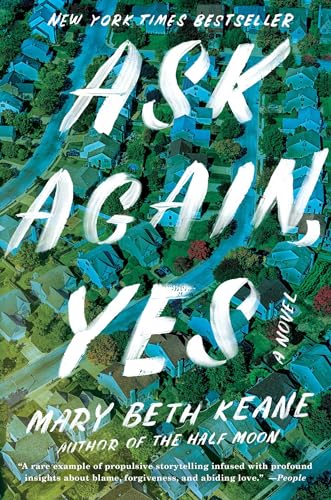
Inhaltsangabe
Named one of the Best Books of the Year by People, Vogue, Parade, NPR, and Elle
“A gem of a book.” —Taylor Jenkins Reid, author of The Seven Husbands of Evelyn Hugo
A triumphant New York Times bestseller and Tonight Show Summer Reads Pick about love, forgiveness, and family—perfect for book clubs and fans of Little Fires Everywhere and The Paper Palace.
How much can a family forgive?
Francis Gleeson and Brian Stanhope, rookie NYPD cops, are neighbors in the suburbs. What happens behind closed doors in both houses—the loneliness of Francis’s wife, Lena, and the instability of Brian’s wife, Anne, sets the stage for the explosive events to come.
In Mary Beth Keane's extraordinary novel, a lifelong friendship and love blossoms between Kate Gleeson and Peter Stanhope, born six months apart. One shocking night their loyalties are divided, and their bond will be tested again and again over the next thirty years. Heartbreaking and redemptive, Ask Again, Yes is a gorgeous and generous portrait of the daily intimacies of marriage and the power of forgiveness.
Die Inhaltsangabe kann sich auf eine andere Ausgabe dieses Titels beziehen.
Über die Autorin bzw. den Autor
Mary Beth Keane is the author of five novels, including the New York Times bestseller Ask Again, Yes. She was awarded a John Simon Guggenheim Fellowship for fiction writing and has received citations from the National Book Foundation, PEN America, and the Hemingway Society. Born in the Bronx to parents from the west of Ireland, she lives in New York with her husband and two sons.
Auszug. © Genehmigter Nachdruck. Alle Rechte vorbehalten.
Chapter One one
GILLAM WAS NICE ENOUGH but lonely, Lena Teobaldo thought when she first saw it. It was the kind of place that if she were there on vacation she’d love for the first two days, and then by the third day she’d start looking forward to leaving. It didn’t seem quite real: the apple trees and maples, the shingled houses with front porches, the cornfields, the dairy, the kids playing stickball in the street as if they didn’t notice their houses were sitting on a half acre of grass. Later, she’d figure out that the kids played the games their parents had played growing up in the city. Stickball. Hopscotch. Kick the can. When a father taught a son how to throw a ball, he marched that boy to the middle of the road as if they were on a block tight with tenements, because that’s where he’d learned from his father. She’d agreed to the trip because it was something to do and if she’d stayed in Bay Ridge that Saturday, her mother would have made her bring food to Mrs. Venard, who’d never been right since her boy went missing in Vietnam.
Her cousin Karolina’s dress was hanging on the hook behind Lena’s bedroom door, altered and ready for Lena to wear in just six days’ time. She’d gotten her shoes, her veil. There was nothing more to do other than wait, so when Francis asked if she wanted to take a little trip to check out a town he’d heard about through a guy at work, she’d said sure, it was a beautiful fall day, it would be nice to get out to the country for a few hours, she’d pack a picnic lunch. They unpacked that lunch on a bench outside the public library, and in the time it took to unwrap their sandwiches, eat them, sip all the tea from the thermos, only one person entered the library. A northbound train pulled into the station and three people got off. Across the town square was a deli, and next to it a five-and-dime with a stroller parked outside. Francis had driven them in Lena’s father’s Datsun—her brother Karol’s copy of Led Zeppelin IV stuck in the tape deck. Lena didn’t have a driver’s license, didn’t have the first idea how to drive. She’d assumed she’d never have to learn.
“So? What do you think?” Francis asked later as they eased back onto the Palisades Parkway. Lena opened the window and lit a cigarette.
“Pretty,” she said. “Quiet.” She slipped off her shoes and put her feet up on the dashboard. She’d put in for two weeks of vacation time—a week before her wedding plus a week after—and that day, a Saturday, was her first day of the longest stretch of days she’d had off in three years.
“You saw the train? There’s also a bus that goes to Midtown,” he said. She thought it a random piece of information until it hit her like a kick in the shin that he wanted to live there. He hadn’t said that. He’d said only that he wanted to take a spin in the car, check out a place he’d heard of. She thought he only wanted a break from all the wedding talk. Relatives from Italy and Poland were already arriving, and her parents’ apartment was packed with food and people every hour of the day. No one from Ireland was coming but some relation of Francis’s who’d emigrated to Chicago had sent a piece of Irish china. Francis said he didn’t mind. It was the bride’s day anyway. But now she saw he had a plan in mind. It seemed so far-fetched she decided not to mention it again unless he brought it up first.
A few weeks later, the wedding over and done with, their guests long departed, Lena back at work with a new name and a new band on her finger, Francis said it was time for them to move out of her parents’ apartment. He said that everyone had to tiptoe through the narrow living room if Lena’s sister, Natusia, was in there with her books. Karol was almost always in a bad mood, probably because the newlyweds had taken over his bedroom. There was nowhere to be alone. Every moment Francis spent there, he said, he felt like he should be offering to help with something, do something. Their wedding gifts were stacked in corners and Lena’s mother was always admonishing everyone to be careful, think of the crystal. Lena thought it was nice, a half dozen people sitting down to dinner together, sometimes more, depending on who stopped by. For the first time she wondered if she’d known him well enough to marry him.
“But where?” she said.
They looked on Staten Island. They looked within Bay Ridge. They climbed walk-ups in Yorkville, Morningside Heights, the Village. They walked through houses filled with other people’s things, their photos displayed on ledges, their polyester flower arrangements. On all those visits, Lena could see the road to Gillam approaching like an exit on the freeway. They’d socked away the cash gifts they’d gotten at the wedding plus most of their salaries and had enough for a down payment.
One Saturday morning in January 1974, after he’d worked a midnight tour plus a few hours of overtime, Francis got to Bay Ridge and told Lena to get her coat, he’d found their house.
“I’m not going,” she said, looking up from her coffee with her face set like stone. Angelo Teobaldo was doing a crossword across from her. Gosia Teobaldo had just cracked two eggs onto a skillet. Standing six foot two in his patrolman’s uniform, Francis’s face burned.
“He’s your husband,” Angelo said to his daughter. A reprimand. Like she’d left her toys scattered on the carpet and forgotten to put them away.
“You keep quiet,” Gosia said, motioning for him to zip his lip. “We’re having breakfast at Hinsch’s,” she announced, extinguishing the flame under the skillet.
“Let’s just go see, Lena. We don’t have to do anything you don’t want to do.”
“Oh, sure,” Lena said.
An hour and twenty minutes later, Lena pressed her forehead against the glass of the passenger window and looked at the house that would be theirs. There was a brightly lettered For Sale sign outside. The hydrangea that would flower in June was just a clump of frostbitten sticks. The current owners were home, their Ford was in the driveway—so Francis kept the engine running.
“What’s that? Are they rocks?” Toward the back of the property were five huge rocks, lined up by Mother Nature hundreds of millennia ago in ascending order, the tallest maybe five feet high.
“Boulders,” Francis said. “They’re all over this area. The realtor told me the builders left some as natural dividers between the houses. They remind me of Ireland.”
Lena looked at him as if to say, So that’s why you brought me here. He’d met a realtor. His mind was made up. The houses on that street—Jefferson—and the surrounding streets—Washington, Adams, Madison, Monroe—were closer together than the houses farther from town, and Francis said that was because these houses were older, built back in the 1920s when there was a tannery in town and everyone walked to work. He thought Lena would like that. There was a porch out front.
“Who will I talk to?” she asked.
“To our neighbors,” he said. “To the people you meet. You make friends faster than anyone. Besides, you’ll still be in the city every day. You’ll have the girls you work with. The bus stops right at the end of the block. You don’t even have to learn to drive if you don’t want to.” He’d be her driver, he...
„Über diesen Titel“ kann sich auf eine andere Ausgabe dieses Titels beziehen.
Suchergebnisse für Ask Again, Yes: A Novel

Beispielbild für diese ISBN
Ask Again, Yes: A Novel
Anbieter: World of Books (was SecondSale), Montgomery, IL, USA
Verkäuferbewertung 5 von 5 Sternen

Zustand: Acceptable. Item in very good condition! Textbooks may not include supplemental items i.e. CDs, access codes etc. Bestandsnummer des Verkäufers 00073684967
Gebraucht kaufen
EUR 3,55
Versand gratis
Versand innerhalb von USA
Versand innerhalb von USA
Anzahl: 1 verfügbar
Beispielbild für diese ISBN
Ask Again, Yes: A Novel
Anbieter: World of Books (was SecondSale), Montgomery, IL, USA
Verkäuferbewertung 5 von 5 Sternen
Zustand: Good. Item in good condition. Textbooks may not include supplemental items i.e. CDs, access codes etc. Bestandsnummer des Verkäufers 00072046527
Gebraucht kaufen
EUR 3,55
Versand gratis
Versand innerhalb von USA
Versand innerhalb von USA
Anzahl: 20 verfügbar
Beispielbild für diese ISBN
Ask Again, Yes: A Novel
Anbieter: World of Books (was SecondSale), Montgomery, IL, USA
Verkäuferbewertung 5 von 5 Sternen
Zustand: Good. Item in good condition. Textbooks may not include supplemental items i.e. CDs, access codes etc. Bestandsnummer des Verkäufers 00079391315
Gebraucht kaufen
EUR 3,75
Versand gratis
Versand innerhalb von USA
Versand innerhalb von USA
Anzahl: 17 verfügbar
Beispielbild für diese ISBN
Ask Again, Yes: A Novel
Anbieter: Gulf Coast Books, Cypress, TX, USA
Verkäuferbewertung 5 von 5 Sternen
Hardcover. Zustand: Fair. Bestandsnummer des Verkäufers 1982106980-4-20649574
Gebraucht kaufen
EUR 3,75
Versand gratis
Versand innerhalb von USA
Versand innerhalb von USA
Anzahl: 1 verfügbar
Beispielbild für diese ISBN
Ask Again, Yes: A Novel
Anbieter: Orion Tech, Kingwood, TX, USA
Verkäuferbewertung 5 von 5 Sternen
Hardcover. Zustand: Good. Bestandsnummer des Verkäufers 1982106980-3-24907003
Gebraucht kaufen
EUR 3,75
Versand gratis
Versand innerhalb von USA
Versand innerhalb von USA
Anzahl: 1 verfügbar
Beispielbild für diese ISBN
Ask Again, Yes: A Novel
Anbieter: Your Online Bookstore, Houston, TX, USA
Verkäuferbewertung 5 von 5 Sternen
Hardcover. Zustand: Good. Bestandsnummer des Verkäufers 1982106980-3-19442391
Gebraucht kaufen
EUR 3,75
Versand gratis
Versand innerhalb von USA
Versand innerhalb von USA
Anzahl: 2 verfügbar
Foto des Verkäufers
Ask Again, Yes: A Novel
Anbieter: 3Brothers Bookstore, Egg harbor township, NJ, USA
Verkäuferbewertung 5 von 5 Sternen
Zustand: acceptable. Books may contain multiple pages with notes and highlighting. Supplements such as Access Codes, Cd's, etc. are not guaranteed with used book purchases. Bestandsnummer des Verkäufers EVV.1982106980.A
Gebraucht kaufen
EUR 3,82
Versand gratis
Versand innerhalb von USA
Versand innerhalb von USA
Anzahl: 1 verfügbar
Foto des Verkäufers
Ask Again, Yes: A Novel
Anbieter: 3Brothers Bookstore, Egg harbor township, NJ, USA
Verkäuferbewertung 5 von 5 Sternen
Zustand: good. Books may contain some notes and highlighting. Supplements such as Access Codes, Cd's Dust Jackets, etc. are not guaranteed with used book purchases. Bestandsnummer des Verkäufers EVV.1982106980.G
Gebraucht kaufen
EUR 3,82
Versand gratis
Versand innerhalb von USA
Versand innerhalb von USA
Anzahl: 2 verfügbar
Beispielbild für diese ISBN
Ask Again, Yes: A Novel
Anbieter: More Than Words, Waltham, MA, USA
Verkäuferbewertung 5 von 5 Sternen
Zustand: Good. A sound copy with only light wear. Overall a solid copy at a great price! Bestandsnummer des Verkäufers BOS-M-03h-01690
Gebraucht kaufen
EUR 1,13
EUR 3,48 Versand
Versand innerhalb von USA
Versand innerhalb von USA
Anzahl: 1 verfügbar
Beispielbild für diese ISBN
Ask Again, Yes: A Novel
Anbieter: More Than Words, Waltham, MA, USA
Verkäuferbewertung 5 von 5 Sternen
Zustand: Good. . Former Library book. All orders guaranteed and ship within 24 hours. Before placing your order for please contact us for confirmation on the book's binding. Check out our other listings to add to your order for discounted shipping. Bestandsnummer des Verkäufers BOS-J-04d-01699
Gebraucht kaufen
EUR 1,13
EUR 3,48 Versand
Versand innerhalb von USA
Versand innerhalb von USA
Anzahl: 1 verfügbar