
Verwandte Artikel zu Head, Hand, Heart: Why Intelligence Is Over-Rewarded,...
Head, Hand, Heart: Why Intelligence Is Over-Rewarded, Manual Workers Matter, and Caregivers Deserve More Respect - Hardcover
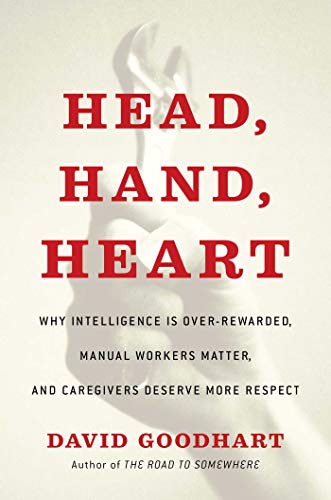
Inhaltsangabe
A Financial Times Best Book of the Year 2020
A TIMELY AND PROVOCATIVE ARGUMENT FROM LEADING POLITICAL ANALYST DAVID GOODHART ABOUT THE SEVERELY IMBALANCED DISTRIBUTION OF STATUS AND WORK IN WESTERN SOCIETIES.
The coronavirus pandemic revealed what we ought to have already known: that nurses, caregivers, supermarket workers, delivery drivers, cleaners, and so many others are essential. Until recently, this work was largely regarded as menial by the same society that now lauds them as heroes. How did we get here?
In his groundbreaking follow-up to the bestselling The Road to Somewhere, David Goodhart divides society into people who work with their Heads (cognitive work), with their Hands (manual work), or with their Hearts (caring work), and considers each group’s changing status and influence. Today, the “best and the brightest” trump the “decent and hardworking.” Qualities like character, compassion, craft, and physical labor command far less respect in our workforce. This imbalance has led to the disaffection and alienation of millions of people.
David Goodhart reveals the untold history behind this disparity and outlines the challenges we face as a result. Cognitive ability has become the gold standard of human esteem, and those in the cognitive class now shape society largely in their own interest. To put it bluntly: smart people have become too powerful.
A healthy democratic society respects and rewards a broad range of achievement, and provides meaning and value for people who cannot—or do not want to—achieve in the classroom and professional career market. We must shift our thinking to see all workers as essential, and not just during crises like the coronavirus pandemic. This is the dramatic story of the struggle for status and dignity in the 21st century.
Die Inhaltsangabe kann sich auf eine andere Ausgabe dieses Titels beziehen.
Über die Autorin bzw. den Autor
David Goodhart is one of the most distinctive and influential contemporary political analysts. He worked for the Financial Times for twelve years before founding Prospect magazine in 1995. He now leads the demography unit for the Policy Exchange think tank. His book The British Dream: Successes and Failures of Post-War Immigration was runner up for the Orwell book prize. In bestselling book The Road to Somewhere: The Populist Revolt and the Future of Politics, Goodhart identified the value divisions in western societies that help explain Brexit, Trump, and the global rise of populism.
Auszug. © Genehmigter Nachdruck. Alle Rechte vorbehalten.
Chapter One: Peak Head
Chapter One Peak Head
We… need to apply ourselves to something we do not yet quite know how to do: to eradicate contempt for those who are disfavoured by the ethic of effortful competition.
Kwame Anthony Appiah
What has gone wrong in rich, Western democracies? Political polarization. Economic stagnation. A weaker sense of common interest. Disappointed expectations among the university-educated mass elite. A rising tide of depression and loneliness. A crisis of meaning.
Even before the Covid-19 crisis struck there was a mood of despondency in our politics—a sense that losers were outnumbering winners in nations buffeted by anonymous global forces, that the public realm was being slowly poisoned by social media, and that mainstream politics was failing to recognize the widespread yearning for stability and belonging.
But there’s an overarching explanation for some of these discontents that was, and still is, hiding in plain sight. In recent decades, in the interests of efficiency, fairness, and progress, Western democracies have established systems of competition in which the most able succeed and too many of the rest feel like failures.
Who are the most able? People with higher levels of cognitive ability, or at least those certified as such by the education system. One form of human aptitude—cognitive-analytical ability, or the talent that helps people to pass exams and then handle information efficiently in their professional lives—has become the gold standard of human esteem. Those with a generous helping of this aptitude have formed a new kind of expanded cognitive class—a mass elite—who now shape society, and do so broadly in their own interests.
To put it more bluntly: smart people have become too powerful. How is this different from the past? Seventy years ago, just after the Second World War, when we lived in less complex societies, the people who ran government and business were generally brighter and more ambitious than the average—as they still are today.
What’s different is that, back then, skills and qualities other than cognitive-analytical intelligence were held in higher regard. Education had not yet emerged as the primary marker of social stratification. In the 1970s most people in rich societies left school with no qualifications at all, and as recently as the 1990s many professionals lacked university degrees.
In the language of political cliché, the “best and brightest” today trump the “decent and hardworking.” Qualities like character, integrity, experience, common sense, courage, and willingness to toil are by no means irrelevant, but they command relatively less respect.
When such virtues are undervalued, it can contribute to what socially conservative critics call a “moral deregulation” in which simply being a good person is valued less and it becomes harder to feel satisfaction and self-respect living an ordinary, decent life, especially in the bottom part of the income spectrum.
Without us noticing it, something fundamental has got out of kilter. It is too early to tell whether the Covid-19 crisis will contribute to a better balance between aptitudes based on “Head,” “Hand,” and “Heart.” But we need one. The three aptitudes overlap to a degree, but the modern knowledge economy has produced ever rising returns for Head workers—who are highly qualified academically—and reduced the relative pay and status of much manual (Hand) work.
At the same time, many aspects of caring (Heart) work, traditionally done by women in the gift economy of the family, continues to be undervalued even as care work has become an increasingly critical part of the public economy and was so widely applauded (literally) at the height of the crisis.
An economic and social system in rich countries that once had a place for a range of aptitudes and abilities—in the skilled and semiskilled jobs of the industrial era, on the land, in the military, in the church, in the private realm of the family—now favors the cognitive classes and the educationally successful.
The diminishing sway of those older structures and ways of life are a necessary condition of freer, more open societies, especially for women. But what many of those institutions also provided were forms of unconditional recognition based simply on being you, and a role and a purpose for the people, both men and women, whose strengths lie elsewhere than in the cognitive-analytical. Just doing your duty and making a contribution brought a degree of respect.
Moreover, whereas until recently different social classes and groups and regions had their own separate leaders and hierarchies and measures of prestige, today in most developed countries there is something more like a single, common elite that has passed through the same funnel of higher education and then into the top quartile of professional and managerial occupations. At the very top, these national elites merge into a semi-global one that studies at the same universities, works at the same corporations and institutions, and consumes the same media.
For most of human history, cognitive-analytical ability was scattered more or less randomly through society, with only a tiny minority attending university, religious seminaries, or similarly elite academies. But in recent decades in rich countries, a huge sorting process has taken place in which most of the young exam passers are swept up and sent into higher education. This has triggered a significant decline in the status of much nongraduate employment and also made promotion from below much harder for those without the passport of a university degree.
This does not mean that we now live in a true meritocracy. Family income and the educational background of your parents still correlates strongly with educational and career success, and indeed with performance in IQ-type tests.
The children of two-parent professional families are far more likely to be brought up by parents who are well-connected, understand what is required for children of even middling academic ability to enter good universities and obtain high-status professional jobs, and have the means to invest heavily in them.
The evidence also suggests that most rich societies are at least somewhat open and that many of the cognitively able from lower social classes can and do rise via higher education (thereby helping to legitimize the status quo).
The end result may be the emergence of a partially hereditary meritocracy, especially in the United States, although a few seem to get there by egregiously playing the system.I Many people, particularly members of the cognitive class themselves, may protest that progress has always been driven forward by the cognitively blessed and that modern, technologically advanced societies simply need more clever people—especially in software and computer science—than ever before.
Moreover, they may add, the so-called Flynn effect (named after the New Zealand academic James Flynn) shows that everyone is getting brighter—that average IQ levels have been rising throughout the twentieth century as a result of improved living conditions and human minds adapting to a more demanding cognitive environment.1
They argue that as long as the social biases mentioned above are ironed out, through...
„Über diesen Titel“ kann sich auf eine andere Ausgabe dieses Titels beziehen.
Suchergebnisse für Head, Hand, Heart: Why Intelligence Is Over-Rewarded,...

Beispielbild für diese ISBN
Head, Hand, Heart: Why Intelligence Is Over-Rewarded, Manual Workers Matter, and Caregivers Deserve More Respect
Anbieter: World of Books (was SecondSale), Montgomery, IL, USA
Verkäuferbewertung 5 von 5 Sternen

Zustand: Very Good. Item in very good condition! Textbooks may not include supplemental items i.e. CDs, access codes etc. Bestandsnummer des Verkäufers 00075009327
Gebraucht kaufen
EUR 5,72
Versand gratis
Versand innerhalb von USA
Versand innerhalb von USA
Anzahl: 1 verfügbar
Beispielbild für diese ISBN
Head, Hand, Heart: Why Intelligence Is Over-Rewarded, Manual Workers Matter, and Caregivers Deserve More Respect
Verlag:
Free Press (edition Illustrated), 2020
ISBN 10: 1982128445
ISBN 13: 9781982128449
Gebraucht
Hardcover
Anbieter: BooksRun, Philadelphia, PA, USA
Verkäuferbewertung 5 von 5 Sternen
Hardcover. Zustand: Very Good. Illustrated. With dust jacket. It's a well-cared-for item that has seen limited use. The item may show minor signs of wear. All the text is legible, with all pages included. It may have slight markings and/or highlighting. Bestandsnummer des Verkäufers 1982128445-11-1-29
Gebraucht kaufen
EUR 5,73
Versand gratis
Versand innerhalb von USA
Versand innerhalb von USA
Anzahl: 1 verfügbar
Beispielbild für diese ISBN
Head, Hand, Heart: Why Intelligence Is Over-Rewarded, Manual Workers Matter, and Caregivers Deserve More Respect
Anbieter: ThriftBooks-Atlanta, AUSTELL, GA, USA
Verkäuferbewertung 5 von 5 Sternen
Hardcover. Zustand: As New. No Jacket. Pages are clean and are not marred by notes or folds of any kind. ~ ThriftBooks: Read More, Spend Less. Bestandsnummer des Verkäufers G1982128445I2N00
Gebraucht kaufen
EUR 6,25
Versand gratis
Versand innerhalb von USA
Versand innerhalb von USA
Anzahl: 1 verfügbar
Beispielbild für diese ISBN
Head, Hand, Heart: Why Intelligence Is Over-Rewarded, Manual Workers Matter, and Caregivers Deserve More Respect
Anbieter: Wonder Book, Frederick, MD, USA
Verkäuferbewertung 5 von 5 Sternen
Zustand: Very Good. Very Good condition. Very Good dust jacket. A copy that may have a few cosmetic defects. May also contain light spine creasing or a few markings such as an owner's name, short gifter's inscription or light stamp. Bestandsnummer des Verkäufers T13P-00965
Gebraucht kaufen
EUR 6,42
Versand gratis
Versand innerhalb von USA
Versand innerhalb von USA
Anzahl: 1 verfügbar
Beispielbild für diese ISBN
Head, Hand, Heart : Why Intelligence Is over-Rewarded, Manual Workers Matter, and Caregivers Deserve More Respect
Anbieter: Better World Books: West, Reno, NV, USA
Verkäuferbewertung 5 von 5 Sternen
Zustand: Fine. Used book that is in almost brand-new condition. May contain a remainder mark. Better World Books: Buy Books. Do Good. Bestandsnummer des Verkäufers 52287472-75
Gebraucht kaufen
EUR 6,74
Versand gratis
Versand innerhalb von USA
Versand innerhalb von USA
Anzahl: 1 verfügbar
Beispielbild für diese ISBN
Head, Hand, Heart: Why Intelligence Is Over-Rewarded, Manual Workers Matter, and Caregivers Deserve More Respect
Anbieter: HPB Inc., Dallas, TX, USA
Verkäuferbewertung 5 von 5 Sternen
hardcover. Zustand: Very Good. Connecting readers with great books since 1972! Used books may not include companion materials, and may have some shelf wear or limited writing. We ship orders daily and Customer Service is our top priority! Bestandsnummer des Verkäufers S_418612537
Gebraucht kaufen
EUR 3,67
EUR 3,34 Versand
Versand innerhalb von USA
Versand innerhalb von USA
Anzahl: 1 verfügbar
Beispielbild für diese ISBN
Head, Hand, Heart: Why Intelligence Is Over-Rewarded, Manual Workers Matter, and Caregivers Deserve More Respect
Anbieter: World of Books Inc, Montgomery, IL, USA
Verkäuferbewertung 4 von 5 Sternen

Hardback. Zustand: Very Good. A Financial Times Best Book of the Year 2020 A TIMELY AND PROVOCATIVE ARGUMENT FROM LEADING POLITICAL ANALYST DAVID GODHART ABOUT THE SEVERELY IMBALANCED DISTRIBUTION OF STATUS AND WORK IN WESTERN SOCIETIES. The coronavirus pandemic revealed what we ought to have already known: that nurses, caregivers, supermarket workers, delivery drivers, cleaners, and so many others are essential. Until recently, this work was largely regarded as menial by the same society that now lauds them as heroes. How did we get here? In his groundbreaking follow-up to the bestselling The Road to Somewhere, David Goodhart divides society into people who work with their Heads (cognitive work), with their Hands (manual work), or with their Hearts (caring work), and considers each group's changing status and influence. Today, the the best and the brightest trump the decent and hardworking. Qualities like character, compassion, craft, and physical labor command far less respect in our workforce. This imbalance has led to the disaffection and alienation of millions of people. David Goodhart reveals the untold history behind this disparity and outlines the challenges we face as a result. Cognitive ability has become the gold standard of human esteem, and those in the cognitive class now shape society largely in their own interest. To put it bluntly: smart people have become too powerful. A healthy democratic society respects and rewards a broad range of achievement, and provides meaning and value for people who cannot--or do not want to--achieve in the classroom and professional career market. We must shift our thinking to see all workers as essential, and not just during crises like the coronavirus pandemic. This is the dramatic story of the struggle for status and dignity in the 21st century. Bestandsnummer des Verkäufers CIN1982128445VG
Gebraucht kaufen
EUR 7,55
Versand gratis
Versand innerhalb von USA
Versand innerhalb von USA
Anzahl: 1 verfügbar
Beispielbild für diese ISBN
Head, Hand, Heart: Why Intelligence Is Over-Rewarded, Manual Workers Matter, and Caregivers Deserve More Respect
Verlag:
Free Press September 2020, 2020
ISBN 10: 1982128445
ISBN 13: 9781982128449
Gebraucht
Hardcover
Anbieter: Inquiring Minds, Saugerties, NY, USA
Verkäuferbewertung 4 von 5 Sternen
Hardcover. Zustand: Used - Very Good. Bestandsnummer des Verkäufers 481337
Gebraucht kaufen
EUR 4,58
EUR 5,34 Versand
Versand innerhalb von USA
Versand innerhalb von USA
Anzahl: 1 verfügbar
Beispielbild für diese ISBN
Head, Hand, Heart : Why Intelligence Is over-Rewarded, Manual Workers Matter, and Caregivers Deserve More Respect
Anbieter: Better World Books Ltd, Dunfermline, Vereinigtes Königreich
Verkäuferbewertung 5 von 5 Sternen
Zustand: Very Good. Pages intact with possible writing/highlighting. Binding strong with minor wear. Dust jackets/supplements may not be included. Stock photo provided. Product includes identifying sticker. Better World Books: Buy Books. Do Good. Bestandsnummer des Verkäufers 19245146-6
Gebraucht kaufen
EUR 8,86
EUR 5,92 Versand
Versand von Vereinigtes Königreich nach USA
Versand von Vereinigtes Königreich nach USA
Anzahl: 1 verfügbar
Beispielbild für diese ISBN
Head, Hand, Heart Format: Hardback
Anbieter: INDOO, Avenel, NJ, USA
Verkäuferbewertung 5 von 5 Sternen
Zustand: As New. Unread copy in mint condition. Bestandsnummer des Verkäufers SS9781982128449
Gebraucht kaufen
EUR 30,53
Versand gratis
Versand innerhalb von USA
Versand innerhalb von USA
Anzahl: Mehr als 20 verfügbar