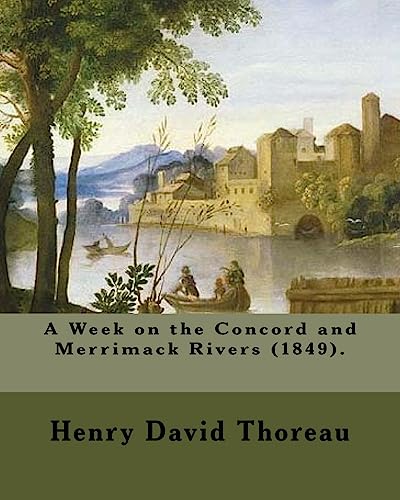
A Week on the Concord and Merrimack Rivers (1849). By: Henry David Thoreau: A Week on the Concord and Merrimack Rivers (1849) is a book by Henry David Thoreau (1817–1862). - Softcover
Inhaltsangabe
A Week on the Concord and Merrimack Rivers (1849) is a book by Henry David Thoreau (1817–1862). It is ostensibly the narrative of a boat trip from Concord, Massachusetts to Concord, New Hampshire, and back, that Thoreau took with his brother John in 1839. John died of tetanus in 1842 and Thoreau wrote the book, in part, as a tribute to his memory.Background[edit] The book's first draft was completed while Thoreau was living at Walden Pond (1845-47). He was unable to find a publisher, however, and therefore had it published at his own expense. Few copies sold and he was left with several hundred extras and went into debt. A slightly revised version of A Week, based on corrections Thoreau had made himself, was published in 1868, six years after his death................... Henry David Thoreau (see name pronunciation; July 12, 1817 – May 6, 1862) was an American essayist, poet, philosopher, abolitionist, naturalist, tax resister, development critic, surveyor, and historian. A leading transcendentalist, Thoreau is best known for his book Walden, a reflection upon simple living in natural surroundings, and his essay "Civil Disobedience" (originally published as "Resistance to Civil Government"), an argument for disobedience to an unjust state. Thoreau's books, articles, essays, journals, and poetry amount to more than 20 volumes. Among his lasting contributions are his writings on natural history and philosophy, in which he anticipated the methods and findings of ecology and environmental history, two sources of modern-day environmentalism. His literary style interweaves close observation of nature, personal experience, pointed rhetoric, symbolic meanings, and historical lore, while displaying a poetic sensibility, philosophical austerity, and Yankee attention to practical detail.He was also deeply interested in the idea of survival in the face of hostile elements, historical change, and natural decay; at the same time he advocated abandoning waste and illusion in order to discover life's true essential needs.He was a lifelong abolitionist, delivering lectures that attacked the Fugitive Slave Law while praising the writings of Wendell Phillips and defending the abolitionist John Brown. Thoreau's philosophy of civil disobedience later influenced the political thoughts and actions of such notable figures as Leo Tolstoy, Mahatma Gandhi, and Martin Luther King Jr.[citation needed] Thoreau is sometimes referred to as an anarchist. Though "Civil Disobedience" seems to call for improving rather than abolishing government—"I ask for, not at once no government, but at once a better government"the direction of this improvement points toward anarchism: "'That government is best which governs not at all;' and when men are prepared for it, that will be the kind of government which they will have."..............
Die Inhaltsangabe kann sich auf eine andere Ausgabe dieses Titels beziehen.
Weitere beliebte Ausgaben desselben Titels

Suchergebnisse für A Week on the Concord and Merrimack Rivers (1849)....

Foto des Verkäufers
Week on the Concord and Merrimack Rivers, 1849 : A Week on the Concord and Merrimack Rivers, 1849 Is a Book by Henry David Thoreau, 1817?1862
Verlag:
CreateSpace Independent Publishing Platform, 2018
ISBN 10: 1984006169
ISBN 13: 9781984006165
Gebraucht
Softcover
Anbieter: GreatBookPrices, Columbia, MD, USA
Verkäuferbewertung 5 von 5 Sternen

Zustand: As New. Unread book in perfect condition. Bestandsnummer des Verkäufers 31577732
Gebraucht kaufen
EUR 12,41
Versand:
EUR 2,27
Innerhalb der USA
Anzahl: Mehr als 20 verfügbar
Foto des Verkäufers
Week on the Concord and Merrimack Rivers, 1849 : A Week on the Concord and Merrimack Rivers, 1849 Is a Book by Henry David Thoreau, 1817?1862
Verlag:
CreateSpace Independent Publishing Platform, 2018
ISBN 10: 1984006169
ISBN 13: 9781984006165
Neu
Softcover
Anbieter: GreatBookPrices, Columbia, MD, USA
Verkäuferbewertung 5 von 5 Sternen
Zustand: New. Bestandsnummer des Verkäufers 31577732-n
Neu kaufen
EUR 12,67
Versand:
EUR 2,27
Innerhalb der USA
Anzahl: Mehr als 20 verfügbar
Beispielbild für diese ISBN
A Week on the Concord and Merrimack Rivers (1849). By (Paperback)
Verlag:
Createspace Independent Publishing Platform, 2018
ISBN 10: 1984006169
ISBN 13: 9781984006165
Neu
Paperback
Anbieter: Grand Eagle Retail, Bensenville, IL, USA
Verkäuferbewertung 5 von 5 Sternen
Paperback. Zustand: new. Paperback. A Week on the Concord and Merrimack Rivers (1849) is a book by Henry David Thoreau (1817-1862). It is ostensibly the narrative of a boat trip from Concord, Massachusetts to Concord, New Hampshire, and back, that Thoreau took with his brother John in 1839. John died of tetanus in 1842 and Thoreau wrote the book, in part, as a tribute to his memory.Background[edit] The book's first draft was completed while Thoreau was living at Walden Pond (1845-47). He was unable to find a publisher, however, and therefore had it published at his own expense. Few copies sold and he was left with several hundred extras and went into debt. A slightly revised version of A Week, based on corrections Thoreau had made himself, was published in 1868, six years after his death. Henry David Thoreau (see name pronunciation; July 12, 1817 - May 6, 1862) was an American essayist, poet, philosopher, abolitionist, naturalist, tax resister, development critic, surveyor, and historian. A leading transcendentalist, Thoreau is best known for his book Walden, a reflection upon simple living in natural surroundings, and his essay "Civil Disobedience" (originally published as "Resistance to Civil Government"), an argument for disobedience to an unjust state. Thoreau's books, articles, essays, journals, and poetry amount to more than 20 volumes. Among his lasting contributions are his writings on natural history and philosophy, in which he anticipated the methods and findings of ecology and environmental history, two sources of modern-day environmentalism. His literary style interweaves close observation of nature, personal experience, pointed rhetoric, symbolic meanings, and historical lore, while displaying a poetic sensibility, philosophical austerity, and Yankee attention to practical detail.He was also deeply interested in the idea of survival in the face of hostile elements, historical change, and natural decay; at the same time he advocated abandoning waste and illusion in order to discover life's true essential needs.He was a lifelong abolitionist, delivering lectures that attacked the Fugitive Slave Law while praising the writings of Wendell Phillips and defending the abolitionist John Brown. Thoreau's philosophy of civil disobedience later influenced the political thoughts and actions of such notable figures as Leo Tolstoy, Mahatma Gandhi, and Martin Luther King Jr.[citation needed] Thoreau is sometimes referred to as an anarchist. Though "Civil Disobedience" seems to call for improving rather than abolishing government-"I ask for, not at once no government, but at once a better government"the direction of this improvement points toward anarchism: "'That government is best which governs not at all;' and when men are prepared for it, that will be the kind of government which they will have.". This item is printed on demand. Shipping may be from multiple locations in the US or from the UK, depending on stock availability. Bestandsnummer des Verkäufers 9781984006165
Beispielbild für diese ISBN
A Week on the Concord and Merrimack Rivers (1849). By: Henry David Thoreau: A Week on the Concord and Merrimack Rivers (1849) is a book by Henry David Thoreau (1817-1862).
Verlag:
CreateSpace Independent Publishing Platform, 2018
ISBN 10: 1984006169
ISBN 13: 9781984006165
Neu
Softcover
Anbieter: California Books, Miami, FL, USA
Verkäuferbewertung 5 von 5 Sternen
Zustand: New. Print on Demand. Bestandsnummer des Verkäufers I-9781984006165
Neu kaufen
EUR 15,04
Versand:
Gratis
Innerhalb der USA
Anzahl: Mehr als 20 verfügbar
Foto des Verkäufers
Week on the Concord and Merrimack Rivers, 1849 : A Week on the Concord and Merrimack Rivers, 1849 Is a Book by Henry David Thoreau, 1817?1862
Verlag:
CreateSpace Independent Publishing Platform, 2018
ISBN 10: 1984006169
ISBN 13: 9781984006165
Gebraucht
Softcover
Anbieter: GreatBookPricesUK, Woodford Green, Vereinigtes Königreich
Verkäuferbewertung 5 von 5 Sternen
Zustand: As New. Unread book in perfect condition. Bestandsnummer des Verkäufers 31577732
Gebraucht kaufen
EUR 18,60
Versand:
EUR 17,17
Von Vereinigtes Königreich nach USA
Anzahl: Mehr als 20 verfügbar
Foto des Verkäufers
Week on the Concord and Merrimack Rivers, 1849 : A Week on the Concord and Merrimack Rivers, 1849 Is a Book by Henry David Thoreau, 1817?1862
Verlag:
CreateSpace Independent Publishing Platform, 2018
ISBN 10: 1984006169
ISBN 13: 9781984006165
Neu
Softcover
Anbieter: GreatBookPricesUK, Woodford Green, Vereinigtes Königreich
Verkäuferbewertung 5 von 5 Sternen
Zustand: New. Bestandsnummer des Verkäufers 31577732-n
Neu kaufen
EUR 22,37
Versand:
EUR 17,17
Von Vereinigtes Königreich nach USA
Anzahl: Mehr als 20 verfügbar
Beispielbild für diese ISBN
A Week on the Concord and Merrimack Rivers (1849). by: Henry David Thoreau: A Week on the Concord and Merrimack Rivers (1849) Is a Book by Henry David Thoreau (1817-1862).
Verlag:
Createspace Independent Publishing Platform, 2018
ISBN 10: 1984006169
ISBN 13: 9781984006165
Neu
Paperback
Anbieter: THE SAINT BOOKSTORE, Southport, Vereinigtes Königreich
Verkäuferbewertung 5 von 5 Sternen
Paperback. Zustand: New. This item is printed on demand. New copy - Usually dispatched within 5-9 working days 452. Bestandsnummer des Verkäufers C9781984006165
Neu kaufen
EUR 29,77
Versand:
EUR 17,48
Von Vereinigtes Königreich nach USA
Anzahl: Mehr als 20 verfügbar
Beispielbild für diese ISBN
A Week on the Concord and Merrimack Rivers (1849). By (Paperback)
Verlag:
Createspace Independent Publishing Platform, 2018
ISBN 10: 1984006169
ISBN 13: 9781984006165
Neu
Paperback
Anbieter: CitiRetail, Stevenage, Vereinigtes Königreich
Verkäuferbewertung 5 von 5 Sternen
Paperback. Zustand: new. Paperback. A Week on the Concord and Merrimack Rivers (1849) is a book by Henry David Thoreau (1817-1862). It is ostensibly the narrative of a boat trip from Concord, Massachusetts to Concord, New Hampshire, and back, that Thoreau took with his brother John in 1839. John died of tetanus in 1842 and Thoreau wrote the book, in part, as a tribute to his memory.Background[edit] The book's first draft was completed while Thoreau was living at Walden Pond (1845-47). He was unable to find a publisher, however, and therefore had it published at his own expense. Few copies sold and he was left with several hundred extras and went into debt. A slightly revised version of A Week, based on corrections Thoreau had made himself, was published in 1868, six years after his death. Henry David Thoreau (see name pronunciation; July 12, 1817 - May 6, 1862) was an American essayist, poet, philosopher, abolitionist, naturalist, tax resister, development critic, surveyor, and historian. A leading transcendentalist, Thoreau is best known for his book Walden, a reflection upon simple living in natural surroundings, and his essay "Civil Disobedience" (originally published as "Resistance to Civil Government"), an argument for disobedience to an unjust state. Thoreau's books, articles, essays, journals, and poetry amount to more than 20 volumes. Among his lasting contributions are his writings on natural history and philosophy, in which he anticipated the methods and findings of ecology and environmental history, two sources of modern-day environmentalism. His literary style interweaves close observation of nature, personal experience, pointed rhetoric, symbolic meanings, and historical lore, while displaying a poetic sensibility, philosophical austerity, and Yankee attention to practical detail.He was also deeply interested in the idea of survival in the face of hostile elements, historical change, and natural decay; at the same time he advocated abandoning waste and illusion in order to discover life's true essential needs.He was a lifelong abolitionist, delivering lectures that attacked the Fugitive Slave Law while praising the writings of Wendell Phillips and defending the abolitionist John Brown. Thoreau's philosophy of civil disobedience later influenced the political thoughts and actions of such notable figures as Leo Tolstoy, Mahatma Gandhi, and Martin Luther King Jr.[citation needed] Thoreau is sometimes referred to as an anarchist. Though "Civil Disobedience" seems to call for improving rather than abolishing government-"I ask for, not at once no government, but at once a better government"the direction of this improvement points toward anarchism: "'That government is best which governs not at all;' and when men are prepared for it, that will be the kind of government which they will have.". This item is printed on demand. Shipping may be from our UK warehouse or from our Australian or US warehouses, depending on stock availability. Bestandsnummer des Verkäufers 9781984006165
Neu kaufen
EUR 22,39
Versand:
EUR 42,34
Von Vereinigtes Königreich nach USA
Anzahl: 1 verfügbar