
Verwandte Artikel zu Advances in Social Networking-based Learning: Machine...
Advances in Social Networking-based Learning: Machine Learning-based User Modelling and Sentiment Analysis (Intelligent Systems Reference Library, Band 181) - Softcover
Buch 146 von 188: Intelligent Systems Reference Library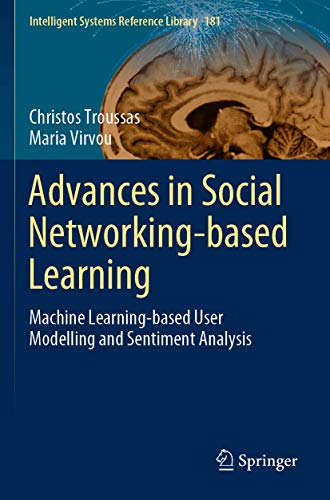
Inhaltsangabe
This book discusses three important, hot research issues: social networking-based learning, machine learning-based user modeling and sentiment analysis. Although these three technologies have been widely used by researchers around the globe by academic disciplines and by R&D departments in the IT industry, they have not yet been used extensively for the purposes of education. The authors present a novel approach that uses adaptive hypermedia in e-learning models to personalize educational content and learning resources based on the needs and preferences of individual learners. According to reports, in 2018 the vast majority of internet users worldwide are active on social networks, and the global average social network penetration rate as of 2018 is close to half the population. Employing social networking technologies in the field of education allows the latest technological advances to be used to create interactive educational environments where students can learn, collaborate with peers and communicate with tutors while benefiting from a social and pedagogical structure similar to a real class.
The book first discusses in detail the current trend of social networking-based learning. It then provides a novel framework that moves further away from digital learning technologies while incorporating a wide range of recent advances to provide solutions to future challenges. This approach incorporates machine learning to the student-modeling component, which also uses conceptual frameworks and pedagogical theories in order to further promote individualization and adaptivity in e-learning environments. Moreover, it examines error diagnosis, misconceptions, tailored testing and collaboration between students are examined and proposes new approaches for these modules. Sentiment analysis is also incorporated into the general framework, supporting personalized learning by considering the user’s emotional state, and creating a user-friendly learningenvironment tailored to students’ needs. Support for students, in the form of motivation, completes the framework. This book helps researchers in the field of knowledge-based software engineering to build more sophisticated personalized educational software, while retaining a high level of adaptivity and user-friendliness within human–computer interactions. Furthermore, it is a valuable resource for educators and software developers designing and implementing intelligent tutoring systems and adaptive educational hypermedia systems.
Die Inhaltsangabe kann sich auf eine andere Ausgabe dieses Titels beziehen.
Über die Autorin bzw. den Autor
Dr. Christos Papakostas is a Postdoctoral Researcher in the Department of Informatics and Computer Engineering at the University of West Attica (Greece). He received his Ph.D. from the same Department. Additionally, he holds a B.Eng. and an M.Sc. degree from the Department of Electrical and Computer Engineering at Democritus University of Thrace. During his studies and research, he has received several scholarships for his academic performance and "Best Paper" awards in international conferences on computer science topics. He has published research articles in international journals, and conferences and has served as Reviewer in the research community. His research interests include artificial intelligence, augmented reality, adaptive tutoring systems, and human-computer interaction. Dr. Christos Troussas is Assistant Professor in the Department of Informatics and Computer Engineering at the University of West Attica. He has been PostDoc Researcher in the field of Software Engineering at the same Department. He has received a PhD degree in Informatics, a MSc degree with specialization in "Intelligent Technologies of Human-Computer Interaction" and a BSc degree in Informatics from the Department of Informatics, University of Piraeus. He has participated in national and international research projects. He is Academic Editor of the journal "Advances in Human-Computer Interaction" (Hindawi). Also, he has been Editorial Board member of many other international journals, and Program Committee chair or member in many international conferences. He has published extensively in international journals, books and conference proceedings and is coauthor of two monographs in the areas of personalized software engineering and artificial intelligence in education (by Springer and IOS Press). His academic influence is indicated by thousands of citations of his work and by having received best paper awards in international conferences in the field of computer science. His current research interests are in the areas of personalized software technology, human-computer interaction and adaptive hypermedia systems. He is among the world's top 2% of scientists, according to the Stanford University ranking for the years 2020, 2021 and 2022. Additionally, he holds the position of Research Fellow at INTI International University, Malaysia. Dr. Cleo Sgouropoulou is Professor in the Department of Informatics and Computer Engineering at the University of West Attica (Greece). She has received a Diploma and Ph.D. degree from the Department of Electrical and Computer Engineering from the National Technical University of Athens (NTUA). Her research interests lie in the fields of artificial intelligence, human-computer interaction and software engineering. She has participated as a main researcher/coordinator in more than 30 related national and European-funded projects. Dr. Sgouropoulou has published more than 150 articles in internationaljournals, scientific collections and conference proceedings. She is an acting reviewer in distinguished journals and has served as General Chair, Program Chair and Steering Committee member in major international computer science conferences and participated in several Program and Organizing conference committees. Dr. Sgouropoulou has been prominently active in the area of European Learning Technologies Standardization. She has been a member of the European Standardization Committee (CEN) Workshop on Learning Technologies since 2000, and since 2007 she has been the Head of the Greek delegation of the Hellenic Organization for Standardization (ELOT) to the CEN Technical Committee 353 "ICT for Learning, Education and Training" and the coordinator of its Greek Mirror Committee TC48/WG3. As a field expert, Dr. Sgouropoulou has been appointed by CEN to contribute/coordinate several of its standardization projects on leaning objects, learning opportunities, learner mobility and learning outcomes/competence information. The res
Von der hinteren Coverseite
This book discusses three important, hot research issues: social networking-based learning, machine learning-based user modeling and sentiment analysis. Although these three technologies have been widely used by researchers around the globe by academic disciplines and by R&D departments in the IT industry, they have not yet been used extensively for the purposes of education. The authors present a novel approach that uses adaptive hypermedia in e-learning models to personalize educational content and learning resources based on the needs and preferences of individual learners. According to reports, in 2018 the vast majority of internet users worldwide are active on social networks, and the global average social network penetration rate as of 2018 is close to half the population. Employing social networking technologies in the field of education allows the latest technological advances to be used to create interactive educational environments where students can learn, collaborate with peers and communicate with tutors while benefiting from a social and pedagogical structure similar to a real class.
The book first discusses in detail the current trend of social networking-based learning. It then provides a novel framework that moves further away from digital learning technologies while incorporating a wide range of recent advances to provide solutions to future challenges. This approach incorporates machine learning to the student-modeling component, which also uses conceptual frameworks and pedagogical theories in order to further promote individualization and adaptivity in e-learning environments. Moreover, it examines error diagnosis, misconceptions, tailored testing and collaboration between students are examined and proposes new approaches for these modules. Sentiment analysis is also incorporated into the general framework, supporting personalized learning by considering the user’s emotional state, and creating a user-friendly learningenvironment tailored to students’ needs. Support for students, in the form of motivation, completes the framework. This book helps researchers in the field of knowledge-based software engineering to build more sophisticated personalized educational software, while retaining a high level of adaptivity and user-friendliness within human–computer interactions. Furthermore, it is a valuable resource for educators and software developers designing and implementing intelligent tutoring systems and adaptive educational hypermedia systems.
„Über diesen Titel“ kann sich auf eine andere Ausgabe dieses Titels beziehen.
Suchergebnisse für Advances in Social Networking-based Learning: Machine...

Beispielbild für diese ISBN
Advances in Social Networking-based Learning (eng)
Print-on-DemandAnbieter: Brook Bookstore On Demand, Napoli, NA, Italien
Verkäuferbewertung 5 von 5 Sternen

Zustand: new. Questo è un articolo print on demand. Bestandsnummer des Verkäufers a517b8fc91aeb1c0568a3dc6cd9addf6
Neu kaufen
EUR 118,26
EUR 5,50 Versand
Versand von Italien nach USA
Versand von Italien nach USA
Anzahl: Mehr als 20 verfügbar
Foto des Verkäufers
Advances in Social Networking-based Learning
Verlag:
Springer International Publishing Jan 2021, 2021
ISBN 10: 3030391329
ISBN 13: 9783030391324
Neu
Taschenbuch
Anbieter: BuchWeltWeit Ludwig Meier e.K., Bergisch Gladbach, Deutschland
Verkäuferbewertung 5 von 5 Sternen
Taschenbuch. Zustand: Neu. This item is printed on demand - it takes 3-4 days longer - Neuware -This book discusses three important, hot research issues: social networking-based learning, machine learning-based user modeling and sentiment analysis. Although these three technologies have been widely used by researchers around the globe by academic disciplines and by R&D departments in the IT industry, they have not yet been used extensively for the purposes of education. The authors present a novel approach that uses adaptive hypermedia in e-learning models to personalize educational content and learning resources based on the needs and preferences of individual learners. According to reports, in 2018 the vast majority of internet users worldwide are active on social networks, and the global average social network penetration rate as of 2018 is close to half the population. Employing social networking technologies in the field of education allows the latest technological advances to be used to create interactive educational environments where students can learn, collaborate with peers and communicate with tutors while benefiting from a social and pedagogical structure similar to a real class. The book first discusses in detail the current trend of social networking-based learning. It then provides a novel framework that moves further away from digital learning technologies while incorporating a wide range of recent advances to provide solutions to future challenges. This approach incorporates machine learning to the student-modeling component, which also uses conceptual frameworks and pedagogical theories in order to further promote individualization and adaptivity in e-learning environments. Moreover, it examines error diagnosis, misconceptions, tailored testing and collaboration between students are examined and proposes new approaches for these modules. Sentiment analysis is also incorporated into the general framework, supporting personalized learning by considering the user's emotional state, and creating a user-friendly learning environment tailored to students' needs. Support for students, in the form of motivation, completes the framework. This book helps researchers in the field of knowledge-based software engineering to build more sophisticated personalized educational software, while retaining a high level of adaptivity and user-friendliness within human-computer interactions. Furthermore, it is a valuable resource for educators and software developers designing and implementing intelligent tutoring systems and adaptive educational hypermedia systems. 188 pp. Englisch. Bestandsnummer des Verkäufers 9783030391324
Neu kaufen
EUR 149,79
EUR 23,00 Versand
Versand von Deutschland nach USA
Versand von Deutschland nach USA
Anzahl: 2 verfügbar
Foto des Verkäufers
Advances in Social Networking-based Learning
Verlag:
Springer International Publishing, 2021
ISBN 10: 3030391329
ISBN 13: 9783030391324
Neu
Kartoniert / Broschiert
Anbieter: moluna, Greven, Deutschland
Verkäuferbewertung 5 von 5 Sternen
Kartoniert / Broschiert. Zustand: New. Bestandsnummer des Verkäufers 448681117
Neu kaufen
EUR 127,40
EUR 48,99 Versand
Versand von Deutschland nach USA
Versand von Deutschland nach USA
Anzahl: Mehr als 20 verfügbar
Beispielbild für diese ISBN
Advances in Social Networking-based Learning: Machine Learning-based User Modelling and Sentiment Analysis (Intelligent Systems Reference Library, 181)
Anbieter: Ria Christie Collections, Uxbridge, Vereinigtes Königreich
Verkäuferbewertung 5 von 5 Sternen
Zustand: New. In English. Bestandsnummer des Verkäufers ria9783030391324_new
Neu kaufen
EUR 168,39
EUR 10,90 Versand
Versand von Vereinigtes Königreich nach USA
Versand von Vereinigtes Königreich nach USA
Anzahl: Mehr als 20 verfügbar
Beispielbild für diese ISBN
Advances in Social Networking-based Learning: Machine Learning-based User Modelling and Sentiment Analysis (Intelligent Systems Reference Library)
Anbieter: Books Puddle, Woodside, NY, USA
Verkäuferbewertung 4 von 5 Sternen

Zustand: New. 1st ed. 2020 edition NO-PA16APR2015-KAP. Bestandsnummer des Verkäufers 26388510544
Neu kaufen
EUR 191,76
EUR 3,51 Versand
Versand innerhalb von USA
Versand innerhalb von USA
Anzahl: 4 verfügbar
Foto des Verkäufers
Advances in Social Networking-based Learning | Machine Learning-based User Modelling and Sentiment Analysis
Anbieter: preigu, Osnabrück, Deutschland
Verkäuferbewertung 5 von 5 Sternen
Taschenbuch. Zustand: Neu. Advances in Social Networking-based Learning | Machine Learning-based User Modelling and Sentiment Analysis | Christos Troussas (u. a.) | Taschenbuch | Intelligent Systems Reference Library | xii | Englisch | 2021 | Springer | EAN 9783030391324 | Verantwortliche Person für die EU: Springer Verlag GmbH, Tiergartenstr. 17, 69121 Heidelberg, juergen[dot]hartmann[at]springer[dot]com | Anbieter: preigu. Bestandsnummer des Verkäufers 119507238
Neu kaufen
EUR 131,15
EUR 70,00 Versand
Versand von Deutschland nach USA
Versand von Deutschland nach USA
Anzahl: 5 verfügbar
Beispielbild für diese ISBN
Advances in Social Networking-based Learning: Machine Learning-based User Modelling and Sentiment Analysis (Intelligent Systems Reference Library)
Print-on-DemandAnbieter: Majestic Books, Hounslow, Vereinigtes Königreich
Verkäuferbewertung 4 von 5 Sternen
Zustand: New. Print on Demand. Bestandsnummer des Verkäufers 392137871
Neu kaufen
EUR 200,73
EUR 7,56 Versand
Versand von Vereinigtes Königreich nach USA
Versand von Vereinigtes Königreich nach USA
Anzahl: 4 verfügbar
Foto des Verkäufers
Advances in Social Networking-based Learning
Verlag:
Springer, Springer Jan 2021, 2021
ISBN 10: 3030391329
ISBN 13: 9783030391324
Neu
Taschenbuch
Anbieter: buchversandmimpf2000, Emtmannsberg, BAYE, Deutschland
Verkäuferbewertung 5 von 5 Sternen
Taschenbuch. Zustand: Neu. This item is printed on demand - Print on Demand Titel. Neuware -This book discusses three important, hot research issues: social networking-based learning, machine learning-based user modeling and sentiment analysis. Although these three technologies have been widely used by researchers around the globe by academic disciplines and by R&D departments in the IT industry, they have not yet been used extensively for the purposes of education. The authors present a novel approach that uses adaptive hypermedia in e-learning models to personalize educational content and learning resources based on the needs and preferences of individual learners. According to reports, in 2018 the vast majority of internet users worldwide are active on social networks, and the global average social network penetration rate as of 2018 is close to half the population. Employing social networking technologies in the field of education allows the latest technological advances to be used to create interactive educational environments where students can learn, collaborate with peers and communicate with tutors while benefiting from a social and pedagogical structure similar to a real class.The book first discusses in detail the current trend of social networking-based learning. It then provides a novel framework that moves further away from digital learning technologies while incorporating a wide range of recent advances to provide solutions to future challenges. This approach incorporates machine learning to the student-modeling component, which also uses conceptual frameworks and pedagogical theories in order to further promote individualization and adaptivity in e-learning environments. Moreover, it examines error diagnosis, misconceptions, tailored testing and collaboration between students are examined and proposes new approaches for these modules. Sentiment analysis is also incorporated into the general framework, supporting personalized learning by considering the user's emotional state, and creating a user-friendly learningenvironment tailored to students' needs. Support for students, in the form of motivation, completes the framework. This book helps researchers in the field of knowledge-based software engineering to build more sophisticated personalized educational software, while retaining a high level of adaptivity and user-friendliness within human-computer interactions. Furthermore, it is a valuable resource for educators and software developers designing and implementing intelligent tutoring systems and adaptive educational hypermedia systems.Springer-Verlag GmbH, Tiergartenstr. 17, 69121 Heidelberg 188 pp. Englisch. Bestandsnummer des Verkäufers 9783030391324
Neu kaufen
EUR 149,79
EUR 60,00 Versand
Versand von Deutschland nach USA
Versand von Deutschland nach USA
Anzahl: 1 verfügbar
Beispielbild für diese ISBN
Advances in Social Networking-based Learning: Machine Learning-based User Modelling and Sentiment Analysis (Intelligent Systems Reference Library)
Print-on-DemandAnbieter: Biblios, Frankfurt am main, HESSE, Deutschland
Verkäuferbewertung 4 von 5 Sternen
Zustand: New. PRINT ON DEMAND. Bestandsnummer des Verkäufers 18388510554
Neu kaufen
EUR 201,47
EUR 9,95 Versand
Versand von Deutschland nach USA
Versand von Deutschland nach USA
Anzahl: 4 verfügbar
Beispielbild für diese ISBN
Advances in Social Networking-based Learning: Machine Learning-based User Modelling and Sentiment Analysis
Anbieter: Revaluation Books, Exeter, Vereinigtes Königreich
Verkäuferbewertung 5 von 5 Sternen
Paperback. Zustand: Brand New. 188 pages. 9.25x6.10x0.55 inches. In Stock. Bestandsnummer des Verkäufers x-3030391329
Neu kaufen
EUR 221,74
EUR 11,63 Versand
Versand von Vereinigtes Königreich nach USA
Versand von Vereinigtes Königreich nach USA
Anzahl: 2 verfügbar