
Verwandte Artikel zu Monsters and Monstrosity: From the Canon to the Anti-Canon:...
Monsters and Monstrosity: From the Canon to the Anti-Canon: Literary and Juridical Subversions (Law & Literature, 16) - Hardcover
Inhaltsangabe
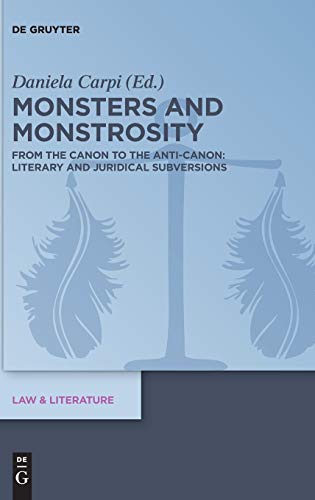
Every culture knows the phenomenon of monsters, terrifying creatures that represent complete alterity and challenge every basic notion of self and identity within a cultural paradigm. In Latin and Greek culture, the monster was created as a marvel, appearing as something which, like transgression itself, did not belong to the assumed natural order of things. Therefore, it could only be created by a divinity responsible for its creation, composition, goals and stability, but it was triggered by some in- or non-human action performed by humans. The identification of something as monstrous denotes its place outside and beyond social norms and values. The monster-evoking transgression is most often indistinguishable from reactions to the experience of otherness, merging the limits of humanity with the limits of a given culture. The topic entails a large intersection among the cultural domains of law, literature, philosophy, anthropology, and technology. Monstrosity has indeed become a necessary condition of our existence in the 21st century: it serves as a representation of change itself. In the process of analysis there are three theoretical approaches: psychoanalytical, representational, ontological. The volume therefore aims at examining the concept of monstrosity from three main perspectives: technophobic, xenophobic, superdiversity. Today’s globalized world is shaped in the unprecedented phenomenon of international migration. The resistance to this phenomenon causes the demonization of the Other, seen as the antagonist and the monster. The monster becomes therefore the ethnic Other, the alien. To reach this new perspective on monstrosity we must start by examining the many facets of monstrosity, also diachronically: from the philological origin of the term to the Roman and classical viewpoint, from the Renaissance medical perspective to the religious background, from the new filmic exploitations in the 20th and 21st centuries to the very recent ethnological and anthropological points of view, to the latest technological perspective , dealing with artificial intelligence.
Die Inhaltsangabe kann sich auf eine andere Ausgabe dieses Titels beziehen.
Über die Autorin bzw. den Autor
Daniela Carpi, University of Verona, Verona, Italy.
„Über diesen Titel“ kann sich auf eine andere Ausgabe dieses Titels beziehen.
Suchergebnisse für Monsters and Monstrosity: From the Canon to the Anti-Canon:...

Beispielbild für diese ISBN
Monsters and Monstrosity
Anbieter: PBShop.store UK, Fairford, GLOS, Vereinigtes Königreich
Verkäuferbewertung 5 von 5 Sternen

HRD. Zustand: New. New Book. Shipped from UK. Established seller since 2000. Bestandsnummer des Verkäufers FW-9783110652192
Neu kaufen
EUR 128,09
EUR 5,92 Versand
Versand von Vereinigtes Königreich nach USA
Versand von Vereinigtes Königreich nach USA
Anzahl: 15 verfügbar
Foto des Verkäufers
Monsters and Monstrosity : From the Canon to the Anti-canon: Literary and Juridical Subversions
Anbieter: GreatBookPrices, Columbia, MD, USA
Verkäuferbewertung 5 von 5 Sternen
Zustand: New. Bestandsnummer des Verkäufers 35887228-n
Neu kaufen
EUR 132,40
EUR 2,36 Versand
Versand innerhalb von USA
Versand innerhalb von USA
Anzahl: Mehr als 20 verfügbar
Beispielbild für diese ISBN
Monsters and Monstrosity
Anbieter: PBShop.store US, Wood Dale, IL, USA
Verkäuferbewertung 5 von 5 Sternen
HRD. Zustand: New. New Book. Shipped from UK. Established seller since 2000. Bestandsnummer des Verkäufers FW-9783110652192
Neu kaufen
EUR 134,84
Versand gratis
Versand innerhalb von USA
Versand innerhalb von USA
Anzahl: 15 verfügbar
Beispielbild für diese ISBN
Monsters and Monstrosity (eng)
Anbieter: Brook Bookstore On Demand, Napoli, NA, Italien
Verkäuferbewertung 5 von 5 Sternen
Zustand: new. Bestandsnummer des Verkäufers 49004c456a16bd491906086f6dcf3ad9
Neu kaufen
EUR 134,97
EUR 6,80 Versand
Versand von Italien nach USA
Versand von Italien nach USA
Anzahl: Mehr als 20 verfügbar
Foto des Verkäufers
Monsters and Monstrosity
Print-on-DemandAnbieter: moluna, Greven, Deutschland
Verkäuferbewertung 5 von 5 Sternen
Hardcover. Zustand: New. Dieser Artikel ist ein Print on Demand Artikel und wird nach Ihrer Bestellung fuer Sie gedruckt. Daniela Carpi, University of Verona, Verona, Italy. Every culture knows the phenomenon of monsters, terrifying creatures that represent complete alterity and challenge every basic notion of self and identity within a cultural paradig. Bestandsnummer des Verkäufers 267732047
Neu kaufen
EUR 93,96
EUR 48,99 Versand
Versand von Deutschland nach USA
Versand von Deutschland nach USA
Anzahl: Mehr als 20 verfügbar
Foto des Verkäufers
Monsters and Monstrosity : From the Canon to the Anti-canon: Literary and Juridical Subversions
Anbieter: GreatBookPricesUK, Woodford Green, Vereinigtes Königreich
Verkäuferbewertung 5 von 5 Sternen
Zustand: New. Bestandsnummer des Verkäufers 35887228-n
Neu kaufen
EUR 125,56
EUR 17,70 Versand
Versand von Vereinigtes Königreich nach USA
Versand von Vereinigtes Königreich nach USA
Anzahl: Mehr als 20 verfügbar
Beispielbild für diese ISBN
Monsters and Monstrosity: From the Canon to the Anti-Canon: Literary and Juridical Subversions (Law & Literature, 16)
Anbieter: Ria Christie Collections, Uxbridge, Vereinigtes Königreich
Verkäuferbewertung 5 von 5 Sternen
Zustand: New. In English. Bestandsnummer des Verkäufers ria9783110652192_new
Neu kaufen
EUR 136,53
EUR 13,32 Versand
Versand von Vereinigtes Königreich nach USA
Versand von Vereinigtes Königreich nach USA
Anzahl: Mehr als 20 verfügbar
Foto des Verkäufers
Monsters and Monstrosity : From the Canon to the Anti-canon: Literary and Juridical Subversions
Anbieter: GreatBookPrices, Columbia, MD, USA
Verkäuferbewertung 5 von 5 Sternen
Zustand: As New. Unread book in perfect condition. Bestandsnummer des Verkäufers 35887228
Gebraucht kaufen
EUR 148,77
EUR 2,36 Versand
Versand innerhalb von USA
Versand innerhalb von USA
Anzahl: Mehr als 20 verfügbar
Foto des Verkäufers
Monsters and Monstrosity : From the Canon to the Anti-Canon: Literary and Juridical Subversions
Anbieter: AHA-BUCH GmbH, Einbeck, Deutschland
Verkäuferbewertung 5 von 5 Sternen
Buch. Zustand: Neu. Druck auf Anfrage Neuware - Printed after ordering - Every culture knows the phenomenon of monsters, terrifying creatures that represent complete alterity and challenge every basic notion of self and identity within a cultural paradigm. In Latin and Greek culture, the monster was created as a marvel, appearing as something which, like transgression itself, did not belong to the assumed natural order of things. Therefore, it could only be created by a divinity responsible for its creation, composition, goals and stability, but it was triggered by some in- or non-human action performed by humans. The identification of something as monstrous denotes its place outside and beyond social norms and values. The monster-evoking transgression is most often indistinguishable from reactions to the experience of otherness, merging the limits of humanity with the limits of a given culture. The topic entails a large intersection among the cultural domains of law, literature, philosophy, anthropology, and technology. Monstrosity has indeed become a necessary condition of our existence in the 21st century: it serves as a representation of change itself. In the process of analysis there are three theoretical approaches: psychoanalytical, representational, ontological. The volume therefore aims at examining the concept of monstrosity from three main perspectives: technophobic, xenophobic, superdiversity. Today's globalized world is shaped in the unprecedented phenomenon of international migration. The resistance to this phenomenon causes the demonization of the Other, seen as the antagonist and the monster. The monster becomes therefore the ethnic Other, the alien. To reach this new perspective on monstrosity we must start by examining the many facets of monstrosity, also diachronically: from the philological origin of the term to the Roman and classical viewpoint, from the Renaissance medical perspective to the religious background, from the new filmic exploitations in the 20th and 21st centuries to the very recent ethnological and anthropological points of view, to the latest technological perspective , dealing with artificial intelligence. Bestandsnummer des Verkäufers 9783110652192
Neu kaufen
EUR 116,17
EUR 35,00 Versand
Versand von Deutschland nach USA
Versand von Deutschland nach USA
Anzahl: 1 verfügbar
Foto des Verkäufers
Monsters and Monstrosity
Anbieter: Rarewaves USA, HEBRON, KY, USA
Verkäuferbewertung 5 von 5 Sternen
Hardback. Zustand: New. Every culture knows the phenomenon of monsters, terrifying creatures that represent complete alterity and challenge every basic notion of self and identity within a cultural paradigm. In Latin and Greek culture, the monster was created as a marvel, appearing as something which, like transgression itself, did not belong to the assumed natural order of things. Therefore, it could only be created by a divinity responsible for its creation, composition, goals and stability, but it was triggered by some in- or non-human action performed by humans. The identification of something as monstrous denotes its place outside and beyond social norms and values. The monster-evoking transgression is most often indistinguishable from reactions to the experience of otherness, merging the limits of humanity with the limits of a given culture. The topic entails a large intersection among the cultural domains of law, literature, philosophy, anthropology, and technology. Monstrosity has indeed become a necessary condition of our existence in the 21st century: it serves as a representation of change itself. In the process of analysis there are three theoretical approaches: psychoanalytical, representational, ontological. The volume therefore aims at examining the concept of monstrosity from three main perspectives: technophobic, xenophobic, superdiversity. Today's globalized world is shaped in the unprecedented phenomenon of international migration. The resistance to this phenomenon causes the demonization of the Other, seen as the antagonist and the monster. The monster becomes therefore the ethnic Other, the alien. To reach this new perspective on monstrosity we must start by examining the many facets of monstrosity, also diachronically: from the philological origin of the term to the Roman and classical viewpoint, from the Renaissance medical perspective to the religious background, from the new filmic exploitations in the 20th and 21st centuries to the very recent ethnological and anthropological points of view, to the latest technological perspective , dealing with artificial intelligence. Bestandsnummer des Verkäufers LU-9783110652192
Neu kaufen
EUR 154,14
Versand gratis
Versand innerhalb von USA
Versand innerhalb von USA
Anzahl: Mehr als 20 verfügbar