
Verwandte Artikel zu The Linear Model and Hypothesis: A General Unifying...
The Linear Model and Hypothesis: A General Unifying Theory (Springer Series in Statistics) - Hardcover
Buch 140 von 160: Springer Series in Statistics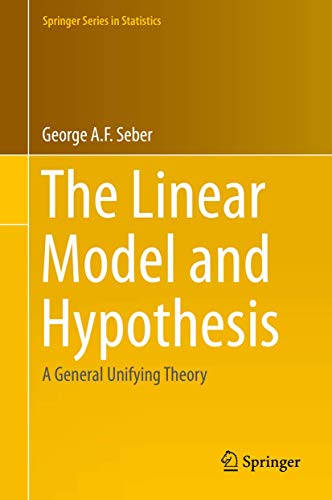
Inhaltsangabe
This book provides a concise and integrated overview of hypothesis testing in four important subject areas, namely linear and nonlinear models, multivariate analysis, and large sample theory. The approach used is a geometrical one based on the concept of projections and their associated idempotent matrices, thus largely avoiding the need to involvematrix ranks. It is shown that all the hypotheses encountered are either linear or asymptotically linear, and that all the underlying models used are either exactly or asymptotically linear normal models. This equivalence can be used, for example, to extend the concept of orthogonality to other models in the analysis of variance, and to show that the asymptotic equivalence of the likelihood ratio, Wald, and Score (Lagrange Multiplier) hypothesis tests generally applies.
Die Inhaltsangabe kann sich auf eine andere Ausgabe dieses Titels beziehen.
Über die Autorin bzw. den Autor
George Seber is an Emeritus Professor of Statistics at Auckland University, New Zealand. He is an elected Fellow of the Royal Society of New Zealand, recipient of their Hector medal in Information Science, and recipient of an international Distinguished Statistical Ecologist Award. He has authored or coauthored 16 books and 90 research articles on a wide variety of topics including linear and nonlinear models, multivariate analysis, matrix theory for statisticians, large sample theory, adaptive sampling, genetics, epidemiology, and statistical ecology.
Von der hinteren Coverseite
This book provides a concise and integrated overview of hypothesis testing in four important subject areas, namely linear and nonlinear models, multivariate analysis, and large sample theory. The approach used is a geometrical one based on the concept of projections and their associated idempotent matrices, thus largely avoiding the need to involve matrix ranks. It is shown that all the hypotheses encountered are either linear or asymptotically linear, and that all the underlying models used are either exactly or asymptotically linear normal models. This equivalence can be used, for example, to extend the concept of orthogonality in the analysis of variance to other models, and to show that the asymptotic equivalence of the likelihood ratio, Wald, and Score (Lagrange Multiplier) hypothesis tests generally applies.
„Über diesen Titel“ kann sich auf eine andere Ausgabe dieses Titels beziehen.
Suchergebnisse für The Linear Model and Hypothesis: A General Unifying...

Beispielbild für diese ISBN
The Linear Model and Hypothesis (eng)
Print-on-DemandAnbieter: Brook Bookstore On Demand, Napoli, NA, Italien
Verkäuferbewertung 5 von 5 Sternen

Zustand: new. Questo è un articolo print on demand. Bestandsnummer des Verkäufers f1d5b38ad116e4c43dcd85bd7137658b
Neu kaufen
EUR 50,23
EUR 6,80 Versand
Versand von Italien nach USA
Versand von Italien nach USA
Anzahl: Mehr als 20 verfügbar
Beispielbild für diese ISBN
Linear Model and Hypothesis : A General Unifying Theory
Anbieter: GreatBookPrices, Columbia, MD, USA
Verkäuferbewertung 5 von 5 Sternen
Zustand: New. Bestandsnummer des Verkäufers 24008249-n
Neu kaufen
EUR 58,06
EUR 2,35 Versand
Versand innerhalb von USA
Versand innerhalb von USA
Anzahl: 15 verfügbar
Beispielbild für diese ISBN
The Linear Model and Hypothesis: A General Unifying Theory (Springer Series in Statistics)
Anbieter: California Books, Miami, FL, USA
Verkäuferbewertung 5 von 5 Sternen
Zustand: New. Bestandsnummer des Verkäufers I-9783319219295
Neu kaufen
EUR 67,95
Versand gratis
Versand innerhalb von USA
Versand innerhalb von USA
Anzahl: Mehr als 20 verfügbar
Foto des Verkäufers
The Linear Model and Hypothesis
Verlag:
Springer International Publishing AG, CH, 2015
ISBN 10: 3319219294
ISBN 13: 9783319219295
Neu
Hardcover
Anbieter: Rarewaves.com USA, London, LONDO, Vereinigtes Königreich
Verkäuferbewertung 5 von 5 Sternen
Hardback. Zustand: New. 1st ed. 2015. This book provides a concise and integrated overview of hypothesis testing in four important subject areas, namely linear and nonlinear models, multivariate analysis, and large sample theory. The approach used is a geometrical one based on the concept of projections and their associated idempotent matrices, thus largely avoiding the need to involvematrix ranks. It is shown that all the hypotheses encountered are either linear or asymptotically linear, and that all the underlying models used are either exactly or asymptotically linear normal models. This equivalence can be used, for example, to extend the concept of orthogonality to other models in the analysis of variance, and to show that the asymptotic equivalence of the likelihood ratio, Wald, and Score (Lagrange Multiplier) hypothesis tests generally applies. Bestandsnummer des Verkäufers LU-9783319219295
Neu kaufen
EUR 68,09
Versand gratis
Versand von Vereinigtes Königreich nach USA
Versand von Vereinigtes Königreich nach USA
Anzahl: Mehr als 20 verfügbar
Beispielbild für diese ISBN
Linear Model and Hypothesis : A General Unifying Theory
Anbieter: GreatBookPrices, Columbia, MD, USA
Verkäuferbewertung 5 von 5 Sternen
Zustand: As New. Unread book in perfect condition. Bestandsnummer des Verkäufers 24008249
Gebraucht kaufen
EUR 69,49
EUR 2,35 Versand
Versand innerhalb von USA
Versand innerhalb von USA
Anzahl: 15 verfügbar
Beispielbild für diese ISBN
The Linear Model and Hypothesis: A General Unifying Theory (Springer Series in Statistics)
Anbieter: Ria Christie Collections, Uxbridge, Vereinigtes Königreich
Verkäuferbewertung 5 von 5 Sternen
Zustand: New. In English. Bestandsnummer des Verkäufers ria9783319219295_new
Neu kaufen
EUR 67,91
EUR 13,30 Versand
Versand von Vereinigtes Königreich nach USA
Versand von Vereinigtes Königreich nach USA
Anzahl: Mehr als 20 verfügbar
Foto des Verkäufers
The Linear Model and Hypothesis
ISBN 10: 3319219294
ISBN 13: 9783319219295
Neu
Hardcover
Anbieter: BuchWeltWeit Ludwig Meier e.K., Bergisch Gladbach, Deutschland
Verkäuferbewertung 5 von 5 Sternen
Buch. Zustand: Neu. This item is printed on demand - it takes 3-4 days longer - Neuware -This book provides a concise and integrated overview of hypothesis testing in four important subject areas, namely linear and nonlinear models, multivariate analysis, and large sample theory. The approach used is a geometrical one based on the concept of projections and their associated idempotent matrices, thus largely avoiding the need to involvematrix ranks. It is shown that all the hypotheses encountered are either linear or asymptotically linear, and that all the underlying models used are either exactly or asymptotically linear normal models. This equivalence can be used, for example, to extend the concept of orthogonality to other models in the analysis of variance, and to show that the asymptotic equivalence of the likelihood ratio, Wald, and Score (Lagrange Multiplier) hypothesis tests generally applies. 216 pp. Englisch. Bestandsnummer des Verkäufers 9783319219295
Neu kaufen
EUR 58,84
EUR 23,00 Versand
Versand von Deutschland nach USA
Versand von Deutschland nach USA
Anzahl: 2 verfügbar
Foto des Verkäufers
The Linear Model and Hypothesis : A General Unifying Theory
Print-on-DemandAnbieter: AHA-BUCH GmbH, Einbeck, Deutschland
Verkäuferbewertung 5 von 5 Sternen
Buch. Zustand: Neu. nach der Bestellung gedruckt Neuware - Printed after ordering - This book provides a concise and integrated overview of hypothesis testing in four important subject areas, namely linear and nonlinear models, multivariate analysis, and large sample theory. The approach used is a geometrical one based on the concept of projections and their associated idempotent matrices, thus largely avoiding the need to involvematrix ranks. It is shown that all the hypotheses encountered are either linear or asymptotically linear, and that all the underlying models used are either exactly or asymptotically linear normal models. This equivalence can be used, for example, to extend the concept of orthogonality to other models in the analysis of variance, and to show that the asymptotic equivalence of the likelihood ratio, Wald, and Score (Lagrange Multiplier) hypothesis tests generally applies. Bestandsnummer des Verkäufers 9783319219295
Neu kaufen
EUR 63,44
EUR 35,00 Versand
Versand von Deutschland nach USA
Versand von Deutschland nach USA
Anzahl: 1 verfügbar
Foto des Verkäufers
The Linear Model and Hypothesis
Verlag:
Springer International Publishing, 2015
ISBN 10: 3319219294
ISBN 13: 9783319219295
Neu
Hardcover
Anbieter: moluna, Greven, Deutschland
Verkäuferbewertung 5 von 5 Sternen
Gebunden. Zustand: New. Dieser Artikel ist ein Print on Demand Artikel und wird nach Ihrer Bestellung fuer Sie gedruckt. Provides a concise and unique overview of hypothesis testing in four important statistical subject areas: linear and nonlinear models, multivariate analysis, and large sample theoryShows that all hypotheses are linear or asymptotically so, . Bestandsnummer des Verkäufers 34798719
Neu kaufen
EUR 52,76
EUR 48,99 Versand
Versand von Deutschland nach USA
Versand von Deutschland nach USA
Anzahl: Mehr als 20 verfügbar
Beispielbild für diese ISBN
The Linear Model and Hypothesis: A General Unifying Theory
Anbieter: Revaluation Books, Exeter, Vereinigtes Königreich
Verkäuferbewertung 5 von 5 Sternen
Hardcover. Zustand: Brand New. 216 pages. 9.25x6.25x0.50 inches. In Stock. Bestandsnummer des Verkäufers x-3319219294
Neu kaufen
EUR 89,02
EUR 14,73 Versand
Versand von Vereinigtes Königreich nach USA
Versand von Vereinigtes Königreich nach USA
Anzahl: 2 verfügbar