
Verwandte Artikel zu The Physics of Traffic: Empirical Freeway Pattern Features,...
The Physics of Traffic: Empirical Freeway Pattern Features, Engineering Applications, and Theory (Understanding Complex Systems) - Hardcover
Inhaltsangabe
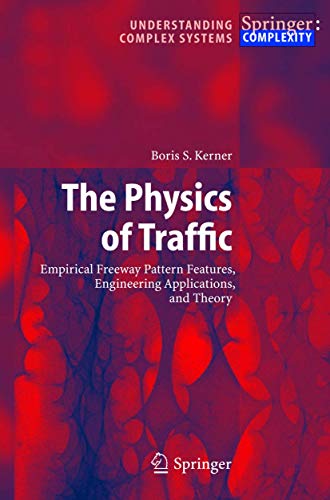
This monograph is devoted to a new approach to an old field of scientific investigation, freeway traffic research. Freeway traffic is an extremely complex spatiotemporal nonlinear dynamic process. For this reason, it is not surprising that empirical traffic pattern features have only recently been sufficiently understood. Such empirical features are in serious conflict with almost all earlier theoretical and model results. Consequently, the author introduced a new traffic flow theory called "three-phase traffic theory," which can explain these empirical spatiotemporal traffic patterns. The main focus of this book is a consideration of empirical spatiotemporal traffic pattern features, their engineering applications, and explanations based on the three-phase traffic theory. The book consists of four parts. In Part I, empirical studies of traffic flow patterns, earlier traffic flow theories, and mathematical models are briefly reviewed. Three-phase traffic theory is considered as well. This theory is a qualitative theory. Main ideas and results of the three-phase traffic flow the ory will be introduced and explained without complex mathematical models. This should be suitable for a very broad audience of practical engineers, physicists, and other readers who may not necessarily be specialists in traf fic flow problems, and who may not necessarily have worked in the field of spatiotemporal pattern formation. In Part II, empirical spatiotemporal traffic pattern features are consid ered. A microscopic three-phase traffic theory of these patterns and results of an application of the pattern features to engineering applications are pre sented in Part III and Part IV, respectively.
Die Inhaltsangabe kann sich auf eine andere Ausgabe dieses Titels beziehen.
Über die Autorin bzw. den Autor
Boris S. Kerner was born in Moscow in 1947 and graduated from Moscow Technical University MIREA in 1972. He received the Ph.D. and Sc.D. (Doctor of Sciences) degrees from the Academy of Sciences of the Soviet Union in 1979 and 1986, respectively. Between 1972 and 1992, his major research interests included the physics of semiconductors, plasma and solid-state physics as well as the development of a theory of autosolitons - solitary intrinsic states, which form in a broad class of physical, chemical and biological dissipative systems. Since 1992, he worked on understanding vehicular traffic at Daimler Company in Stuttgart, Germany. He is the pioneer of the three-phase traffic theory, which he introduced and developed in 1996-2002. Between 2000 and 2013, he was Head of Traffic, a field of research at Daimler. In 2011, he was appointed Professor at the University of Duisburg-Essen in Germany. Since his retirement from Daimler in 2013, Prof. Kernerhas been working at the University of Duisburg-Essen. He authored more than 260 scientific works and patents as well as five books that are devoted to a variety of physical systems, complex dynamics of traffic flow in traffic and transportation networks, applications of diverse intelligent transportation systems for traffic prognosis, traffic control, dynamic traffic assignment as well as to the study of autonomous and connected vehicles in mixed traffic flow.
Von der hinteren Coverseite
This book is devoted to the explanation of freeway traffic congestion, a fact of life for many car drivers. Results of empirical observations of freeway congestion, which exhibit diverse complex spatiotemporal patterns including moving traffic jams, are analyzed. Empirical features of these reproducible freeway traffic patterns only recently sufficiently well understood are reviewed. In the first part, three-phase traffic theory can be found, which is the basis for a physical theory of traffic phenomena and its applications in engineering. In the second part, the empirical spatiotemporal patterns are examined and, finally in parts III and IV, the mathematical model and the engineering applications are addressed. The Physics of Traffic addresses researchers and practitioners alike.
„Über diesen Titel“ kann sich auf eine andere Ausgabe dieses Titels beziehen.
Suchergebnisse für The Physics of Traffic: Empirical Freeway Pattern Features,...

Beispielbild für diese ISBN
The Physics of Traffic : Empirical Freeway Pattern Features, Engineering Applications, and Theory
Verlag:
Springer Berlin / Heidelberg, 2004
ISBN 10: 3540207163
ISBN 13: 9783540207160
Gebraucht
Hardcover
Anbieter: Better World Books Ltd, Dunfermline, Vereinigtes Königreich
Verkäuferbewertung 5 von 5 Sternen

Zustand: Good. Former library copy. Pages intact with minimal writing/highlighting. The binding may be loose and creased. Dust jackets/supplements are not included. Includes library markings. Stock photo provided. Product includes identifying sticker. Better World Books: Buy Books. Do Good. Bestandsnummer des Verkäufers 68481531-20
Gebraucht kaufen
EUR 35,20
EUR 5,97 Versand
Versand von Vereinigtes Königreich nach USA
Versand von Vereinigtes Königreich nach USA
Anzahl: 1 verfügbar
Beispielbild für diese ISBN
The Physics of Traffic: Empirical Freeway Pattern Features, Engineering Applications, and Theory (Understanding Complex Systems)
Print-on-DemandAnbieter: YESIBOOKSTORE, MIAMI, FL, USA
Verkäuferbewertung 5 von 5 Sternen
hardcover. Zustand: As New. This item is printed on demand. Bestandsnummer des Verkäufers 3540207163-VB
Gebraucht kaufen
EUR 73,81
Versand gratis
Versand innerhalb von USA
Versand innerhalb von USA
Anzahl: 1 verfügbar
Foto des Verkäufers
The Physics of Traffic: Empirical Freeway Pattern Features, Engineering Applications, and Theory.
Anbieter: Antiquariat Bookfarm, Löbnitz, Deutschland
Verkäuferbewertung 5 von 5 Sternen
Hardcover. Zustand: Gut. 708 S. Ex-library with stamp and library-signature in good condition, some traces of use. C-02879 9783540207160 Sprache: Englisch Gewicht in Gramm: 1150. Bestandsnummer des Verkäufers 2488765
Gebraucht kaufen
EUR 162,40
EUR 40,00 Versand
Versand von Deutschland nach USA
Versand von Deutschland nach USA
Anzahl: 1 verfügbar
Foto des Verkäufers
Physics of Traffic
Print-on-DemandAnbieter: moluna, Greven, Deutschland
Verkäuferbewertung 5 von 5 Sternen
Gebunden. Zustand: New. Dieser Artikel ist ein Print on Demand Artikel und wird nach Ihrer Bestellung fuer Sie gedruckt. The core of ths book presents a theory developed by the author to combine the recent insight into empirical data with mathematical models in freeway traffic research based on dynamical non-linear processes.|This monograph is devoted to a new approach. Bestandsnummer des Verkäufers 4884798
Neu kaufen
EUR 162,51
EUR 48,99 Versand
Versand von Deutschland nach USA
Versand von Deutschland nach USA
Anzahl: Mehr als 20 verfügbar
Foto des Verkäufers
The Physics of Traffic
Verlag:
Springer Berlin Heidelberg Nov 2004, 2004
ISBN 10: 3540207163
ISBN 13: 9783540207160
Neu
Hardcover
Anbieter: BuchWeltWeit Ludwig Meier e.K., Bergisch Gladbach, Deutschland
Verkäuferbewertung 5 von 5 Sternen
Buch. Zustand: Neu. This item is printed on demand - it takes 3-4 days longer - Neuware -The core of ths book presents a theory developed by the author to combine the recent insight into empirical data with mathematical models in freeway traffic research based on dynamical non-linear processes. 708 pp. Englisch. Bestandsnummer des Verkäufers 9783540207160
Neu kaufen
EUR 192,59
EUR 23,00 Versand
Versand von Deutschland nach USA
Versand von Deutschland nach USA
Anzahl: 2 verfügbar
Beispielbild für diese ISBN
Physics Of Traffic : Empirical Freeway Pattern Features, Engineering Applications, And Theory
Anbieter: GreatBookPrices, Columbia, MD, USA
Verkäuferbewertung 5 von 5 Sternen
Zustand: New. Bestandsnummer des Verkäufers 2589825-n
Neu kaufen
EUR 220,43
EUR 2,36 Versand
Versand innerhalb von USA
Versand innerhalb von USA
Anzahl: 15 verfügbar
Beispielbild für diese ISBN
Physics Of Traffic : Empirical Freeway Pattern Features, Engineering Applications, And Theory
Anbieter: GreatBookPrices, Columbia, MD, USA
Verkäuferbewertung 5 von 5 Sternen
Zustand: As New. Unread book in perfect condition. Bestandsnummer des Verkäufers 2589825
Gebraucht kaufen
EUR 229,95
EUR 2,36 Versand
Versand innerhalb von USA
Versand innerhalb von USA
Anzahl: 15 verfügbar
Beispielbild für diese ISBN
The Physics of Traffic: Empirical Freeway Pattern Features, Engineering Applications, and Theory (Understanding Complex Systems)
Anbieter: Ria Christie Collections, Uxbridge, Vereinigtes Königreich
Verkäuferbewertung 5 von 5 Sternen
Zustand: New. In English. Bestandsnummer des Verkäufers ria9783540207160_new
Neu kaufen
EUR 228,34
EUR 17,84 Versand
Versand von Vereinigtes Königreich nach USA
Versand von Vereinigtes Königreich nach USA
Anzahl: Mehr als 20 verfügbar
Foto des Verkäufers
The Physics of Traffic
Verlag:
Springer, Springer Vieweg Nov 2004, 2004
ISBN 10: 3540207163
ISBN 13: 9783540207160
Neu
Hardcover
Anbieter: buchversandmimpf2000, Emtmannsberg, BAYE, Deutschland
Verkäuferbewertung 5 von 5 Sternen
Buch. Zustand: Neu. This item is printed on demand - Print on Demand Titel. Neuware -This monograph is devoted to a new approach to an old field of scientific investigation, freeway traffic research. Freeway traffic is an extremely complex spatiotemporal nonlinear dynamic process. For this reason, it is not surprising that empirical traffic pattern features have only recently been sufficiently understood. Such empirical features are in serious conflict with almost all earlier theoretical and model results. Consequently, the author introduced a new traffic flow theory called 'three-phase traffic theory,' which can explain these empirical spatiotemporal traffic patterns. The main focus of this book is a consideration of empirical spatiotemporal traffic pattern features, their engineering applications, and explanations based on the three-phase traffic theory. The book consists of four parts. In Part I, empirical studies of traffic flow patterns, earlier traffic flow theories, and mathematical models are briefly reviewed. Three-phase traffic theory is considered as well. This theory is a qualitative theory. Main ideas and results of the three-phase traffic flow the ory will be introduced and explained without complex mathematical models. This should be suitable for a very broad audience of practical engineers, physicists, and other readers who may not necessarily be specialists in traf fic flow problems, and who may not necessarily have worked in the field of spatiotemporal pattern formation. In Part II, empirical spatiotemporal traffic pattern features are consid ered. A microscopic three-phase traffic theory of these patterns and results of an application of the pattern features to engineering applications are pre sented in Part III and Part IV, respectively.Springer-Verlag KG, Sachsenplatz 4-6, 1201 Wien 708 pp. Englisch. Bestandsnummer des Verkäufers 9783540207160
Neu kaufen
EUR 192,59
EUR 60,00 Versand
Versand von Deutschland nach USA
Versand von Deutschland nach USA
Anzahl: 1 verfügbar
Foto des Verkäufers
The Physics of Traffic : Empirical Freeway Pattern Features, Engineering Applications, and Theory
Anbieter: AHA-BUCH GmbH, Einbeck, Deutschland
Verkäuferbewertung 5 von 5 Sternen
Buch. Zustand: Neu. Druck auf Anfrage Neuware - Printed after ordering - This monograph is devoted to a new approach to an old field of scientific investigation, freeway traffic research. Freeway traffic is an extremely complex spatiotemporal nonlinear dynamic process. For this reason, it is not surprising that empirical traffic pattern features have only recently been sufficiently understood. Such empirical features are in serious conflict with almost all earlier theoretical and model results. Consequently, the author introduced a new traffic flow theory called 'three-phase traffic theory,' which can explain these empirical spatiotemporal traffic patterns. The main focus of this book is a consideration of empirical spatiotemporal traffic pattern features, their engineering applications, and explanations based on the three-phase traffic theory. The book consists of four parts. In Part I, empirical studies of traffic flow patterns, earlier traffic flow theories, and mathematical models are briefly reviewed. Three-phase traffic theory is considered as well. This theory is a qualitative theory. Main ideas and results of the three-phase traffic flow the ory will be introduced and explained without complex mathematical models. This should be suitable for a very broad audience of practical engineers, physicists, and other readers who may not necessarily be specialists in traf fic flow problems, and who may not necessarily have worked in the field of spatiotemporal pattern formation. In Part II, empirical spatiotemporal traffic pattern features are consid ered. A microscopic three-phase traffic theory of these patterns and results of an application of the pattern features to engineering applications are pre sented in Part III and Part IV, respectively. Bestandsnummer des Verkäufers 9783540207160
Neu kaufen
EUR 218,37
EUR 43,14 Versand
Versand von Deutschland nach USA
Versand von Deutschland nach USA
Anzahl: 1 verfügbar