
Verwandte Artikel zu Springer Handbook of Robotics: Book with DVD-rom
Inhaltsangabe
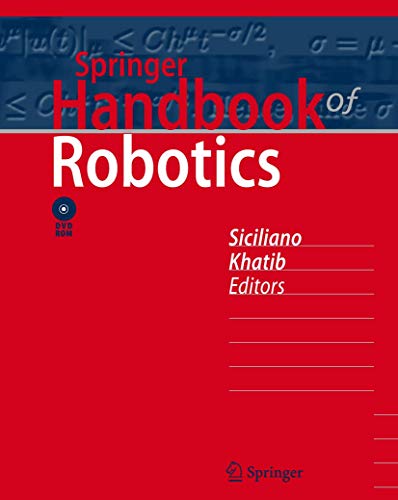
With the science of robotics undergoing a major transformation just now, Springer’s new, authoritative handbook on the subject couldn’t have come at a better time. Having broken free from its origins in industry, robotics has been rapidly expanding into the challenging terrain of unstructured environments. Unlike other handbooks that focus on industrial applications, the Springer Handbook of Robotics incorporates these new developments. Just like all Springer Handbooks, it is utterly comprehensive, edited by internationally renowned experts, and replete with contributions from leading researchers from around the world. The handbook is an ideal resource for robotics experts but also for people new to this expanding field.
Die Inhaltsangabe kann sich auf eine andere Ausgabe dieses Titels beziehen.
Über die Autorin bzw. den Autor
Bruno Siciliano is Professor of Control and Robotics at the University of Naples Federico II in Italy, President of the IEEE Robotics and Automation Society, and a Fellow of both IEEE and ASME.
Oussama Khatib is Professor of Computer Science at Stanford University in the USA, President of the International Foundation of Robotics Research, an IEEE Fellow, and a recipient of the Japan Robot Association Award in Research and Development.
Von der hinteren Coverseite
Reaching for the human frontier, robotics is vigorously engaged in the growing challenges of new emerging domains. Interacting, exploring, and working with humans, the new generation of robots will increasingly touch people and their lives. The credible prospect of practical robots among humans is the result of the scientific endeavour of a half a century of robotic developments that established robotics as a modern scientific discipline. The Springer Handbook of Robotics brings a widespread
and well-structured compilation of classic and emerging application areas of robotics. From the foundations to the social and ethical implications of robotics, the handbook provides a comprehensive collection of the accomplishments in the field, and constitutes a premise of further advances towards new challenges in robotics.
This handbook, edited by two internationally renowned scientists with the support of an outstanding team of seven part editors and onehundred sixty-four authors, is an authoritative reference for robotics researchers, newcomers to the field, and scholars from related disciplines such as biomechanics, neurosciences, virtual simulation, animation, surgery, and sensor networks among others.
Key Topics
- Robotics foundations
- Robot structures
- Sensing and perception
- Manipulation and interfaces
- Mobile and distributed robotics
- Field and service robotics
- Human-centered and life-like robotics
Features
- Comprehensive coverage of research and development in robotics
- Scientific resource for both experts and non experts in the field
- Technical contents laid out in a tutorial setting
- A coherent three-layer organization: robotics foundations, consolidated
methodologies and technologies, advanced applications - Anchored in seven parts expanded into sixty-four chapters with interconnected
presentation of subject matter - Developed in about 1650 pages with over 950 color illustrations including
422 four-color, 80 tables and over 5500 references - Detailed index and fully searchable DVD-ROM providing rapid access to
data and links to other source
„Über diesen Titel“ kann sich auf eine andere Ausgabe dieses Titels beziehen.
Suchergebnisse für Springer Handbook of Robotics: Book with DVD-rom

Beispielbild für diese ISBN
Springer Handbook of Robotics
Anbieter: Buchpark, Trebbin, Deutschland
Verkäuferbewertung 5 von 5 Sternen

Zustand: Sehr gut. Zustand: Sehr gut | Seiten: 1611 | Sprache: Englisch | Produktart: Bücher | Keine Beschreibung verfügbar. Bestandsnummer des Verkäufers 1727066/202
Gebraucht kaufen
EUR 254,85
EUR 105,00 Versand
Versand von Deutschland nach USA
Versand von Deutschland nach USA
Anzahl: 1 verfügbar
Beispielbild für diese ISBN
"Springer Handbook of Robotics Incl DVD [Englisch] [Gebundene Ausgabe] Methods of Robotics Biologically-Inspired Robots Industrial Robotics Roboter Life-Like Robotics Manipulation and Interfaces of Robots Mobile and Distributed Robotics Roboethics Roboter Robotics Foundations Robot Structures Sensing and Perception of Robots Elektrotechnik Energietechnik ISBN-10 3-540-23957-X 354023957X ISBN-13 978-3-540-23957-4 9783540239574 Bruno Siciliano (Herausgeber), Oussama Khatib (Herausgeber) Robotik Robotertechnik Basic Principles and Methods of Robotics Biologically-Inspired Robots Industrial Robotics Life-Like Robotics Manipulation and Interfaces of Robots Mobile and Distributed Robotics Roboethics Roboter Robotics Foundations Robot Structures Sensing and Perception of Robots Elektrotechnik Energietechnik A new, authoritative and utterly comprehensive reference work on robotics that incorporates new developments, surpassing the narrow scope of other robotics handbooks that focus on industri
Verlag:
Springer Auflage: 2008 (20. Mai 2008), 2008
ISBN 10: 354023957X
ISBN 13: 9783540239574
Gebraucht
Hardcover
Anbieter: BUCHSERVICE / ANTIQUARIAT Lars Lutzer, Wahlstedt, Deutschland
Verkäuferbewertung 5 von 5 Sternen
Hardcover. Zustand: gut. Auflage: 2008 (20. Mai 2008). "A new, authoritative and utterly comprehensive reference work on robotics that incorporates new developments, surpassing the narrow scope of other robotics handbooks that focus on industrial applications. Edited by internationally renowned experts. With the science of robotics undergoing a major transformation just now, Springer's new, authoritative handbook on the subject couldn't have come at a better time. Having broken free from its origins in industry, robotics has been rapidly expanding into the challenging terrain of unstructured environments. Unlike other handbooks that focus on industrial applications, the Springer Handbook of Robotics incorporates these new developments. Just like all Springer Handbooks, it is utterly comprehensive, edited by internationally renowned experts, and replete with contributions from leading researchers from around the world. The handbook is an ideal resource for robotics experts but also for people new to this expanding field. With the science of robotics undergoing a major transformation just now, Springer's new, authoritative handbook on the subject couldn't have come at a better time. Having broken free from its origins in industry, robotics has been rapidly expanding into the challenging terrain of unstructured environments. Unlike other handbooks that focus on industrial applications, the Springer Handbook of Robotics incorporates these new developments. Just like all Springer Handbooks, it is utterly comprehensive, edited by internationally renowned experts, and replete with contributions from leading researchers from around the world. The handbook is an ideal resource for robotics experts but also for people new to this expanding field. Bruno Siciliano is Professor of Control and Robotics at the University of Naples Federico II in Italy, President of the IEEE Robotics and Automation Society, and a Fellow of both IEEE and ASME. Oussama Khatib is Professor of Computer Science at Stanford University in the USA, President of the International Foundation of Robotics Research, an IEEE Fellow, and a recipient of the Japan Robot Association Award in Research and Development. Introduction (Bruno Siciliano, Oussama Khatib) Part A: Robotics Foundations (David Orin) Part A presents the fundamental principles and methods that are used to model, design, and control a robotic system. All of the foundational topics are included in this part: kinematics, dynamics, mechanical design and actuation, sensing and estimation, motion planning, motion control, force control, robotic systems architectures and programming, and AI reasoning methods for task planning and learning. A chapter is devoted to each of these topics. The topics are expanded and applied to specific robotic structures and systems in subsequent parts. Chap. 1. Kinematics (Ken Waldron, James Schmiedeler) Chap. 2. Dynamics (Roy Featherstone, David Orin) Chap. 3. Mechanisms and Actuation (Victor Scheinman, Michael McCarthy) Chap. 4. Sensing and Estimation (Henrik Christensen, Gregory Hager) Chap. 5. Motion Planning (Lydia Kavraki, Steve LaValle) Chap. 6. Motion Control (Wankyun Chung, Li-Chen Fu, Su-Hau Hsu) Chap. 7. Force Control (Luigi Villani, Joris De Schutter) Chap. 8. Robotic Systems Architectures and Programming (David Kortenkamp, Reid Simmons) Chap. 9. AI Reasoning Methods for Robotics (Joachim Hertzberg, Raja Chatila) Part B: Robot Structures (Frank Park) Part B is concerned with the design, modeling, motion planning, and control of the actual physical realizations of a robot. Some of the more obvious mechanical structures that come to mind are arms, legs, and hands; to this list can be added wheeled vehicles and platforms, and robot structures at the micro and nano scales. With separate chapters devoted to performance criteria and model identification, the chapters in this part successively examine serial redundant mechanisms, parallel mechanisms, flexible robots, robot hands, robot legs, wheeled robots, and micro- and nanoscale robots. Chap. 10. Performance Evaluation and Design Criteria (Jorge Angeles, Frank Park) Chap. 11. Redundant Manipulators (Stefano Chiaverini, Giuseppe Oriolo, Ian Walker) Chap. 12. Parallel Mechanisms and Robots (Jean-Pierre Merlet, Clément Gosselin) Chap. 13. Robots with Flexible Elements (Alessandro De Luca, Wayne Book) Chap. 14. Model Identification (John Hollerbach, Wisama Khalil, Maxime Gautier, ) Chap. 15. Robot Hands (Claudio Melchiorri, Makoto Kaneko) Chap. 16. Legged Robots (Shuuji Kajita, Bernard Espiau) Chap. 17. Wheeled Robots (Guy Campion, Woojin Chung) Chap. 18. Micro/Nano Robots (Brad Nelson, Lixin Dong, Fumihito Arai) Part C: Sensing and Perception (Henrik Christensen) Part C covers different sensory modalities and integration of sensor data across space and time to generate models of robots and the external environment. The main sensor types such as tactile, odometry, GPS, ranging and visual perception are presented. Both basic sensor models, sensor data processing and associated representations are covered. Finally, a chapter on sensor fusion itroduces the mathematical tools needed for integration of sensor information across space and time. Chap. 19. Force and Tactile Sensors (Mark Cutkosky, Robert Howe, William Provancher) Chap. 20. Inertial Sensors, GPS and Odometry (Gregory Dudek, Michael Jenkin) Chap. 21. Sonar Sensing (Lindsay Kleeman, Roman Kuc) Chap. 22. Range Sensors (Robert Fisher, Kurt Konolige) Chap. 23. 3D Vision and Recognition (Kostas Daniliidis, Jan-Olof Eklundh) Chap. 24. Visual Servoing and Visual Tracking (François Chaumette, Seth Hutchinson) Chap. 25. Sensor Fusion (Hugh Durrant-Whyte, Tom Henderson) Part D: Manipulation and Interfaces (Makoto Kaneko) Part D is separated into two subparts. The first half is concerned with manipulation where frameworks of modeling, motion planning, and control of grasp and manipulation of an object are addressed, and the second half is concerned with interfaces where physical human-robot interac. Bestandsnummer des Verkäufers BN22299
Gebraucht kaufen
EUR 479,90
EUR 39,95 Versand
Versand von Deutschland nach USA
Versand von Deutschland nach USA
Anzahl: 1 verfügbar