
Verwandte Artikel zu Gravitational Lensing: Strong, Weak and Micro: Saas-Fee...
Gravitational Lensing: Strong, Weak and Micro: Saas-Fee Advanced Course 33 - Hardcover
Buch 13 von 26: Saas-Fee Advanced Course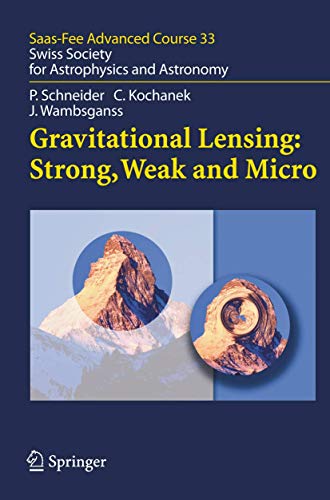
Inhaltsangabe
The observation, in 1919 by A.S. Eddington and collaborators, of the gra- tational de?ection of light by the Sun proved one of the many predictions of Einstein’s Theory of General Relativity: The Sun was the ?rst example of a gravitational lens. In 1936, Albert Einstein published an article in which he suggested - ing stars as gravitational lenses. A year later, Fritz Zwicky pointed out that galaxies would act as lenses much more likely than stars, and also gave a list of possible applications, as a means to determine the dark matter content of galaxies and clusters of galaxies. It was only in 1979 that the ?rst example of an extragalactic gravitational lens was provided by the observation of the distant quasar QSO 0957+0561, by D. Walsh, R.F. Carswell, and R.J. Weymann. A few years later, the ?rst lens showing images in the form of arcs was detected. The theory, observations, and applications of gravitational lensing cons- tute one of the most rapidly growing branches of astrophysics. The gravi- tional de?ection of light generated by mass concentrations along a light path producesmagni?cation,multiplicity,anddistortionofimages,anddelaysp- ton propagation from one line of sight relative to another. The huge amount of scienti?c work produced over the last decade on gravitational lensing has clearly revealed its already substantial and wide impact, and its potential for future astrophysical applications.
Die Inhaltsangabe kann sich auf eine andere Ausgabe dieses Titels beziehen.
Über die Autorin bzw. den Autor
Peter Schneider is a Full Professor for Astrophysics at the University of Bonn and Founding Director of the Argelander-Institut für Astronomie, Bonn. He is one of the internationally most respected German astrophysicists, well known for his research on gravitational lensing (strong and weak) and cosmology, and author of 3 successful Springer books.
Von der hinteren Coverseite
The theory, observations, and applications of gravitational lensing constitute one of the most rapidly growing branches of astrophysics. The gravitational deflection of light generated by mass concentrations along a light path produces magnification, multiplicity, and distortion of images and delays photon propagation from one line of sight relative to another. The huge amount of scientific work on gravitational lensing produced over the last decade has clearly revealed its already substantial and wide impact and its potential for future astrophysical applications.
The up-to-date contributions in this book are based on the lecture notes of the 33rd Saas–Fee Advanced Course of the Swiss Society of Astronomy and Astrophysics, entitled Gravitational Lensing: Strong, Weak, and Micro. The book comprises four complementary parts, written by leading experts in the field, constituting a genuine textbook about gravitational lensing:
• Peter Schneider – Part 1: Introduction to Gravitational Lensing and Cosmology
• Christopher Kochanek – Part 2: Strong Gravitational Lensing
• Peter Schneider – Part 3: Weak Gravitational Lensing
• Joachim Wambsganss – Part 4: Gravitational Microlensing
Students and researchers alike will benefit from this comprehensive presentation of the astrophysical and astronomical aspects of gravitational lensing.
„Über diesen Titel“ kann sich auf eine andere Ausgabe dieses Titels beziehen.
Suchergebnisse für Gravitational Lensing: Strong, Weak and Micro: Saas-Fee...

Foto des Verkäufers
GRAVITATIONAL LENSING: Strong, Weak and Micro
Anbieter: johnson rare books & archives, ABAA, Covina, CA, USA
Verkäuferbewertung 5 von 5 Sternen

Hardcover. Zustand: Very good. Saas-Fee Advanced Course 33. Octavo: 552 p. with 196 illustrations, including 36 in color. Original glossy boards; issued without a dust jacket. The top corner of the rear board is bumped; else a crisp and clean copy. Better than very good. Bestandsnummer des Verkäufers 74884
Gebraucht kaufen
EUR 55,38
EUR 5,15 Versand
Versand innerhalb von USA
Versand innerhalb von USA
Anzahl: 1 verfügbar
Foto des Verkäufers
Gravitational Lensing : Strong, Weak, And Micro
Anbieter: GreatBookPrices, Columbia, MD, USA
Verkäuferbewertung 5 von 5 Sternen
Zustand: As New. Unread book in perfect condition. Bestandsnummer des Verkäufers 4083562
Gebraucht kaufen
EUR 136,11
EUR 2,37 Versand
Versand innerhalb von USA
Versand innerhalb von USA
Anzahl: Mehr als 20 verfügbar
Foto des Verkäufers
Gravitational Lensing: Strong, Weak and Micro
Verlag:
Springer Berlin Heidelberg Mai 2006, 2006
ISBN 10: 354030309X
ISBN 13: 9783540303091
Neu
Hardcover
Anbieter: BuchWeltWeit Ludwig Meier e.K., Bergisch Gladbach, Deutschland
Verkäuferbewertung 5 von 5 Sternen
Buch. Zustand: Neu. This item is printed on demand - it takes 3-4 days longer - Neuware -The observation, in 1919 by A.S. Eddington and collaborators, of the gra- tational de ection of light by the Sun proved one of the many predictions of Einstein's Theory of General Relativity: The Sun was the rst example of a gravitational lens. In 1936, Albert Einstein published an article in which he suggested - ing stars as gravitational lenses. A year later, Fritz Zwicky pointed out that galaxies would act as lenses much more likely than stars, and also gave a list of possible applications, as a means to determine the dark matter content of galaxies and clusters of galaxies. It was only in 1979 that the rst example of an extragalactic gravitational lens was provided by the observation of the distant quasar QSO 0957+0561, by D. Walsh, R.F. Carswell, and R.J. Weymann. A few years later, the rst lens showing images in the form of arcs was detected. The theory, observations, and applications of gravitational lensing cons- tute one of the most rapidly growing branches of astrophysics. The gravi- tional de ection of light generated by mass concentrations along a light path producesmagni cation,multiplicity,anddistortionofimages,anddelaysp- ton propagation from one line of sight relative to another. The huge amount of scienti c work produced over the last decade on gravitational lensing has clearly revealed its already substantial and wide impact, and its potential for future astrophysical applications. 572 pp. Englisch. Bestandsnummer des Verkäufers 9783540303091
Neu kaufen
EUR 117,69
EUR 23,00 Versand
Versand von Deutschland nach USA
Versand von Deutschland nach USA
Anzahl: 2 verfügbar
Beispielbild für diese ISBN
Gravitational Lensing: Strong, Weak and Micro: Saas-Fee Advanced Course 33
Anbieter: California Books, Miami, FL, USA
Verkäuferbewertung 5 von 5 Sternen
Zustand: New. Bestandsnummer des Verkäufers I-9783540303091
Neu kaufen
EUR 141,23
EUR 2,69 Versand
Versand innerhalb von USA
Versand innerhalb von USA
Anzahl: Mehr als 20 verfügbar
Foto des Verkäufers
Gravitational Lensing : Strong, Weak, And Micro
Anbieter: GreatBookPrices, Columbia, MD, USA
Verkäuferbewertung 5 von 5 Sternen
Zustand: New. Bestandsnummer des Verkäufers 4083562-n
Neu kaufen
EUR 141,55
EUR 2,37 Versand
Versand innerhalb von USA
Versand innerhalb von USA
Anzahl: Mehr als 20 verfügbar
Foto des Verkäufers
Gravitational Lensing: Strong, Weak and Micro
Anbieter: moluna, Greven, Deutschland
Verkäuferbewertung 5 von 5 Sternen
Gebunden. Zustand: New. Bestandsnummer des Verkäufers 4887389
Neu kaufen
EUR 101,04
EUR 48,99 Versand
Versand von Deutschland nach USA
Versand von Deutschland nach USA
Anzahl: Mehr als 20 verfügbar
Foto des Verkäufers
Gravitational Lensing : Strong, Weak, And Micro
Anbieter: GreatBookPricesUK, Woodford Green, Vereinigtes Königreich
Verkäuferbewertung 5 von 5 Sternen
Zustand: New. Bestandsnummer des Verkäufers 4083562-n
Neu kaufen
EUR 132,93
EUR 18,00 Versand
Versand von Vereinigtes Königreich nach USA
Versand von Vereinigtes Königreich nach USA
Anzahl: Mehr als 20 verfügbar
Foto des Verkäufers
Gravitational Lensing : Strong, Weak, And Micro
Anbieter: GreatBookPricesUK, Woodford Green, Vereinigtes Königreich
Verkäuferbewertung 5 von 5 Sternen
Zustand: As New. Unread book in perfect condition. Bestandsnummer des Verkäufers 4083562
Gebraucht kaufen
EUR 143,56
EUR 18,00 Versand
Versand von Vereinigtes Königreich nach USA
Versand von Vereinigtes Königreich nach USA
Anzahl: Mehr als 20 verfügbar
Beispielbild für diese ISBN
Gravitational Lensing: Strong, Weak and Micro: Saas-Fee Advanced Course 33
Anbieter: BennettBooksLtd, Los Angeles, CA, USA
Verkäuferbewertung 5 von 5 Sternen
hardcover. Zustand: New. In shrink wrap. Looks like an interesting title! Bestandsnummer des Verkäufers Q-354030309X
Neu kaufen
EUR 156,41
EUR 6,23 Versand
Versand innerhalb von USA
Versand innerhalb von USA
Anzahl: 1 verfügbar
Foto des Verkäufers
Gravitational Lensing: Strong, Weak and Micro
ISBN 10: 354030309X
ISBN 13: 9783540303091
Neu
Hardcover
Anbieter: Rarewaves.com USA, London, LONDO, Vereinigtes Königreich
Verkäuferbewertung 5 von 5 Sternen
Hardback. Zustand: New. 2006 ed. The observation, in 1919 by A.S. Eddington and collaborators, of the gra- tational de?ection of light by the Sun proved one of the many predictions of Einstein's Theory of General Relativity: The Sun was the ?rst example of a gravitational lens. In 1936, Albert Einstein published an article in which he suggested - ing stars as gravitational lenses. A year later, Fritz Zwicky pointed out that galaxies would act as lenses much more likely than stars, and also gave a list of possible applications, as a means to determine the dark matter content of galaxies and clusters of galaxies. It was only in 1979 that the ?rst example of an extragalactic gravitational lens was provided by the observation of the distant quasar QSO 0957+0561, by D. Walsh, R.F. Carswell, and R.J. Weymann. A few years later, the ?rst lens showing images in the form of arcs was detected. The theory, observations, and applications of gravitational lensing cons- tute one of the most rapidly growing branches of astrophysics. The gravi- tional de?ection of light generated by mass concentrations along a light path producesmagni?cation,multiplicity,anddistortionofimages,anddelaysp- ton propagation from one line of sight relative to another. The huge amount of scienti?c work produced over the last decade on gravitational lensing has clearly revealed its already substantial and wide impact, and its potential for future astrophysical applications. Bestandsnummer des Verkäufers LU-9783540303091
Neu kaufen
EUR 173,45
Versand gratis
Versand von Vereinigtes Königreich nach USA
Versand von Vereinigtes Königreich nach USA
Anzahl: Mehr als 20 verfügbar