
Verwandte Artikel zu Weak Links: The Universal Key to the Stability of Networks...
Weak Links: The Universal Key to the Stability of Networks and Complex Systems (The Frontiers Collection) - Hardcover
Buch 14 von 82: The Frontiers Collection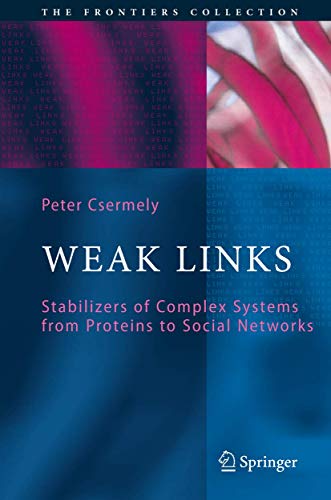
Inhaltsangabe
How can our societies be stabilized in a crisis? Why can we enjoy and understand Shakespeare? Why are fruitflies uniform? How do omnivorous eating habits aid our survival? What makes the Mona Lisa’s smile beautiful? How do women keep our social structures intact? – Could there possibly be a single answer to all these questions? This book shows that the statement: "weak links stabilize complex systems" provides the key to understanding each of these intriguing puzzles, and many others too. The author (recipient of several distinguished science communication prizes) uses weak (low affinity, low probability) interactions as a thread to introduce a vast variety of networks from proteins to economics and ecosystems. Many people, from Nobel Laureates to high-school students have helped to make the book understandable to all interested readers. This unique book and the ideas it develops will have a significant impact on many, seemingly diverse, fields of study.
Die Inhaltsangabe kann sich auf eine andere Ausgabe dieses Titels beziehen.
Über die Autorin bzw. den Autor
Peter Csermely (50) is a professor at the Semmelweis University in Budapest. A former Fogarty Fellow at Harvard University, his main fields of study are molecular chaperones and networks. In 1996 Dr. Csermely launched a highly successful initiative providing research opportunities for more than 10,000 gifted high school students. He also established the Hungarian National Talent Support Council and the Network of Youth Excellence, www.nyex.info, promoting similar activities in 33 countries. He has published 11 books and more than 200 research papers. Dr. Csermely holds several distinguished appointments including membership of the Wise Persons' Council of the Hungarian President, vice-president of the Hungarian Biochemical Society and has been recipient of numerous international fellowships and awards, for example the 2003 Science Communication Award of the European Molecular Biology Organization and the 2004 Descartes Award of the European Union for Science Communication.
Von der hinteren Coverseite
How can our societies be stabilized in a crisis? Why can we enjoy and understand Shakespeare? Why are fruitflies uniform? How do omnivorous eating habits aid our survival? What makes the Mona Lisa’s smile beautiful? How do women keep our social structures intact? – Could there possibly be a single answer to all these questions? This book shows that the statement: "weak links stabilize complex systems" provides the key to understanding each of these intriguing puzzles, and many others too. The author (recipient of several distinguished science communication prizes) uses weak (low affinity, low probability) interactions as a thread to introduce a vast variety of networks from proteins to economics and ecosystems. Many people, from Nobel Laureates to high-school students have helped to make the book understandable to all interested readers. This unique book and the ideas it develops will have a significant impact on many, seemingly diverse, fields of study.
A very personal, engaging, and unique book that will appeal to readers and get them thinking
Steve Strogatz
An adventurous, entertainingly eclectic and rich work both for experts and laymen
László-Albert Barabási
This masterpiece should serve as an example of how science can be discussed
György Buzsáki
Outstanding - I wish more books were written this way
Daniel J. Bilar
„Über diesen Titel“ kann sich auf eine andere Ausgabe dieses Titels beziehen.
Suchergebnisse für Weak Links: The Universal Key to the Stability of Networks...

Beispielbild für diese ISBN
Weak Links : Stabilizers of Complex Systems from Proteins to Social Networks
Verlag:
Springer Berlin / Heidelberg, 2006
ISBN 10: 3540311513
ISBN 13: 9783540311515
Gebraucht
Hardcover
Erstausgabe
Anbieter: Better World Books, Mishawaka, IN, USA
Verkäuferbewertung 5 von 5 Sternen

Zustand: Good. 1st Edition. Former library copy. Pages intact with minimal writing/highlighting. The binding may be loose and creased. Dust jackets/supplements are not included. Includes library markings. Stock photo provided. Product includes identifying sticker. Better World Books: Buy Books. Do Good. Bestandsnummer des Verkäufers 10682826-6
Gebraucht kaufen
EUR 15,88
Versand gratis
Versand innerhalb von USA
Versand innerhalb von USA
Anzahl: 1 verfügbar
Beispielbild für diese ISBN
Weak Links : Stabilizers of Complex Systems from Proteins to Social Networks
Verlag:
Springer Berlin / Heidelberg, 2006
ISBN 10: 3540311513
ISBN 13: 9783540311515
Gebraucht
Hardcover
Erstausgabe
Anbieter: Better World Books: West, Reno, NV, USA
Verkäuferbewertung 5 von 5 Sternen
Zustand: Very Good. 1st Edition. Former library copy. Pages intact with possible writing/highlighting. Binding strong with minor wear. Dust jackets/supplements may not be included. Includes library markings. Stock photo provided. Product includes identifying sticker. Better World Books: Buy Books. Do Good. Bestandsnummer des Verkäufers 12439927-75
Gebraucht kaufen
EUR 15,88
Versand gratis
Versand innerhalb von USA
Versand innerhalb von USA
Anzahl: 1 verfügbar
Beispielbild für diese ISBN
Weak Links: The Universal Key to the Stability of Networks and Complex Systems
Anbieter: ThriftBooks-Dallas, Dallas, TX, USA
Verkäuferbewertung 5 von 5 Sternen
Hardcover. Zustand: Good. No Jacket. Pages can have notes/highlighting. Spine may show signs of wear. ~ ThriftBooks: Read More, Spend Less. Bestandsnummer des Verkäufers G3540311513I3N00
Gebraucht kaufen
EUR 29,06
Versand gratis
Versand innerhalb von USA
Versand innerhalb von USA
Anzahl: 1 verfügbar
Beispielbild für diese ISBN
Weak Links: The Universal Key to the Stability of Networks and Complex Systems
Anbieter: ThriftBooks-Atlanta, AUSTELL, GA, USA
Verkäuferbewertung 5 von 5 Sternen
Hardcover. Zustand: As New. No Jacket. Pages are clean and are not marred by notes or folds of any kind. ~ ThriftBooks: Read More, Spend Less. Bestandsnummer des Verkäufers G3540311513I2N00
Gebraucht kaufen
EUR 29,06
Versand gratis
Versand innerhalb von USA
Versand innerhalb von USA
Anzahl: 1 verfügbar
Beispielbild für diese ISBN
Weak Links: The Universal Key to the Stability of Networks and Complex Systems (The Frontiers Collection) [Hardcover] Csermely, Peter
Anbieter: Lakeside Books, Benton Harbor, MI, USA
Verkäuferbewertung 5 von 5 Sternen
Zustand: New. Brand New! Not Overstocks or Low Quality Book Club Editions! Direct From the Publisher! We're not a giant, faceless warehouse organization! We're a small town bookstore that loves books and loves it's customers! Buy from Lakeside Books! Bestandsnummer des Verkäufers OTF-S-9783540311515
Neu kaufen
EUR 34,42
EUR 3,55 Versand
Versand innerhalb von USA
Versand innerhalb von USA
Anzahl: Mehr als 20 verfügbar
Foto des Verkäufers
Weak Links : Stabilizers of Complex Systems from Proteins to Social Networks
Anbieter: GreatBookPrices, Columbia, MD, USA
Verkäuferbewertung 5 von 5 Sternen
Zustand: New. Bestandsnummer des Verkäufers 4154558-n
Neu kaufen
EUR 35,64
EUR 2,35 Versand
Versand innerhalb von USA
Versand innerhalb von USA
Anzahl: Mehr als 20 verfügbar
Foto des Verkäufers
Weak Links: The Universal Key to the Stability of Networks and Complex Systems (Hardback or Cased Book)
Anbieter: BargainBookStores, Grand Rapids, MI, USA
Verkäuferbewertung 5 von 5 Sternen
Hardback or Cased Book. Zustand: New. Weak Links: The Universal Key to the Stability of Networks and Complex Systems. Book. Bestandsnummer des Verkäufers BBS-9783540311515
Foto des Verkäufers
Weak Links : Stabilizers of Complex Systems from Proteins to Social Networks
Anbieter: GreatBookPrices, Columbia, MD, USA
Verkäuferbewertung 5 von 5 Sternen
Zustand: As New. Unread book in perfect condition. Bestandsnummer des Verkäufers 4154558
Gebraucht kaufen
EUR 41,89
EUR 2,35 Versand
Versand innerhalb von USA
Versand innerhalb von USA
Anzahl: Mehr als 20 verfügbar
Beispielbild für diese ISBN
Weak Links: The Universal Key to the Stability of Networks and Complex Systems (The Frontiers Collection)
Anbieter: California Books, Miami, FL, USA
Verkäuferbewertung 5 von 5 Sternen
Zustand: New. Bestandsnummer des Verkäufers I-9783540311515
Neu kaufen
EUR 44,85
Versand gratis
Versand innerhalb von USA
Versand innerhalb von USA
Anzahl: Mehr als 20 verfügbar
Foto des Verkäufers
Weak Links, Stabilizers of Complex Systems from Proteins to Social Networks
Verlag:
Springer, New York, 2006
ISBN 10: 3540311513
ISBN 13: 9783540311515
Gebraucht
Hardcover
Erstausgabe
Anbieter: Roger Lucas Booksellers, Horncastle, Vereinigtes Königreich
Verkäuferbewertung 5 von 5 Sternen
Hard Cover. Zustand: Very Good. First Edition. 1st US edition, 8vo, 392pp, line drawings and diagrams, illustrated boards; VG/VG+ Copy, no DJ as issued Size: 8vo - over 7¾" - 9¾" tall. Bestandsnummer des Verkäufers 49539
Gebraucht kaufen
EUR 27,33
EUR 21,22 Versand
Versand von Vereinigtes Königreich nach USA
Versand von Vereinigtes Königreich nach USA
Anzahl: 1 verfügbar