
Verwandte Artikel zu Lexical Semantics and Knowledge Representation: First...
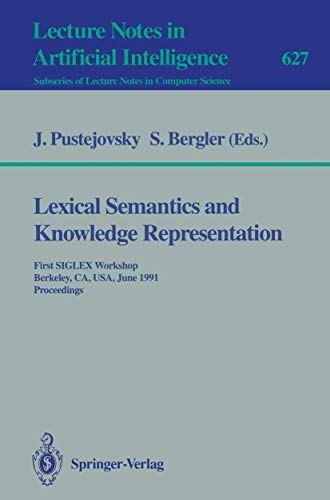
Lexical Semantics and Knowledge Representation: First SIGLEX Workshop, Berkeley, CA, USA, June 17, 1991. Proceedings (Lecture Notes in Computer Science, 627, Band 627) - Softcover
Inhaltsangabe
Recent work on formal methods in computational lexical semantics has had theeffect of bringing many linguistic formalisms much closer to the knowledge representation languages used in artificial intelligence. Formalisms are now emerging which may be more expressive and formally better understood than many knowledge representation languages. The interests of computational linguists now extend to include such domains as commonsense knowledge, inheritance, default reasoning, collocational relations, and even domain knowledge. With such an extension of the normal purview of "linguistic" knowledge, one may question whether there is any logical justification for distinguishing between lexical semantics and commonsense reasoning. This volume explores the question from several methodologicaland theoretical perspectives. What emerges is a clear consensus that the notion of the lexicon and lexical knowledge assumed in earlier linguistic research is grossly inadequate and fails to address the deeper semantic issues required for natural language analysis.
Die Inhaltsangabe kann sich auf eine andere Ausgabe dieses Titels beziehen.
Über die Autorin bzw. den Autor
Parisa Kordjamshidi, Ph.D, is an Associate Professor in the Department of Computer Science and Engineering at Michigan State University. She received her Ph.D. in Computer Science from KU Leuven. Dr. Kordjamshidi's main research interests are natural language processing, combining vision and language, and neurosymbolic AI.
Marie-Francine (Sien) Moens, Ph.D, is Professor Emerita in the Department of Computer Science and Director of the Language Intelligence and Information Retrieval Lab (LIIR) at KU Leuven. Her research interests include machine learning for natural language, speech, and image processing; multimedia information retrieval; deep learning and latent variable models; and language understanding, information extraction from text, and content recognition.
James Pustejovsky, Ph.D., is the TJX Feldberg Chair in Computer Science at Brandeis University, where he is also Chair of the Linguistics Program, Chair of the Computational Linguistics M.S. Program, and Director of the Lab for Linguistics and Computation. He has authored numerous books on lexical and computational semantics, linguistic annotation, and temporal and spatial reasoning. He conducts research in areas of computational linguistics, lexical semantics, multimodal interactions and reasoning, situated grounding, and developing standards and annotated datasets for machine learning.
Von der hinteren Coverseite
Recent work on formal methods in computational lexical semantics has had theeffect of bringing many linguistic formalisms much closer to the knowledge representation languages used in artificial intelligence. Formalisms are now emerging which may be more expressive and formally better understood than many knowledge representation languages. The interests of computational linguists now extend to include such domains as commonsense knowledge, inheritance, default reasoning, collocational relations, and even domain knowledge. With such an extension of the normal purview of "linguistic" knowledge, one may question whether there is any logical justification for distinguishing between lexical semantics and commonsense reasoning. This volume explores the question from several methodologicaland theoretical perspectives. What emerges is a clear consensus that the notion of the lexicon and lexical knowledge assumed in earlier linguistic research is grossly inadequate and fails to address the deeper semantic issues required for natural language analysis.
„Über diesen Titel“ kann sich auf eine andere Ausgabe dieses Titels beziehen.
Ihre gesetzlichen Garantierechte: Alle Verbraucher:innen in der EU profitieren von mindestens 2 Jahren gesetzlichem Garantieschutz für alle in der EU verkauften Konsumgüter. Mehr erfahren
Suchergebnisse für Lexical Semantics and Knowledge Representation: First...

Foto des Verkäufers
Lexical Semantics and Knowledge Representation : First Siglex Workshop, Berkeley, Ca, USA, June 17, 1991. Proceedings
Anbieter: GreatBookPrices, Columbia, MD, USA
Verkäuferbewertung 5 von 5 Sternen

Zustand: New. Bestandsnummer des Verkäufers 5906298-n
Neu kaufen
EUR 59,12
EUR 2,41 Versand
Versand innerhalb von USA
Versand innerhalb von USA
Anzahl: Mehr als 20 verfügbar
Foto des Verkäufers
Lexical Semantics and Knowledge Representation: First Siglex Workshop, Berkeley, Ca, Usa, June 17, 1991. Proceedings (Paperback or Softback)
Verlag:
Springer 9/10/1992, 1992
ISBN 10: 3540558012
ISBN 13: 9783540558019
Neu
Paperback or Softback
Anbieter: BargainBookStores, Grand Rapids, MI, USA
Verkäuferbewertung 5 von 5 Sternen
Paperback or Softback. Zustand: New. Lexical Semantics and Knowledge Representation: First Siglex Workshop, Berkeley, Ca, Usa, June 17, 1991. Proceedings. Book. Bestandsnummer des Verkäufers BBS-9783540558019
Beispielbild für diese ISBN
Lexical Semantics and Knowledge Representation : First SIGLEX Workshop, Berkeley, CA, USA, June 17, 1991. Proceedings
Print-on-DemandAnbieter: Chiron Media, Wallingford, Vereinigtes Königreich
Verkäuferbewertung 5 von 5 Sternen
PF. Zustand: New. This item is printed on demand. Brand new book, sourced directly from publisher. Dispatch time is 6-7 days from our warehouse. Book will be sent in robust, secure packaging to ensure it reaches you securely. Bestandsnummer des Verkäufers 6666-IUK-9783540558019
Neu kaufen
EUR 59,14
EUR 7,78 Versand
Versand von Vereinigtes Königreich nach USA
Versand von Vereinigtes Königreich nach USA
Anzahl: 20 verfügbar
Foto des Verkäufers
Lexical Semantics and Knowledge Representation : First Siglex Workshop, Berkeley, Ca, USA, June 17, 1991. Proceedings
Anbieter: GreatBookPrices, Columbia, MD, USA
Verkäuferbewertung 5 von 5 Sternen
Zustand: As New. Unread book in perfect condition. Bestandsnummer des Verkäufers 5906298
Gebraucht kaufen
EUR 65,29
EUR 2,41 Versand
Versand innerhalb von USA
Versand innerhalb von USA
Anzahl: Mehr als 20 verfügbar
Beispielbild für diese ISBN
Lexical Semantics and Knowledge Representation: First SIGLEX Workshop, Berkeley, CA, USA, June 17, 1991. Proceedings (Lecture Notes in Computer Science / Lecture Notes in Artificial Intelligence 627)
Anbieter: California Books, Miami, FL, USA
Verkäuferbewertung 5 von 5 Sternen
Zustand: New. Bestandsnummer des Verkäufers I-9783540558019
Neu kaufen
EUR 67,59
EUR 2,73 Versand
Versand innerhalb von USA
Versand innerhalb von USA
Anzahl: Mehr als 20 verfügbar
Foto des Verkäufers
Lexical Semantics and Knowledge Representation
Verlag:
Springer Berlin Heidelberg Sep 1992, 1992
ISBN 10: 3540558012
ISBN 13: 9783540558019
Neu
Taschenbuch
Anbieter: BuchWeltWeit Ludwig Meier e.K., Bergisch Gladbach, Deutschland
Verkäuferbewertung 5 von 5 Sternen
Taschenbuch. Zustand: Neu. This item is printed on demand - it takes 3-4 days longer - Neuware -Recent work on formal methods in computational lexicalsemantics has had theeffect of bringing many linguisticformalisms much closer to the knowledge representationlanguages used in artificial intelligence. Formalisms arenow emerging which may be more expressive and formallybetter understood than many knowledge representationlanguages. The interests of computational linguists nowextend to include such domains as commonsense knowledge,inheritance, default reasoning, collocational relations, andeven domain knowledge. With such an extension of the normalpurview of 'linguistic' knowledge, one may question whetherthere is any logical justification for distinguishingbetween lexical semantics and commonsense reasoning.This volume explores the question from severalmethodologicaland theoretical perspectives. What emerges isa clear consensus that the notion of the lexicon and lexicalknowledge assumed in earlier linguistic research is grosslyinadequate and fails to address the deeper semantic issuesrequired for natural language analysis. 400 pp. Englisch. Bestandsnummer des Verkäufers 9783540558019
Neu kaufen
EUR 53,49
EUR 23,00 Versand
Versand von Deutschland nach USA
Versand von Deutschland nach USA
Anzahl: 2 verfügbar
Foto des Verkäufers
Lexical Semantics and Knowledge Representation : First Siglex Workshop, Berkeley, Ca, USA, June 17, 1991. Proceedings
Anbieter: GreatBookPricesUK, Woodford Green, Vereinigtes Königreich
Verkäuferbewertung 5 von 5 Sternen
Zustand: New. Bestandsnummer des Verkäufers 5906298-n
Neu kaufen
EUR 62,20
EUR 17,97 Versand
Versand von Vereinigtes Königreich nach USA
Versand von Vereinigtes Königreich nach USA
Anzahl: Mehr als 20 verfügbar
Beispielbild für diese ISBN
Lexical Semantics and Knowledge Representation: First SIGLEX Workshop, Berkeley, CA, USA, June 17, 1991. Proceedings (Lecture Notes in Computer Science / Lecture Notes in Artificial Intelligence 627)
Anbieter: Ria Christie Collections, Uxbridge, Vereinigtes Königreich
Verkäuferbewertung 5 von 5 Sternen
Zustand: New. In English. Bestandsnummer des Verkäufers ria9783540558019_new
Neu kaufen
EUR 69,05
EUR 13,43 Versand
Versand von Vereinigtes Königreich nach USA
Versand von Vereinigtes Königreich nach USA
Anzahl: Mehr als 20 verfügbar
Foto des Verkäufers
Lexical Semantics and Knowledge Representation : First Siglex Workshop, Berkeley, Ca, USA, June 17, 1991. Proceedings
Anbieter: GreatBookPricesUK, Woodford Green, Vereinigtes Königreich
Verkäuferbewertung 5 von 5 Sternen
Zustand: As New. Unread book in perfect condition. Bestandsnummer des Verkäufers 5906298
Gebraucht kaufen
EUR 69,26
EUR 17,97 Versand
Versand von Vereinigtes Königreich nach USA
Versand von Vereinigtes Königreich nach USA
Anzahl: Mehr als 20 verfügbar
Foto des Verkäufers
Lexical Semantics and Knowledge Representation
Print-on-DemandAnbieter: moluna, Greven, Deutschland
Verkäuferbewertung 5 von 5 Sternen
Zustand: New. Dieser Artikel ist ein Print on Demand Artikel und wird nach Ihrer Bestellung fuer Sie gedruckt. Recent work on formal methods in computational lexicalsemantics has had theeffect of bringing many linguisticformalisms much closer to the knowledge representationlanguages used in artificial intelligence. Formalisms arenow emerging which may be mor. Bestandsnummer des Verkäufers 4893736
Neu kaufen
EUR 48,37
EUR 48,99 Versand
Versand von Deutschland nach USA
Versand von Deutschland nach USA
Anzahl: Mehr als 20 verfügbar