
Verwandte Artikel zu Pathways to Empathy: New Studies on Commodification,...
Pathways to Empathy: New Studies on Commodification, Emotional Labor, and Time Binds (Arbeit und Alltag, 6, Band 6) - Softcover
Buch 6 von 28: Arbeit und Alltag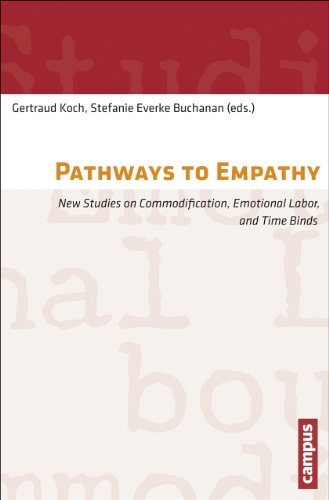
Inhaltsangabe
Arbeit und Alltag
Beiträge zur ethnografischen Arbeitskulturenforschung
Hg. von Irene Götz, Gertraud Koch, Klaus Schönberger und Manfred Seifert
Die Inhaltsangabe kann sich auf eine andere Ausgabe dieses Titels beziehen.
Über die Autorin bzw. den Autor
Gertraud Koch ist Professorin am Institut für Volkskunde/Kulturanthropologie an der Universität Hamburg. Zuvor war sie an der Zeppelin Universität tätig, wo sie von 2003 bis 2013 den Lehrstuhl für Kommunikationswissenschaft und Wissenanthropologie inne hatte.
Stefanie Everke Buchanan, Dr. phil., ist dort wissenschaftliche Mitarbeiterin.
Auszug. © Genehmigter Nachdruck. Alle Rechte vorbehalten.
Introduction: Getting There: From Impediments to Pathways to Empathy
Gertraud Koch and Stefanie Everke Buchanan
Across Europe and the United States of America, over the last decades, we hear an ever louder call for an expansion of the market, reduced regulation, and shrinking of government services. Indeed, in the eyes of many, the market can do no wrong, and the government―outside of its military function―can do little right. Since the 1970s, we have witnessed the rise of global corporate giants, the reduced power of labor unions and increased co-optation of governments by business. To be sure, market forces have risen alongside other trends―the rise of science, technology and a rationalization of life reflected in all parts of life (Larsen 2011; Löfgren 2006 on meta-narrative). Taken as a whole, the free-market zeitgeist has produced a powerful―and as yet under-theorized―impact on our lives. As a worker, the pre-Fordist employee is now the post-Fordist “entre-ployee”. She assumes risks and lives with insecurity like an entrepreneur. But she works for a boss, like an employee. As a consumer, the individual who once turned to family, friends and church to meet personal needs now turns―in the absence of government services―to market services, i.e., to babysitters, eldercare workers, for pay dating services, life coaches. As private individuals, we draw from a market-colonized culture, ideas and images of the self. The individual is adviced to develop a “personal brand”. The internet dater is advised to count his “R.O.I”, i.e., return on investment. All this takes place within a larger culture of “blur” between companies seeking to add emotional appeal to the goods and services they sell, and individuals who seek to draw useful tips for successful living from the market (Illouz 2007). Workers bring to work personal ideas, tastes, habits. And for its part, the workplace exercises great influence over every aspect of the private individual (Moldaschl and Voss 2002; Hochschild 1983, 2003; Sieben and Wettergren 2010).
Arlie Hochschild has studied the impact of capitalist forces on intimate life in many ways and from many perspectives. Her work carves an important path between those who barely acknowledge capitalism at all, and those who acknowledge it but assume that its influence is always alienating. Especially in The Outsourced Self (2012), she describes a large and well-occupied space for resistance. Adapting Freud’s notion of “mechanisms of defense” she describes the various semi-conscious means through which individuals work to keep personal life personal. A woman pays a love coach to guide her through the many small acts of looking for love on Match.com―picking a photo to post, a subject line, a self-description, for example. But when the coach says, “Shall I scan the replies you get on line” she says, “No, I’ll do that, because when I find my true love I want to tell him that that it was I who found him.” She purchases a whole service, but elevates one act to symbolize her un-outsourced self. Or a middle-aged daughter comes to love the caretaker she hires to care for her elderly, brain-injured father, and so loves the father through an empathic reach to a proxy caregiver. In these ways and more, people carve out ways to detach themselves from a culture of detachment so often connected to market life. They protect both their autonomy and sense of relatedness to others.
In line with this new emphasis in Hochschild’s perspective, the authors of these essays are interested in the contradictions, counter moves, resistances and the daily practices individuals use to cope with the promise and demands of the market. For indeed, there are limits to market influence, as Collin Williams shows (2005). To what degree does the individual draw a line between self and the myriad everyday manifestations of market culture? By what feeling rules does he or she say, I will be emotionally attached to this, but I will be detached from that? In addition to rules about what to feel―happy, anguished, sad―we encounter rules about how much to feel―or even whether to feel anything at all. Given these rules of attachment and detachment, what emotion work does an individual perform in an effort to abide by this rule? Sometimes at a certain point in an interaction, an individual will encounter a moment of anxiety―he is too detached, alienated―and he will counter it using various mechanisms of defense (Hochschild 2011, 2012). At other times, in the quest for efficiency, he finds himself too emotionally attached. (“I don’t need to be best friends with the babysitter or have drinks with the dog-walker” one respondent told Hochschild.) It is through our various personal rules of engagement, Hochschild argues, that we regulate capitalism from inside.
It is the purpose of this collection to explore the complex forces of commodification and the many ways we embrace it, resist it and “muddle through”. We aim to delineate the strategies by which the individual asserts the un-alienated self, and the public discourses available for trying to seem that way. We aim to theorize the collective strategies by which we might achieve a better balance of social spheres―market, governmental, civic, personal, and so articulate an alternate cultural world in which to assert a humane self.
This shift of perspective from impediments to pathways to empathy is the leading paradigm for the contributions in this volume. In their work, many of these authors have developed ideas about ways in which the individual counters commercialization and point to welcome and unexpected spaces of resistance. The contributions―literally in the sense of “paying tribute to”―demonstrate to how many areas the thoughts of Arlie Russell Hochschild have flowed over the past three decades, and show the wide variety of fields her work has influenced.
The Contributions
Leading into the topic, Arlie Russell Hochschild sketches Empathy Maps and develops a novel way of looking at ways in which we direct our empathy, zoning people in one area of life to receive much empathy, and those in another area of life, to receive little or any. While proposing a metaphor-driven idea we can apply to all spheres of life, it clearly applies to the division between commercial life (for which the cultural rule is emotional detachment) and personal life (for which the rule is attachment―care, empathy). She thus provides a connection with her detailed studies on the commodification of life in contemporary societies, and simultaneously assumes a changed perspective on them. Her mapping out of the borderlands between alienated and fulfilling lives calls forth the “credit” side of our lives―that which makes up for what commodification sometimes subtracts. Hochschild thus introduces us to a central antagonist who, in everyday life, can be against the depersonalizing effects of commodification.
Empathy is part of human nature, and we may feel it even in the heat of conflict. The feeling can be strong or mild, laced with ambivalence or pure. And there is a “sociology” to empathy. Some social categories of people feel it more than others―women more than men, for example. And we differ in aim―some social groups empathize with the poor, others empathize with the rich. Some cultures provide feeling rules that promote wide-spread, race-blind, empathy. Others don’t. Hochschild shows that the links to commodification are far more multi-faceted and contradictory than we might first assume. In her paper, she maps out a landscape full of pathways which individuals may take on their way to achieving a wide-zone marked for empathy with many others. Without ignoring or downplaying the constraints placed upon individuals by the rules of the post-Fordist world, she also points to a way forward and to...
„Über diesen Titel“ kann sich auf eine andere Ausgabe dieses Titels beziehen.
Suchergebnisse für Pathways to Empathy: New Studies on Commodification,...

Beispielbild für diese ISBN
Pathways to Empathy Format: Paperback
Anbieter: INDOO, Avenel, NJ, USA
Verkäuferbewertung 5 von 5 Sternen

Zustand: New. Brand New. Bestandsnummer des Verkäufers 9783593398945
Neu kaufen
EUR 53,16
Versand gratis
Versand innerhalb von USA
Versand innerhalb von USA
Anzahl: Mehr als 20 verfügbar
Foto des Verkäufers
Pathways to Empathy : New Studies on Commodification, Emotional Labor, and Time Binds
Anbieter: AHA-BUCH GmbH, Einbeck, Deutschland
Verkäuferbewertung 5 von 5 Sternen
Taschenbuch. Zustand: Neu. Neuware - Dreißig Jahre nach Arlie Hochschilds einflussreicher Studie 'The Managed Heart' über die Folgen der Kommodifizierung von Gefühlen für das Individuum ist die Ökonomisierung des vormals Privaten weiter vorangeschritten. Ausgehend von Hochschilds Konzepten beleuchtet der Band Ökonomisierungsprozesse in Schule und Bildung, Familie und Pflege, Dienstleistungsbereich und Management. Es wird sichtbar, dass sich neben Entfremdungstendenzen auch Kreativität sowie Widerständigkeiten im Umgang mit diesen entwickeln: Statt sich determinieren zu lassen, werden Spielräume ausgelotet und Autonomiegewinne organisiert.; Dreißig Jahre nach Arlie Hochschilds einflussreicher Studie »The Managed Heart« über die Folgen der Kommodifizierung von Gefühlen für das Individuum ist die Ökonomisierung des vormals Privaten weiter vorangeschritten. Ausgehend von Hochschilds Konzepten beleuchtet der Band Ökonomisierungsprozesse in Schule und Bildung, Familie und Pflege, Dienstleistungsbereich und Management. Es wird sichtbar, dass sich neben Entfremdungstendenzen auch Kreativität sowie Widerständigkeiten im Umgang mit diesen entwickeln: Statt sich determinieren zu lassen, werden Spielräume ausgelotet und Autonomiegewinne organisiert. Bestandsnummer des Verkäufers 9783593398945
Neu kaufen
EUR 41,00
EUR 35,00 Versand
Versand von Deutschland nach USA
Versand von Deutschland nach USA
Anzahl: 2 verfügbar
Beispielbild für diese ISBN
Pathways to Empathy
Anbieter: Kennys Bookshop and Art Galleries Ltd., Galway, GY, Irland
Verkäuferbewertung 5 von 5 Sternen
Zustand: New. Covers the processes of commodification of emotion about now reach into all areas of labor processes, extending even to private life and intimate relationships. This title takes concepts to study the diversity of this economic intrusion into family, education, and nursing in the service sector as well as into corporate management. Editor(s): Koch, Gertraud; Buchanan, Stefanie Everke. Series: Arbeit und Alltag. Num Pages: 220 pages. BIC Classification: KCA. Category: (G) General (US: Trade). Dimension: 213 x 140 x 18. Weight in Grams: 295. . 2013. Paperback. . . . . Bestandsnummer des Verkäufers V9783593398945
Neu kaufen
EUR 72,80
EUR 9,50 Versand
Versand von Irland nach USA
Versand von Irland nach USA
Anzahl: 15 verfügbar
Foto des Verkäufers
Pathways to Empathy
Anbieter: moluna, Greven, Deutschland
Verkäuferbewertung 5 von 5 Sternen
Kartoniert / Broschiert. Zustand: New. Bestandsnummer des Verkäufers 4913292
Neu kaufen
EUR 41,00
EUR 48,99 Versand
Versand von Deutschland nach USA
Versand von Deutschland nach USA
Anzahl: Mehr als 20 verfügbar
Beispielbild für diese ISBN
Pathways to Empathy
Anbieter: Kennys Bookstore, Olney, MD, USA
Verkäuferbewertung 5 von 5 Sternen
Zustand: New. Covers the processes of commodification of emotion about now reach into all areas of labor processes, extending even to private life and intimate relationships. This title takes concepts to study the diversity of this economic intrusion into family, education, and nursing in the service sector as well as into corporate management. Editor(s): Koch, Gertraud; Buchanan, Stefanie Everke. Series: Arbeit und Alltag. Num Pages: 220 pages. BIC Classification: KCA. Category: (G) General (US: Trade). Dimension: 213 x 140 x 18. Weight in Grams: 295. . 2013. Paperback. . . . . Books ship from the US and Ireland. Bestandsnummer des Verkäufers V9783593398945
Neu kaufen
EUR 91,01
EUR 9,33 Versand
Versand innerhalb von USA
Versand innerhalb von USA
Anzahl: 15 verfügbar
Foto des Verkäufers
Pathways to Empathy | New Studies on Commodification, Emotional Labor, and Time Binds, Arbeit und Alltag 6
Verlag:
Campus Verlag in der Beltz Verlagsgruppe, 2013
ISBN 10: 359339894X
ISBN 13: 9783593398945
Neu
Taschenbuch
Anbieter: preigu, Osnabrück, Deutschland
Verkäuferbewertung 5 von 5 Sternen
Taschenbuch. Zustand: Neu. Pathways to Empathy | New Studies on Commodification, Emotional Labor, and Time Binds, Arbeit und Alltag 6 | Gertraud Koch | Taschenbuch | 213 S. | Deutsch | 2013 | Campus Verlag in der Beltz Verlagsgruppe | EAN 9783593398945 | Verantwortliche Person für die EU: Beltz Verlagsgruppe GmbH & Co. KG, Werderstr. 10, 69469 Weinheim, info[at]campus[dot]de | Anbieter: preigu. Bestandsnummer des Verkäufers 106159008
Neu kaufen
EUR 41,00
EUR 70,00 Versand
Versand von Deutschland nach USA
Versand von Deutschland nach USA
Anzahl: 1 verfügbar