
Verwandte Artikel zu Arguing and Communicative Asymmetry: The Analysis of...
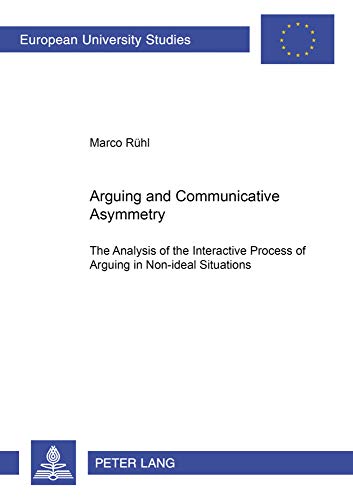
Arguing and Communicative Asymmetry: The Analysis of the Interactive Process of Arguing in Non-ideal Situations (Europäische Hochschulschriften / ... Universitaires Européennes, Band 263) - Softcover
Inhaltsangabe
Why is it that people are often inclined to accept irrational arguments or to reject rational ones? It is, the author argues, because discussions in everyday life are both dialectical – conducted with the best possible solution in mind – and rhetorical – organized by the interactors in the form of a discursive event. By combining argumentation theoretical and discourse analytical insights and revisiting ancient and medieval rhetoric and dialectics, this study transcends the assumption of a symmetrical communicative situation in which only «good» arguments matter. It redefines dialectical concepts, e.g., acceptability or conclusiveness, from a rhetorical and dialogic perspective and is thereby able to address colloquial speech arguing as the inherently asymmetrical discursive event it is.
Die Inhaltsangabe kann sich auf eine andere Ausgabe dieses Titels beziehen.
Über die Autorin bzw. den Autor
The Author: Marco Rühl studied Romance Languages and Literatures, German, Rhetoric, and Discourse and Argumentation at the Universities of Marburg, Germany, Paris-Sorbonne, France, Freiburg im Breisgau, Germany, and Amsterdam, The Netherlands. He is currently an Assistant Professor for Romance Lingui-stics and French Language teaching at the University of Kiel, Germany. His research focus includes Discourse and Multimedia, IT Media in Teaching Environments, and Language Policies.
„Über diesen Titel“ kann sich auf eine andere Ausgabe dieses Titels beziehen.
Suchergebnisse für Arguing and Communicative Asymmetry: The Analysis of...

Beispielbild für diese ISBN
Arguing and Communicative Asymmetry The Analysis of the Interacti
Anbieter: Librairie La Canopee. Inc., Saint-Armand, QC, Kanada
Verkäuferbewertung 5 von 5 Sternen

Zustand: AS NEW. Etat de NEUF / AS NEW condition 3631397666 9783631397664 BP103 1. Bestandsnummer des Verkäufers 126647
Gebraucht kaufen
EUR 55,64
EUR 21,40 Versand
Versand von Kanada nach USA
Versand von Kanada nach USA
Anzahl: 1 verfügbar
Foto des Verkäufers
Arguing and Communicative Asymmetry
ISBN 10: 3631397666
ISBN 13: 9783631397664
Neu
Taschenbuch
Anbieter: BuchWeltWeit Ludwig Meier e.K., Bergisch Gladbach, Deutschland
Verkäuferbewertung 5 von 5 Sternen
Taschenbuch. Zustand: Neu. This item is printed on demand - it takes 3-4 days longer - Neuware -Why is it that people are often inclined to accept irrational arguments or to reject rational ones It is, the author argues, because discussions in everyday life are both dialectical - conducted with the best possible solution in mind - and rhetorical - organized by the interactors in the form of a discursive event. By combining argumentation theoretical and discourse analytical insights and revisiting ancient and medieval rhetoric and dialectics, this study transcends the assumption of a symmetrical communicative situation in which only 'good' arguments matter. It redefines dialectical concepts, e.g., acceptability or conclusiveness, from a rhetorical and dialogic perspective and is thereby able to address colloquial speech arguing as the inherently asymmetrical discursive event it is. 336 pp. Englisch. Bestandsnummer des Verkäufers 9783631397664
Neu kaufen
EUR 104,20
EUR 23,00 Versand
Versand von Deutschland nach USA
Versand von Deutschland nach USA
Anzahl: 2 verfügbar
Foto des Verkäufers
Arguing and Communicative Asymmetry
Print-on-DemandAnbieter: moluna, Greven, Deutschland
Verkäuferbewertung 5 von 5 Sternen
Zustand: New. Dieser Artikel ist ein Print on Demand Artikel und wird nach Ihrer Bestellung fuer Sie gedruckt. Why is it that people are often inclined to accept irrational arguments or to reject rational ones? It is, the author argues, because discussions in everyday life are both dialectical - conducted with the best possible solution in mind - and rhetorical - or. Bestandsnummer des Verkäufers 129968124
Neu kaufen
EUR 104,20
EUR 48,99 Versand
Versand von Deutschland nach USA
Versand von Deutschland nach USA
Anzahl: Mehr als 20 verfügbar
Foto des Verkäufers
Arguing and Communicative Asymmetry
Verlag:
Peter Lang, Peter Lang Sep 2002, 2002
ISBN 10: 3631397666
ISBN 13: 9783631397664
Neu
Taschenbuch
Anbieter: buchversandmimpf2000, Emtmannsberg, BAYE, Deutschland
Verkäuferbewertung 5 von 5 Sternen
Taschenbuch. Zustand: Neu. This item is printed on demand - Print on Demand Titel. Neuware -Why is it that people are often inclined to accept irrational arguments or to reject rational ones It is, the author argues, because discussions in everyday life are both dialectical - conducted with the best possible solution in mind - and rhetorical - organized by the interactors in the form of a discursive event. By combining argumentation theoretical and discourse analytical insights and revisiting ancient and medieval rhetoric and dialectics, this study transcends the assumption of a symmetrical communicative situation in which only «good» arguments matter. It redefines dialectical concepts, e.g., acceptability or conclusiveness, from a rhetorical and dialogic perspective and is thereby able to address colloquial speech arguing as the inherently asymmetrical discursive event it is.Lang, Peter GmbH, Gontardstraße 11, 10178 Berlin 338 pp. Englisch. Bestandsnummer des Verkäufers 9783631397664
Neu kaufen
EUR 104,20
EUR 60,00 Versand
Versand von Deutschland nach USA
Versand von Deutschland nach USA
Anzahl: 1 verfügbar
Foto des Verkäufers
Arguing and Communicative Asymmetry : The Analysis of the Interactive Process of Arguing in Non-ideal Situations
Anbieter: AHA-BUCH GmbH, Einbeck, Deutschland
Verkäuferbewertung 5 von 5 Sternen
Taschenbuch. Zustand: Neu. Druck auf Anfrage Neuware - Printed after ordering - Why is it that people are often inclined to accept irrational arguments or to reject rational ones It is, the author argues, because discussions in everyday life are both dialectical - conducted with the best possible solution in mind - and rhetorical - organized by the interactors in the form of a discursive event. By combining argumentation theoretical and discourse analytical insights and revisiting ancient and medieval rhetoric and dialectics, this study transcends the assumption of a symmetrical communicative situation in which only 'good' arguments matter. It redefines dialectical concepts, e.g., acceptability or conclusiveness, from a rhetorical and dialogic perspective and is thereby able to address colloquial speech arguing as the inherently asymmetrical discursive event it is. Bestandsnummer des Verkäufers 9783631397664
Neu kaufen
EUR 104,20
EUR 62,19 Versand
Versand von Deutschland nach USA
Versand von Deutschland nach USA
Anzahl: 1 verfügbar
Foto des Verkäufers
Arguing and Communicative Asymmetry | The Analysis of the Interactive Process of Arguing in Non-ideal Situations
Anbieter: preigu, Osnabrück, Deutschland
Verkäuferbewertung 5 von 5 Sternen
Taschenbuch. Zustand: Neu. Arguing and Communicative Asymmetry | The Analysis of the Interactive Process of Arguing in Non-ideal Situations | Marco Rühl | Taschenbuch | Englisch | 2002 | Peter Lang | EAN 9783631397664 | Verantwortliche Person für die EU: Lang, Peter GmbH, Gontardstr. 11, 10178 Berlin, r[dot]boehm-korff[at]peterlang[dot]com | Anbieter: preigu. Bestandsnummer des Verkäufers 128695423
Neu kaufen
EUR 104,20
EUR 70,00 Versand
Versand von Deutschland nach USA
Versand von Deutschland nach USA
Anzahl: 5 verfügbar