
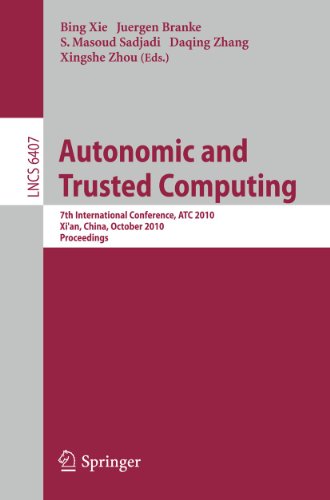
Autonomic and Trusted Computing: 7th International Conference, ATC 2010, Xi'an, China, October 26-29, 2010, Proceedings (Lecture Notes in Computer Science, 6407, Band 6407) - Softcover
Inhaltsangabe
Computing systems including hardware, software, communication, and networks are becoming increasingly large and heterogeneous. In short, they have become - creasingly complex. Such complexity is getting even more critical with the ubiquitous permeation of embedded devices and other pervasive systems. To cope with the growing and ubiquitous complexity, autonomic computing (AC) focuses on self-manageable computing and communication systems that exhibit self-awareness, self-configuration, self-optimization, self-healing, self-protection and other self-* properties to the maximum extent possible without human intervention or guidance. Organic computing (OC) additionally addresses adaptability, robustness, and c- trolled emergence as well as nature-inspired concepts for self-organization. Any autonomic or organic system must be trustworthy to avoid the risk of losing control and retain confidence that the system will not fail. Trust and/or distrust relationships in the Internet and in pervasive infrastructures are key factors to enable dynamic interaction and cooperation of various users, systems, and services. Trusted/ trustworthy computing (TC) aims at making computing and communication systems––as well as services––available, predictable, traceable, controllable, asse- able, sustainable, dependable, persistent, security/privacy protectable, etc. A series of grand challenges exists to achieve practical autonomic or organic s- tems with truly trustworthy services. Started in 2005, ATC conferences have been held at Nagasaki (Japan), Vienna (Austria), Three Gorges (China), Hong Kong (China), Oslo (Norway) and Brisbane (Australia). The 2010 proceedings contain the papers presented at the 7th International Conference on Autonomic and Trusted Computing (ATC 2010), heldin Xi’an, China, October 26–29, 2010.
Die Inhaltsangabe kann sich auf eine andere Ausgabe dieses Titels beziehen.
Weitere beliebte Ausgaben desselben Titels

Suchergebnisse für Autonomic and Trusted Computing: 7th International...

Foto des Verkäufers
Autonomic and Trusted Computing : 7th International Conference, ATC 2010, Xi'an, China, October 26-29, 2010 Proceedings
Anbieter: GreatBookPrices, Columbia, MD, USA
Verkäuferbewertung 5 von 5 Sternen

Zustand: New. Bestandsnummer des Verkäufers 11879117-n
Neu kaufen
EUR 64,10
EUR 2,32 Versand
Versand innerhalb von USA
Versand innerhalb von USA
Anzahl: 2 verfügbar
Beispielbild für diese ISBN
Autonomic and Trusted Computing (Paperback)
ISBN 10: 3642165753
ISBN 13: 9783642165757
Neu
Paperback
Anbieter: Grand Eagle Retail, Bensenville, IL, USA
Verkäuferbewertung 5 von 5 Sternen
Paperback. Zustand: new. Paperback. Computing systems including hardware, software, communication, and networks are becoming increasingly large and heterogeneous. In short, they have become - creasingly complex. Such complexity is getting even more critical with the ubiquitous permeation of embedded devices and other pervasive systems. To cope with the growing and ubiquitous complexity, autonomic computing (AC) focuses on self-manageable computing and communication systems that exhibit self-awareness, self-configuration, self-optimization, self-healing, self-protection and other self-* properties to the maximum extent possible without human intervention or guidance. Organic computing (OC) additionally addresses adaptability, robustness, and c- trolled emergence as well as nature-inspired concepts for self-organization. Any autonomic or organic system must be trustworthy to avoid the risk of losing control and retain confidence that the system will not fail. Trust and/or distrust relationships in the Internet and in pervasive infrastructures are key factors to enable dynamic interaction and cooperation of various users, systems, and services. Trusted/ trustworthy computing (TC) aims at making computing and communication systemsas well as servicesavailable, predictable, traceable, controllable, asse- able, sustainable, dependable, persistent, security/privacy protectable, etc. A series of grand challenges exists to achieve practical autonomic or organic s- tems with truly trustworthy services. Started in 2005, ATC conferences have been held at Nagasaki (Japan), Vienna (Austria), Three Gorges (China), Hong Kong (China), Oslo (Norway) and Brisbane (Australia). The 2010 proceedings contain the papers presented at the 7th International Conference on Autonomic and Trusted Computing (ATC 2010), heldin Xian, China, October 2629, 2010. Computing systems including hardware, software, communication, and networks are becoming increasingly large and heterogeneous. Shipping may be from multiple locations in the US or from the UK, depending on stock availability. Bestandsnummer des Verkäufers 9783642165757
Foto des Verkäufers
Autonomic and Trusted Computing : 7th International Conference, ATC 2010, Xi'an, China, October 26-29, 2010 Proceedings
Anbieter: GreatBookPrices, Columbia, MD, USA
Verkäuferbewertung 5 von 5 Sternen
Zustand: As New. Unread book in perfect condition. Bestandsnummer des Verkäufers 11879117
Gebraucht kaufen
EUR 64,21
EUR 2,32 Versand
Versand innerhalb von USA
Versand innerhalb von USA
Anzahl: 2 verfügbar
Beispielbild für diese ISBN
Autonomic and Trusted Computing: 7th International Conference, Atc 2010, Xi'an, China, October 26-29, 2010, Proceedings
Anbieter: Revaluation Books, Exeter, Vereinigtes Königreich
Verkäuferbewertung 5 von 5 Sternen
Paperback. Zustand: Brand New. 328 pages. 9.50x6.50x1.00 inches. In Stock. Bestandsnummer des Verkäufers x-3642165753
Neu kaufen
EUR 79,67
EUR 14,67 Versand
Versand von Vereinigtes Königreich nach USA
Versand von Vereinigtes Königreich nach USA
Anzahl: 1 verfügbar
Foto des Verkäufers
Autonomic and Trusted Computing
Anbieter: moluna, Greven, Deutschland
Verkäuferbewertung 5 von 5 Sternen
Zustand: New. Fast-track conference proceedingsFast-track conference proceedingsComputing systems including hardware, software, communication, and networks are becoming increasingly large and heterogeneous. In short, they have become - creasingly complex. . Bestandsnummer des Verkäufers 5051194
Neu kaufen
EUR 60,84
EUR 48,99 Versand
Versand von Deutschland nach USA
Versand von Deutschland nach USA
Anzahl: 1 verfügbar
Foto des Verkäufers
Autonomic and Trusted Computing : 7th International Conference, ATC 2010, Xi'an, China, October 26-29, 2010, Proceedings
Anbieter: AHA-BUCH GmbH, Einbeck, Deutschland
Verkäuferbewertung 5 von 5 Sternen
Taschenbuch. Zustand: Neu. Neuware - Computing systems including hardware, software, communication, and networks are becoming increasingly large and heterogeneous. In short, they have become - creasingly complex. Such complexity is getting even more critical with the ubiquitous permeation of embedded devices and other pervasive systems. To cope with the growing and ubiquitous complexity, autonomic computing (AC) focuses on self-manageable computing and communication systems that exhibit self-awareness, self-configuration, self-optimization, self-healing, self-protection and other self-\* properties to the maximum extent possible without human intervention or guidance. Organic computing (OC) additionally addresses adaptability, robustness, and c- trolled emergence as well as nature-inspired concepts for self-organization. Any autonomic or organic system must be trustworthy to avoid the risk of losing control and retain confidence that the system will not fail. Trust and/or distrust relationships in the Internet and in pervasive infrastructures are key factors to enable dynamic interaction and cooperation of various users, systems, and services. Trusted/ trustworthy computing (TC) aims at making computing and communication systems--as well as services--available, predictable, traceable, controllable, asse- able, sustainable, dependable, persistent, security/privacy protectable, etc. A series of grand challenges exists to achieve practical autonomic or organic s- tems with truly trustworthy services. Started in 2005, ATC conferences have been held at Nagasaki (Japan), Vienna (Austria), Three Gorges (China), Hong Kong (China), Oslo (Norway) and Brisbane (Australia). The 2010 proceedings contain the papers presented at the 7th International Conference on Autonomic and Trusted Computing (ATC 2010), heldin Xi'an, China, October 26-29, 2010. Bestandsnummer des Verkäufers 9783642165757
Neu kaufen
EUR 73,74
EUR 62,09 Versand
Versand von Deutschland nach USA
Versand von Deutschland nach USA
Anzahl: 1 verfügbar
Beispielbild für diese ISBN
Autonomic and Trusted Computing : 7th International Conference, ATC 2010, Xi'an, China, October 26-29, 2010, Proceedings
Anbieter: Buchpark, Trebbin, Deutschland
Verkäuferbewertung 5 von 5 Sternen
Zustand: Sehr gut. Zustand: Sehr gut | Seiten: 328 | Sprache: Englisch | Produktart: Bücher | Keine Beschreibung verfügbar. Bestandsnummer des Verkäufers 9526626/12
Gebraucht kaufen
EUR 60,63
EUR 105,00 Versand
Versand von Deutschland nach USA
Versand von Deutschland nach USA
Anzahl: 1 verfügbar