
Verwandte Artikel zu Natural Computing in Computational Finance: Volume...
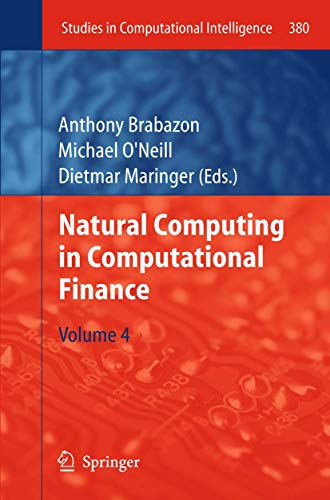
Natural Computing in Computational Finance: Volume 4 (Studies in Computational Intelligence, 380, Band 380) - Hardcover
Inhaltsangabe
This book follows on from Natural Computing in Computational Finance Volumes I, II and III. As in the previous volumes of this series, the book consists of a series of chapters each of
which was selected following a rigorous, peer-reviewed, selection process. The chapters illustrate the application of a range of cutting-edge natural computing and agent-based methodologies in computational finance and economics.
The applications explored include option model calibration, financial trend reversal detection, enhanced indexation, algorithmic trading, corporate payout determination and agent-based modeling of liquidity costs, and trade strategy adaptation. While describing cutting edge applications, the chapters are
written so that they are accessible to a wide audience. Hence, they should be of interest to academics, students and practitioners in the fields of computational finance and economics.
which was selected following a rigorous, peer-reviewed, selection process. The chapters illustrate the application of a range of cutting-edge natural computing and agent-based methodologies in computational finance and economics.
The applications explored include option model calibration, financial trend reversal detection, enhanced indexation, algorithmic trading, corporate payout determination and agent-based modeling of liquidity costs, and trade strategy adaptation. While describing cutting edge applications, the chapters are
written so that they are accessible to a wide audience. Hence, they should be of interest to academics, students and practitioners in the fields of computational finance and economics.
The applications explored include option model calibration, financial trend reversal detection, enhanced indexation, algorithmic trading, corporate payout determination and agent-based modeling of liquidity costs, and trade strategy adaptation. While describing cutting edge applications, the chapters are
written so that they are accessible to a wide audience. Hence, they should be of interest to academics, students and practitioners in the fields of computational finance and economics.
written so that they are accessible to a wide audience. Hence, they should be of interest to academics, students and practitioners in the fields of computational finance and economics.
Die Inhaltsangabe kann sich auf eine andere Ausgabe dieses Titels beziehen.
Über die Autorin bzw. den Autor
Anthony Brabazon [B. Comm (UCD), DPA (UCD), Dip Stats (Dub), MS (Statistics) (Stanford), MS (Operations Research) (Stanford), MBA (Heriot-Watt), DBA (Kingston), FCA, ACMA] lectures at University College Dublin. His research interests include mathematical decision models, evolutionary computation, and the application of computational intelligence to the domain of finance. He has published in excess of 100 papers in journals, conferences and professional publications, and has been a member of the programme committee at both EuroGP and GECCO conferences, as well as acting as reviewer for several journals. He has also acted as consultant to a wide range of public and private companies in several countries. He currently serves as a member of the CCAB (Ireland) Consultative Committee on Accounting Standards, and is a former Secretary and Treasurer of the Irish Accounting and Finance Association. Prior to joining UCD, he worked in the banking sector, and for KPMG.
Michael O'Neill [BSc. (UCD), PhD (UL)] is a lecturer in the Department of Computer Science and Information Systems at the University of Limerick. He has over 70 publications on biologically inspired algorithms (BIAs). He coauthored the Springer title "Grammatical Evolution -- Evolutionary Automatic Programming in an Arbitrary Language", Genetic Programming Series, 2003, 160 pp., ISBN 1-4020-7444-1. He is one of the two original developers of the Grammatical Evolution algorithm, research that spawned an annual invited tutorial at the largest evolutionary computation conference and an international workshop, and is also on a number of relevant organising committees (e.g., GECCO 2005). Michael is a regular reviewer for the leading evolutionary computation (EC) journals, namely IEEE Trans. on Evolutionary Computation, MIT Press's Evolutionary Computation, and Springer's Genetic Programming and Evolvable Hardware journal.
Von der hinteren Coverseite
This book follows on from Natural Computing in Computational Finance Volumes I, II and III. As in the previous volumes of this series, the book consists of a series of chapters each of
which was selected following a rigorous, peer-reviewed, selection process. The chapters illustrate the application of a range of cutting-edge natural computing and agent-based methodologies in computational finance and economics.
The applications explored include option model calibration, financial trend reversal detection, enhanced indexation, algorithmic trading, corporate payout determination and agent-based modeling of liquidity costs, and trade strategy adaptation. While describing cutting edge applications, the chapters are
written so that they are accessible to a wide audience. Hence, they should be of interest to academics, students and practitioners in the fields of computational finance and economics.
„Über diesen Titel“ kann sich auf eine andere Ausgabe dieses Titels beziehen.
Suchergebnisse für Natural Computing in Computational Finance: Volume...

Beispielbild für diese ISBN
Natural Computing in Computational Finance: Volume 4: 380 (Studies in Computational Intelligence, 380) [Hardcover] [Sep 10, 2011] Brabazon, Anthony; O'Neill, Michael and Maringer, Dietmar
Anbieter: StainesBookhub, Weybridge, SURRE, Vereinigtes Königreich
Verkäuferbewertung 2 von 5 Sternen

Zustand: New. A brand new book in pristine condition. Showing zero signs of shelf wear, creases, or damage. Bestandsnummer des Verkäufers SPRLISTINGBYSHB12611
Neu kaufen
EUR 94,81
EUR 35,93 Versand
Versand von Vereinigtes Königreich nach USA
Versand von Vereinigtes Königreich nach USA
Anzahl: 1 verfügbar
Beispielbild für diese ISBN
Natural Computing in Computational Finance (eng)
Print-on-DemandAnbieter: Brook Bookstore On Demand, Napoli, NA, Italien
Verkäuferbewertung 5 von 5 Sternen

Zustand: new. Questo è un articolo print on demand. Bestandsnummer des Verkäufers d641b941a81ef3d44fd9847732b4bacc
Neu kaufen
EUR 126,26
EUR 5,50 Versand
Versand von Italien nach USA
Versand von Italien nach USA
Anzahl: Mehr als 20 verfügbar
Foto des Verkäufers
Natural Computing in Computational Finance: Volume 4 (Studies in Computational Intelligence, 380, Band 380)
Anbieter: Studibuch, Stuttgart, Deutschland
Verkäuferbewertung 5 von 5 Sternen
hardcover. Zustand: Gut. 212 Seiten; 9783642233357.3 Gewicht in Gramm: 500. Bestandsnummer des Verkäufers 1313189
Gebraucht kaufen
EUR 76,63
EUR 80,70 Versand
Versand von Deutschland nach USA
Versand von Deutschland nach USA
Anzahl: 1 verfügbar
Foto des Verkäufers
Natural Computing in Computational Finance
ISBN 10: 364223335X
ISBN 13: 9783642233357
Neu
Hardcover
Anbieter: BuchWeltWeit Ludwig Meier e.K., Bergisch Gladbach, Deutschland
Verkäuferbewertung 5 von 5 Sternen
Buch. Zustand: Neu. This item is printed on demand - it takes 3-4 days longer - Neuware -This book follows on from Natural Computing in Computational Finance Volumes I, II and III. As in the previous volumes of this series, the book consists of a series of chapters each of which was selected following a rigorous, peer-reviewed, selection process. The chapters illustrate the application of a range of cutting-edge natural computing and agent-based methodologies in computational finance and economics. The applications explored include option model calibration, financial trend reversal detection, enhanced indexation, algorithmic trading, corporate payout determination and agent-based modeling of liquidity costs, and trade strategy adaptation. While describing cutting edge applications, the chapters are written so that they are accessible to a wide audience. Hence, they should be of interest to academics, students and practitioners in the fields of computational finance and economics. which was selected following a rigorous, peer-reviewed, selection process. The chapters illustrate the application of a range of cutting-edge natural computing and agent-based methodologies in computational finance and economics. The applications explored include option model calibration, financial trend reversal detection, enhanced indexation, algorithmic trading, corporate payout determination and agent-based modeling of liquidity costs, and trade strategy adaptation. While describing cutting edge applications, the chapters are written so that they are accessible to a wide audience. Hence, they should be of interest to academics, students and practitioners in the fields of computational finance and economics. The applications explored include option model calibration, financial trend reversal detection, enhanced indexation, algorithmic trading, corporate payout determination and agent-based modeling of liquidity costs, and trade strategy adaptation. While describing cutting edge applications, the chapters are written so that they are accessible to a wide audience. Hence, they should be of interest to academics, students and practitioners in the fields of computational finance and economics. written so that they are accessible to a wide audience. Hence, they should be of interest to academics, students and practitioners in the fields of computational finance and economics. 212 pp. Englisch. Bestandsnummer des Verkäufers 9783642233357
Neu kaufen
EUR 160,49
EUR 23,00 Versand
Versand von Deutschland nach USA
Versand von Deutschland nach USA
Anzahl: 2 verfügbar
Foto des Verkäufers
Natural Computing in Computational Finance
Anbieter: moluna, Greven, Deutschland
Verkäuferbewertung 5 von 5 Sternen
Gebunden. Zustand: New. Bestandsnummer des Verkäufers 5053182
Neu kaufen
EUR 136,16
EUR 48,99 Versand
Versand von Deutschland nach USA
Versand von Deutschland nach USA
Anzahl: Mehr als 20 verfügbar
Foto des Verkäufers
Natural Computing in Computational Finance
Anbieter: GreatBookPricesUK, Woodford Green, Vereinigtes Königreich
Verkäuferbewertung 5 von 5 Sternen
Zustand: New. Bestandsnummer des Verkäufers 12937824-n
Neu kaufen
EUR 170,06
EUR 17,97 Versand
Versand von Vereinigtes Königreich nach USA
Versand von Vereinigtes Königreich nach USA
Anzahl: Mehr als 20 verfügbar
Beispielbild für diese ISBN
Natural Computing in Computational Finance: Volume 4 (Studies in Computational Intelligence, 380)
Anbieter: California Books, Miami, FL, USA
Verkäuferbewertung 5 von 5 Sternen
Zustand: New. Bestandsnummer des Verkäufers I-9783642233357
Neu kaufen
EUR 185,40
EUR 2,67 Versand
Versand innerhalb von USA
Versand innerhalb von USA
Anzahl: Mehr als 20 verfügbar
Foto des Verkäufers
Natural Computing in Computational Finance
Anbieter: GreatBookPrices, Columbia, MD, USA
Verkäuferbewertung 5 von 5 Sternen
Zustand: New. Bestandsnummer des Verkäufers 12937824-n
Neu kaufen
EUR 185,72
EUR 2,35 Versand
Versand innerhalb von USA
Versand innerhalb von USA
Anzahl: Mehr als 20 verfügbar
Beispielbild für diese ISBN
Natural Computing in Computational Finance
Anbieter: GreatBookPrices, Columbia, MD, USA
Verkäuferbewertung 5 von 5 Sternen
Zustand: As New. Unread book in perfect condition. Bestandsnummer des Verkäufers 12937824
Gebraucht kaufen
EUR 192,46
EUR 2,35 Versand
Versand innerhalb von USA
Versand innerhalb von USA
Anzahl: Mehr als 20 verfügbar
Foto des Verkäufers
Natural Computing in Computational Finance : Volume 4
Anbieter: AHA-BUCH GmbH, Einbeck, Deutschland
Verkäuferbewertung 5 von 5 Sternen
Buch. Zustand: Neu. Druck auf Anfrage Neuware - Printed after ordering - This book follows on from Natural Computing in Computational Finance Volumes I, II and III. As in the previous volumes of this series, the book consists of a series of chapters each of which was selected following a rigorous, peer-reviewed, selection process. The chapters illustrate the application of a range of cutting-edge natural computing and agent-based methodologies in computational finance and economics. The applications explored include option model calibration, financial trend reversal detection, enhanced indexation, algorithmic trading, corporate payout determination and agent-based modeling of liquidity costs, and trade strategy adaptation. While describing cutting edge applications, the chapters are written so that they are accessible to a wide audience. Hence, they should be of interest to academics, students and practitioners in the fields of computational finance and economics. which was selected following a rigorous, peer-reviewed, selection process. The chapters illustrate the application of a range of cutting-edge natural computing and agent-based methodologies in computational finance and economics. The applications explored include option model calibration, financial trend reversal detection, enhanced indexation, algorithmic trading, corporate payout determination and agent-based modeling of liquidity costs, and trade strategy adaptation. While describing cutting edge applications, the chapters are written so that they are accessible to a wide audience. Hence, they should be of interest to academics, students and practitioners in the fields of computational finance and economics. The applications explored include option model calibration, financial trend reversal detection, enhanced indexation, algorithmic trading, corporate payout determination and agent-based modeling of liquidity costs, and trade strategy adaptation. While describing cutting edge applications, the chapters are written so that they are accessible to a wide audience. Hence, they should be of interest to academics, students and practitioners in the fields of computational finance and economics. written so that they are accessible to a wide audience. Hence, they should be of interest to academics, students and practitioners in the fields of computational finance and economics. Bestandsnummer des Verkäufers 9783642233357
Neu kaufen
EUR 183,30
EUR 35,00 Versand
Versand von Deutschland nach USA
Versand von Deutschland nach USA
Anzahl: 1 verfügbar