
Verwandte Artikel zu Organizational Interoperability in E-Government: Lessons...
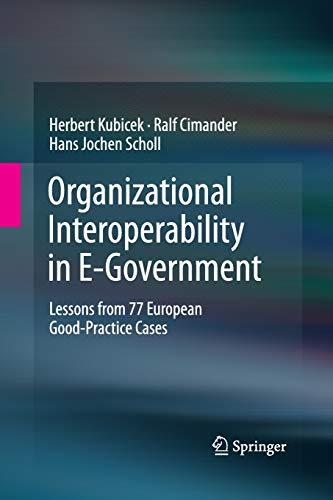
Organizational Interoperability in E-Government: Lessons from 77 European Good-Practice Cases - Softcover
Inhaltsangabe
In the e-government research community as well as in many national e-government programs, interoperability is widely seen as a key factor in developing effective and attractive e-services. There is also agreement that interoperability encompasses not only mere technical standards and interfaces, but also includes organizational, legal, and cultural aspects. Several interoperability frameworks have been introduced on national and international levels, and recommendations have been made for the adaptation of enterprise architectures in the public sector.
Common to all these approaches is their top-down deductive procedure, which does not connect very well to the real world of e-government projects. In contrast, in this volume, which is based on empirical research, the authors introduce a bottom-up inductive approach to deal with the challenges of interoperability-related governance. Based on so-called “good-practice” cases of interoperability in e-government, they derive concepts and classifications that help to uncover and assess similarities and differences between the cases. As a result, they present an empirically based conceptual framework that details the options for IT governance of interoperability in government. In addition, their findings also make it possible to critically assess and improve other existing frameworks.
With this work, which combines different thematic foci as well as a European and a US background the authors situate empirical results in the broader context of theoretical and political reflection. Thus they provide insights into strategic choices for CIOs in e-government at a national or regional level, experiences and lessons learned for managers and developers in e-government projects, and a huge set of empirical data for administrative and politicalscientists.Die Inhaltsangabe kann sich auf eine andere Ausgabe dieses Titels beziehen.
Über die Autorin bzw. den Autor
Dr. Herbert Kubicek is a Professor of Applied Computer Science, in particular Telecommunications and Information Management, at the University of Bremen, Germany, and Scientific Director of the Institute for Information Management Bremen (ifib). He has a background in business administration and social science, and his research deals with inter-organizational information systems since the 1990s.
Ralf Cimander is a Senior Researcher at the Institute for Information Management Bremen (ifib). He was involved in the identification, analysis and description of good practice cases in the European Commissions’ Study on Back-office Reorganization and the MODINIS Study on Interoperability in E-Government at the Local and Regional Level, as well as a European Commission transfer project concerned with interoperability in public procurement. His current research focuses on the comparative assessment of e-participation in the context of sustainable development and climate change.
Dr. Hans J. Scholl is an Associate Professor with tenure in the Information School at the University of Washington, Seattle, WA, USA. His special interests include open government, interoperability, emergency and disaster response management, and strategic choices in mobile technology diffusion in digital government. He is President of the Digital Government Society and also the vice chair of the IFIP TC 8.5 Working Group (Information Systems and Public Administration). In addition, he chairs the renowned Electronic Government Track at the Hawaii International Conference on System Sciences (HICSS) and co-organizes the premier European conference on e-Government (IFIP EGOV).Von der hinteren Coverseite
In the e-government research community as well as in many national e-government programs, interoperability is widely seen as a key factor in developing effective and attractive e-services. There is also agreement that interoperability encompasses not only mere technical standards and interfaces, but also includes organizational, legal, and cultural aspects. Several interoperability frameworks have been introduced on national and international levels, and recommendations have been made for the adaptation of enterprise architectures in the public sector.
Common to all these approaches is their top-down deductive procedure, which does not connect very well to the real world of e-government projects. In contrast, in this volume, which is based on empirical research, the authors introduce a bottom-up inductive approach to deal with the challenges of interoperability-related governance. Based on so-called “good-practice” cases of interoperability in e-government, they derive concepts and classifications that help to uncover and assess similarities and differences between the cases. As a result, they present an empirically based conceptual framework that details the options for IT governance of interoperability in government. In addition, their findings also make it possible to critically assess and improve other existing frameworks.
With this work, which combines different thematic foci as well as a European and a US background the authors situate empirical results in the broader context of theoretical and political reflection. Thus they provide insights into strategic choices for CIOs in e-government at a national or regional level, experiences and lessons learned for managers and developers in e-government projects, and a huge set of empirical data for administrative and politicalscientists.
„Über diesen Titel“ kann sich auf eine andere Ausgabe dieses Titels beziehen.
Suchergebnisse für Organizational Interoperability in E-Government: Lessons...

Beispielbild für diese ISBN
Kubicek:Organizational Interoperability (eng)
Print-on-DemandAnbieter: Brook Bookstore On Demand, Napoli, NA, Italien
Verkäuferbewertung 5 von 5 Sternen

Zustand: new. Questo è un articolo print on demand. Bestandsnummer des Verkäufers de60efe6d05c35885a595052eabc776d
Neu kaufen
EUR 46,22
EUR 5,50 Versand
Versand von Italien nach USA
Versand von Italien nach USA
Anzahl: Mehr als 20 verfügbar
Foto des Verkäufers
Organizational Interoperability in E-government : Lessons from 77 European Good-practice Cases
Anbieter: GreatBookPrices, Columbia, MD, USA
Verkäuferbewertung 5 von 5 Sternen
Zustand: New. Bestandsnummer des Verkäufers 22065208-n
Neu kaufen
EUR 52,27
EUR 2,35 Versand
Versand innerhalb von USA
Versand innerhalb von USA
Anzahl: Mehr als 20 verfügbar
Beispielbild für diese ISBN
Organizational Interoperability in E-Government: Lessons from 77 European Good-Practice Cases
Anbieter: Chiron Media, Wallingford, Vereinigtes Königreich
Verkäuferbewertung 5 von 5 Sternen
Paperback. Zustand: New. Bestandsnummer des Verkäufers 6666-IUK-9783642433344
Neu kaufen
EUR 57,83
EUR 18,23 Versand
Versand von Vereinigtes Königreich nach USA
Versand von Vereinigtes Königreich nach USA
Anzahl: 10 verfügbar
Foto des Verkäufers
Organizational Interoperability in E-Government
Verlag:
Springer Berlin Heidelberg Okt 2014, 2014
ISBN 10: 3642433340
ISBN 13: 9783642433344
Neu
Taschenbuch
Anbieter: BuchWeltWeit Ludwig Meier e.K., Bergisch Gladbach, Deutschland
Verkäuferbewertung 5 von 5 Sternen
Taschenbuch. Zustand: Neu. This item is printed on demand - it takes 3-4 days longer - Neuware -In the e-government research community as well as in many national e-government programs, interoperability is widely seen as a key factor in developing effective and attractive e-services. There is also agreement that interoperability encompasses not only mere technical standards and interfaces, but also includes organizational, legal, and cultural aspects. Several interoperability frameworks have been introduced on national and international levels, and recommendations have been made for the adaptation of enterprise architectures in the public sector.Common to all these approaches is their top-down deductive procedure, which does not connect very well to the real world of e-government projects. In contrast, in this volume, which is based on empirical research, the authors introduce a bottom-up inductive approach to deal with the challenges of interoperability-related governance. Based on so-called 'good-practice' cases of interoperability in e-government, they derive concepts and classifications that help to uncover and assess similarities and differences between the cases. As a result, they present an empirically based conceptual framework that details the options for IT governance of interoperability in government. In addition, their findings also make it possible to critically assess and improve other existing frameworks.With this work, which combines different thematic foci as well as a European and a US background the authors situate empirical results in the broader context of theoretical and political reflection. Thus they provide insights into strategic choices for CIOs in e-government at a national or regional level, experiences and lessons learned for managers and developers in e-government projects, and a huge set of empirical data for administrative and political scientists. 200 pp. Englisch. Bestandsnummer des Verkäufers 9783642433344
Neu kaufen
EUR 53,49
EUR 23,00 Versand
Versand von Deutschland nach USA
Versand von Deutschland nach USA
Anzahl: 2 verfügbar
Foto des Verkäufers
Organizational Interoperability in E-government : Lessons from 77 European Good-practice Cases
Anbieter: GreatBookPricesUK, Woodford Green, Vereinigtes Königreich
Verkäuferbewertung 5 von 5 Sternen
Zustand: New. Bestandsnummer des Verkäufers 22065208-n
Neu kaufen
EUR 60,85
EUR 17,65 Versand
Versand von Vereinigtes Königreich nach USA
Versand von Vereinigtes Königreich nach USA
Anzahl: Mehr als 20 verfügbar
Beispielbild für diese ISBN
Organizational Interoperability in E-Government: Lessons from 77 European Good-Practice Cases
Anbieter: Ria Christie Collections, Uxbridge, Vereinigtes Königreich
Verkäuferbewertung 5 von 5 Sternen
Zustand: New. In English. Bestandsnummer des Verkäufers ria9783642433344_new
Neu kaufen
EUR 67,81
EUR 11,03 Versand
Versand von Vereinigtes Königreich nach USA
Versand von Vereinigtes Königreich nach USA
Anzahl: Mehr als 20 verfügbar
Beispielbild für diese ISBN
Organizational Interoperability in E-Government: Lessons.
Anbieter: Books Puddle, Woodside, NY, USA
Verkäuferbewertung 4 von 5 Sternen

Zustand: New. Bestandsnummer des Verkäufers 26357360741
Neu kaufen
EUR 85,03
EUR 3,55 Versand
Versand innerhalb von USA
Versand innerhalb von USA
Anzahl: 4 verfügbar
Beispielbild für diese ISBN
Organizational Interoperability in E-Government: Lessons.
Print-on-DemandAnbieter: Majestic Books, Hounslow, Vereinigtes Königreich
Verkäuferbewertung 4 von 5 Sternen
Zustand: New. Print on Demand. Bestandsnummer des Verkäufers 356211642
Neu kaufen
EUR 84,57
EUR 7,65 Versand
Versand von Vereinigtes Königreich nach USA
Versand von Vereinigtes Königreich nach USA
Anzahl: 4 verfügbar
Foto des Verkäufers
Organizational Interoperability in E-Government : Lessons from 77 European Good-Practice Cases
Anbieter: AHA-BUCH GmbH, Einbeck, Deutschland
Verkäuferbewertung 5 von 5 Sternen
Taschenbuch. Zustand: Neu. Druck auf Anfrage Neuware - Printed after ordering - In the e-government research community as well as in many national e-government programs, interoperability is widely seen as a key factor in developing effective and attractive e-services. There is also agreement that interoperability encompasses not only mere technical standards and interfaces, but also includes organizational, legal, and cultural aspects. Several interoperability frameworks have been introduced on national and international levels, and recommendations have been made for the adaptation of enterprise architectures in the public sector.Common to all these approaches is their top-down deductive procedure, which does not connect very well to the real world of e-government projects. In contrast, in this volume, which is based on empirical research, the authors introduce a bottom-up inductive approach to deal with the challenges of interoperability-related governance. Based on so-called 'good-practice' cases of interoperability in e-government, they derive concepts and classifications that help to uncover and assess similarities and differences between the cases. As a result, they present an empirically based conceptual framework that details the options for IT governance of interoperability in government. In addition, their findings also make it possible to critically assess and improve other existing frameworks.With this work, which combines different thematic foci as well as a European and a US background the authors situate empirical results in the broader context of theoretical and political reflection. Thus they provide insights into strategic choices for CIOs in e-government at a national or regional level, experiences and lessons learned for managers and developers in e-government projects, and a huge set of empirical data for administrative and politicalscientists. Bestandsnummer des Verkäufers 9783642433344
Neu kaufen
EUR 57,82
EUR 35,00 Versand
Versand von Deutschland nach USA
Versand von Deutschland nach USA
Anzahl: 1 verfügbar
Beispielbild für diese ISBN
Organizational Interoperability in E-Government: Lessons.
Print-on-DemandAnbieter: Biblios, Frankfurt am main, HESSE, Deutschland
Verkäuferbewertung 4 von 5 Sternen
Zustand: New. PRINT ON DEMAND. Bestandsnummer des Verkäufers 18357360751
Neu kaufen
EUR 84,18
EUR 9,95 Versand
Versand von Deutschland nach USA
Versand von Deutschland nach USA
Anzahl: 4 verfügbar