
Verwandte Artikel zu Bionic Optimization in Structural Design: Stochastically...
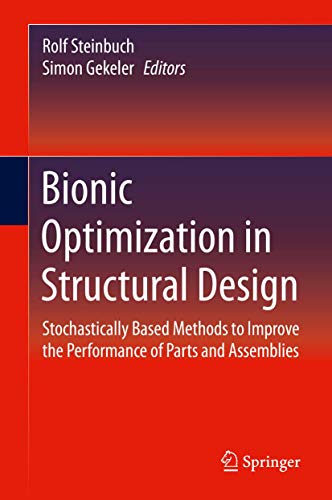
Bionic Optimization in Structural Design: Stochastically Based Methods to Improve the Performance of Parts and Assemblies - Hardcover
Inhaltsangabe
The book provides suggestions on how to start using bionic optimization methods, including pseudo-code examples of each of the important approaches and outlines of how to improve them. The most efficient methods for accelerating the studies are discussed. These include the selection of size and generations of a study’s parameters, modification of these driving parameters, switching to gradient methods when approaching local maxima, and the use of parallel working hardware.
Bionic Optimization means finding the best solution to a problem using methods found in nature. As Evolutionary Strategies and Particle Swarm Optimization seem to be the most important methods for structural optimization, we primarily focus on them. Other methods such as neural nets or ant colonies are more suited to control or process studies, so their basic ideas are outlined in order to motivate readers to start using them.
A set of sample applications shows how Bionic Optimization works in practice. From academic studies on simple frames made of rods to earthquake-resistant buildings, readers follow the lessons learned, difficulties encountered and effective strategies for overcoming them. For the problem of tuned mass dampers, which play an important role in dynamic control, changing the goal and restrictions paves the way for Multi-Objective-Optimization. As most structural designers today use commercial software such as FE-Codes or CAE systems with integrated simulation modules, ways of integrating Bionic Optimization into these software packages are outlined and examples of typical systems and typical optimization approaches are presented.
The closing section focuses on an overview and outlook on reliable and robust as well as on Multi-Objective-Optimization, including
discussions of current and upcoming research topics in the field concerning a unified theory for handling stochastic design processes.Die Inhaltsangabe kann sich auf eine andere Ausgabe dieses Titels beziehen.
Über die Autorin bzw. den Autor
Professor Rolf Steinbuch, University of Reutlingen,
1977-1982 Fracture mechanics / safety analysis KWU/SIEMENS, Erlangen,
1982-1983 Design of Desalination plants BTB Leonberg
1984-1993 Simulation of car components at DaimlerChrysler Untertürkheim
since 1993 Professor (C3) Mathematics. Simulation and Mechanics at Reutlingen University, Dep. of Engineering
Simon Gekeler, University of Reutlingen
since 2011 Design optimization/sensitivity analysis, evaluation of design robustness and reliability, algorithm development Reutlingen Research Institute, Reutlingen University.Von der hinteren Coverseite
The book provides suggestions on how to start using bionic optimization methods, including pseudo-code examples of each of the important approaches and outlines of how to improve them. The most efficient methods for accelerating the studies are discussed. These include the selection of size and generations of a study’s parameters, modification of these driving parameters, switching to gradient methods when approaching local maxima, and the use of parallel working hardware.
Bionic Optimization means finding the best solution to a problem using methods found in nature. As Evolutionary Strategies and Particle Swarm Optimization seem to be the most important methods for structural optimization, we primarily focus on them. Other methods such as neural nets or ant colonies are more suited to control or process studies, so their basic ideas are outlined in order to motivate readers to start using them.
A set of sample applications shows how Bionic Optimization works in practice. From academic studies on simple frames made of rods to earthquake-resistant buildings, readers follow the lessons learned, difficulties encountered and effective strategies for overcoming them. For the problem of tuned mass dampers, which play an important role in dynamic control, changing the goal and restrictions paves the way for Multi-Objective-Optimization. As most structural designers today use commercial software such as FE-Codes or CAE systems with integrated simulation modules, ways of integrating Bionic Optimization into these software packages are outlined and examples of typical systems and typical optimization approaches are presented.
The closing section focuses on an overview and outlook on reliable and robust as well as on Multi-Objective-Optimization, including
discussions of current and upcoming research topics in the field concerning a unified theory for handling stochastic design processes.„Über diesen Titel“ kann sich auf eine andere Ausgabe dieses Titels beziehen.
Suchergebnisse für Bionic Optimization in Structural Design: Stochastically...

Beispielbild für diese ISBN
Bionic Optimization in Structural Design: Stochastically Based Methods to Improve the Performance of Parts and Assemblies [Hardcover] Steinbuch, Rolf and Gekeler, Simon (eng)
Print-on-DemandAnbieter: Brook Bookstore On Demand, Napoli, NA, Italien
Verkäuferbewertung 5 von 5 Sternen

Zustand: new. Questo è un articolo print on demand. Bestandsnummer des Verkäufers 993f3ce5e0cafa1a2462c2dca67c8ed1
Neu kaufen
EUR 86,24
EUR 5,50 Versand
Versand von Italien nach USA
Versand von Italien nach USA
Anzahl: Mehr als 20 verfügbar
Foto des Verkäufers
Bionic Optimization in Structural Design
Verlag:
Springer Berlin Heidelberg Nov 2015, 2015
ISBN 10: 3662465957
ISBN 13: 9783662465950
Neu
Hardcover
Anbieter: BuchWeltWeit Ludwig Meier e.K., Bergisch Gladbach, Deutschland
Verkäuferbewertung 5 von 5 Sternen
Buch. Zustand: Neu. This item is printed on demand - it takes 3-4 days longer - Neuware -The book provides suggestions on how to start using bionic optimization methods, including pseudo-code examples of each of the important approaches and outlines of how to improve them. The most efficient methods for accelerating the studies are discussed. These include the selection of size and generations of a study's parameters, modification of these driving parameters, switching to gradient methods when approaching local maxima, and the use of parallel working hardware.Bionic Optimization means finding the best solution to a problem using methods found in nature. As Evolutionary Strategies and Particle Swarm Optimization seem to be the most important methods for structural optimization, we primarily focus on them. Other methods such as neural nets or ant colonies are more suited to control or process studies, so their basic ideas are outlined in order to motivate readers to start using them.A set of sample applications shows how Bionic Optimization works in practice. From academic studies on simple frames made of rods to earthquake-resistant buildings, readers follow the lessons learned, difficulties encountered and effective strategies for overcoming them. For the problem of tuned mass dampers, which play an important role in dynamic control, changing the goal and restrictions paves the way for Multi-Objective-Optimization. As most structural designers today use commercial software such as FE-Codes or CAE systems with integrated simulation modules, ways of integrating Bionic Optimization into these software packages are outlined and examples of typical systems and typical optimization approaches are presented.The closing section focuses on an overview and outlook on reliable and robust as well as on Multi-Objective-Optimization, including discussions of current and upcoming research topics in the field concerning a unified theory for handling stochastic design processes. 172 pp. Englisch. Bestandsnummer des Verkäufers 9783662465950
Neu kaufen
EUR 106,99
EUR 23,00 Versand
Versand von Deutschland nach USA
Versand von Deutschland nach USA
Anzahl: 2 verfügbar
Beispielbild für diese ISBN
Bionic Optimization in Structural Design : Stochastically Based Methods to Improve the Performance of Parts and Assemblies
Anbieter: GreatBookPrices, Columbia, MD, USA
Verkäuferbewertung 5 von 5 Sternen
Zustand: New. Bestandsnummer des Verkäufers 23291721-n
Neu kaufen
EUR 134,61
EUR 2,35 Versand
Versand innerhalb von USA
Versand innerhalb von USA
Anzahl: 15 verfügbar
Foto des Verkäufers
Bionic Optimization in Structural Design
Print-on-DemandAnbieter: moluna, Greven, Deutschland
Verkäuferbewertung 5 von 5 Sternen
Gebunden. Zustand: New. Dieser Artikel ist ein Print on Demand Artikel und wird nach Ihrer Bestellung fuer Sie gedruckt. Focus on the optimization of high-dimensional problemsEasily applicable by pseudo-code examplesPractical implementation and applicationProfessor Rolf Steinbuch, University of Reutlingen, 1977-1982 Fracture mechanics. Bestandsnummer des Verkäufers 35623397
Neu kaufen
EUR 89,99
EUR 48,99 Versand
Versand von Deutschland nach USA
Versand von Deutschland nach USA
Anzahl: Mehr als 20 verfügbar
Beispielbild für diese ISBN
Bionic Optimization in Structural Design: Stochastically Based Methods to Improve the Performance of Parts and Assemblies
Anbieter: Ria Christie Collections, Uxbridge, Vereinigtes Königreich
Verkäuferbewertung 5 von 5 Sternen
Zustand: New. In English. Bestandsnummer des Verkäufers ria9783662465950_new
Neu kaufen
EUR 129,67
EUR 13,32 Versand
Versand von Vereinigtes Königreich nach USA
Versand von Vereinigtes Königreich nach USA
Anzahl: Mehr als 20 verfügbar
Foto des Verkäufers
Bionic Optimization in Structural Design : Stochastically Based Methods to Improve the Performance of Parts and Assemblies
Anbieter: AHA-BUCH GmbH, Einbeck, Deutschland
Verkäuferbewertung 5 von 5 Sternen
Buch. Zustand: Neu. Druck auf Anfrage Neuware - Printed after ordering - The book provides suggestions on how to start using bionic optimization methods, including pseudo-code examples of each of the important approaches and outlines of how to improve them. The most efficient methods for accelerating the studies are discussed. These include the selection of size and generations of a study's parameters, modification of these driving parameters, switching to gradient methods when approaching local maxima, and the use of parallel working hardware.Bionic Optimization means finding the best solution to a problem using methods found in nature. As Evolutionary Strategies and Particle Swarm Optimization seem to be the most important methods for structural optimization, we primarily focus on them. Other methods such as neural nets or ant colonies are more suited to control or process studies, so their basic ideas are outlined in order to motivate readers to start using them.A set of sample applications shows how Bionic Optimization works in practice. From academic studies on simple frames made of rods to earthquake-resistant buildings, readers follow the lessons learned, difficulties encountered and effective strategies for overcoming them. For the problem of tuned mass dampers, which play an important role in dynamic control, changing the goal and restrictions paves the way for Multi-Objective-Optimization. As most structural designers today use commercial software such as FE-Codes or CAE systems with integrated simulation modules, ways of integrating Bionic Optimization into these software packages are outlined and examples of typical systems and typical optimization approaches are presented.The closing section focuses on an overview and outlook on reliable and robust as well as on Multi-Objective-Optimization, including discussions of current and upcoming research topics in the field concerning a unified theory for handling stochastic design processes. Bestandsnummer des Verkäufers 9783662465950
Neu kaufen
EUR 119,90
EUR 35,00 Versand
Versand von Deutschland nach USA
Versand von Deutschland nach USA
Anzahl: 1 verfügbar
Beispielbild für diese ISBN
Bionic Optimization in Structural Design: Stochastically Based Methods to Improve the Performance of Parts and Assemblies
Anbieter: Mispah books, Redhill, SURRE, Vereinigtes Königreich
Verkäuferbewertung 4 von 5 Sternen

Hardcover. Zustand: Like New. Like New. book. Bestandsnummer des Verkäufers ERICA77336624659576
Gebraucht kaufen
EUR 133,67
EUR 29,49 Versand
Versand von Vereinigtes Königreich nach USA
Versand von Vereinigtes Königreich nach USA
Anzahl: 1 verfügbar
Beispielbild für diese ISBN
Bionic Optimization in Structural Design: Stochastically Based Methods to Improve the Performance of Parts and Assemblies
Anbieter: Books Puddle, Woodside, NY, USA
Verkäuferbewertung 4 von 5 Sternen
Zustand: New. pp. 200. Bestandsnummer des Verkäufers 26372413290
Neu kaufen
EUR 162,83
EUR 3,56 Versand
Versand innerhalb von USA
Versand innerhalb von USA
Anzahl: 4 verfügbar
Foto des Verkäufers
Bionic Optimization in Structural Design
Print-on-DemandAnbieter: buchversandmimpf2000, Emtmannsberg, BAYE, Deutschland
Verkäuferbewertung 5 von 5 Sternen
Buch. Zustand: Neu. This item is printed on demand - Print on Demand Titel. Neuware -The book provides suggestions on how to start using bionic optimization methods, including pseudo-code examples of each of the important approaches and outlines of how to improve them. The most efficient methods for accelerating the studies are discussed. These include the selection of size and generations of a study¿s parameters, modification of these driving parameters, switching to gradient methods when approaching local maxima, and the use of parallel working hardware.Bionic Optimization means finding the best solution to a problem using methods found in nature. As Evolutionary Strategies and Particle Swarm Optimization seem to be the most important methods for structural optimization, we primarily focus on them. Other methods such as neural nets or ant colonies are more suited to control or process studies, so their basic ideas are outlined in order to motivate readers to start using them.A set of sample applications shows how Bionic Optimization works in practice. From academic studies on simple frames made of rods to earthquake-resistant buildings, readers follow the lessons learned, difficulties encountered and effective strategies for overcoming them. For the problem of tuned mass dampers, which play an important role in dynamic control, changing the goal and restrictions paves the way for Multi-Objective-Optimization. As most structural designers today use commercial software such as FE-Codes or CAE systems with integrated simulation modules, ways of integrating Bionic Optimization into these software packages are outlined and examples of typical systems and typical optimization approaches are presented.The closing section focuses on an overview and outlook on reliable and robust as well as on Multi-Objective-Optimization, including discussions of current and upcoming research topics in the field concerning a unified theory for handling stochastic design processes.Springer-Verlag KG, Sachsenplatz 4-6, 1201 Wien 172 pp. Englisch. Bestandsnummer des Verkäufers 9783662465950
Neu kaufen
EUR 106,99
EUR 60,00 Versand
Versand von Deutschland nach USA
Versand von Deutschland nach USA
Anzahl: 1 verfügbar
Beispielbild für diese ISBN
Bionic Optimization in Structural Design : Stochastically Based Methods to Improve the Performance of Parts and Assemblies
Anbieter: GreatBookPrices, Columbia, MD, USA
Verkäuferbewertung 5 von 5 Sternen
Zustand: As New. Unread book in perfect condition. Bestandsnummer des Verkäufers 23291721
Gebraucht kaufen
EUR 166,11
EUR 2,35 Versand
Versand innerhalb von USA
Versand innerhalb von USA
Anzahl: 15 verfügbar