
Verwandte Artikel zu Decision Procedures: An Algorithmic Point of View (Texts...
Decision Procedures: An Algorithmic Point of View (Texts in Theoretical Computer Science. An EATCS Series) - Softcover
Buch 41 von 44: Texts in Theoretical Computer Science. An EATCS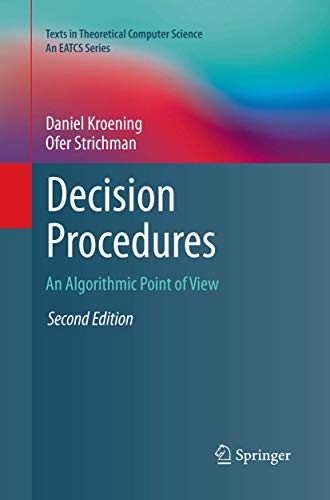
Inhaltsangabe
A decision procedure is an algorithm that, given a decision problem, terminates with a correct yes/no answer. Here, the authors focus on theories that are expressive enough to model real problems, but are still decidable. Specifically, the book concentrates on decision procedures for first-order theories that are commonly used in automated verification and reasoning, theorem-proving, compiler optimization and operations research. The techniques described in the book draw from fields such as graph theory and logic, and are routinely used in industry.
The authors introduce the basic terminology of SAT, Satisfiability Modulo Theories (SMT) and the DPLL(T) framework. Then, in separate chapters, they study decision procedures for propositional logic; equalities and uninterpreted functions; linear arithmetic; bit vectors; arrays; pointer logic; and quantified formulas. They also study the problem of deciding combined theories based on the Nelson-Oppen procedure.
Thefirst edition of this book was adopted as a textbook in courses worldwide. It was published in 2008 and the field now called SMT was then in its infancy, without the standard terminology and canonic algorithms it has now; this second edition reflects these changes. It brings forward the DPLL(T) framework. It also expands the SAT chapter with modern SAT heuristics, and includes a new section about incremental satisfiability, and the related Constraints Satisfaction Problem (CSP). The chapter about quantifiers was expanded with a new section about general quantification using E-matching and a section about Effectively Propositional Reasoning (EPR). The book also includes a new chapter on the application of SMT in industrial software engineering and in computational biology, coauthored by Nikolaj Bjørner and Leonardo de Moura, and Hillel Kugler, respectively.
Each chapter includes a detailed bibliography and exercises. Lecturers’ slides and a C++ library for rapid prototyping of decision procedures are available from the authors’ website.
Die Inhaltsangabe kann sich auf eine andere Ausgabe dieses Titels beziehen.
Über die Autorin bzw. den Autor
Daniel Kroening is a professor in the Dept. of Computer Science at the University of Oxford; his interests include automated verification, software engineering, and programming languages. Ofer Strichman is a professor in the faculty of industrial engineering and management at the Technion; his research interests include formal verification of software and hardware, and decision procedures for fragments of first-order logic.
Von der hinteren Coverseite
A decision procedure is an algorithm that, given a decision problem, terminates with a correct yes/no answer. Here, the authors focus on theories that are expressive enough to model real problems, but are still decidable. Specifically, the book concentrates on decision procedures for first-order theories that are commonly used in automated verification and reasoning, theorem-proving, compiler optimization and operations research. The techniques described in the book draw from fields such as graph theory and logic, and are routinely used in industry.
The authors introduce the basic terminology of SAT, Satisfiability Modulo Theories (SMT) and the DPLL(T) framework. Then, in separate chapters, they study decision procedures for propositional logic; equalities and uninterpreted functions; linear arithmetic; bit vectors; arrays; pointer logic; and quantified formulas. They also study the problem of deciding combined theories based on the Nelson-Oppen procedure.
The first edition of this book was adopted as a textbook in courses worldwide. It was published in 2008 and the field now called SMT was then in its infancy, without the standard terminology and canonic algorithms it has now; this second edition reflects these changes. It brings forward the DPLL(T) framework. It also expands the SAT chapter with modern SAT heuristics, and includes a new section about incremental satisfiability, and the related Constraints Satisfaction Problem (CSP). The chapter about quantifiers was expanded with a new section about general quantification using E-matching and a section about Effectively Propositional Reasoning (EPR). The book also includes a new chapter on the application of SMT in industrial software engineering and in computational biology, coauthored by Nikolaj Bjørner and Leonardo de Moura, and Hillel Kugler, respectively.
Each chapter includes a detailed bibliography and exercises. Lecturers’ slides and a C++ library forrapid prototyping of decision procedures are available from the authors’ website.
„Über diesen Titel“ kann sich auf eine andere Ausgabe dieses Titels beziehen.
Suchergebnisse für Decision Procedures: An Algorithmic Point of View (Texts...

Foto des Verkäufers
Decision Procedures : An Algorithmic Point of View
Anbieter: GreatBookPrices, Columbia, MD, USA
Verkäuferbewertung 5 von 5 Sternen

Zustand: As New. Unread book in perfect condition. Bestandsnummer des Verkäufers 33575164
Gebraucht kaufen
EUR 34,62
EUR 2,30 Versand
Versand innerhalb von USA
Versand innerhalb von USA
Anzahl: Mehr als 20 verfügbar
Foto des Verkäufers
Decision Procedures : An Algorithmic Point of View
Anbieter: GreatBookPrices, Columbia, MD, USA
Verkäuferbewertung 5 von 5 Sternen
Zustand: New. Bestandsnummer des Verkäufers 33575164-n
Neu kaufen
EUR 36,33
EUR 2,30 Versand
Versand innerhalb von USA
Versand innerhalb von USA
Anzahl: Mehr als 20 verfügbar
Foto des Verkäufers
Decision Procedures
ISBN 10: 3662570653
ISBN 13: 9783662570654
Neu
Paperback
Anbieter: Rarewaves.com USA, London, LONDO, Vereinigtes Königreich
Verkäuferbewertung 5 von 5 Sternen
Paperback. Zustand: New. A decision procedure is an algorithm that, given a decision problem, terminates with a correct yes/no answer. Here, the authors focus on theories that are expressive enough to model real problems, but are still decidable. Specifically, the book concentrates on decision procedures for first-order theories that are commonly used in automated verification and reasoning, theorem-proving, compiler optimization and operations research. The techniques described in the book draw from fields such as graph theory and logic, and are routinely used in industry.The authors introduce the basic terminology of SAT, Satisfiability Modulo Theories (SMT) and the DPLL(T) framework. Then, in separate chapters, they study decision procedures for propositional logic; equalities and uninterpreted functions; linear arithmetic; bit vectors; arrays; pointer logic; and quantified formulas. They also study the problem of deciding combined theories based on the Nelson-Oppen procedure.Thefirst edition of this book was adopted as a textbook in courses worldwide. It was published in 2008 and the field now called SMT was then in its infancy, without the standard terminology and canonic algorithms it has now; this second edition reflects these changes. It brings forward the DPLL(T) framework. It also expands the SAT chapter with modern SAT heuristics, and includes a new section about incremental satisfiability, and the related Constraints Satisfaction Problem (CSP). The chapter about quantifiers was expanded with a new section about general quantification using E-matching and a section about Effectively Propositional Reasoning (EPR). The book also includes a new chapter on the application of SMT in industrial software engineering and in computational biology, coauthored by Nikolaj Bjørner and Leonardo de Moura, and Hillel Kugler, respectively.Each chapter includes a detailed bibliography and exercises. Lecturers' slides and a C++ library for rapid prototyping of decision procedures are available from the authors' website. Softcover reprint of the original 2nd ed. 2016. Bestandsnummer des Verkäufers LU-9783662570654
Neu kaufen
EUR 38,71
Versand gratis
Versand von Vereinigtes Königreich nach USA
Versand von Vereinigtes Königreich nach USA
Anzahl: Mehr als 20 verfügbar
Beispielbild für diese ISBN
Decision Procedures: An Algorithmic Point of View (Texts in Theoretical Computer Science. An EATCS Series)
Anbieter: Ria Christie Collections, Uxbridge, Vereinigtes Königreich
Verkäuferbewertung 5 von 5 Sternen
Zustand: New. In English. Bestandsnummer des Verkäufers ria9783662570654_new
Neu kaufen
EUR 33,96
EUR 13,17 Versand
Versand von Vereinigtes Königreich nach USA
Versand von Vereinigtes Königreich nach USA
Anzahl: Mehr als 20 verfügbar
Foto des Verkäufers
Decision Procedures : An Algorithmic Point of View
Anbieter: GreatBookPricesUK, Woodford Green, Vereinigtes Königreich
Verkäuferbewertung 5 von 5 Sternen
Zustand: New. Bestandsnummer des Verkäufers 33575164-n
Neu kaufen
EUR 33,95
EUR 17,49 Versand
Versand von Vereinigtes Königreich nach USA
Versand von Vereinigtes Königreich nach USA
Anzahl: Mehr als 20 verfügbar
Foto des Verkäufers
Decision Procedures : An Algorithmic Point of View
Anbieter: GreatBookPricesUK, Woodford Green, Vereinigtes Königreich
Verkäuferbewertung 5 von 5 Sternen
Zustand: As New. Unread book in perfect condition. Bestandsnummer des Verkäufers 33575164
Gebraucht kaufen
EUR 36,59
EUR 17,49 Versand
Versand von Vereinigtes Königreich nach USA
Versand von Vereinigtes Königreich nach USA
Anzahl: Mehr als 20 verfügbar
Beispielbild für diese ISBN
Decision Procedures
Anbieter: Basi6 International, Irving, TX, USA
Verkäuferbewertung 5 von 5 Sternen
Zustand: Brand New. New. US edition. Expediting shipping for all USA and Europe orders excluding PO Box. Excellent Customer Service. Bestandsnummer des Verkäufers ABEOCT25-16143
Beispielbild für diese ISBN
Decision Procedures (eng)
Print-on-DemandAnbieter: Brook Bookstore On Demand, Napoli, NA, Italien
Verkäuferbewertung 5 von 5 Sternen
Zustand: new. Questo è un articolo print on demand. Bestandsnummer des Verkäufers b44a6b2217a3051f768418e5d64c741c
Neu kaufen
EUR 54,23
EUR 6,80 Versand
Versand von Italien nach USA
Versand von Italien nach USA
Anzahl: Mehr als 20 verfügbar
Beispielbild für diese ISBN
Decision Procedures: An Algorithmic Point of View
Anbieter: Basi6 International, Irving, TX, USA
Verkäuferbewertung 5 von 5 Sternen
Zustand: Brand New. New. US edition. Expediting shipping for all USA and Europe orders excluding PO Box. Excellent Customer Service. Bestandsnummer des Verkäufers ABEOCT25-246545
Beispielbild für diese ISBN
Decision Procedures: An Algorithmic Point of View (Texts in Theoretical Computer Science. An EATCS Series)
Anbieter: Books Puddle, Woodside, NY, USA
Verkäuferbewertung 4 von 5 Sternen

Zustand: New. pp. 377. Bestandsnummer des Verkäufers 26384056213
Neu kaufen
EUR 78,06
EUR 3,48 Versand
Versand innerhalb von USA
Versand innerhalb von USA
Anzahl: 4 verfügbar