
Verwandte Artikel zu Adaptive Finite Element Methods for Differential Equations...
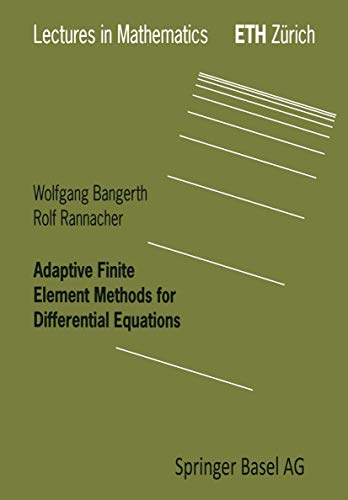
Adaptive Finite Element Methods for Differential Equations (Lectures in Mathematics. ETH Zürich) - Softcover
Inhaltsangabe
These Lecture Notes have been compiled from the material presented by the second author in a lecture series ('Nachdiplomvorlesung') at the Department of Mathematics of the ETH Zurich during the summer term 2002. Concepts of 'self adaptivity' in the numerical solution of differential equations are discussed with emphasis on Galerkin finite element methods. The key issues are a posteriori er ror estimation and automatic mesh adaptation. Besides the traditional approach of energy-norm error control, a new duality-based technique, the Dual Weighted Residual method (or shortly D WR method) for goal-oriented error estimation is discussed in detail. This method aims at economical computation of arbitrary quantities of physical interest by properly adapting the computational mesh. This is typically required in the design cycles of technical applications. For example, the drag coefficient of a body immersed in a viscous flow is computed, then it is minimized by varying certain control parameters, and finally the stability of the resulting flow is investigated by solving an eigenvalue problem. 'Goal-oriented' adaptivity is designed to achieve these tasks with minimal cost. The basics of the DWR method and various of its applications are described in the following survey articles: R. Rannacher [114], Error control in finite element computations. In: Proc. of Summer School Error Control and Adaptivity in Scientific Computing (H. Bulgak and C. Zenger, eds), pp. 247-278. Kluwer Academic Publishers, 1998. M. Braack and R. Rannacher [42], Adaptive finite element methods for low Mach-number flows with chemical reactions.
Die Inhaltsangabe kann sich auf eine andere Ausgabe dieses Titels beziehen.
Von der hinteren Coverseite
These Lecture Notes discuss concepts of `self-adaptivity' in the numerical solution of differential equations, with emphasis on Galerkin finite element methods. The key issues are a posteriori error estimation and it automatic mesh adaptation. Besides the traditional approach of energy-norm error control, a new duality-based technique, the Dual Weighted Residual method for goal-oriented error estimation, is discussed in detail. This method aims at economical computation of arbitrary quantities of physical interest by properly adapting the computational mesh. This is typically required in the design cycles of technical applications. For example, the drag coefficient of a body immersed in a viscous flow is computed, then it is minimized by varying certain control parameters, and finally the stability of the resulting flow is investigated by solving an eigenvalue problem. `Goal-oriented' adaptivity is designed to achieve these tasks with minimal cost.
At the end of each chapter some exercises are posed in order to assist the interested reader in better understanding the concepts presented. Solutions and accompanying remarks are given in the Appendix. For the practical exercises, sample programs are provided via internet.
„Über diesen Titel“ kann sich auf eine andere Ausgabe dieses Titels beziehen.
Suchergebnisse für Adaptive Finite Element Methods for Differential Equations...

Beispielbild für diese ISBN
Adaptive Finite Element Method
Anbieter: World of Books (was SecondSale), Montgomery, IL, USA
Verkäuferbewertung 5 von 5 Sternen

Zustand: Good. Item in good condition. Textbooks may not include supplemental items i.e. CDs, access codes etc. Bestandsnummer des Verkäufers 00110273616
Gebraucht kaufen
EUR 42,79
Versand gratis
Versand innerhalb von USA
Versand innerhalb von USA
Anzahl: 1 verfügbar
Beispielbild für diese ISBN
Adaptive Finite Element Methods for Differential Equations (Lectures in Mathematics. ETH Z�rich)
Anbieter: Phatpocket Limited, Waltham Abbey, HERTS, Vereinigtes Königreich
Verkäuferbewertung 5 von 5 Sternen
Zustand: Good. Your purchase helps support Sri Lankan Children's Charity 'The Rainbow Centre'. Ex-library, so some stamps and wear, but in good overall condition. Our donations to The Rainbow Centre have helped provide an education and a safe haven to hundreds of children who live in appalling conditions. Bestandsnummer des Verkäufers Z1-A-012-02605
Gebraucht kaufen
EUR 32,13
EUR 12,41 Versand
Versand von Vereinigtes Königreich nach USA
Versand von Vereinigtes Königreich nach USA
Anzahl: 1 verfügbar
Beispielbild für diese ISBN
Adaptive Finite Element Methods for Differential Equations
Anbieter: World of Books Inc, Montgomery, IL, USA
Verkäuferbewertung 4 von 5 Sternen

Paperback. Zustand: Good. These Lecture Notes have been compiled from the material presented by the second author in a lecture series ('Nachdiplomvorlesung') at the Department of Mathematics of the ETH Zurich during the summer term 2002. Concepts of 'self adaptivity' in the numerical solution of differential equations are discussed with emphasis on Galerkin finite element methods. The key issues are a posteriori er ror estimation and automatic mesh adaptation. Besides the traditional approach of energy-norm error control, a new duality-based technique, the Dual Weighted Residual method (or shortly D WR method) for goal-oriented error estimation is discussed in detail. This method aims at economical computation of arbitrary quantities of physical interest by properly adapting the computational mesh. This is typically required in the design cycles of technical applications. For example, the drag coefficient of a body immersed in a viscous flow is computed, then it is minimized by varying certain control parameters, and finally the stability of the resulting flow is investigated by solving an eigenvalue problem. 'Goal-oriented' adaptivity is designed to achieve these tasks with minimal cost. The basics of the DWR method and various of its applications are described in the following survey articles: R. Rannacher [114], Error control in finite element computations. In: Proc. of Summer School Error Control and Adaptivity in Scientific Computing (H. Bulgak and C. Zenger, eds), pp. 247-278. Kluwer Academic Publishers, 1998. M. Braack and R. Rannacher [42], Adaptive finite element methods for low Mach-number flows with chemical reactions. Bestandsnummer des Verkäufers CIN3764370092G
Gebraucht kaufen
EUR 44,93
Versand gratis
Versand innerhalb von USA
Versand innerhalb von USA
Anzahl: 1 verfügbar
Beispielbild für diese ISBN
Adaptive Finite Element Methods for Differential Equations (Lectures in Mathematics. ETH Zürich)
Anbieter: Zubal-Books, Since 1961, Cleveland, OH, USA
Verkäuferbewertung 5 von 5 Sternen
Zustand: Fine. 216 pp., paperback, fine. - If you are reading this, this item is actually (physically) in our stock and ready for shipment once ordered. We are not bookjackers. Buyer is responsible for any additional duties, taxes, or fees required by recipient's country. Bestandsnummer des Verkäufers ZB1351517
Gebraucht kaufen
EUR 48,09
EUR 3,97 Versand
Versand innerhalb von USA
Versand innerhalb von USA
Anzahl: 1 verfügbar
Beispielbild für diese ISBN
Adaptive Finite Element Methods for Differential Equations (Paperback)
Verlag:
Birkhauser Verlag AG, Basel, 2003
ISBN 10: 3764370092
ISBN 13: 9783764370091
Neu
Paperback
Erstausgabe
Anbieter: Grand Eagle Retail, Bensenville, IL, USA
Verkäuferbewertung 5 von 5 Sternen
Paperback. Zustand: new. Paperback. The key issues are a posteriori error estimation and it automatic mesh adaptation. Besides the traditional approach of energy-norm error control, a new duality-based technique, the Dual Weighted Residual method for goal-oriented error estimation, is discussed in detail. This method aims at economical computation of arbitrary quantities of physical interest by properly adapting the computational mesh. This is typically required in the design cycles of technical applications. For example, the drag coefficient of a body immersed in a viscous flow is computed, then it is minimized by varying certain control parameters, and finally the stability of the resulting flow is investigated by solving an eigenvalue problem. 'Goal-oriented' adaptivity is designed to achieve these tasks with minimal cost.At the end of each chapter some exercises are posed in order to assist the interested reader in better understanding the concepts presented. Solutions and accompanying remarks are given in the Appendix. Besides the traditional approach of energy-norm error control, a new duality-based technique, the Dual Weighted Residual method (or shortly D WR method) for goal-oriented error estimation is discussed in detail. Rannacher [42], Adaptive finite element methods for low Mach-number flows with chemical reactions. Shipping may be from multiple locations in the US or from the UK, depending on stock availability. Bestandsnummer des Verkäufers 9783764370091
Beispielbild für diese ISBN
Adaptive Finite Element Methods for Differential Equations (Lectures in Mathematics. ETH Z�rich)
Anbieter: Chiron Media, Wallingford, Vereinigtes Königreich
Verkäuferbewertung 5 von 5 Sternen
Paperback. Zustand: New. Bestandsnummer des Verkäufers 6666-IUK-9783764370091
Neu kaufen
EUR 57,40
EUR 18,07 Versand
Versand von Vereinigtes Königreich nach USA
Versand von Vereinigtes Königreich nach USA
Anzahl: 10 verfügbar
Foto des Verkäufers
Adaptive Finite Element Methods for Differential Equations
Verlag:
Springer, Basel, Birkhäuser Basel, Birkhäuser Jan 2003, 2003
ISBN 10: 3764370092
ISBN 13: 9783764370091
Neu
Taschenbuch
Anbieter: BuchWeltWeit Ludwig Meier e.K., Bergisch Gladbach, Deutschland
Verkäuferbewertung 5 von 5 Sternen
Taschenbuch. Zustand: Neu. This item is printed on demand - it takes 3-4 days longer - Neuware -These Lecture Notes have been compiled from the material presented by the second author in a lecture series ('Nachdiplomvorlesung') at the Department of Mathematics of the ETH Zurich during the summer term 2002. Concepts of 'self adaptivity' in the numerical solution of differential equations are discussed with emphasis on Galerkin finite element methods. The key issues are a posteriori er ror estimation and automatic mesh adaptation. Besides the traditional approach of energy-norm error control, a new duality-based technique, the Dual Weighted Residual method (or shortly D WR method) for goal-oriented error estimation is discussed in detail. This method aims at economical computation of arbitrary quantities of physical interest by properly adapting the computational mesh. This is typically required in the design cycles of technical applications. For example, the drag coefficient of a body immersed in a viscous flow is computed, then it is minimized by varying certain control parameters, and finally the stability of the resulting flow is investigated by solving an eigenvalue problem. 'Goal-oriented' adaptivity is designed to achieve these tasks with minimal cost. The basics of the DWR method and various of its applications are described in the following survey articles: R. Rannacher [114], Error control in finite element computations. In: Proc. of Summer School Error Control and Adaptivity in Scientific Computing (H. Bulgak and C. Zenger, eds), pp. 247-278. Kluwer Academic Publishers, 1998. M. Braack and R. Rannacher [42], Adaptive finite element methods for low Mach-number flows with chemical reactions. 208 pp. Englisch. Bestandsnummer des Verkäufers 9783764370091
Neu kaufen
EUR 53,49
EUR 23,00 Versand
Versand von Deutschland nach USA
Versand von Deutschland nach USA
Anzahl: 2 verfügbar
Beispielbild für diese ISBN
Adaptive Finite Element Methods for Differential Equations
Anbieter: Kennys Bookshop and Art Galleries Ltd., Galway, GY, Irland
Verkäuferbewertung 5 von 5 Sternen
Zustand: New. Series: Lectures in Mathematics. ETH Zurich. Num Pages: 216 pages, 151 black & white illustrations, biography. BIC Classification: PBKJ. Category: (P) Professional & Vocational; (UP) Postgraduate, Research & Scholarly; (UU) Undergraduate. Dimension: 244 x 170 x 11. Weight in Grams: 416. . 2003. Softcover reprint of the original 1st ed. 2003. Paperback. . . . . Bestandsnummer des Verkäufers V9783764370091
Neu kaufen
EUR 68,52
EUR 9,50 Versand
Versand von Irland nach USA
Versand von Irland nach USA
Anzahl: 15 verfügbar
Beispielbild für diese ISBN
Adaptive Finite Element Methods for Differential Equations (Lectures in Mathematics. ETH Zürich)
Anbieter: Ria Christie Collections, Uxbridge, Vereinigtes Königreich
Verkäuferbewertung 5 von 5 Sternen
Zustand: New. In English. Bestandsnummer des Verkäufers ria9783764370091_new
Neu kaufen
EUR 67,17
EUR 10,93 Versand
Versand von Vereinigtes Königreich nach USA
Versand von Vereinigtes Königreich nach USA
Anzahl: Mehr als 20 verfügbar
Beispielbild für diese ISBN
Adaptive Finite Element Methods for Differential Equations
Anbieter: Books Puddle, Woodside, NY, USA
Verkäuferbewertung 4 von 5 Sternen
Zustand: New. pp. 220. Bestandsnummer des Verkäufers 26354941
Neu kaufen
EUR 80,15
EUR 3,52 Versand
Versand innerhalb von USA
Versand innerhalb von USA
Anzahl: 4 verfügbar