
Verwandte Artikel zu Strategy, Structure and Performance in a Transition...
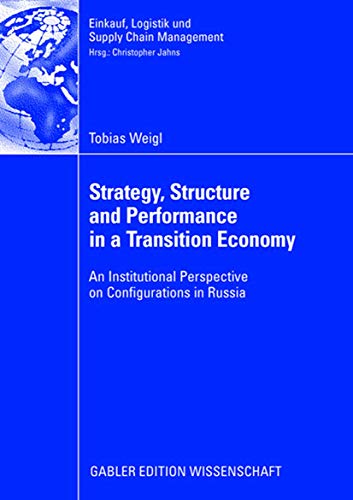
Strategy, Structure and Performance in a Transition Economy: An Institutional Perspective on Configurations in Russia (Einkauf, Logistik und Supply Chain Management) - Softcover
Inhaltsangabe
st Since the beginning of the 21 century, three key business trends have been identified with a pronounced influence on future microeconomic and macroeconomic developments across the globe: Firstly, with the advent of the network economy, int- organizational relations and structures are increasingly becoming the object of analysis. Successful companies have extended the concept of an appropriate organizational structure beyond internal relationships to those spanning across the entire business network by taking the country specific institutional context into consideration. Secondly, with slowing growth in the developed markets and abundant growth opportunities in the developing economies, companies are turning to these markets for new business expansion. Finally, during the last number of years, so called ‘emerging giants’, which are strong local players from developing economies, have started to globalize and to expand into the developed markets. Among other reasons, these firms have edged themselves into the limelight by maintaining the right fit between their strategy type and inter-organizational structures in their home markets.
Die Inhaltsangabe kann sich auf eine andere Ausgabe dieses Titels beziehen.
Über die Autorin bzw. den Autor
Dr. Tobias Weigl promovierte bei Prof. Dr. Christopher Jahns am Supply Management Institute der European Business School (ebs) in Oestrich-Winkel. Er ist als Business Development Manager Emerging Markets bei DHL tätig.
Von der hinteren Coverseite
Being one of the biggest transition markets, Russia plays an increasing role within the global economy. Non-Russian firms are expanding into Russia in order to exploit the abundant growth opportunities. Simultaneously they face stronger competition in their home markets due to the entrance of global Russian players which try to explore opportunities abroad.
Based on the results of 177 survey responses, Tobias Weigl shows that the simple transfer of managerial and organizational skills, techniques, values and culture from developed countries to Russia is a false assumption among academics and practitioners. While executives from developed markets are driven by a rational economic model, which includes objective rules and arm’s length transaction structures, successful businesses in Russia need to incorporate the remaining influence of collectivism, paternalism and ‘blat’. Thus, successfully conducting business in Russia is based on network capitalism and relationships that co-exist within the pervasive environment of the Russian state.
„Über diesen Titel“ kann sich auf eine andere Ausgabe dieses Titels beziehen.
Suchergebnisse für Strategy, Structure and Performance in a Transition...

Beispielbild für diese ISBN
Strategy, structure and performance in a transition economy : an institutional perspective on configurations in Russia. Dissertation.
Anbieter: Wissenschaftliches Antiquariat Köln Dr. Sebastian Peters UG, Köln, Deutschland
Verkäuferbewertung 5 von 5 Sternen

Zustand: sehr gut. XXII, 384 S., Abb., 21 cm, Schnittkante mit kleinem Fleck. Sprache: Englisch. Bestandsnummer des Verkäufers B560-014
Gebraucht kaufen
EUR 36,00
EUR 10,00 Versand
Versand von Deutschland nach USA
Versand von Deutschland nach USA
Anzahl: 1 verfügbar
Foto des Verkäufers
Strategy, Structure and Perfurmance in a Transition Economy : An Institutional Perspective on Configurations in Russia
Anbieter: GreatBookPrices, Columbia, MD, USA
Verkäuferbewertung 5 von 5 Sternen
Zustand: As New. Unread book in perfect condition. Bestandsnummer des Verkäufers 7298600
Gebraucht kaufen
EUR 64,34
EUR 2,37 Versand
Versand innerhalb von USA
Versand innerhalb von USA
Anzahl: 15 verfügbar
Foto des Verkäufers
Strategy, Structure and Performance in a Transition Economy
Print-on-DemandAnbieter: BuchWeltWeit Ludwig Meier e.K., Bergisch Gladbach, Deutschland
Verkäuferbewertung 5 von 5 Sternen
Taschenbuch. Zustand: Neu. This item is printed on demand - it takes 3-4 days longer - Neuware -Being one of the biggest transition markets, Russia plays an increasing role within the global economy. Non-Russian firms are expanding into Russia in order to exploit the abundant growth opportunities. Simultaneously they face stronger competition in their home markets due to the entrance of global Russian players which try to explore opportunities abroad. Based on the results of 177 survey responses, Tobias Weigl shows that the simple transfer of managerial and organizational skills, techniques, values and culture from developed countries to Russia is a false assumption among academics and practitioners. While executives from developed markets are driven by a rational economic model, which includes objective rules and arm's length transaction structures, successful businesses in Russia need to incorporate the remaining influence of collectivism, paternalism and'blat'. Thus, successfully conducting business in Russia is based on network capitalism and relationships that co-exist within the pervasive environment of the Russian state. 408 pp. Englisch. Bestandsnummer des Verkäufers 9783835008748
Neu kaufen
EUR 53,49
EUR 23,00 Versand
Versand von Deutschland nach USA
Versand von Deutschland nach USA
Anzahl: 2 verfügbar
Beispielbild für diese ISBN
Strategy, Structure and Performance in a Transition Economy : An Institutional Perspective on Configurations in Russia
Anbieter: Chiron Media, Wallingford, Vereinigtes Königreich
Verkäuferbewertung 5 von 5 Sternen
PF. Zustand: New. Bestandsnummer des Verkäufers 6666-IUK-9783835008748
Neu kaufen
EUR 58,27
EUR 18,34 Versand
Versand von Vereinigtes Königreich nach USA
Versand von Vereinigtes Königreich nach USA
Anzahl: 10 verfügbar
Foto des Verkäufers
Strategy, Structure and Perfurmance in a Transition Economy : An Institutional Perspective on Configurations in Russia
Anbieter: GreatBookPrices, Columbia, MD, USA
Verkäuferbewertung 5 von 5 Sternen
Zustand: New. Bestandsnummer des Verkäufers 7298600-n
Neu kaufen
EUR 76,63
EUR 2,37 Versand
Versand innerhalb von USA
Versand innerhalb von USA
Anzahl: 15 verfügbar
Beispielbild für diese ISBN
Strategy, Structure and Performance in a Transition Economy: An Institutional Perspective on Configurations in Russia (Einkauf, Logistik und Supply Chain Management)
Anbieter: Ria Christie Collections, Uxbridge, Vereinigtes Königreich
Verkäuferbewertung 5 von 5 Sternen
Zustand: New. In English. Bestandsnummer des Verkäufers ria9783835008748_new
Neu kaufen
EUR 68,16
EUR 13,36 Versand
Versand von Vereinigtes Königreich nach USA
Versand von Vereinigtes Königreich nach USA
Anzahl: Mehr als 20 verfügbar
Beispielbild für diese ISBN
Strategy, Structure and Performance in a Transition Economy: An Institutional Perspective on Configurations in Russia (Einkauf, Logistik und Supply Chain Management)
Anbieter: Books Puddle, Woodside, NY, USA
Verkäuferbewertung 4 von 5 Sternen

Zustand: New. pp. xxii + 385. Bestandsnummer des Verkäufers 26323894712
Neu kaufen
EUR 92,20
EUR 3,58 Versand
Versand innerhalb von USA
Versand innerhalb von USA
Anzahl: 4 verfügbar
Foto des Verkäufers
Stategy, Structure and Performance in a Transition Economy
Print-on-DemandAnbieter: moluna, Greven, Deutschland
Verkäuferbewertung 5 von 5 Sternen
Zustand: New. Dieser Artikel ist ein Print on Demand Artikel und wird nach Ihrer Bestellung fuer Sie gedruckt. Dr. Tobias Weigl promovierte bei Prof. Dr. Christopher Jahns am Supply Management Institute der European Business School (ebs) in Oestrich-Winkel. Er ist als Business Development Manager Emerging Markets bei DHL taetig.Based on the results of. Bestandsnummer des Verkäufers 5383280
Neu kaufen
EUR 48,37
EUR 48,99 Versand
Versand von Deutschland nach USA
Versand von Deutschland nach USA
Anzahl: Mehr als 20 verfügbar
Beispielbild für diese ISBN
Strategy, Structure and Performance in a Transitional Economy: An Insitutional Perspective on Configurations in Russia
Anbieter: Revaluation Books, Exeter, Vereinigtes Königreich
Verkäuferbewertung 5 von 5 Sternen
Paperback. Zustand: Brand New. 2008 edition. 406 pages. 8.20x5.80x0.90 inches. In Stock. Bestandsnummer des Verkäufers x-3835008749
Neu kaufen
EUR 83,06
EUR 14,80 Versand
Versand von Vereinigtes Königreich nach USA
Versand von Vereinigtes Königreich nach USA
Anzahl: 2 verfügbar
Beispielbild für diese ISBN
Strategy, Structure and Performance in a Transition Economy: An Institutional Perspective on Configurations in Russia (Einkauf, Logistik und Supply Chain Management)
Print-on-DemandAnbieter: Majestic Books, Hounslow, Vereinigtes Königreich
Verkäuferbewertung 4 von 5 Sternen
Zustand: New. Print on Demand pp. xxii + 385. Bestandsnummer des Verkäufers 322536039
Neu kaufen
EUR 92,57
EUR 7,69 Versand
Versand von Vereinigtes Königreich nach USA
Versand von Vereinigtes Königreich nach USA
Anzahl: 4 verfügbar