
Verwandte Artikel zu Time, Space and Material: The Mechanics of Layering...
Inhaltsangabe
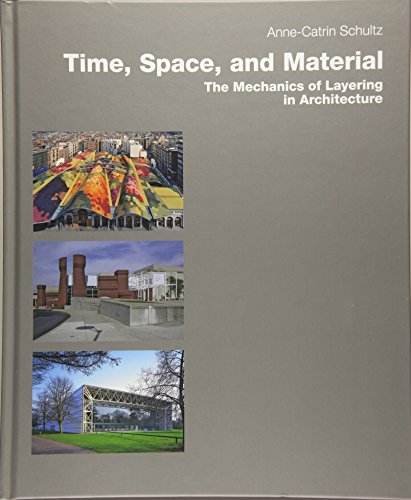
This book examines the application of the principle of layering in architecture, its mechanics, possible application and meaning. Layering is widely used in the discussions of the 20th and 21st centuries architecture but rarely defined or examined. Layering bridges the tectonics of structure and skin, offers a system for the creation of different architectural spaces over time and functions as a design principle without hierarchy. Three types of layering are identified: a chronological sedimentation of planes materializing changes over time (temporal layering), the additive sequence of spaces (spatial layering), and the stratification of individual planes (material layering). Like a palimpsest, historic cities frequently reveal temporal layering and aspects of change over time, a condition familiar to archaeologists who study layer upon layer of remnants of civilization, including architectural remains and urban organization. In historic cities, one can read at least the most recent layers to determine a physical chronology of the city's history; contemporary architects add strata of the 21st century. Cities are composed of several layers, offering a complex understanding of time in which a view of the present includes the simultaneous perception of the past. At a building scale, layers can be part of the spatial composition, multiple elements of walls, the skin, the structure or decorative and narrative elements. Just as the position and order of geological stra-ta contain information related to their age, formation, and origin, the position and form of architectural layers come with information about their function, intellectual scope, and provenance. The possible elements of such an architectural strategy include materials, light, water, and color as well as associations, memories, and analogies embedded in the layers or in the voids between them. Material layering is based on a perceived separation of spatial enclosures into floor, wall, and ceiling or roof elements and combinations thereof. Individual elements may consist of multiple planes fulfilling a series of specific functions. The architectural enclosure can represent the physical wrapper of a building and might transport the structure’s narrative, tectonic information, cultural expression, the architect’s design intent, and other topics that might be embedded. Anne-Catrin Schultz studied architecture in Stuttgart and Florence. Following post-doctoral research at the Massachusetts Institute of Technology in Boston, she worked for several years with Turnbull Griffin Haesloop and Skidmore Owings & Merrill in San Francisco. While developing her own practice, she has taught at the University of California in Berkeley, the California College of the Arts and the Academy of Arts University in San Francisco. In 2013 she joined the Department of Architecture at Wentworth Institute of Technology in Boston. Anne-Catrin’s research concentrates on architecture in historic context, the evolution of buildings over time and questions of contemporary tectonics.
Die Inhaltsangabe kann sich auf eine andere Ausgabe dieses Titels beziehen.
Über die Autorin bzw. den Autor
Anne-Catrin Schultz studied architecture in Stuttgart, Germany and Florence, Italy, and earned a Ph.D. from the University of Stuttgart. For several years she worked with Turnbull Griffin Haesloop (TGH) and Skidmore Owings & Merrill (SOM). She has taught architecture history and theory as well as design studios at the University of California in Berkeley, the California College of the Arts (CCA) and the Academy of Arts University in San Francisco. In the fall 2013 she joined the Department of Architecture at the Wentworth Institute of Technology in Boston.
„Über diesen Titel“ kann sich auf eine andere Ausgabe dieses Titels beziehen.
Suchergebnisse für Time, Space and Material: The Mechanics of Layering...

Foto des Verkäufers
Time, Space and Material : The Mechanics of Layering in Architecture
Anbieter: GreatBookPrices, Columbia, MD, USA
Verkäuferbewertung 5 von 5 Sternen

Zustand: As New. Unread book in perfect condition. Bestandsnummer des Verkäufers 22473485
Gebraucht kaufen
EUR 39,46
EUR 2,35 Versand
Versand innerhalb von USA
Versand innerhalb von USA
Anzahl: 2 verfügbar
Beispielbild für diese ISBN
TIME SPACE & MATERIAL:THE MECHANICS Format: Hardcover
Anbieter: INDOO, Avenel, NJ, USA
Verkäuferbewertung 5 von 5 Sternen
Zustand: As New. Unread copy in mint condition. Bestandsnummer des Verkäufers SS9783936681888
Gebraucht kaufen
EUR 41,88
Versand gratis
Versand innerhalb von USA
Versand innerhalb von USA
Anzahl: Mehr als 20 verfügbar
Beispielbild für diese ISBN
Time, Space and Material : The Mechanics of Layering in Architecture
Anbieter: GreatBookPrices, Columbia, MD, USA
Verkäuferbewertung 5 von 5 Sternen
Zustand: New. Bestandsnummer des Verkäufers 22473485-n
Neu kaufen
EUR 39,55
EUR 2,35 Versand
Versand innerhalb von USA
Versand innerhalb von USA
Anzahl: 2 verfügbar
Beispielbild für diese ISBN
TIME SPACE & MATERIAL:THE MECHANICS Format: Hardcover
Anbieter: INDOO, Avenel, NJ, USA
Verkäuferbewertung 5 von 5 Sternen
Zustand: New. Brand New. Bestandsnummer des Verkäufers 9783936681888
Neu kaufen
EUR 41,98
Versand gratis
Versand innerhalb von USA
Versand innerhalb von USA
Anzahl: Mehr als 20 verfügbar
Beispielbild für diese ISBN
Time, Space and Material
Anbieter: PBShop.store US, Wood Dale, IL, USA
Verkäuferbewertung 5 von 5 Sternen
HRD. Zustand: New. New Book. Shipped from UK. Established seller since 2000. Bestandsnummer des Verkäufers GZ-9783936681888
Beispielbild für diese ISBN
Time, Space and Material
Anbieter: PBShop.store UK, Fairford, GLOS, Vereinigtes Königreich
Verkäuferbewertung 5 von 5 Sternen
HRD. Zustand: New. New Book. Shipped from UK. Established seller since 2000. Bestandsnummer des Verkäufers GZ-9783936681888
Neu kaufen
EUR 40,02
EUR 5,92 Versand
Versand von Vereinigtes Königreich nach USA
Versand von Vereinigtes Königreich nach USA
Anzahl: 1 verfügbar
Foto des Verkäufers
Time, Space and Material
Anbieter: Rarewaves.com USA, London, LONDO, Vereinigtes Königreich
Verkäuferbewertung 5 von 5 Sternen
Hardback. Zustand: New. This book examines the application of the principle of layering in architecture, its mechanics, possible application and meaning. Layering is widely used in the discussions of the 20th and 21st centuries architecture but rarely defined or examined. Layering bridges the tectonics of structure and skin, offers a system for the creation of different architectural spaces over time and functions as a design principle without hierarchy. Three types of layering are identified: a chronological sedimentation of planes materializing changes over time (temporal layering), the additive sequence of spaces (spatial layering), and the stratification of individual planes (material layering). Like a palimpsest, historic cities frequently reveal temporal layering and aspects of change over time, a condition familiar to archaeologists who study layer upon layer of remnants of civilisation, including architectural remains and urban organization. In historic cities, one can read at least the most recent layers to determine a physical chronology of the city's history; contemporary architects add strata of the 21st century. Cities are composed of several layers, offering a complex understanding of time in which a view of the present includes also the perception of the past. At a building scale, layers can be part of the spatial composition, multiple elements of walls, the skin, the structure or decorative and narrative elements. Just as the position and order of geological strata contain information related to their age, formation, and origin, the position and form of architectural layers come with information about their function, intellectual scope, and provenance. The possible elements of such an architectural strategy include materials, light, water, and color as well as associations, memories, and analogies embedded in the layers or in the voids between them. Material layering is based on a perceived separation of spatial enclosures into floor, wall, and ceiling or roof elements and combinations thereof. Individual elements may consist of multiple planes fulfilling a series of specific functions. The architectural enclosure can represent the physical wrapper of a building and might transport the structure's narrative, tectonic information, cultural expression, the architect's design intent, and other topics that might be embedded. Bestandsnummer des Verkäufers LU-9783936681888
Neu kaufen
EUR 45,97
Versand gratis
Versand von Vereinigtes Königreich nach USA
Versand von Vereinigtes Königreich nach USA
Anzahl: 1 verfügbar
Beispielbild für diese ISBN
Time, Space & Material (Hardcover)
Verlag:
Edition Axel Menges, Fellbach, 2015
ISBN 10: 3936681880
ISBN 13: 9783936681888
Neu
Hardcover
Anbieter: Grand Eagle Retail, Bensenville, IL, USA
Verkäuferbewertung 5 von 5 Sternen
Hardcover. Zustand: new. Hardcover. This book examines the application of the principle of layering in architecture, its mechanics, possible application and meaning. Layering is widely used in the discussions of the 20th and 21st centuries architecture but rarely defined or examined. Layering bridges the tectonics of structure and skin, offers a system for the creation of different architectural spaces over time and functions as a design principle without hierarchy. Three types of layering are identified: a chronological sedimentation of planes materializing changes over time (temporal layering), the additive sequence of spaces (spatial layering), and the stratification of individual planes (material layering). Like a palimpsest, historic cities frequently reveal temporal layering and aspects of change over time, a condition familiar to archaeologists who study layer upon layer of remnants of civilisation, including architectural remains and urban organization. In historic cities, one can read at least the most recent layers to determine a physical chronology of the city's history; contemporary architects add strata of the 21st century. Cities are composed of several layers, offering a complex understanding of time in which a view of the present includes also the perception of the past. At a building scale, layers can be part of the spatial composition, multiple elements of walls, the skin, the structure or decorative and narrative elements. Just as the position and order of geological strata contain information related to their age, formation, and origin, the position and form of architectural layers come with information about their function, intellectual scope, and provenance. The possible elements of such an architectural strategy include materials, light, water, and color as well as associations, memories, and analogies embedded in the layers or in the voids between them. Material layering is based on a perceived separation of spatial enclosures into floor, wall, and ceiling or roof elements and combinations thereof. Individual elements may consist of multiple planes fulfilling a series of specific functions. The architectural enclosure can represent the physical wrapper of a building and might transport the structure's narrative, tectonic information, cultural expression, the architect's design intent, and other topics that might be embedded. Shipping may be from multiple locations in the US or from the UK, depending on stock availability. Bestandsnummer des Verkäufers 9783936681888
Beispielbild für diese ISBN
Time, Space and Material : The Mechanics of Layering in Architecture
Anbieter: GreatBookPricesUK, Woodford Green, Vereinigtes Königreich
Verkäuferbewertung 5 von 5 Sternen
Zustand: New. Bestandsnummer des Verkäufers 22473485-n
Neu kaufen
EUR 40,01
EUR 17,68 Versand
Versand von Vereinigtes Königreich nach USA
Versand von Vereinigtes Königreich nach USA
Anzahl: 2 verfügbar
Beispielbild für diese ISBN
Time, Space and Material: The Mechanics of Layering in Architecture
Anbieter: Kennys Bookshop and Art Galleries Ltd., Galway, GY, Irland
Verkäuferbewertung 5 von 5 Sternen
Zustand: New. Num Pages: 80 pages, black & white illustrations, black & white halftones, colour illustrations. BIC Classification: AMC. Category: (G) General (US: Trade). Dimension: 298 x 244 x 12. Weight in Grams: 698. . 2015. Hardcover. . . . . Bestandsnummer des Verkäufers V9783936681888
Neu kaufen
EUR 49,21
EUR 9,50 Versand
Versand von Irland nach USA
Versand von Irland nach USA
Anzahl: 1 verfügbar