
Verwandte Artikel zu Process-structure-property relationship of polymer-fullerene...
Process-structure-property relationship of polymer-fullerene bulk heterojunction films for organic solar cells: Drying process, film structure and ... (Forum Organic Electronics Science) - Softcover
Inhaltsangabe
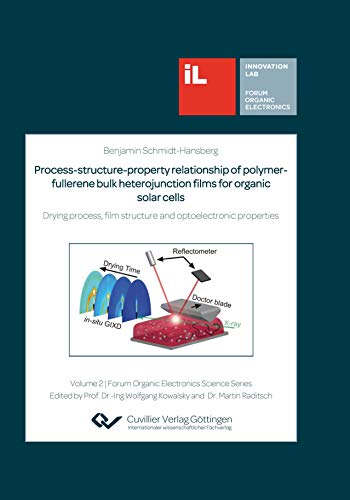
Photovoltaic (PV) is attracting increasing interest as an important contribution to renewable energy supply. Organic photovoltaic (OPV) is a comparable young PV technology with a great potential towards low cost solar power. This is due to the intrinsic advantage of the incorporated organic semiconductors which are soluble. Solution processing allows high throughput coating and printing processes. Hence, energy intensive high temperature and vacuum steps can be avoided which reduces the fabrication costs and keeps energy payback times low. The performance of organic solar cells strongly depends on the structure of the solution cast photoactive layer which comprises a polymer-fullerene blend. The blend structure evolves during the film drying step which has been studied in this thesis. Starting point of this work was the hypothesis that drying process parameters are suitable for systematically tuning the structure formation during drying of solution cast polymer-fullerene films in order to generate optimized structures with improved photovoltaic performance. For the evaluation of this hypothesis the structure formation of the polymer-fullerene system Poly(3-hexylthiophene-2,5-diyl):[6,6]-Phenyl C61-butyric acid methyl ester (P3HT:PCBM) was investigated incorporating i) thin film drying kinetics, ii) phase behavior of polymer-fullerene solutions, iii) structure formation and iv) the drying process-structure-property relationship of solar cells. The generality of the obtained results has been studied in comparison with the behavior of Poly{[4,40-bis(2-ethylhexyl)dithieno(3,2-b;20,30-d)silole]-2,6-diyl-alt-(2,1,3-benzothidiazole)-4,7-diyl} (PSBTBT). i) Within this thesis a dedicated coating and drying setup was developed which afforded precisely defined coating and drying process conditions as prerequisite for all obtained results. For the first time, the drying behavior of finally a few hundred nanometer thin films could be investigated at five measurement positions with laser reflectometry simultaneously. This allowed the elaboration of a spatially resolved numerical thin film drying model. ii) In conjunction with the measurement and simulation of the evolution of film composition it was required to determine important instants of phase transitions such as solubility limits. Therefore the binodal region of P3HT solutions has been determined in the temperature range of 0°C-60°C. Within the unstable region P3HT solutions phase separate into a sol and a gel phase. The fullerene PCBM exhibits only a single solubility limit. iii) In order to correlate the expected phase transitions according to the phase diagrams with the real structure formation, the above mentioned coating and drying setup was combined with synchrotron based in situ grazing incidence X-ray diffraction (GIXD) measurements. This gave unique insights into the mechanisms and dynamics of polymer-fullerene blend crystallization. After reaching P3HT solubility the crystallization proceeded with well-oriented interface-induced P3HT nucleation followed by P3HT crystal growth with increasing orientation distribution of the crystallites and PCBM aggregation in the final drying period. Furthermore strong polymer-fullerene interaction forces could be derived. By increasing the PCBM fraction it could be shown for the 1:2 P3HT:PCBM ratio that PCBM molecules brake the (020) π-π-stacking of P3HT lamellae which signifies a dramatic loss of hole mobility and consequently reduced device performance. It is further notable that increasing drying temperatures reduce the amount of (020) π-π-stacked P3HT molecules but lead to an increased amount of P3HT (100) crystallinity. Hence, drying temperature determines the preferred direction of crystal growth. iv) Besides a finer degree of phase separation, reduced drying temperatures also cause a higher amount of π-π-stacked polymers, longer effective polymer conjugation length, increased amount of vertical charge transport pathways and an increasingly rough topography due to larger polymer aggregates. Jointly this leads to improved power conversion efficiency at lower drying temperatures. Based on the elaborated knowledge a strategy for a 40% reduction of drying time with only small drawbacks in solar cell performance could be developed. Finally it was important to investigate the transferability of the obtained knowledge to other material systems. PSBTBT:PC71BM blends show similarities to that of P3HT:PCBM with partly interface induced polymer nucleation and subsequent fullerene aggregation in the final drying stage. The kinetics of molecular ordering however proceed fast enough such that the drying process under the investigated conditions cannot limit the structure formation. Hence, P3HT:PCBM is a suitable model system due to its sensitivity to many process parameters. According to the process influence on novel materials the results of this thesis can serve as a source for appropriate process strategies. Im Zuge des Ausbaus erneuerbarer Energien wächst das Interesse an Photovoltaik (PV). Organische Photovoltaik (OPV) ist eine vergleichsweise junge Technologie mit großem Potential zu kostengünstiger Solarenergie. Dabei stellt die Löslichkeit der verwendeten organischen Halbleiter einen intrinsischen Vorteil dar. Beschichtungs- und Druckprozesse von organischen Lösungen ermöglichen eine großflächige Herstellung mit hohen Durchsätzen. Dadurch können energieaufwändige Hochtemperatur- und Vakuumschritte vermieden werden, was Kosten und Energierücklaufzeiten gering hält. Die Leistung organischer Solarzellen hängt wesentlich von der Struktur der fotoaktiven Schicht ab, die ein Polymer-Fulleren-Gemisch enthält. Diese Struktur bildet sich während der Filmtrocknung aus, was im Rahmen dieser Arbeit untersucht wurde. Startpunkt dieser Arbeit war die Hypothese, dass der Trocknungsprozess systematisch zur Beeinflussung der Strukturbildung in Polymer-Fulleren-Gemischen genutzt werden kann, um damit optimierte Strukturen mit gesteigerter PV Leistung zu erzeugen. Zur Evaluation dieser Hypothese wurde die Strukturbildung des Systems Poly(3-hexylthiophene-2,5-diyl ):[6,6]-Phenyl C61-butyric acid methyl ester (P3HT:PCBM) untersucht. Dies umfasste die Bereiche i) Filmtrocknung dünner Schichten, ii) Phasenverhalten von Polymer-Fulleren-Lösungen, iii) Strukturbildung und iv) Prozess-Struktur-Eingenschaftsbeziehung der fotoaktiven Schicht. Die Übertragbarkeit der gewonnenen Erkenntnisse wurde mit dem Verhalten von Poly{[4,40-bis(2-ethylhexyl)dithieno(3,2-b;20,30-d)silole]-2,6-diyl-alt-(2,1,3-benzothidiazole)-4,7-diyl} (PSBTBT) untersucht. i) Als Grundvoraussetzung für diese Arbeit wurde ein Trocknungskanal mit automatisierter Beschichtungseinheit entwickelt, was definierte und reproduzierbare Prozessbedingungen gewährleistete. Darin konnte mit Laserreflektometrie erstmalig das Trocknungsverhalten von letztendlich wenige hundert Nanometer dicken Schichten simultan an fünf Positionen gemessen werden. Anhand der gewonnenen Messdaten konnte ein lateral aufgelöstes Filmtrocknungsmodell erarbeitet werden. ii) Zusammen mit der Messung und Simulation der Filmtrocknung war es nötig die während der Trocknung durchschrittenen Phasenübergänge wie z.B. Löslichkeitsgrenzen zu bestimmen. Für P3HT Lösungen wurde die Binodalkurve im Bereich von 0°C-60°C bestimmt. Innerhalb des instabilen Bereichs phasensepariert die Lösung in eine Sol und Gel Phase. PCBM Lösungen zeigten hingegen nur eine einfache Löslichkeitsgrenze. iii) Um die anhand der Phasendiagramme erwarteten Phasenübergänge mit der realen Strukturbildung korrelieren zu können, wurde der Trocknungskanal mit Synchrotron basierter in situ Röntgenbeugung im streifenden Einfall (GIXD) für Echtzeitmessungen während der Trocknung kombiniert. Somit konnten erstmalig die Mechanismen und die Dynamik der Polymer-Fulleren-Kristallisation während der Trocknung beobachtet werden. Mit der Überschreitung der P3HT Löslichkeit kam es zur grenzflächeninduzierten P3HT Keimbildung gefolgt von kristallinem P3HT-Wachstum mit steigender Orientierungsverteilung und abschließender Fulleren Aggregation. Des Weiteren wurden starke Polymer-Fulleren Wechselwirkungen nachgewiesen. Unter erhöhtem PCBM Anteil konnte für eine P3HT:PCBM (1:2) Mischung nachgewiesen werden, dass PCBM Moleküle die (020) π-π-Stapelung der P3HT Lamellen unterbrechen, was starke Einbußen in der Lochmobilität und somit einen Leistungsverlust der Solarzelle bewirkt. Außerdem wurde mit ansteigender Trocknungstemperatur ein verringerter Anteil π-π-gestapelter Polymere, aber ein erhöhter Anteil an P3HT (100) Kristallinität nachgewiesen. Demzufolge eignet sich die Trocknungstemperatur zur Steuerung der bevorzugten Kristallisationsrichtung iv) Neben einer feineren Phasenseparation bewirkt die Absenkung der Trocknungstemperatur einen Anstieg π-π-gestapelter Polymere, eine längere effektive Konjugationslänge, einen erhöhten Anteil vertikaler Ladungstransportpfade und eine erhöhte Oberflächenrauigkeit. Gemeinsam führt dies zu einer erhöhten Leistungsfähigkeit für niedrige Trocknungstemperaturen. Anhand der erarbeiteten Erkenntnisse konnte eine Strategie zur Reduktion der Trocknungszeit um 40% mit nur geringen Leistungseinbußen entwickelt werden. Abschließend wurde die Übertragbarkeit der gewonnenen Erkenntnisse auf andere Stoffsysteme untersucht. PSBTBT:PC71BM zeigt ebenfalls eine grenzflächeninduzierte Kristallisation mit abschließender PCBM Aggregation. Die Kinetik der Molekülanordnung verläuft jedoch schnell genug, sodass der Trocknungsprozess nicht limitierend auf die Strukturbildung wirkt. Aufgrund seiner hohen Sensitivität gegenüber der Prozessierung erwies sich P3HT:PCBM somit als ein geeignetes Modellsystem. Die Ergebnisse dieser Dissertation können je nach Prozesseinfluss bei neuen Materialien als Quelle zur Entwicklung passender Prozessstrategien genutzt werden.
Die Inhaltsangabe kann sich auf eine andere Ausgabe dieses Titels beziehen.
Suchergebnisse für Process-structure-property relationship of polymer-fullerene...

Foto des Verkäufers
Process-structure-property relationship of polymer-fullerene bulk heterojunction films for organic solar cells. Drying process, film structure and optoelectronic properties
Print-on-DemandAnbieter: BuchWeltWeit Ludwig Meier e.K., Bergisch Gladbach, Deutschland
Verkäuferbewertung 5 von 5 Sternen

Taschenbuch. Zustand: Neu. This item is printed on demand - it takes 3-4 days longer - Neuware -Photovoltaic (PV) is attracting increasing interest as an important contribution to renewable energy supply. Organic photovoltaic (OPV) is a comparable young PV technology with a great potential towards low cost solar power. This is due to the intrinsic advantage of the incorporated organic semiconductors which are soluble. Solution processing allows high throughput coating and printing processes. Hence, energy intensive high temperature and vacuum steps can be avoided which reduces the fabrication costs and keeps energy payback times low. The performance of organic solar cells strongly depends on the structure of the solution cast photoactive layer which comprises a polymer-fullerene blend. The blend structure evolves during the film drying step which has been studied in this thesis.Starting point of this work was the hypothesis that drying process parameters are suitable for systematically tuning the structure formation during drying of solution cast polymer-fullerene films in order to generate optimized structures with improved photovoltaic performance. For the evaluation of this hypothesis the structure formation of the polymer-fullerene system Poly(3-hexylthiophene-2,5-diyl):[6,6]-Phenyl C61-butyric acid methyl ester (P3HT:PCBM) was investigated incorporating i) thin film drying kinetics, ii) phase behavior of polymer-fullerene solutions, iii) structure formation and iv) the drying process-structure-property relationship of solar cells. The generality of the obtained results has been studied in comparison with the behavior of Poly{[4,40-bis(2-ethylhexyl)dithieno(3,2-b;20,30-d)silole]-2,6-diyl-alt-(2,1,3-benzothidiazole)-4,7-diyl} (PSBTBT). 226 pp. Englisch. Bestandsnummer des Verkäufers 9783954040735
Neu kaufen
EUR 56,05
EUR 23,00 Versand
Versand von Deutschland nach USA
Versand von Deutschland nach USA
Anzahl: 2 verfügbar
Foto des Verkäufers
Process-structure-property relationship of polymer-fullerene bulk heterojunction films for organic solar cells. Drying process, film structure and optoelectronic properties
Print-on-DemandAnbieter: AHA-BUCH GmbH, Einbeck, Deutschland
Verkäuferbewertung 5 von 5 Sternen
Taschenbuch. Zustand: Neu. nach der Bestellung gedruckt Neuware - Printed after ordering - Photovoltaic (PV) is attracting increasing interest as an important contribution to renewable energy supply. Organic photovoltaic (OPV) is a comparable young PV technology with a great potential towards low cost solar power. This is due to the intrinsic advantage of the incorporated organic semiconductors which are soluble. Solution processing allows high throughput coating and printing processes. Hence, energy intensive high temperature and vacuum steps can be avoided which reduces the fabrication costs and keeps energy payback times low. The performance of organic solar cells strongly depends on the structure of the solution cast photoactive layer which comprises a polymer-fullerene blend. The blend structure evolves during the film drying step which has been studied in this thesis.Starting point of this work was the hypothesis that drying process parameters are suitable for systematically tuning the structure formation during drying of solution cast polymer-fullerene films in order to generate optimized structures with improved photovoltaic performance. For the evaluation of this hypothesis the structure formation of the polymer-fullerene system Poly(3-hexylthiophene-2,5-diyl):[6,6]-Phenyl C61-butyric acid methyl ester (P3HT:PCBM) was investigated incorporating i) thin film drying kinetics, ii) phase behavior of polymer-fullerene solutions, iii) structure formation and iv) the drying process-structure-property relationship of solar cells. The generality of the obtained results has been studied in comparison with the behavior of Poly{[4,40-bis(2-ethylhexyl)dithieno(3,2-b;20,30-d)silole]-2,6-diyl-alt-(2,1,3-benzothidiazole)-4,7-diyl} (PSBTBT). Bestandsnummer des Verkäufers 9783954040735
Neu kaufen
EUR 56,05
EUR 35,00 Versand
Versand von Deutschland nach USA
Versand von Deutschland nach USA
Anzahl: 1 verfügbar
Foto des Verkäufers
Process-structure-property relationship of polymer-fullerene bulk heterojunction films for organic solar cells
Print-on-DemandAnbieter: moluna, Greven, Deutschland
Verkäuferbewertung 5 von 5 Sternen
Zustand: New. Dieser Artikel ist ein Print on Demand Artikel und wird nach Ihrer Bestellung fuer Sie gedruckt. KlappentextrnrnPhotovoltaic (PV) is attracting increasing interest as an important contribution to renewable energy supply. Organic photovoltaic (OPV) is a comparable young PV technology with a great potential towards low cost solar power. This . Bestandsnummer des Verkäufers 68826015
Neu kaufen
EUR 56,05
EUR 48,99 Versand
Versand von Deutschland nach USA
Versand von Deutschland nach USA
Anzahl: Mehr als 20 verfügbar
Foto des Verkäufers
Process-structure-property relationship of polymer-fullerene bulk heterojunction films for organic solar cells. Drying process, film structure and optoelectronic properties
Verlag:
Cuvillier, Cuvillier Mai 2012, 2012
ISBN 10: 3954040735
ISBN 13: 9783954040735
Neu
Taschenbuch
Anbieter: buchversandmimpf2000, Emtmannsberg, BAYE, Deutschland
Verkäuferbewertung 5 von 5 Sternen
Taschenbuch. Zustand: Neu. This item is printed on demand - Print on Demand Titel. Neuware -Photovoltaic (PV) is attracting increasing interest as an important contribution to renewable energy supply. Organic photovoltaic (OPV) is a comparable young PV technology with a great potential towards low cost solar power. This is due to the intrinsic advantage of the incorporated organic semiconductors which are soluble. Solution processing allows high throughput coating and printing processes. Hence, energy intensive high temperature and vacuum steps can be avoided which reduces the fabrication costs and keeps energy payback times low. The performance of organic solar cells strongly depends on the structure of the solution cast photoactive layer which comprises a polymer-fullerene blend. The blend structure evolves during the film drying step which has been studied in this thesis.Starting point of this work was the hypothesis that drying process parameters are suitable for systematically tuning the structure formation during drying of solution cast polymer-fullerene films in order to generate optimized structures with improved photovoltaic performance. For the evaluation of this hypothesis the structure formation of the polymer-fullerene system Poly(3-hexylthiophene-2,5-diyl):[6,6]-Phenyl C61-butyric acid methyl ester (P3HT:PCBM) was investigated incorporating i) thin film drying kinetics, ii) phase behavior of polymer-fullerene solutions, iii) structure formation and iv) the drying process-structure-property relationship of solar cells. The generality of the obtained results has been studied in comparison with the behavior of Poly{[4,40-bis(2-ethylhexyl)dithieno(3,2-b;20,30-d)silole]-2,6-diyl-alt-(2,1,3-benzothidiazole)-4,7-diyl} (PSBTBT).Cuvillier Verlag, Nonnenstieg 8, 37075 Göttingen 226 pp. Englisch. Bestandsnummer des Verkäufers 9783954040735
Neu kaufen
EUR 56,05
EUR 60,00 Versand
Versand von Deutschland nach USA
Versand von Deutschland nach USA
Anzahl: 1 verfügbar
Foto des Verkäufers
Process-structure-property relationship of polymer-fullerene bulk heterojunction films for organic solar cells. Drying process, film structure and optoelectronic properties
Print-on-DemandAnbieter: preigu, Osnabrück, Deutschland
Verkäuferbewertung 5 von 5 Sternen
Taschenbuch. Zustand: Neu. Process-structure-property relationship of polymer-fullerene bulk heterojunction films for organic solar cells. Drying process, film structure and optoelectronic properties | Benjamin Schmidt-Hansberg | Taschenbuch | Forum Organic Electronics Science 2 | Englisch | 2012 | Cuvillier | EAN 9783954040735 | Verantwortliche Person für die EU: preigu GmbH & Co. KG, Lengericher Landstr. 19, 49078 Osnabrück, mail[at]preigu[dot]de | Anbieter: preigu Print on Demand. Bestandsnummer des Verkäufers 121688689
Neu kaufen
EUR 48,10
EUR 70,00 Versand
Versand von Deutschland nach USA
Versand von Deutschland nach USA
Anzahl: 5 verfügbar