
Verwandte Artikel zu Systems Science for Complex Policy Making: A Study...
Systems Science for Complex Policy Making: A Study of Indonesia (Translational Systems Sciences, Band 3) - Softcover
Buch 5 von 38: Translational Systems Sciences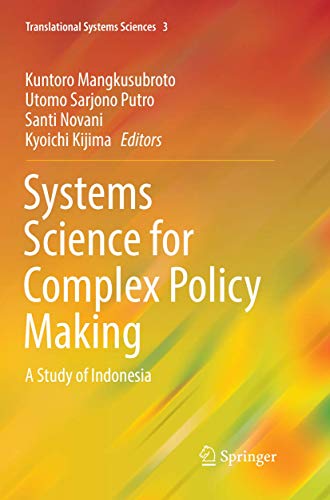
Inhaltsangabe
This volume applies a systems science perspective to complex policy making dynamics, using the case of Indonesia to illustrate the concepts. Indonesia is an archipelago with a high heterogeneity. Her people consist of 1,340 tribes who are scattered over 17,508 islands. Every region has different natural strengths and conditions. In the national development process all regions depend on one another other while optimizing their own conditions. In addition to this diversity, Indonesia also employs a democratic system of government with high regional autonomy. A democratic government puts a high value on individual freedom, but on the other hand, conflicts of interest also occur frequently. High regional autonomy also often causes problems in coordination among agencies and regional governments. This uniqueness creates a kind of complexity that is rarely found in other countries.These daily complexities requires intensive interaction, negotiation processes, and coordination. Such necessities should be considered in public policy making and in managing the implementation of national development programs. In this context, common theories and best practices generated on the basis of more simplified assumptions often fail. Systems science offer a way of thinking that can take into account and potentially overcome these complexities. However, efforts to apply systems science massively and continuously in real policy making by involving many stakeholders are still rarely carried out. The first part of the book discusses the gap between the existing public policy-making approach and needs in the real world. After that, the characteristics of the appropriate policy-making process in a complex environment and how this process can be carried are described. In later sections, important systems science concepts that can be applied in managing these complexities are discussed. Finally, the efforts to apply these concepts in real cases in Indonesia are described.
Die Inhaltsangabe kann sich auf eine andere Ausgabe dieses Titels beziehen.
Von der hinteren Coverseite
This volume applies a systems science perspective to complex policy making dynamics, using the case of Indonesia to illustrate the concepts. Indonesia is an archipelago with a high heterogeneity. Her people consist of 1,340 tribes who are scattered over 17,508 islands. Every region has different natural strengths and conditions. In the national development process all regions depend on one another other while optimizing their own conditions. In addition to this diversity, Indonesia also employs a democratic system of government with high regional autonomy. A democratic government puts a high value on individual freedom, but on the other hand, conflicts of interest also occur frequently. High regional autonomy also often causes problems in coordination among agencies and regional governments. This uniqueness creates a kind of complexity that is rarely found in other countries.These daily complexities requires intensive interaction, negotiation processes, and coordination. Such necessities should be considered in public policy making and in managing the implementation of national development programs. In this context, common theories and best practices generated on the basis of more simplified assumptions often fail. Systems science offer a way of thinking that can take into account and potentially overcome these complexities. However, efforts to apply systems science massively and continuously in real policy making by involving many stakeholders are still rarely carried out. The first part of the book discusses the gap between the existing public policy-making approach and needs in the real world. After that, the characteristics of the appropriate policy-making process in a complex environment and how this process can be carried are described. In later sections, important systems science concepts that can be applied in managing these complexities are discussed. Finally, the efforts to apply these concepts in real cases in Indonesia are described.
„Über diesen Titel“ kann sich auf eine andere Ausgabe dieses Titels beziehen.
Suchergebnisse für Systems Science for Complex Policy Making: A Study...

Beispielbild für diese ISBN
Systems Science for Complex Policy Maki (eng)
Print-on-DemandAnbieter: Brook Bookstore On Demand, Napoli, NA, Italien
Verkäuferbewertung 5 von 5 Sternen

Zustand: new. Questo è un articolo print on demand. Bestandsnummer des Verkäufers b64b9223978bbe2033de86846338ae3d
Neu kaufen
EUR 46,22
EUR 4,00 Versand
Versand von Italien nach USA
Versand von Italien nach USA
Anzahl: Mehr als 20 verfügbar
Foto des Verkäufers
Systems Science for Complex Policy Making : A Study of Indonesia
Anbieter: GreatBookPrices, Columbia, MD, USA
Verkäuferbewertung 5 von 5 Sternen
Zustand: New. Bestandsnummer des Verkäufers 33184333-n
Neu kaufen
EUR 57,38
EUR 2,35 Versand
Versand innerhalb von USA
Versand innerhalb von USA
Anzahl: 15 verfügbar
Foto des Verkäufers
Systems Science for Complex Policy Making: A Study of Indonesia (Paperback or Softback)
Verlag:
Springer 6/7/2018, 2018
ISBN 10: 443156649X
ISBN 13: 9784431566496
Neu
Paperback or Softback
Anbieter: BargainBookStores, Grand Rapids, MI, USA
Verkäuferbewertung 5 von 5 Sternen
Paperback or Softback. Zustand: New. Systems Science for Complex Policy Making: A Study of Indonesia. Book. Bestandsnummer des Verkäufers BBS-9784431566496
Foto des Verkäufers
Systems Science for Complex Policy Making : A Study of Indonesia
Anbieter: GreatBookPrices, Columbia, MD, USA
Verkäuferbewertung 5 von 5 Sternen
Zustand: As New. Unread book in perfect condition. Bestandsnummer des Verkäufers 33184333
Gebraucht kaufen
EUR 63,40
EUR 2,35 Versand
Versand innerhalb von USA
Versand innerhalb von USA
Anzahl: 15 verfügbar
Beispielbild für diese ISBN
Systems Science for Complex Policy Making: A Study of Indonesia (Translational Systems Sciences)
Anbieter: Chiron Media, Wallingford, Vereinigtes Königreich
Verkäuferbewertung 5 von 5 Sternen
Paperback. Zustand: New. Bestandsnummer des Verkäufers 6666-IUK-9784431566496
Neu kaufen
EUR 57,54
EUR 18,26 Versand
Versand von Vereinigtes Königreich nach USA
Versand von Vereinigtes Königreich nach USA
Anzahl: 10 verfügbar
Foto des Verkäufers
Systems Science for Complex Policy Making: A Study of Indonesia
Print-on-DemandAnbieter: BuchWeltWeit Ludwig Meier e.K., Bergisch Gladbach, Deutschland
Verkäuferbewertung 5 von 5 Sternen
Taschenbuch. Zustand: Neu. This item is printed on demand - it takes 3-4 days longer - Neuware -This volume applies a systems science perspective to complex policy making dynamics, using the case of Indonesia to illustrate the concepts. Indonesia is an archipelago with a high heterogeneity. Her people consist of 1,340 tribes who are scattered over 17,508 islands. Every region has different natural strengths and conditions. In the national development process all regions depend on one another other while optimizing their own conditions. In addition to this diversity, Indonesia also employs a democratic system of government with high regional autonomy. A democratic government puts a high value on individual freedom, but on the other hand, conflicts of interest also occur frequently. High regional autonomy also often causes problems in coordination among agencies and regional governments. This uniqueness creates a kind of complexity that is rarely found in other countries.These daily complexities requires intensive interaction, negotiation processes, and coordination. Such necessities should be considered in public policy making and in managing the implementation of national development programs. In this context, common theories and best practices generated on the basis of more simplified assumptions often fail. Systems science offer a way of thinking that can take into account and potentially overcome these complexities. However, efforts to apply systems science massively and continuously in real policy making by involving many stakeholders are still rarely carried out. The first part of the book discusses the gap between the existing public policy-making approach and needs in the real world. After that, the characteristics of the appropriate policy-making process in a complex environment and how this process can be carried are described. In later sections, important systems science concepts that can be applied in managing these complexities are discussed. Finally, the efforts to apply these concepts in real cases in Indonesia are described. 108 pp. Englisch. Bestandsnummer des Verkäufers 9784431566496
Neu kaufen
EUR 53,49
EUR 23,00 Versand
Versand von Deutschland nach USA
Versand von Deutschland nach USA
Anzahl: 2 verfügbar
Beispielbild für diese ISBN
Systems Science for Complex Policy Making: A Study of Indonesia (Translational Systems Sciences, 3)
Anbieter: Ria Christie Collections, Uxbridge, Vereinigtes Königreich
Verkäuferbewertung 5 von 5 Sternen
Zustand: New. In English. Bestandsnummer des Verkäufers ria9784431566496_new
Neu kaufen
EUR 66,07
EUR 11,05 Versand
Versand von Vereinigtes Königreich nach USA
Versand von Vereinigtes Königreich nach USA
Anzahl: Mehr als 20 verfügbar
Beispielbild für diese ISBN
Systems Science for Complex Policy Making: A Study of Indonesia (Translational Systems Sciences (3))
Anbieter: Books Puddle, Woodside, NY, USA
Verkäuferbewertung 4 von 5 Sternen

Zustand: New. pp. 115. Bestandsnummer des Verkäufers 26383430165
Neu kaufen
EUR 81,02
EUR 3,55 Versand
Versand innerhalb von USA
Versand innerhalb von USA
Anzahl: 4 verfügbar
Beispielbild für diese ISBN
Systems Science for Complex Policy Making: A Study of Indonesia (Translational Systems Sciences (3))
Print-on-DemandAnbieter: Majestic Books, Hounslow, Vereinigtes Königreich
Verkäuferbewertung 4 von 5 Sternen
Zustand: New. Print on Demand pp. 115. Bestandsnummer des Verkäufers 380441034
Neu kaufen
EUR 81,85
EUR 7,66 Versand
Versand von Vereinigtes Königreich nach USA
Versand von Vereinigtes Königreich nach USA
Anzahl: 4 verfügbar
Beispielbild für diese ISBN
Systems Science for Complex Policy Making: A Study of Indonesia (Translational Systems Sciences (3))
Print-on-DemandAnbieter: Biblios, Frankfurt am main, HESSE, Deutschland
Verkäuferbewertung 4 von 5 Sternen
Zustand: New. PRINT ON DEMAND pp. 115. Bestandsnummer des Verkäufers 18383430175
Neu kaufen
EUR 81,56
EUR 9,95 Versand
Versand von Deutschland nach USA
Versand von Deutschland nach USA
Anzahl: 4 verfügbar