
Verwandte Artikel zu "Science Policy, Ethics, and Economic Methodology":...
"Science Policy, Ethics, and Economic Methodology": Some Problems of Technology Assessment and Environmental-Impact Analysis - Softcover
Inhaltsangabe
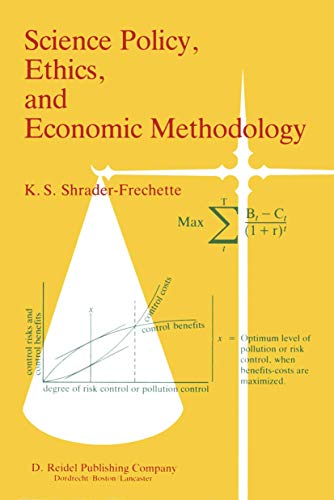
If indeed scientists and technologists, especially economists, set much of the agenda by which the future is played out, and I think they do, then the student of scientific methodology and public ethics has at least three options. He can embrace certain scientific methods and the value they hold for social decisionmaking, much as Milton Friedman has accepted neoclassical econom ics. Or, he can condemn them, regardless of their value, much as Stuart Hampshire has rejected risk-cost-benefit analysis (RCBA). Finally, he can critically assess these scientific methods and attempt to provide solutions to the problems he has uncovered. As a philosopher of science seeking the middle path between uncritical acceptance and extremist rejection of the economic methods used in policy analysis, I have tried to avoid the charge of being "anti science". Fred Hapgood, in response to my presentation at a recent Boston Colloquium for the Philosophy of Science, said that my arguments "felt like" a call for rejection of the methods of risk-cost-benefit analysis. Not so, as Chapter Two of this volume should make eminently clear. All my criticisms are construc tive ones, and the flaws in economic methodology which I address are uncovered for the purpose of suggesting means of making good techniques better. Likewise, although I criticize the economic methodology by which many technology assessments (TA's) and environmental-impact analyses (EIA's) have been used to justify public projects, it is wrong to conclude that I am anti-technology.
Die Inhaltsangabe kann sich auf eine andere Ausgabe dieses Titels beziehen.
Suchergebnisse für "Science Policy, Ethics, and Economic Methodology":...

Beispielbild für diese ISBN
Science Policy, Ethics, and Economic Methodology
Anbieter: Better World Books, Mishawaka, IN, USA
Verkäuferbewertung 5 von 5 Sternen

Zustand: Good. 1985th Edition. Former library copy. Pages intact with minimal writing/highlighting. The binding may be loose and creased. Dust jackets/supplements are not included. Includes library markings. Stock photo provided. Product includes identifying sticker. Better World Books: Buy Books. Do Good. Bestandsnummer des Verkäufers 6154851-6
Gebraucht kaufen
EUR 29,34
Versand gratis
Versand innerhalb von USA
Versand innerhalb von USA
Anzahl: 1 verfügbar
Beispielbild für diese ISBN
Science Policy, Ethics, and Economic Methodology: Some Problems of Technology Assessment and Environmental-impact Analysis
Verlag:
D. Reidel Publishing Company, U.S.A., 1985
ISBN 10: 9027718458
ISBN 13: 9789027718457
Gebraucht
Soft cover
Anbieter: G3 Books, Winnipeg, MB, Kanada
Verkäuferbewertung 5 von 5 Sternen
Soft cover. Zustand: Very Good. Owner's name stamped on edge, but text is unmarked and binding is tight. Bestandsnummer des Verkäufers 014823
Gebraucht kaufen
EUR 27,69
EUR 19,70 Versand
Versand von Kanada nach USA
Versand von Kanada nach USA
Anzahl: 1 verfügbar
Beispielbild für diese ISBN
Science Policy, Ethics, and Economic Methodology of Social Science: Some Problems of Technology Assessment and Environmental Impact Analysis
Print-on-DemandAnbieter: Chiron Media, Wallingford, Vereinigtes Königreich
Verkäuferbewertung 5 von 5 Sternen
PF. Zustand: New. This item is printed on demand. Brand new book, sourced directly from publisher. Dispatch time is 6-7 days from our warehouse. Book will be sent in robust, secure packaging to ensure it reaches you securely. Bestandsnummer des Verkäufers 6666-IUK-9789027718457
Neu kaufen
EUR 168,75
EUR 5,98 Versand
Versand von Vereinigtes Königreich nach USA
Versand von Vereinigtes Königreich nach USA
Anzahl: 20 verfügbar
Foto des Verkäufers
Science Policy, Ethics, and Economic Methodology : Some Problems of Technology Assessment and Environmental-impact Analysis
Anbieter: GreatBookPrices, Columbia, MD, USA
Verkäuferbewertung 5 von 5 Sternen
Zustand: New. Bestandsnummer des Verkäufers 3308921-n
Neu kaufen
EUR 177,52
EUR 2,37 Versand
Versand innerhalb von USA
Versand innerhalb von USA
Anzahl: 15 verfügbar
Foto des Verkäufers
Science Policy, Ethics, and Economic Methodology
Verlag:
Springer Netherlands, Springer Netherlands Dez 1984, 1984
ISBN 10: 9027718458
ISBN 13: 9789027718457
Neu
Taschenbuch
Anbieter: BuchWeltWeit Ludwig Meier e.K., Bergisch Gladbach, Deutschland
Verkäuferbewertung 5 von 5 Sternen
Taschenbuch. Zustand: Neu. This item is printed on demand - it takes 3-4 days longer - Neuware -If indeed scientists and technologists, especially economists, set much of the agenda by which the future is played out, and I think they do, then the student of scientific methodology and public ethics has at least three options. He can embrace certain scientific methods and the value they hold for social decisionmaking, much as Milton Friedman has accepted neoclassical econom ics. Or, he can condemn them, regardless of their value, much as Stuart Hampshire has rejected risk-cost-benefit analysis (RCBA). Finally, he can critically assess these scientific methods and attempt to provide solutions to the problems he has uncovered. As a philosopher of science seeking the middle path between uncritical acceptance and extremist rejection of the economic methods used in policy analysis, I have tried to avoid the charge of being 'anti science'. Fred Hapgood, in response to my presentation at a recent Boston Colloquium for the Philosophy of Science, said that my arguments 'felt like' a call for rejection of the methods of risk-cost-benefit analysis. Not so, as Chapter Two of this volume should make eminently clear. All my criticisms are construc tive ones, and the flaws in economic methodology which I address are uncovered for the purpose of suggesting means of making good techniques better. Likewise, although I criticize the economic methodology by which many technology assessments (TA's) and environmental-impact analyses (EIA's) have been used to justify public projects, it is wrong to conclude that I am anti-technology. 344 pp. Englisch. Bestandsnummer des Verkäufers 9789027718457
Neu kaufen
EUR 160,49
EUR 23,00 Versand
Versand von Deutschland nach USA
Versand von Deutschland nach USA
Anzahl: 2 verfügbar
Foto des Verkäufers
Science Policy, Ethics, and Economic Methodology
Print-on-DemandAnbieter: moluna, Greven, Deutschland
Verkäuferbewertung 5 von 5 Sternen
Zustand: New. Dieser Artikel ist ein Print on Demand Artikel und wird nach Ihrer Bestellung fuer Sie gedruckt. If indeed scientists and technologists, especially economists, set much of the agenda by which the future is played out, and I think they do, then the student of scientific methodology and public ethics has at least three options. He can embrace certain sci. Bestandsnummer des Verkäufers 5815004
Neu kaufen
EUR 136,16
EUR 48,99 Versand
Versand von Deutschland nach USA
Versand von Deutschland nach USA
Anzahl: Mehr als 20 verfügbar
Foto des Verkäufers
Science Policy, Ethics, and Economic Methodology : Some Problems of Technology Assessment and Environmental-impact Analysis
Anbieter: GreatBookPrices, Columbia, MD, USA
Verkäuferbewertung 5 von 5 Sternen
Zustand: As New. Unread book in perfect condition. Bestandsnummer des Verkäufers 3308921
Gebraucht kaufen
EUR 193,87
EUR 2,37 Versand
Versand innerhalb von USA
Versand innerhalb von USA
Anzahl: 15 verfügbar
Foto des Verkäufers
Science Policy, Ethics, and Economic Methodology | Some Problems of Technology Assessment and Environmental-Impact Analysis
Anbieter: preigu, Osnabrück, Deutschland
Verkäuferbewertung 5 von 5 Sternen
Taschenbuch. Zustand: Neu. Science Policy, Ethics, and Economic Methodology | Some Problems of Technology Assessment and Environmental-Impact Analysis | Kristin Shrader-Frechette | Taschenbuch | xviii | Englisch | 1984 | Springer | EAN 9789027718457 | Verantwortliche Person für die EU: Springer Verlag GmbH, Tiergartenstr. 17, 69121 Heidelberg, juergen[dot]hartmann[at]springer[dot]com | Anbieter: preigu. Bestandsnummer des Verkäufers 102423767
Neu kaufen
EUR 141,45
EUR 70,00 Versand
Versand von Deutschland nach USA
Versand von Deutschland nach USA
Anzahl: 5 verfügbar
Foto des Verkäufers
Science Policy, Ethics, and Economic Methodology : Some Problems of Technology Assessment and Environmental-Impact Analysis
Anbieter: AHA-BUCH GmbH, Einbeck, Deutschland
Verkäuferbewertung 5 von 5 Sternen
Taschenbuch. Zustand: Neu. Druck auf Anfrage Neuware - Printed after ordering - If indeed scientists and technologists, especially economists, set much of the agenda by which the future is played out, and I think they do, then the student of scientific methodology and public ethics has at least three options. He can embrace certain scientific methods and the value they hold for social decisionmaking, much as Milton Friedman has accepted neoclassical econom ics. Or, he can condemn them, regardless of their value, much as Stuart Hampshire has rejected risk-cost-benefit analysis (RCBA). Finally, he can critically assess these scientific methods and attempt to provide solutions to the problems he has uncovered. As a philosopher of science seeking the middle path between uncritical acceptance and extremist rejection of the economic methods used in policy analysis, I have tried to avoid the charge of being 'anti science'. Fred Hapgood, in response to my presentation at a recent Boston Colloquium for the Philosophy of Science, said that my arguments 'felt like' a call for rejection of the methods of risk-cost-benefit analysis. Not so, as Chapter Two of this volume should make eminently clear. All my criticisms are construc tive ones, and the flaws in economic methodology which I address are uncovered for the purpose of suggesting means of making good techniques better. Likewise, although I criticize the economic methodology by which many technology assessments (TA's) and environmental-impact analyses (EIA's) have been used to justify public projects, it is wrong to conclude that I am anti-technology. Bestandsnummer des Verkäufers 9789027718457
Neu kaufen
EUR 183,30
EUR 35,00 Versand
Versand von Deutschland nach USA
Versand von Deutschland nach USA
Anzahl: 1 verfügbar
Foto des Verkäufers
Science Policy, Ethics, and Economic Methodology
Verlag:
Springer Netherlands, Springer Dez 1984, 1984
ISBN 10: 9027718458
ISBN 13: 9789027718457
Neu
Taschenbuch
Anbieter: buchversandmimpf2000, Emtmannsberg, BAYE, Deutschland
Verkäuferbewertung 5 von 5 Sternen
Taschenbuch. Zustand: Neu. This item is printed on demand - Print on Demand Titel. Neuware -If indeed scientists and technologists, especially economists, set much of the agenda by which the future is played out, and I think they do, then the student of scientific methodology and public ethics has at least three options. He can embrace certain scientific methods and the value they hold for social decisionmaking, much as Milton Friedman has accepted neoclassical econom ics. Or, he can condemn them, regardless of their value, much as Stuart Hampshire has rejected risk-cost-benefit analysis (RCBA). Finally, he can critically assess these scientific methods and attempt to provide solutions to the problems he has uncovered. As a philosopher of science seeking the middle path between uncritical acceptance and extremist rejection of the economic methods used in policy analysis, I have tried to avoid the charge of being 'anti science'. Fred Hapgood, in response to my presentation at a recent Boston Colloquium for the Philosophy of Science, said that my arguments 'felt like' a call for rejection of the methods of risk-cost-benefit analysis. Not so, as Chapter Two of this volume should make eminently clear. All my criticisms are construc tive ones, and the flaws in economic methodology which I address are uncovered for the purpose of suggesting means of making good techniques better. Likewise, although I criticize the economic methodology by which many technology assessments (TA's) and environmental-impact analyses (EIA's) have been used to justify public projects, it is wrong to conclude that I am anti-technology.Springer-Verlag GmbH, Tiergartenstr. 17, 69121 Heidelberg 344 pp. Englisch. Bestandsnummer des Verkäufers 9789027718457
Neu kaufen
EUR 160,49
EUR 60,00 Versand
Versand von Deutschland nach USA
Versand von Deutschland nach USA
Anzahl: 1 verfügbar