
Verwandte Artikel zu From Pots to People: A Ceramic Approach to the Archaeologica...
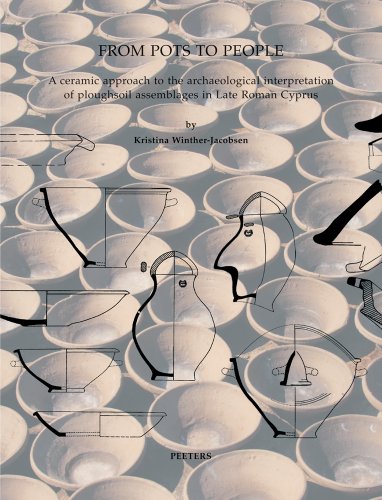
From Pots to People: A Ceramic Approach to the Archaeological Interpretation of Ploughsoil Assemblages in Late Roman Cyprus (Babesch Supplement, Band 17) - Softcover
Inhaltsangabe
During the last forty odd years, archaeological surveys have demonstrated that much can be said about changing patterns of regional exchange and settlement hierarchies based on surface observations. Walking the Mediterranean landscape, the most common indication of ancient human activity survey archaeologists come across are scatters of pottery and other ceramics. Enormous numbers of sherds are counted, collected, recorded, and interpreted in order to understand the ancient cultural, social, economic, and ritual landscapes. Some discrete scatters of ancient artefacts are interpreted as sites where people have lived and/or worked based on an analysis of both cultural and environmental data. These artefact scatters are modern phenomena affected by complex post-depositional processes such as cultivation which obscure potentional behavioural patterning. Artefact-based survey with its treatment of artefacts behaving as sediments in the soil enhanced with a detailed pottery analysis centred on use has the potential to greatly increase our understanding of the ancient rural world. This book offers an attempt to create a methodology for hypothesizing about the general activities taking place at sites identified by survey based on ceramics. The use typology is put forward as a tool for studying artefactual differentiation, and the method consists of establishing empirically generalized pottery indices of different human activities based on artefactual differentiation at Late Roman sites in Cyprus.
Die Inhaltsangabe kann sich auf eine andere Ausgabe dieses Titels beziehen.
Suchergebnisse für From Pots to People: A Ceramic Approach to the Archaeologica...

Beispielbild für diese ISBN
From Pots to People
Verlag:
Peeters Publishers, 2010
ISBN 10: 9042923830
ISBN 13: 9789042923836
Neu
paperback
Erstausgabe
Anbieter: ISD LLC, Bristol, CT, USA
Verkäuferbewertung 5 von 5 Sternen

paperback. Zustand: New. 1st. Bestandsnummer des Verkäufers 129321
Foto des Verkäufers
From Pots to People : A Ceramic Approach to the Archaeological Interpretation of Ploughsoil Assemblages in Late Roman Cyprus
Anbieter: GreatBookPrices, Columbia, MD, USA
Verkäuferbewertung 5 von 5 Sternen
Zustand: As New. Unread book in perfect condition. Bestandsnummer des Verkäufers 12438759
Gebraucht kaufen
EUR 89,81
EUR 2,35 Versand
Versand innerhalb von USA
Versand innerhalb von USA
Anzahl: 6 verfügbar
Beispielbild für diese ISBN
From Pots to People : A Ceramic Approach to the Archaeological Interpretation of Ploughsoil Assemblages in Late Roman Cyprus
Anbieter: GreatBookPrices, Columbia, MD, USA
Verkäuferbewertung 5 von 5 Sternen
Zustand: New. Bestandsnummer des Verkäufers 12438759-n
Neu kaufen
EUR 94,10
EUR 2,35 Versand
Versand innerhalb von USA
Versand innerhalb von USA
Anzahl: 6 verfügbar
Beispielbild für diese ISBN
From Pots to People (Paperback)
Anbieter: Grand Eagle Retail, Bensenville, IL, USA
Verkäuferbewertung 5 von 5 Sternen
Paperback. Zustand: new. Paperback. During the last forty odd years, archaeological surveys have demonstrated that much can be said about changing patterns of regional exchange and settlement hierarchies based on surface observations. Walking the Mediterranean landscape, the most common indication of ancient human activity survey archaeologists come across are scatters of pottery and other ceramics. Enormous numbers of sherds are counted, collected, recorded, and interpreted in order to understand the ancient cultural, social, economic, and ritual landscapes. Some discrete scatters of ancient artefacts are interpreted as sites where people have lived and/or worked based on an analysis of both cultural and environmental data. These artefact scatters are modern phenomena affected by complex post-depositional processes such as cultivation which obscure potentional behavioural patterning. Artefact-based survey with its treatment of artefacts behaving as sediments in the soil enhanced with a detailed pottery analysis centred on use has the potential to greatly increase our understanding of the ancient rural world. This book offers an attempt to create a methodology for hypothesizing about the general activities taking place at sites identified by survey based on ceramics. The use typology is put forward as a tool for studying artefactual differentiation, and the method consists of establishing empirically generalized pottery indices of different human activities based on artefactual differentiation at Late Roman sites in Cyprus. Artefact-based survey with its treatment of artefacts behaving as sediments in the soil enhanced with a detailed pottery analysis centred on use has the potential to greatly increase our understanding of the ancient rural world. This book offers an attempt to create a methodology for hypothesizing about the general activities taking Shipping may be from multiple locations in the US or from the UK, depending on stock availability. Bestandsnummer des Verkäufers 9789042923836
Beispielbild für diese ISBN
FROM POTS TO PEOPLE. A CERAMIC APPROACH TO THE ARCHAEOLOGICAL INTERPRETATIONS OF PLOUGHSOIL ASSEMBLAGES IN LATE ROMAN CY
Anbieter: Pórtico [Portico], ZARAGOZA, Z, Spanien
Verkäuferbewertung 4 von 5 Sternen

Tapa blanda. Zustand: New. WINTHER-JACOBSEN, K.: FROM POTS TO PEOPLE. A CERAMIC APPROACH TO THE ARCHAEOLOGICAL INTERPRETATIONS OF PLOUGHSOIL ASSEMBLAGES IN LATE ROMAN CY. LEUVEN, 2010, viii 147 p. figuras, 580 gr. Encuadernacion original. Nuevo. (A/DG) 580 gr. Libro. Bestandsnummer des Verkäufers 495668
Neu kaufen
EUR 62,00
EUR 35,00 Versand
Versand von Spanien nach USA
Versand von Spanien nach USA
Anzahl: 1 verfügbar
Foto des Verkäufers
From Pots to People : A Ceramic Approach to the Archaeological Interpretation of Ploughsoil Assemblages in Late Roman Cyprus
Anbieter: GreatBookPricesUK, Woodford Green, Vereinigtes Königreich
Verkäuferbewertung 5 von 5 Sternen
Zustand: New. Bestandsnummer des Verkäufers 12438759-n
Neu kaufen
EUR 85,11
EUR 17,65 Versand
Versand von Vereinigtes Königreich nach USA
Versand von Vereinigtes Königreich nach USA
Anzahl: 1 verfügbar
Beispielbild für diese ISBN
From Pots to People: A Ceramic Approach to the Archaeological Interpretation of Ploughsoil Assemblages in Late Roman Cyprus
Anbieter: Kennys Bookshop and Art Galleries Ltd., Galway, GY, Irland
Verkäuferbewertung 5 von 5 Sternen
Zustand: New. 2010. Paperback. . . . . . Bestandsnummer des Verkäufers V9789042923836
Neu kaufen
EUR 96,90
EUR 9,50 Versand
Versand von Irland nach USA
Versand von Irland nach USA
Anzahl: 2 verfügbar
Foto des Verkäufers
From Pots to People : A Ceramic Approach to the Archaeological Interpretation of Ploughsoil Assemblages in Late Roman Cyprus
Anbieter: GreatBookPricesUK, Woodford Green, Vereinigtes Königreich
Verkäuferbewertung 5 von 5 Sternen
Zustand: As New. Unread book in perfect condition. Bestandsnummer des Verkäufers 12438759
Gebraucht kaufen
EUR 96,82
EUR 17,65 Versand
Versand von Vereinigtes Königreich nach USA
Versand von Vereinigtes Königreich nach USA
Anzahl: 1 verfügbar
Beispielbild für diese ISBN
From Pots to People: A Ceramic Approach to the Archaeological Interpretation of Ploughsoil Assemblages in Late Roman Cyprus
Anbieter: Revaluation Books, Exeter, Vereinigtes Königreich
Verkäuferbewertung 5 von 5 Sternen
Paperback. Zustand: Brand New. 147 pages. 10.50x8.00x0.25 inches. In Stock. Bestandsnummer des Verkäufers x-9042923830
Neu kaufen
EUR 119,02
EUR 14,71 Versand
Versand von Vereinigtes Königreich nach USA
Versand von Vereinigtes Königreich nach USA
Anzahl: 1 verfügbar
Beispielbild für diese ISBN
From Pots to People: A Ceramic Approach to the Archaeological Interpretation of Ploughsoil Assemblages in Late Roman Cyprus
Anbieter: Kennys Bookstore, Olney, MD, USA
Verkäuferbewertung 5 von 5 Sternen
Zustand: New. 2010. Paperback. . . . . . Books ship from the US and Ireland. Bestandsnummer des Verkäufers V9789042923836
Neu kaufen
EUR 124,76
EUR 9,33 Versand
Versand innerhalb von USA
Versand innerhalb von USA
Anzahl: 2 verfügbar