
Verwandte Artikel zu Neo-latin Commentaries and the Management of Knowledge...
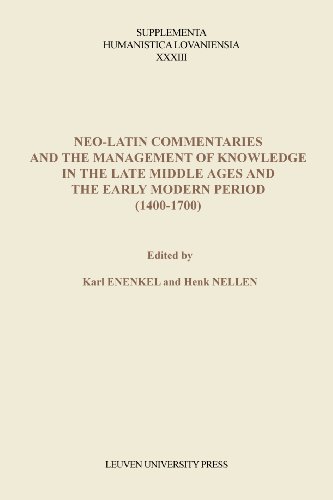
Neo-latin Commentaries and the Management of Knowledge in the Late Middle Ages and the Early Modern Period, 1400-1700 (Supplementa Humanistica Lovaniensia, Band 33) - Softcover
Inhaltsangabe
Between 1400 and 1700 the political, religious, intellectual, and even geographic landscape was profoundly changed by the Reformation, humanism, the rise of empirical science, the invention of printing technology, and the colonization of the Americas. The late medieval and early modern intellectuals felt an urgent need to respond to the changes they were involved in, and to come to a revision and reauthorization of knowledge. They embarked on a scholarly program of a quality and extent hitherto unknown in the Western world: the whole body of the literature of antiquity, including the Bible, was to be critically edited and furnished with commentaries. The Neo-Latin commentary became the most important genre of humanist scholarship. This book sheds light on the various ways in which classical authors and the Bible were commented on; the types of commentary; the commenting strategies that were used to approach different readerships; the various kinds of knowledge that were collected, created, and transmitted; and the usages and reading practices applied to commentaries.
Contributors: Karl Enenkel, Westfalische Wilhelms-Universitat, Munster; Susanna de Beer, Leiden University Centre for the Arts in Society; Craig Kallendorf, Texas A&M University; Christoph Pieper, Leiden University Centre for the Arts in Society; Marianne Pade, Aarhus University; Valéry Berlincourt, Université de Genève; Jan Bloemendal, Huygens Institute for the History of the Netherlands; Volkhard Wels, Berlin; Willem J. Zwalve, Institute for the Interdisciplinary Study of the Law, Leiden University; Bernard H. Stolte, University of Groningen; Bernd Roling, Institut fur Griechische und Lateinische Philologie, Freie Universitat Berlin; Henk Nellen, Huygens Institute for the History of the Netherlands; Jetze Touber, Utrecht University
Die Inhaltsangabe kann sich auf eine andere Ausgabe dieses Titels beziehen.
Über die Autorin bzw. den Autor
Karl Enenkel is Professor of Latin Philology of the Middle Ages and the Early Modern Period, Westfälische Wilhelms-Universität (WWU), Münster.
Von der hinteren Coverseite
Profound study of one of the most important genres within Humanist scholarship. Between 1400 and 1700 the political, religious, intellectual, and even geographic landscape was profoundly changed by the Reformation, Humanism, the rise of empirical science, the invention of printing technology, and the discovery of the New World. The late medieval and early modern intellectuals felt an urgent need to respond to the changes they were involved in, and to come to a revision and re-authorisation of knowledge. They embarked on a scholarly programme of a quality and extent hitherto unknown in the Western world: the whole body of the literature of antiquity, including the Bible, was to be re-edited critically and furnished with commentaries. The Neo-Latin commentary became the most important genre of humanist scholarship. This book sheds light on the various ways in which classical authors and the Bible were commented on, the types of commentary, the commenting strategies that were used to approach different readerships, the various kinds of knowledge that were collected, created, and transmitted, and the usages and reading practices applied to commentaries. (Contributors: K. Enenkel (Westfälische Wilhelms-Universität, Münster), S. de Beer (Leiden University Centre for the Arts in Society), C. Kallendorf (Texas A&M University), C. Pieper (Leiden University Centre for the Arts in Society), M. Pade (Aarhus University), V. Berlincourt (Université de Genève), J. Bloemendal (Huygens Institute for the History of the Netherlands), V. Wels (Berlin), W. J. Zwalve (Institute for the Interdisciplinary Study of the Law, Leiden University), B. H. Stolte (University of Groningen), B. Roling (Institut für Griechische und Lateinische Philologie, Freie Universität Berlin), H. Nellen (Huygens Institute for the History of the Netherlands), J. Touber (Utrecht University))
„Über diesen Titel“ kann sich auf eine andere Ausgabe dieses Titels beziehen.
Suchergebnisse für Neo-latin Commentaries and the Management of Knowledge...

Beispielbild für diese ISBN
Neo-Latin Commentaries and the Management of Knowledge in the Late Middle Ages and the Early Modern Period (1400â"1700) (Supplementa Humanistica Lovaniensia)
Verlag:
Leuven University Press, 2014
ISBN 10: 9058679365
ISBN 13: 9789058679369
Gebraucht
Paperback
Anbieter: Midtown Scholar Bookstore, Harrisburg, PA, USA
Verkäuferbewertung 5 von 5 Sternen

Paperback. Zustand: Good. Stamped nonreturnable. Good - Bumped and creased book with tears to the extremities, but not affecting the text block, may have remainder mark or previous owner's name - GOOD Standard-sized. Bestandsnummer des Verkäufers M9058679365Z3
Gebraucht kaufen
EUR 66,90
EUR 5,16 Versand
Versand innerhalb von USA
Versand innerhalb von USA
Anzahl: 2 verfügbar
Beispielbild für diese ISBN
Neo-Latin Commentaries and the Management of Knowledge in the Late Middle Ages and the Early Modern Period (14001700) (Paperback)
Verlag:
Leuven University Press, Leuven, 2013
ISBN 10: 9058679365
ISBN 13: 9789058679369
Neu
Paperback
Anbieter: Grand Eagle Retail, Bensenville, IL, USA
Verkäuferbewertung 5 von 5 Sternen
Paperback. Zustand: new. Paperback. Between 1400 and 1700 the political, religious, intellectual, and even geographic landscape was profoundly changed by the Reformation, humanism, the rise of empirical science, the invention of printing technology, and the colonization of the Americas. The late medieval and early modern intellectuals felt an urgent need to respond to the changes they were involved in, and to come to a revision and reauthorization of knowledge. They embarked on a scholarly program of a quality and extent hitherto unknown in the Western world: the whole body of the literature of antiquity, including the Bible, was to be critically edited and furnished with commentaries. The Neo-Latin commentary became the most important genre of humanist scholarship. This book sheds light on the various ways in which classical authors and the Bible were commented on; the types of commentary; the commenting strategies that were used to approach different readerships; the various kinds of knowledge that were collected, created, and transmitted; and the usages and reading practices applied to commentaries.Contributors: Karl Enenkel, Westfalische Wilhelms-Universitat, Munster; Susanna de Beer, Leiden University Centre for the Arts in Society; Craig Kallendorf, Texas A&M University; Christoph Pieper, Leiden University Centre for the Arts in Society; Marianne Pade, Aarhus University; Valery Berlincourt, Universite de Geneve; Jan Bloemendal, Huygens Institute for the History of the Netherlands; Volkhard Wels, Berlin; Willem J. Zwalve, Institute for the Interdisciplinary Study of the Law, Leiden University; Bernard H. Stolte, University of Groningen; Bernd Roling, Institut fur Griechische und Lateinische Philologie, Freie Universitat Berlin; Henk Nellen, Huygens Institute for the History of the Netherlands; Jetze Touber, Utrecht University This book sheds light on the various ways in which classical authors and the Bible were commented on by neo-Latin writers between 1400 and 1700. Shipping may be from multiple locations in the US or from the UK, depending on stock availability. Bestandsnummer des Verkäufers 9789058679369
Beispielbild für diese ISBN
Neo Latin Commentaries Amp Manage Kno
Anbieter: Kennys Bookshop and Art Galleries Ltd., Galway, GY, Irland
Verkäuferbewertung 5 von 5 Sternen
Zustand: New. Bestandsnummer des Verkäufers V9789058679369
Neu kaufen
EUR 134,26
EUR 9,50 Versand
Versand von Irland nach USA
Versand von Irland nach USA
Anzahl: 7 verfügbar
Beispielbild für diese ISBN
Neo-Latin Commentaries and the Management of Knowledge in the Late Middle Ages and the Early Modern Period (1400 1700) (Supplementa Humanistica Lovaniensia)
Verlag:
Leuven University Press, 2014
ISBN 10: 9058679365
ISBN 13: 9789058679369
Gebraucht
paperback
Anbieter: Mispah books, Redhill, SURRE, Vereinigtes Königreich
Verkäuferbewertung 4 von 5 Sternen

paperback. Zustand: Very Good. Very Good .Ships From Multiple Locations. book. Bestandsnummer des Verkäufers ERICA80390586793656
Gebraucht kaufen
EUR 131,95
EUR 29,12 Versand
Versand von Vereinigtes Königreich nach USA
Versand von Vereinigtes Königreich nach USA
Anzahl: 1 verfügbar
Foto des Verkäufers
Neo-Latin Commentaries and the Management of Knowledge in the Late Middle Ages and the Early Modern Period (1400-1700)
Anbieter: moluna, Greven, Deutschland
Verkäuferbewertung 5 von 5 Sternen
Zustand: New. KlappentextrnrnThe first monograph entirely devoted to the Epicurean doctrine of minimal parts.The Epicurean doctrine of minimal parts (ta elachista) is a crucial aspect of Epicurus s philosophy and a genuine turning point compared to the an. Bestandsnummer des Verkäufers 599122787
Neu kaufen
EUR 118,09
EUR 48,99 Versand
Versand von Deutschland nach USA
Versand von Deutschland nach USA
Anzahl: 5 verfügbar
Beispielbild für diese ISBN
Neo-Latin Commentaries and the Management of Knowledge in the Late Middle Ages and the Early Modern Period (1400-1700)
Anbieter: Revaluation Books, Exeter, Vereinigtes Königreich
Verkäuferbewertung 5 von 5 Sternen
Paperback. Zustand: Brand New. multilingual edition. 523 pages. 9.40x6.30x1.25 inches. In Stock. Bestandsnummer des Verkäufers x-9058679365
Neu kaufen
EUR 156,17
EUR 14,56 Versand
Versand von Vereinigtes Königreich nach USA
Versand von Vereinigtes Königreich nach USA
Anzahl: 2 verfügbar
Beispielbild für diese ISBN
Neo Latin Commentaries Amp Manage Kno
Anbieter: Kennys Bookstore, Olney, MD, USA
Verkäuferbewertung 5 von 5 Sternen
Zustand: New. Bestandsnummer des Verkäufers V9789058679369
Neu kaufen
EUR 171,25
EUR 9,03 Versand
Versand innerhalb von USA
Versand innerhalb von USA
Anzahl: 7 verfügbar