
Verwandte Artikel zu Aristotle's Modal Proofs: Prior Analytics A8-22...
Aristotle's Modal Proofs: Prior Analytics A8-22 in Predicate Logic (The New Synthese Historical Library, 68, Band 68) - Hardcover
Buch 14 von 60: Synthese Historical Library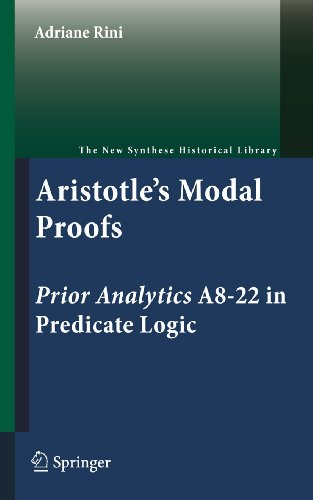
Inhaltsangabe
Aristotle’s modal syllogistic is his study of patterns of reasoning about necessity and possibility. Many scholars think the modal syllogistic is incoherent, a ‘realm of darkness’. Others think it is coherent, but devise complicated formal modellings to mimic Aristotle’s results. This volume provides a simple interpretation of Aristotle’s modal syllogistic using standard predicate logic. Rini distinguishes between red terms, such as ‘horse’, ‘plant’ or ‘man’, which name things in virtue of features those things must have, and green terms, such as ‘moving’, which name things in virtue of their non-necessary features. By applying this distinction to the Prior Analytics, Rini shows how traditional interpretive puzzles about the modal syllogistic melt away and the simple structure of Aristotle’s own proofs is revealed. The result is an applied logic which provides needed links between Aristotle’s views of science and logical demonstration. The volume is particularly valuable to researchers and students of the history of logic, Aristotle’s theory of modality, and the philosophy of logic in general.
Die Inhaltsangabe kann sich auf eine andere Ausgabe dieses Titels beziehen.
Über die Autorin bzw. den Autor
Adriane Rini received an A.B. in philosophy at Smith College, and a Ph.D. at the University of Massachusetts-Amherst. She is the author of numerous articles on the history of modal logic. In 2003, she was awarded a Marsden Grant from the Royal Society of New Zealand for her research on Aristotle’s logic. Subsequently, she has been working on a book, together with M.J. Cresswell, about the world-time parallel. In 2010, Rini is working on a project on the development of Quine’s attitude to modal logic, for which she has been awarded a four month fellowship from the Royal Flemish Academy of Belgium for Science and the Arts. Rini has taught at the University of Massachusetts-Amherst, the University of California-Davis, Texas A&M University, Victoria University Wellington, and at Massey University, where she is currently a senior lecturer in philosophy.
Von der hinteren Coverseite
Aristotle’s modal syllogistic is his study of patterns of reasoning about necessity and possibility. Many scholars think the modal syllogistic is incoherent, a ‘realm of darkness’. Others think it is coherent, but devise complicated formal modellings to mimic Aristotle’s results. This volume provides a simple interpretation of Aristotle’s modal syllogistic using standard predicate logic. Rini distinguishes between red terms, such as ‘horse’, ‘plant’ or ‘man’, which name things in virtue of features those things must have, and green terms, such as ‘moving’, which name things in virtue of their non-necessary features. By applying this distinction to the Prior Analytics, Rini shows how traditional interpretive puzzles about the modal syllogistic melt away and the simple structure of Aristotle’s own proofs is revealed. The result is an applied logic which provides needed links between Aristotle’s views of science and logical demonstration. The volume is particularly valuable to researchers and students of the history of logic, Aristotle’s theory of modality, and the philosophy of logic in general.
„Über diesen Titel“ kann sich auf eine andere Ausgabe dieses Titels beziehen.
Suchergebnisse für Aristotle's Modal Proofs: Prior Analytics A8-22...

Beispielbild für diese ISBN
Aristotle's Modal Proofs (The New Synthese Historical Library, 68)
Anbieter: MostlyAcademic, Berrima, NSW, Australien
Verkäuferbewertung 5 von 5 Sternen

Hardcover. Zustand: New. Aristotle's modal syllogistic is his study of patterns of reasoning about necessity and possibility. Many scholars think the modal syllogistic is incoherent, a 'realm of darkness'. Others think it is coherent, but devise complicated formal modellings to mimic Aristotle's results. This volume provides a simple interpretation of Aristotle's modal syllogistic using standard predicate logic. Rini distinguishes between red terms, such as 'horse', 'plant' or 'man', which name things in virtue of features those things must have, and green terms, such as 'moving', which name things in virtue of their non-necessary features. By applying this distinction to the Prior Analytics, Rini shows how traditional interpretive puzzles about the modal syllogistic melt away and the simple structure of Aristotle's own proofs is revealed. The result is an applied logic which provides needed links between Aristotle's views of science and logical demonstration. The volume is particularly valuable to researchers and students of the history of logic, Aristotle's theory of modality, and the philosophy of logic in general. Bestandsnummer des Verkäufers ABE-1633579946075
Neu kaufen
EUR 64,22
EUR 31,20 Versand
Versand von Australien nach USA
Versand von Australien nach USA
Anzahl: 1 verfügbar
Beispielbild für diese ISBN
Aristotle's Modal Proofs (eng)
Print-on-DemandAnbieter: Brook Bookstore On Demand, Napoli, NA, Italien
Verkäuferbewertung 5 von 5 Sternen
Zustand: new. Questo è un articolo print on demand. Bestandsnummer des Verkäufers 95c6bf2ca4eb0e04430d0eb2bb7d8d55
Neu kaufen
EUR 110,26
EUR 6,80 Versand
Versand von Italien nach USA
Versand von Italien nach USA
Anzahl: Mehr als 20 verfügbar
Foto des Verkäufers
Aristotle's Modal Proofs : Prior Analytics A8-22 in Predicate Logic
Anbieter: GreatBookPrices, Columbia, MD, USA
Verkäuferbewertung 5 von 5 Sternen
Zustand: As New. Unread book in perfect condition. Bestandsnummer des Verkäufers 11506981
Gebraucht kaufen
EUR 159,89
EUR 2,36 Versand
Versand innerhalb von USA
Versand innerhalb von USA
Anzahl: 15 verfügbar
Foto des Verkäufers
Aristotle s Modal Proofs
Anbieter: moluna, Greven, Deutschland
Verkäuferbewertung 5 von 5 Sternen
Gebunden. Zustand: New. Bestandsnummer des Verkäufers 5825188
Neu kaufen
EUR 119,56
EUR 48,99 Versand
Versand von Deutschland nach USA
Versand von Deutschland nach USA
Anzahl: Mehr als 20 verfügbar
Beispielbild für diese ISBN
Aristotle's Modal Proofs: Prior Analytics A8-22 in Predicate Logic (The New Synthese Historical Library, 68)
Anbieter: Ria Christie Collections, Uxbridge, Vereinigtes Königreich
Verkäuferbewertung 5 von 5 Sternen
Zustand: New. In English. Bestandsnummer des Verkäufers ria9789400700499_new
Neu kaufen
EUR 157,25
EUR 13,34 Versand
Versand von Vereinigtes Königreich nach USA
Versand von Vereinigtes Königreich nach USA
Anzahl: Mehr als 20 verfügbar
Foto des Verkäufers
Aristotle's Modal Proofs : Prior Analytics A8-22 in Predicate Logic
Anbieter: GreatBookPrices, Columbia, MD, USA
Verkäuferbewertung 5 von 5 Sternen
Zustand: New. Bestandsnummer des Verkäufers 11506981-n
Neu kaufen
EUR 174,87
EUR 2,36 Versand
Versand innerhalb von USA
Versand innerhalb von USA
Anzahl: 15 verfügbar
Beispielbild für diese ISBN
Aristotle's Modal Proofs : Prior Analytics A8-22 in Predicate Logic
Anbieter: Buchpark, Trebbin, Deutschland
Verkäuferbewertung 5 von 5 Sternen
Zustand: Hervorragend. Zustand: Hervorragend | Sprache: Englisch | Produktart: Bücher | Aristotle's modal syllogistic is his study of patterns of reasoning about necessity and possibility. Many scholars think the modal syllogistic is incoherent, a 'realm of darkness'. Others think it is coherent, but devise complicated formal modellings to mimic Aristotle's results. This volume provides a simple interpretation of Aristotle's modal syllogistic using standard predicate logic. Rini distinguishes between red terms, such as 'horse', 'plant' or 'man', which name things in virtue of features those things must have, and green terms, such as 'moving', which name things in virtue of their non-necessary features. By applying this distinction to the Prior Analytics, Rini shows how traditional interpretive puzzles about the modal syllogistic melt away and the simple structure of Aristotle's own proofs is revealed. The result is an applied logic which provides needed links between Aristotle's views of science and logical demonstration. The volume is particularly valuable to researchers and students of the history of logic, Aristotle's theory of modality, and the philosophy of logic in general. Bestandsnummer des Verkäufers 8642565/1
Gebraucht kaufen
EUR 79,98
EUR 105,00 Versand
Versand von Deutschland nach USA
Versand von Deutschland nach USA
Anzahl: 2 verfügbar
Beispielbild für diese ISBN
Aristotle's Modal Proofs
Anbieter: Books Puddle, Woodside, NY, USA
Verkäuferbewertung 4 von 5 Sternen

Zustand: New. pp. 254. Bestandsnummer des Verkäufers 262124491
Neu kaufen
EUR 202,57
EUR 3,56 Versand
Versand innerhalb von USA
Versand innerhalb von USA
Anzahl: 4 verfügbar
Beispielbild für diese ISBN
Aristotle's Modal Proofs
Print-on-DemandAnbieter: Majestic Books, Hounslow, Vereinigtes Königreich
Verkäuferbewertung 4 von 5 Sternen
Zustand: New. Print on Demand pp. 254 52:B&W 6.14 x 9.21in or 234 x 156mm (Royal 8vo) Case Laminate on White w/Gloss Lam. Bestandsnummer des Verkäufers 5756180
Neu kaufen
EUR 213,57
EUR 7,68 Versand
Versand von Vereinigtes Königreich nach USA
Versand von Vereinigtes Königreich nach USA
Anzahl: 4 verfügbar
Beispielbild für diese ISBN
Aristotle's Modal Proofs
Print-on-DemandAnbieter: Biblios, Frankfurt am main, HESSE, Deutschland
Verkäuferbewertung 4 von 5 Sternen
Zustand: New. PRINT ON DEMAND pp. 254. Bestandsnummer des Verkäufers 182124481
Neu kaufen
EUR 213,45
EUR 9,95 Versand
Versand von Deutschland nach USA
Versand von Deutschland nach USA
Anzahl: 4 verfügbar