
Verwandte Artikel zu Disaster Bioethics: Normative Issues When Nothing is...
Disaster Bioethics: Normative Issues When Nothing is Normal (Public Health Ethics Analysis, 2, Band 2) - Hardcover
Buch 3 von 7: Public Health Ethics Analysis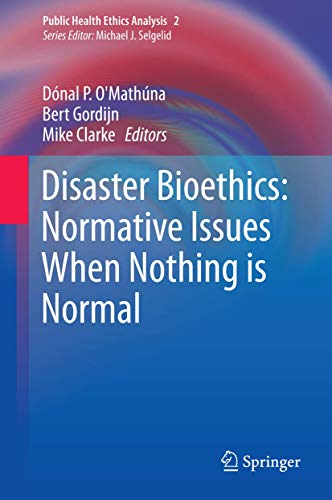
Inhaltsangabe
This book provides an early exploration of the new field of disaster bioethics:
examining the ethical issues raised by disasters. Healthcare ethics issues are addressed in the first part of this book. Large-scale casualties lead to decisions about who to treat and who to leave behind, cultural challenges, and communication ethics. The second part focuses on disaster research ethics.
With the growing awareness of the need for evidence to guide disaster preparedness and response, more research is being conducted in disasters. Any research involving humans raises ethical questions and requires appropriate regulation and oversight. The authors explore how disaster research can take account of survivors? vulnerability, informed consent, the sudden onset of disasters, and other ethical issues. Both parts examine ethical challenges where seeking to do good, harm can be done. Faced with overwhelming needs and scarce resources, no good solution may be apparent. But choosing the less wrong option can have a high price. In addition, what might seem right at home may not be seen to be right elsewhere. This book provides in-depth and practical reflection on these and other challenging ethical questions arising during disasters.
Scholars and practitioners who gathered at the Brocher Foundation in Geneva, Switzerland in 2011 offer their reflections to promote further dialogue so that those devastated by disasters are respected by being treated in the most ethically soun
d ways possible.
Die Inhaltsangabe kann sich auf eine andere Ausgabe dieses Titels beziehen.
Über die Autorinnen und Autoren
Bert Gordijn is Chair of Ethics and Director of the Ethics Institute at Dublin City University. He has studied Philosophy and History at the Universities of Utrecht (Netherlands), Strasbourg (France) and Freiburg in Breisgau (Germany). In 1995 he was awarded a doctorate in Philosophy; in 2003 he received a doctorate in Bioethics. He was a Visiting Research Fellow at the Centre for Economic and Social Aspects of Genomics at Lancaster University (UK), the Center for Clinical Bioethics at Georgetown University (USA) and the Fondation Brocher (Switzerland). Bert is Editor-in-Chief of the academic book series The International Library of Ethics, Law and Technology (published by Springer). In addition he is Editor-in-Chief of two peer reviewed journals: Medicine, Health Care and Philosophy (also published by Springer) and Studies in Ethics, Law and Technology (published by Berkeley Electronic Press). Bert has been appointed to the Scientific Advisory Board of the European Patent Organization, the External Science Advisory Panel to the Long-Range Research Initiative of the European Chemical Industry Council and has served on the UNESCO expert committee on ethics and nanotechnology.
Dr. Bert Gordijn ist Universitätsdozent am Fachbereich für Ethik, Philosophie und Geschichte der Medizin an der Universität Nijmegen/Niederlande und klinischer Ethiker an der dortigen Universitätsklinik.
Von der hinteren Coverseite
This book provides an early exploration of the new field of disaster bioethics:
examining the ethical issues raised by disasters. Healthcare ethics issues are addressed in the first part of this book. Large-scale casualties lead to decisions about who to treat and who to leave behind, cultural challenges, and communication ethics. The second part focuses on disaster research ethics.
With the growing awareness of the need for evidence to guide disaster preparedness and response, more research is being conducted in disasters. Any research involving humans raises ethical questions and requires appropriate regulation and oversight. The authors explore how disaster research can take account of survivors? vulnerability, informed consent, the sudden onset of disasters, and other ethical issues. Both parts examine ethical challenges where seeking to do good, harm can be done. Faced with overwhelming needs and scarce resources, no good solution may be apparent. But choosing the less wrong option can have a high price. In addition, what might seem right at home may not be seen to be right elsewhere. This book provides in-depth and practical reflection on these and other challenging ethical questions arising during disasters.
Scholars and practitioners who gathered at the Brocher Foundation in Geneva, Switzerland in 2011 offer their reflections to promote further dialogue so that those devastated by disasters are respected by being treated in the most ethically sou
nd ways possible.
„Über diesen Titel“ kann sich auf eine andere Ausgabe dieses Titels beziehen.
Suchergebnisse für Disaster Bioethics: Normative Issues When Nothing is...

Beispielbild für diese ISBN
Disaster Bioethics: Normative Issues When Nothing is Normal (eng)
Print-on-DemandAnbieter: Brook Bookstore On Demand, Napoli, NA, Italien
Verkäuferbewertung 5 von 5 Sternen

Zustand: new. Questo è un articolo print on demand. Bestandsnummer des Verkäufers UWTWNHIZO9
Neu kaufen
EUR 118,26
EUR 5,50 Versand
Versand von Italien nach USA
Versand von Italien nach USA
Anzahl: Mehr als 20 verfügbar
Foto des Verkäufers
Disaster Bioethics : Normative Issues When Nothing Is Normal
Anbieter: GreatBookPrices, Columbia, MD, USA
Verkäuferbewertung 5 von 5 Sternen
Zustand: New. Bestandsnummer des Verkäufers 17847156-n
Neu kaufen
EUR 128,65
EUR 2,39 Versand
Versand innerhalb von USA
Versand innerhalb von USA
Anzahl: 2 verfügbar
Beispielbild für diese ISBN
Disaster Bioethics: Normative Issues When Nothing is Normal (Public Health Ethics Analysis)
Anbieter: Chiron Media, Wallingford, Vereinigtes Königreich
Verkäuferbewertung 5 von 5 Sternen
Hardcover. Zustand: New. Brand new book, sourced directly from publisher. Dispatch time is 24-48 hours from our warehouse. Book will be sent in robust, secure packaging to ensure it reaches you securely. Bestandsnummer des Verkäufers 6666-GRD-9789400738638
Neu kaufen
EUR 134,08
EUR 5,98 Versand
Versand von Vereinigtes Königreich nach USA
Versand von Vereinigtes Königreich nach USA
Anzahl: 1 verfügbar
Beispielbild für diese ISBN
Disaster Bioethics: Normative Issues When Nothing is Normal
Anbieter: PBShop.store UK, Fairford, GLOS, Vereinigtes Königreich
Verkäuferbewertung 5 von 5 Sternen
HRD. Zustand: New. New Book. Shipped from UK. Established seller since 2000. Bestandsnummer des Verkäufers GB-9789400738638
Neu kaufen
EUR 138,06
EUR 6,02 Versand
Versand von Vereinigtes Königreich nach USA
Versand von Vereinigtes Königreich nach USA
Anzahl: 1 verfügbar
Beispielbild für diese ISBN
Disaster Bioethics: Normative Issues When Nothing is Normal
Anbieter: PBShop.store US, Wood Dale, IL, USA
Verkäuferbewertung 5 von 5 Sternen
HRD. Zustand: New. New Book. Shipped from UK. Established seller since 2000. Bestandsnummer des Verkäufers GB-9789400738638
Foto des Verkäufers
Disaster Bioethics : Normative Issues When Nothing Is Normal
Anbieter: GreatBookPricesUK, Woodford Green, Vereinigtes Königreich
Verkäuferbewertung 5 von 5 Sternen
Zustand: New. Bestandsnummer des Verkäufers 17847156-n
Neu kaufen
EUR 128,28
EUR 17,98 Versand
Versand von Vereinigtes Königreich nach USA
Versand von Vereinigtes Königreich nach USA
Anzahl: 2 verfügbar
Foto des Verkäufers
Disaster Bioethics : Normative Issues When Nothing Is Normal
Anbieter: GreatBookPrices, Columbia, MD, USA
Verkäuferbewertung 5 von 5 Sternen
Zustand: As New. Unread book in perfect condition. Bestandsnummer des Verkäufers 17847156
Gebraucht kaufen
EUR 150,06
EUR 2,39 Versand
Versand innerhalb von USA
Versand innerhalb von USA
Anzahl: 2 verfügbar
Beispielbild für diese ISBN
Disaster Bioethics: Normative Issues When Nothing is Normal (Public Health Ethics Analysis, 2)
Anbieter: Ria Christie Collections, Uxbridge, Vereinigtes Königreich
Verkäuferbewertung 5 von 5 Sternen
Zustand: New. In English. Bestandsnummer des Verkäufers ria9789400738638_new
Neu kaufen
EUR 150,04
EUR 13,44 Versand
Versand von Vereinigtes Königreich nach USA
Versand von Vereinigtes Königreich nach USA
Anzahl: Mehr als 20 verfügbar
Foto des Verkäufers
Disaster Bioethics : Normative Issues When Nothing Is Normal
Anbieter: GreatBookPricesUK, Woodford Green, Vereinigtes Königreich
Verkäuferbewertung 5 von 5 Sternen
Zustand: As New. Unread book in perfect condition. Bestandsnummer des Verkäufers 17847156
Gebraucht kaufen
EUR 151,51
EUR 17,98 Versand
Versand von Vereinigtes Königreich nach USA
Versand von Vereinigtes Königreich nach USA
Anzahl: 2 verfügbar
Foto des Verkäufers
Disaster Bioethics: Normative Issues When Nothing is Normal
Anbieter: Rarewaves.com USA, London, LONDO, Vereinigtes Königreich
Verkäuferbewertung 5 von 5 Sternen
Hardback. Zustand: New. 2012. This book provides an early exploration of the new field of disaster bioethics:examining the ethical issues raised by disasters. Healthcare ethics issues are addressed in the first part of this book. Large-scale casualties lead to decisions about who to treat and who to leave behind, cultural challenges, and communication ethics. The second part focuses on disaster research ethics.With the growing awareness of the need for evidence to guide disaster preparedness and response, more research is being conducted in disasters. Any research involving humans raises ethical questions and requires appropriate regulation and oversight. The authors explore how disaster research can take account of survivors? vulnerability, informed consent, the sudden onset of disasters, and other ethical issues. Both parts examine ethical challenges where seeking to do good, harm can be done. Faced with overwhelming needs and scarce resources, no good solution may be apparent. But choosing the less wrong option can have a high price. In addition, what might seem right at home may not be seen to be right elsewhere. This book provides in-depth and practical reflection on these and other challenging ethical questions arising during disasters.Scholars and practitioners who gathered at the Brocher Foundation in Geneva, Switzerland in 2011 offer their reflections to promote further dialogue so that those devastated by disasters are respected by being treated in the most ethically sound ways possible. Bestandsnummer des Verkäufers LU-9789400738638
Neu kaufen
EUR 171,57
Versand gratis
Versand von Vereinigtes Königreich nach USA
Versand von Vereinigtes Königreich nach USA
Anzahl: 1 verfügbar