
Verwandte Artikel zu RUNX Proteins in Development and Cancer (Advances in...
RUNX Proteins in Development and Cancer (Advances in Experimental Medicine and Biology, 962, Band 962) - Hardcover
Buch 282 von 544: Advances in Experimental Medicine and Biology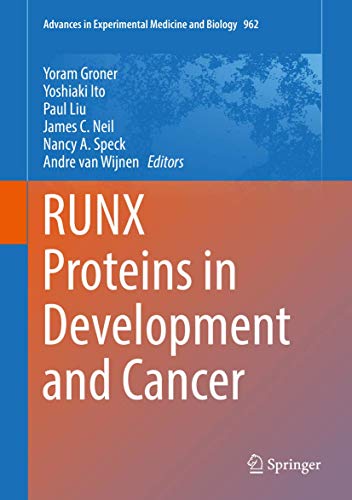
Inhaltsangabe
This volume provides the reader with an overview of the diverse functions of the RUNX family of genes. As highlighted in the introduction and several of the 29 chapters, humans and other mammals have three RUNX genes that are known to play specific roles in blood, bone and neuronal development. However, their evolutionary history has recently been traced back to unicellular organisms and their involvement in many well-known signaling pathways (Wnt, TGFb, Notch, Hippo) is indicative of a more general function in cell biology. Their documented roles in cell fate decisions include control of proliferation, differentiation, survival, senescence and autophagy.
The pleiotropic effects of RUNX in development are mirrored in cancer, where RUNX genes can function as oncogenes that collaborate strongly with Myc family oncogenes or as tumour suppressor genes. In the latter role, they display hallmarks of both ‘gatekeepers’ that modulate p53 responses and ‘caretakers’ that protect the genome from DNA damage. Several chapters focus on the importance of these genes in leukemia research, where RUNX1 and CBFB are frequently affected by chromosomal translocations that generate fusion oncoproteins, while recent studies suggest wider roles for RUNX modulation in solid cancers. Moreover, RUNX genes are intimately involved in the development and regulation of the immune system, while emerging evidence suggests a role in innate immunity to infectious agents, including HIV.
At the biochemical level, the RUNX family can serve as activators or repressors of transcription and as stable mediators of epigenetic memory through mitosis. Not surprisingly, RUNX activity is controlled at multiple levels, this includes miRNAs and a plethora of post-translational modifications. Several chapters highlight the interplay between the three mammalian RUNX genes, where cross-talk and partial functional redundancies are evident. Finally, structural analysis of the RUNX/CBFB interaction has led to the development of small molecule inhibitors that provide exciting new tools to decipher the roles of RUNX in development and as targets for therapy.
This volume provides a compendium and reference source that will be of broad interest to cancer researchers, developmental biologists and immunologists.
Die Inhaltsangabe kann sich auf eine andere Ausgabe dieses Titels beziehen.
Von der hinteren Coverseite
This volume provides the reader with an overview of the diverse functions of the RUNX family of genes. As highlighted in the introduction and several of the 29 chapters, humans and other mammals have three RUNX genes that are known to play specific roles in blood, bone and neuronal development. However, their evolutionary history has recently been traced back to unicellular organisms and their involvement in many well-known signaling pathways (Wnt, TGFb, Notch, Hippo) is indicative of a more general function in cell biology. Their documented roles in cell fate decisions include control of proliferation, differentiation, survival, senescence and autophagy.
The pleiotropic effects of RUNX in development are mirrored in cancer, where RUNX genes can function as oncogenes that collaborate strongly with Myc family oncogenes or as tumour suppressor genes. In the latter role, they display hallmarks of both ‘gatekeepers’ that modulate p53 responses and ‘caretakers’ that protect the genome from DNA damage. Several chapters focus on the importance of these genes in leukemia research, where RUNX1 and CBFB are frequently affected by chromosomal translocations that generate fusion oncoproteins, while recent studies suggest wider roles for RUNX modulation in solid cancers. Moreover, RUNX genes are intimately involved in the development and regulation of the immune system, while emerging evidence suggests a role in innate immunity to infectious agents, including HIV.
At the biochemical level, the RUNX family can serve as activators or repressors of transcription and as stable mediators of epigenetic memory through mitosis. Not surprisingly, RUNX activity is controlled at multiple levels, this includes miRNAs and a plethora of post-translational modifications. Several chapters highlight the interplay between the three mammalian RUNX genes, where cross-talk and partial functional redundancies are evident. Finally, structural analysis of the RUNX/CBFB interaction has led to the development of small molecule inhibitors that provide exciting new tools to decipher the roles of RUNX in development and as targets for therapy.
This volume provides a compendium and reference source that will be of broad interest to cancer researchers, developmental biologists and immunologists.
„Über diesen Titel“ kann sich auf eine andere Ausgabe dieses Titels beziehen.
Suchergebnisse für RUNX Proteins in Development and Cancer (Advances in...

Foto des Verkäufers
RUNX Proteins in Development and Cancer (Advances in Experimental Medicine and Biology, 962)
Anbieter: Solr Books, Lincolnwood, IL, USA
Verkäuferbewertung 5 von 5 Sternen

Zustand: very_good. This book is in Very good condition. There may be a few flaws like shelf wear and some light wear. Bestandsnummer des Verkäufers 5D4000008KAR_ns
Gebraucht kaufen
EUR 157,30
EUR 6,88 Versand
Versand innerhalb von USA
Versand innerhalb von USA
Anzahl: 1 verfügbar
Beispielbild für diese ISBN
RUNX Proteins in Development and Cancer (eng)
Print-on-DemandAnbieter: Brook Bookstore On Demand, Napoli, NA, Italien
Verkäuferbewertung 5 von 5 Sternen
Zustand: new. Questo è un articolo print on demand. Bestandsnummer des Verkäufers 4HWURLMIU8
Neu kaufen
EUR 166,29
EUR 11,00 Versand
Versand von Italien nach USA
Versand von Italien nach USA
Anzahl: Mehr als 20 verfügbar
Foto des Verkäufers
RUNX PROTEINS IN DEVELOPMENT &
Print-on-DemandAnbieter: moluna, Greven, Deutschland
Verkäuferbewertung 5 von 5 Sternen
Zustand: New. Dieser Artikel ist ein Print on Demand Artikel und wird nach Ihrer Bestellung fuer Sie gedruckt. Provides readers with an overview of the diverse functions of the RUNX family genesIs a compendium and reference source that will be of broad interest to cancer researchers, developmental biologists and immunologists. Bestandsnummer des Verkäufers 147085956
Neu kaufen
EUR 180,07
EUR 48,99 Versand
Versand von Deutschland nach USA
Versand von Deutschland nach USA
Anzahl: Mehr als 20 verfügbar
Foto des Verkäufers
RUNX Proteins in Development and Cancer
Verlag:
Springer Nature Singapore Mrz 2017, 2017
ISBN 10: 9811032319
ISBN 13: 9789811032318
Neu
Hardcover
Anbieter: BuchWeltWeit Ludwig Meier e.K., Bergisch Gladbach, Deutschland
Verkäuferbewertung 5 von 5 Sternen
Buch. Zustand: Neu. This item is printed on demand - it takes 3-4 days longer - Neuware -This volume provides the reader with an overview of the diverse functions of the RUNX family of genes. As highlighted in the introduction and several of the 29 chapters, humans and other mammals have three RUNX genes that are known to play specific roles in blood, bone and neuronal development. However, their evolutionary history has recently been traced back to unicellular organisms and their involvement in many well-known signaling pathways (Wnt, TGFb, Notch, Hippo) is indicative of a more general function in cell biology. Their documented roles in cell fate decisions include control of proliferation, differentiation, survival, senescence and autophagy.The pleiotropic effects of RUNX in development are mirrored in cancer, where RUNX genes can function as oncogenes that collaborate strongly with Myc family oncogenes or as tumour suppressor genes. In the latter role, they display hallmarks of both 'gatekeepers' that modulate p53 responses and 'caretakers' that protect the genome from DNA damage. Several chapters focus on the importance of these genes in leukemia research, where RUNX1 and CBFB are frequently affected by chromosomal translocations that generate fusion oncoproteins, while recent studies suggest wider roles for RUNX modulation in solid cancers. Moreover, RUNX genes are intimately involved in the development and regulation of the immune system, while emerging evidence suggests a role in innate immunity to infectious agents, including HIV.At the biochemical level, the RUNX family can serve as activators or repressors of transcription and as stable mediators of epigenetic memory through mitosis. Not surprisingly, RUNX activity is controlled at multiple levels, this includes miRNAs and a plethora of post-translational modifications. Several chapters highlight the interplay between the three mammalian RUNX genes, where cross-talk and partial functional redundancies are evident. Finally, structural analysis of the RUNX/CBFB interaction has led to the development of small molecule inhibitors that provide exciting new tools to decipher the roles of RUNX in development and as targets for therapy.This volume provides a compendium and reference source that will be of broad interest to cancer researchers, developmental biologists and immunologists. 536 pp. Englisch. Bestandsnummer des Verkäufers 9789811032318
Neu kaufen
EUR 213,99
EUR 23,00 Versand
Versand von Deutschland nach USA
Versand von Deutschland nach USA
Anzahl: 2 verfügbar
Beispielbild für diese ISBN
RUNX Proteins in Development and Cancer (Hardcover)
Verlag:
Springer Verlag, Singapore, Singapore, 2017
ISBN 10: 9811032319
ISBN 13: 9789811032318
Neu
Hardcover
Anbieter: Grand Eagle Retail, Bensenville, IL, USA
Verkäuferbewertung 5 von 5 Sternen
Hardcover. Zustand: new. Hardcover. This volume provides the reader with an overview of the diverse functions of the RUNX family of genes. As highlighted in the introduction and several of the 29 chapters, humans and other mammals have three RUNX genes that are known to play specific roles in blood, bone and neuronal development. However, their evolutionary history has recently been traced back to unicellular organisms and their involvement in many well-known signaling pathways (Wnt, TGFb, Notch, Hippo) is indicative of a more general function in cell biology. Their documented roles in cell fate decisions include control of proliferation, differentiation, survival, senescence and autophagy.The pleiotropic effects of RUNX in development are mirrored in cancer, where RUNX genes can function as oncogenes that collaborate strongly with Myc family oncogenes or as tumour suppressor genes. In the latter role, they display hallmarks of both gatekeepers that modulate p53 responses and caretakers that protect the genome from DNA damage. Several chapters focus on the importance of these genes in leukemia research, where RUNX1 and CBFB are frequently affected by chromosomal translocations that generate fusion oncoproteins, while recent studies suggest wider roles for RUNX modulation in solid cancers. Moreover, RUNX genes are intimately involved in the development and regulation of the immune system, while emerging evidence suggests a role in innate immunity to infectious agents, including HIV. At the biochemical level, the RUNX family can serve as activators or repressors of transcription and as stable mediators of epigenetic memory through mitosis. Not surprisingly, RUNX activity is controlled at multiple levels, this includes miRNAs and a plethora of post-translational modifications. Several chapters highlight the interplay between the three mammalian RUNX genes, where cross-talk and partial functional redundancies are evident. Finally, structural analysis of the RUNX/CBFB interaction has led to the development of small molecule inhibitors that provide exciting new tools to decipher the roles of RUNX in development and as targets for therapy.This volume provides a compendium and reference source that will be of broad interest to cancer researchers, developmental biologists and immunologists. Their documented roles in cell fate decisions include control of proliferation, differentiation, survival, senescence and autophagy.The pleiotropic effects of RUNX in development are mirrored in cancer, where RUNX genes can function as oncogenes that collaborate strongly with Myc family oncogenes or as tumour suppressor genes. Shipping may be from multiple locations in the US or from the UK, depending on stock availability. Bestandsnummer des Verkäufers 9789811032318
Foto des Verkäufers
RUNX Proteins in Development and Cancer
Print-on-DemandAnbieter: buchversandmimpf2000, Emtmannsberg, BAYE, Deutschland
Verkäuferbewertung 5 von 5 Sternen
Buch. Zustand: Neu. This item is printed on demand - Print on Demand Titel. Neuware -This volume provides the reader with an overview of the diverse functions of the RUNX family of genes. As highlighted in the introduction and several of the 29 chapters, humans and other mammals have three RUNX genes that are known to play specific roles in blood, bone and neuronal development. However, their evolutionary history has recently been traced back to unicellular organisms and their involvement in many well-known signaling pathways (Wnt, TGFb, Notch, Hippo) is indicative of a more general function in cell biology. Their documented roles in cell fate decisions include control of proliferation, differentiation, survival, senescence and autophagy.The pleiotropic effects of RUNX in development are mirrored in cancer, where RUNX genes can function as oncogenes that collaborate strongly with Myc family oncogenes or as tumour suppressor genes. In the latter role, they display hallmarks of both 'gatekeepers' that modulate p53 responses and 'caretakers' that protect the genome from DNA damage. Several chapters focus on the importance of these genes in leukemia research, where RUNX1 and CBFB are frequently affected by chromosomal translocations that generate fusion oncoproteins, while recent studies suggest wider roles for RUNX modulation in solid cancers. Moreover, RUNX genes are intimately involved in the development and regulation of the immune system, while emerging evidence suggests a role in innate immunity to infectious agents, including HIV.At the biochemical level, the RUNX family can serve as activators or repressors of transcription and as stable mediators of epigenetic memory through mitosis. Not surprisingly, RUNX activity is controlled at multiple levels, this includes miRNAs and a plethora of post-translational modifications. Several chapters highlight the interplay between the three mammalian RUNX genes, where cross-talk and partial functional redundancies are evident. Finally, structural analysis of the RUNX/CBFB interaction has led to the development of small molecule inhibitors that provide exciting new tools to decipher the roles of RUNX in development and as targets for therapy.This volume provides a compendium and reference source that will be of broad interest to cancer researchers, developmental biologists and immunologists.Springer-Verlag KG, Sachsenplatz 4-6, 1201 Wien 536 pp. Englisch. Bestandsnummer des Verkäufers 9789811032318
Neu kaufen
EUR 213,99
EUR 60,00 Versand
Versand von Deutschland nach USA
Versand von Deutschland nach USA
Anzahl: 1 verfügbar
Beispielbild für diese ISBN
RUNX Proteins in Development and Cancer: 962 (Advances in Experimental Medicine and Biology)
Anbieter: Books Puddle, New York, NY, USA
Verkäuferbewertung 4 von 5 Sternen

Zustand: New. pp. 515 1st ed. 2017 edition NO-PA16APR2015-KAP. Bestandsnummer des Verkäufers 26375193824
Neu kaufen
EUR 288,89
EUR 3,44 Versand
Versand innerhalb von USA
Versand innerhalb von USA
Anzahl: 4 verfügbar
Beispielbild für diese ISBN
RUNX Proteins in Development and Cancer: 962 (Advances in Experimental Medicine and Biology)
Print-on-DemandAnbieter: Majestic Books, Hounslow, Vereinigtes Königreich
Verkäuferbewertung 4 von 5 Sternen
Zustand: New. Print on Demand pp. 515. Bestandsnummer des Verkäufers 371900223
Neu kaufen
EUR 297,77
EUR 7,58 Versand
Versand von Vereinigtes Königreich nach USA
Versand von Vereinigtes Königreich nach USA
Anzahl: 4 verfügbar
Beispielbild für diese ISBN
RUNX Proteins in Development and Cancer: 962 (Advances in Experimental Medicine and Biology)
Print-on-DemandAnbieter: Biblios, Frankfurt am main, HESSE, Deutschland
Verkäuferbewertung 4 von 5 Sternen
Zustand: New. PRINT ON DEMAND pp. 515. Bestandsnummer des Verkäufers 18375193834
Neu kaufen
EUR 305,66
EUR 9,95 Versand
Versand von Deutschland nach USA
Versand von Deutschland nach USA
Anzahl: 4 verfügbar
Beispielbild für diese ISBN
RUNX Proteins in Development and Cancer
Anbieter: Revaluation Books, Exeter, Vereinigtes Königreich
Verkäuferbewertung 5 von 5 Sternen
Hardcover. Zustand: Brand New. 515 pages. 10.25x7.25x1.25 inches. In Stock. Bestandsnummer des Verkäufers x-9811032319
Neu kaufen
EUR 311,19
EUR 17,49 Versand
Versand von Vereinigtes Königreich nach USA
Versand von Vereinigtes Königreich nach USA
Anzahl: 2 verfügbar