
Verwandte Artikel zu Elusive Balances: Shaping U.S.-Southeast Asia Strategy
Inhaltsangabe
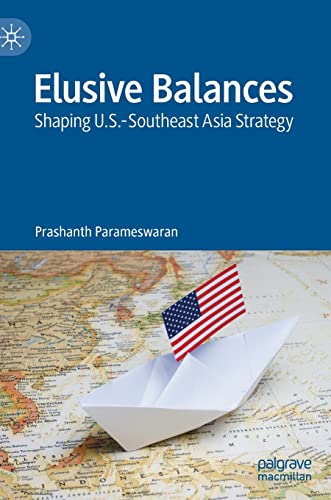
This book undertakes an in-depth examination of the dynamics of commitment in U.S.-Southeast Asia strategy. Drawing on cases including the U.S. withdrawal from Vietnam and Washington’s pivot to Asia amid China’s growing regional role, it constructs an original balance of commitment model to explain continuity and change in U.S.-Southeast Asia policy. Balance of commitment goes beyond balance of power approaches to explains how translating Southeast Asia’s importance in U.S. thinking into actual commitments has proven challenging for policymakers as it requires simultaneously calibrating adjustments to power shifts, threat perceptions and resource extraction.
The book applies the balance of commitment approach to several practical case studies, based on hundreds of conversations with policymakers and experts in the United States and Southeast Asia, personal experiences across nearly two decades and primary and secondary source material across a half-century. The findings suggest that the challenges of U.S. commitment to the region are rooted not simply in differences between administrations or divergences in outlook between Washington and regional capitals, but tough balancing acts for U.S. policymakers in domestic politics and wider foreign policy. As such, shaping U.S. strategy in Southeast Asia and calibrating and sustaining commitment requires not just appreciating Southeast Asia’s significance, but committing to the region in ways that manage structural aspects of U.S. thinking, capabilities and resourcing.
Die Inhaltsangabe kann sich auf eine andere Ausgabe dieses Titels beziehen.
Über die Autorin bzw. den Autor
Dr. Prashanth Parameswaran is a senior fellow at the Foreign Policy Research Institute and founder of the weekly ASEAN Wonk newsletter on Southeast Asia and Indo-Pacific geopolitics and geoeconomics. Born and raised in Southeast Asia, he is also a senior columnist at The Diplomat, an advisor at the strategic consultancy BowerGroupAsia, a fellow at the Institute for Indo-Pacific Security, and an instructor for regional courses at the State Department and Pentagon.
Dr. Parameswaran has spent nearly two decades working with businesses, think tanks, governments, and universities in Southeast Asia and the Indo-Pacific region, including early stints with Singapore’s Ministry of Trade and Industry, the Agence France-Presse news wire service agency in Thailand, and the Center for Strategic and International Studies in Washington, DC. He has conducted extensive field research across the Indo-Pacific region, including all 11 countries in Southeast Asia, publishing over 2,000 articles and commentaries in international outlets such as CNN, The Straits Times, Nikkei Asia, South China Morning Post, and Foreign Policy on topics including major power competition, maritime security, economic statecraft, regional institutional development, military modernization, and foreign policy strategy.
Dr. Parameswaran is the author of two books: Mandalas of Multialignment: Hedging Bets in Southeast Asia Grand Strategy Spheres, Foreign and Security Policy Webs, and Global Geopolitics and Geoeconomics (2026) and Elusive Balances: Shaping US-Southeast Asia Strategy (2022). He holds a PhD and an MA from the Fletcher School of Law and Diplomacy at Tufts University, and a BA with highest honors from the University of Virginia.
Von der hinteren Coverseite
This book undertakes an in-depth examination of the dynamics of commitment in U.S.-Southeast Asia strategy. Drawing on cases including the U.S. withdrawal from Vietnam and Washington’s pivot to Asia amid China’s growing regional role, it constructs an original balance of commitment model to explain continuity and change in U.S.-Southeast Asia policy. Balance of commitment goes beyond balance of power approaches to explains how translating Southeast Asia’s importance in U.S. thinking into actual commitments has proven challenging for policymakers as it requires simultaneously calibrating adjustments to power shifts, threat perceptions and resource extraction.
Dr. Prashanth Parameswaran is an analyst and educator focused on Southeast Asia, politics and security issues in the Asia-Pacific and U.S. foreign policy in the region. He is currently a fellow at the Asia Program at the Woodrow Wilson International Center for Scholars based in Washington, D.C. and a senior columnist at The Diplomat, one of Asia’s leading current affairs magazines. A political scientist by training, he has previously held roles linked to think tanks, media, business, and government, conducting field research, consulting, writing and teaching on these issues for nearly two decades and widely publishing policy insights, research and commentary in the United States and in Southeast Asia.
„Über diesen Titel“ kann sich auf eine andere Ausgabe dieses Titels beziehen.
Suchergebnisse für Elusive Balances: Shaping U.S.-Southeast Asia Strategy

Beispielbild für diese ISBN
Elusive Balances (eng)
Print-on-DemandAnbieter: Brook Bookstore On Demand, Napoli, NA, Italien
Verkäuferbewertung 5 von 5 Sternen

Zustand: new. Questo è un articolo print on demand. Bestandsnummer des Verkäufers TJSG0SL77Q
Neu kaufen
EUR 102,25
EUR 5,50 Versand
Versand von Italien nach USA
Versand von Italien nach USA
Anzahl: Mehr als 20 verfügbar
Beispielbild für diese ISBN
Elusive Balances: Shaping U.S.-Southeast Asia Strategy
Anbieter: Ria Christie Collections, Uxbridge, Vereinigtes Königreich
Verkäuferbewertung 5 von 5 Sternen
Zustand: New. In. Bestandsnummer des Verkäufers ria9789811666117_new
Neu kaufen
EUR 128,93
EUR 14,00 Versand
Versand von Vereinigtes Königreich nach USA
Versand von Vereinigtes Königreich nach USA
Anzahl: Mehr als 20 verfügbar
Foto des Verkäufers
Elusive Balances
Verlag:
Springer Nature Singapore Jan 2022, 2022
ISBN 10: 9811666113
ISBN 13: 9789811666117
Neu
Hardcover
Anbieter: BuchWeltWeit Ludwig Meier e.K., Bergisch Gladbach, Deutschland
Verkäuferbewertung 5 von 5 Sternen
Buch. Zustand: Neu. This item is printed on demand - it takes 3-4 days longer - Neuware -This book undertakes an in-depth examination of the dynamics of commitment in U.S.-Southeast Asia strategy. Drawing on cases including the U.S. withdrawal from Vietnam and Washington's pivot to Asia amid China's growing regional role, it constructs an original balance of commitment model to explain continuity and change in U.S.-SoutheastAsia policy.Balance of commitment goes beyond balance of power approaches toexplains how translating Southeast Asia's importance in U.S. thinking into actual commitments has proven challenging for policymakers as it requires simultaneously calibrating adjustments to power shifts, threat perceptions and resource extraction.The book applies the balance of commitment approach to several practical case studies, based on hundreds of conversations with policymakers and experts in the United States and Southeast Asia, personal experiences across nearly two decades and primary and secondary source material across a half-century. The findings suggest that the challenges of U.S. commitment to the region are rooted not simply in differences between administrations or divergences in outlook between Washington and regional capitals, but tough balancing acts for U.S. policymakers in domestic politics and wider foreign policy. As such, shaping U.S. strategy in Southeast Asia and calibrating and sustaining commitment requires not just appreciating Southeast Asia's significance, but committing to the region in ways that manage structural aspects of U.S. thinking, capabilities and resourcing. 228 pp. Englisch. Bestandsnummer des Verkäufers 9789811666117
Neu kaufen
EUR 128,39
EUR 23,00 Versand
Versand von Deutschland nach USA
Versand von Deutschland nach USA
Anzahl: 2 verfügbar
Foto des Verkäufers
Elusive Balances
ISBN 10: 9811666113
ISBN 13: 9789811666117
Neu
Hardcover
Anbieter: moluna, Greven, Deutschland
Verkäuferbewertung 5 von 5 Sternen
Zustand: New. Dieser Artikel ist ein Print on Demand Artikel und wird nach Ihrer Bestellung fuer Sie gedruckt. As such, shaping U.S. strategy in Southeast Asia and calibrating and sustaining commitment requires not just appreciating Southeast Asia s significance, but committing to the region in ways that manage structural aspects of U.S. thinking, capabilities and r. Bestandsnummer des Verkäufers 501252665
Neu kaufen
EUR 110,71
EUR 48,99 Versand
Versand von Deutschland nach USA
Versand von Deutschland nach USA
Anzahl: Mehr als 20 verfügbar
Beispielbild für diese ISBN
Elusive Balances: Shaping U.S.-Southeast Asia Strategy
Anbieter: Kennys Bookshop and Art Galleries Ltd., Galway, GY, Irland
Verkäuferbewertung 5 von 5 Sternen
Zustand: New. 2022. Hardcover. . . . . . Bestandsnummer des Verkäufers V9789811666117
Neu kaufen
EUR 152,91
EUR 9,50 Versand
Versand von Irland nach USA
Versand von Irland nach USA
Anzahl: Mehr als 20 verfügbar
Beispielbild für diese ISBN
Elusive Balances
Anbieter: Books Puddle, New York, NY, USA
Verkäuferbewertung 4 von 5 Sternen

Zustand: New. pp. 211. Bestandsnummer des Verkäufers 26394588045
Neu kaufen
EUR 169,38
EUR 3,45 Versand
Versand innerhalb von USA
Versand innerhalb von USA
Anzahl: 4 verfügbar
Beispielbild für diese ISBN
Elusive Balances
Print-on-DemandAnbieter: Majestic Books, Hounslow, Vereinigtes Königreich
Verkäuferbewertung 4 von 5 Sternen
Zustand: New. Print on Demand pp. 211. Bestandsnummer des Verkäufers 401821778
Neu kaufen
EUR 176,00
EUR 7,60 Versand
Versand von Vereinigtes Königreich nach USA
Versand von Vereinigtes Königreich nach USA
Anzahl: 4 verfügbar
Foto des Verkäufers
Elusive Balances
Print-on-DemandAnbieter: buchversandmimpf2000, Emtmannsberg, BAYE, Deutschland
Verkäuferbewertung 5 von 5 Sternen
Buch. Zustand: Neu. This item is printed on demand - Print on Demand Titel. Neuware -This book undertakes an in-depth examination of the dynamics of commitment in U.S.-Southeast Asia strategy. Drawing on cases including the U.S. withdrawal from Vietnam and Washington's pivot to Asia amid China's growing regional role, it constructs an original balance of commitment model to explain continuity and change in U.S.-Southeast Asia policy. Balance of commitment goes beyond balance of power approaches to explains how translating Southeast Asia's importance in U.S. thinking into actual commitments has proven challenging for policymakers as it requires simultaneously calibrating adjustments to power shifts, threat perceptions and resource extraction.The book applies the balance of commitment approach to several practical case studies, based on hundreds of conversations with policymakers and experts in the United States and Southeast Asia, personal experiences across nearly two decades and primary and secondary source material across a half-century. The findings suggest that the challenges of U.S. commitment to the region are rooted not simply in differences between administrations or divergences in outlook between Washington and regional capitals, but tough balancing acts for U.S. policymakers in domestic politics and wider foreign policy. As such, shaping U.S. strategy in Southeast Asia and calibrating and sustaining commitment requires not just appreciating Southeast Asia's significance, but committing to the region in ways that manage structural aspects of U.S. thinking, capabilities and resourcing.Springer-Verlag GmbH, Tiergartenstr. 17, 69121 Heidelberg 228 pp. Englisch. Bestandsnummer des Verkäufers 9789811666117
Neu kaufen
EUR 128,39
EUR 60,00 Versand
Versand von Deutschland nach USA
Versand von Deutschland nach USA
Anzahl: 1 verfügbar
Beispielbild für diese ISBN
Elusive Balances
Print-on-DemandAnbieter: Biblios, Frankfurt am main, HESSE, Deutschland
Verkäuferbewertung 4 von 5 Sternen
Zustand: New. PRINT ON DEMAND pp. 211. Bestandsnummer des Verkäufers 18394588039
Neu kaufen
EUR 180,48
EUR 9,95 Versand
Versand von Deutschland nach USA
Versand von Deutschland nach USA
Anzahl: 4 verfügbar
Foto des Verkäufers
Elusive Balances : Shaping U.S.-Southeast Asia Strategy
Verlag:
Springer Nature Singapore, Springer Nature Singapore, 2022
ISBN 10: 9811666113
ISBN 13: 9789811666117
Neu
Hardcover
Anbieter: AHA-BUCH GmbH, Einbeck, Deutschland
Verkäuferbewertung 5 von 5 Sternen
Buch. Zustand: Neu. Druck auf Anfrage Neuware - Printed after ordering - This book undertakes an in-depth examination of the dynamics of commitment in U.S.-Southeast Asia strategy. Drawing on cases including the U.S. withdrawal from Vietnam and Washington's pivot to Asia amid China's growing regional role, it constructs an original balance of commitment model to explain continuity and change in U.S.-SoutheastAsia policy.Balance of commitment goes beyond balance of power approaches toexplains how translating Southeast Asia's importance in U.S. thinking into actual commitments has proven challenging for policymakers as it requires simultaneously calibrating adjustments to power shifts, threat perceptions and resource extraction.The book applies the balance of commitment approach to several practical case studies, based on hundreds of conversations with policymakers and experts in the United States and Southeast Asia, personal experiences across nearly two decades and primary and secondary source material across a half-century. The findings suggest that the challenges of U.S. commitment to the region are rooted not simply in differences between administrations or divergences in outlook between Washington and regional capitals, but tough balancing acts for U.S. policymakers in domestic politics and wider foreign policy. As such, shaping U.S. strategy in Southeast Asia and calibrating and sustaining commitment requires not just appreciating Southeast Asia's significance, but committing to the region in ways that manage structural aspects of U.S. thinking, capabilities and resourcing. Bestandsnummer des Verkäufers 9789811666117
Neu kaufen
EUR 132,83
EUR 62,07 Versand
Versand von Deutschland nach USA
Versand von Deutschland nach USA
Anzahl: 1 verfügbar