
Verwandte Artikel zu AI System Design Interview Mastery — 2026: Designing...
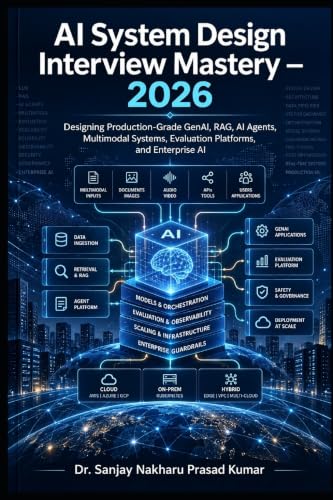
AI System Design Interview Mastery — 2026: Designing Production-Grade GenAI, RAG, AI Agents, Multimodal Systems, Evaluation Platforms, and Enterprise AI - Softcover
Inhaltsangabe
Master the AI system design interview—and learn how to design AI systems that actually work in production.
AI interviews have changed. Knowing the definitions of RAG, vector databases, agents, embeddings, or LLMs is no longer enough. Today’s AI engineering and product roles demand something more difficult: the ability to design complete, production-ready AI systems, explain the tradeoffs behind your decisions, anticipate failure modes, and defend your architecture under pressure.
AI System Design Interview Mastery — 2026 is a practical guide for AI Engineers, ML Engineers, Forward Deployed Engineers, AI Product Managers, Solution Architects, Technical Product Managers, and technology leaders preparing for modern AI system design interviews.
Written by Dr. Sanjay Nakharu Prasad Kumar, the book introduces the DESIGN-AI Framework, a reusable approach for moving from business requirements to scalable AI architecture:
Define the problem → Establish success criteria → Shape the data and context → Intelligence architecture → Govern actions and agency → Neutralize failures → Assess continuously → Industrialize for production.
Rather than treating the LLM as the entire system, this book shows how production AI applications bring together models, retrieval, agents, tools, memory, evaluation, guardrails, security, observability, infrastructure, governance, and human oversight.
Inside, you will learn how to:
- Design production-grade GenAI and enterprise AI architectures
- Build advanced RAG pipelines, including hybrid search, reranking, GraphRAG, and agentic retrieval
- Choose between prompting, retrieval, fine-tuning, long context, and model routing
- Architect AI agents, multi-agent systems, tool-calling workflows, MCP integrations, and agent harnesses
- Design short-term, working, episodic, and long-term memory
- Build secure multimodal systems for documents, images, audio, and structured enterprise data
- Create evaluation systems for groundedness, correctness, retrieval quality, tool execution, safety, and task completion
- Apply deterministic checks, LLM-as-a-judge, human evaluation, regression testing, and production monitoring
- Engineer guardrails for prompt injection, hallucination, unsafe actions, PII exposure, and authorization failures
- Design enterprise security using identity, RBAC/ABAC, least privilege, auditability, and human approval
- Implement LLMOps and AgentOps with tracing, observability, CI/CD, canary releases, rollback, and continuous evaluation
- Optimize AI systems for latency, reliability, scale, token consumption, and cost
- Explain architecture tradeoffs clearly during interviews
The book also includes extensive system-design case studies covering enterprise knowledge assistants, customer-service agents, Text-to-SQL analytics, intelligent document processing, fraud and risk systems, coding agents, voice AI, SRE agents, multimodal workflows, recommendation systems, and enterprise agentic AI platforms.
Interview preparation is woven throughout the book with architecture exercises, follow-up questions, failure scenarios, design checklists, rapid-fire questions, advanced system-design labs, and structured techniques for answering the most difficult interviewer prompts.
Die Inhaltsangabe kann sich auf eine andere Ausgabe dieses Titels beziehen.
Suchergebnisse für AI System Design Interview Mastery — 2026: Designing...

Beispielbild für diese ISBN
AI System Design Interview Mastery ? 2026: Designing Production-Grade GenAI, RAG, AI Agents, Multimodal Systems, Evaluation Platforms, and Enterprise AI
Print-on-DemandAnbieter: California Books, Miami, FL, USA
Verkäuferbewertung 5 von 5 Sternen

Zustand: New. Print on Demand. Bestandsnummer des Verkäufers I-9798160055152
Neu kaufen
EUR 31,12
Versand gratis
Versand innerhalb von USA
Versand innerhalb von USA
Anzahl: Mehr als 20 verfügbar