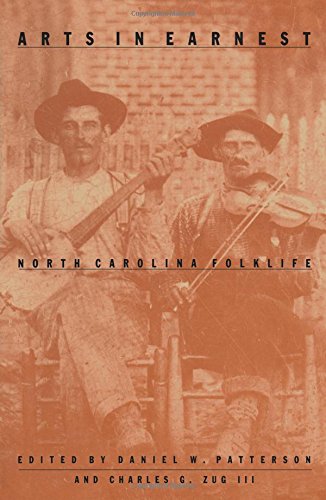
ARTS IN EARNEST: NORTH CAROLINA
Verkauft von BennettBooksLtd, Los Angeles, CA, USA
AbeBooks-Verkäufer seit 17. April 2008
Neu - Softcover
Zustand: Neu
Versand innerhalb von USA
Anzahl: 1 verfügbar
In den Warenkorb legenVerkauft von BennettBooksLtd, Los Angeles, CA, USA
AbeBooks-Verkäufer seit 17. April 2008
Zustand: Neu
Anzahl: 1 verfügbar
In den Warenkorb legenNew. In shrink wrap. Looks like an interesting title! 1.2.
Bestandsnummer des Verkäufers Q-082231021X
Acknowledgments,
Introduction,
Of the Past,
1. The North Carolina Wildfowl Decoy Tradition,
2. "I Never Could Play Alone": The Emergence of the New River Valley String Band, 1875–1915,
3. The Hugh Dixon Homestead: What to Make of Tradition?,
4. Economic and Cultural Influences on German and Scotch-Irish Quilts in Antebellum Rowan County, North Carolina,
5. The Development of the Bright-Leaf Tobacco Auctioneer's Chant,
Of Individuals,
6. The Solitary Memory: A Greek-American's Recollections of the Folk Play Panáretos,
7. The Banjo-Song Genre: A Study of "High Sheriff," Dink Roberts's Man-against-the-Law Song,
9. Symbols from Ribbons: Afro-American Funeral-Ribbon Quilts in Chatham County, North Carolina,
10. "Learnin', Though": Environmental Art as a Creative Process,
Of Communities,
11. In the Good Old Way: Primitive Baptist Tradition in an Age of Change,
12. Banjos and Blues,
13. Why Do Duck Decoys Have Eyes?,
14. Tugging on Superman's Cape: The Making of a College Legend,
15. The Dissembling Line: Industrial Pranks in a North Carolina Textile Mill,
Notes,
Contributors,
The North Carolina Wildfowl Decoy Tradition
Stephen Matchak
Wildfowl-decoy carving has been a folk tradition since the middle of the nineteenth century, and many hands have contributed to it. In the antique collectors' scheme of things, however, North Carolina decoys fare poorly; William Mackey describes the regional decoys as "solid, crude, roughly finished and poorly painted." But hunters design decoys not for collectors, but as tools to lure passing birds within range of their guns. The decoys have specific functions within the busy lives of men like John W. Austin of Corolla, North Carolina.
Austin was born in Hatteras, North Carolina, in 1891 and moved to Corolla when his father became the lighthouse keeper. As a boy, Austin watched his father and older brothers make decoys. He also helped paint their decoys and accompanied them in hunting. While in the field, he watched and handled birds, slowly building a storehouse of practical knowledge. Austin told me that when he was fourteen he decided to hunt for himself and consequently had to carve his own decoys. He started by copying his father's decoys and remembers that his first few tries produced funny-looking results—birds that rode awkwardly in the water and failed to resemble the intended species. After a while, he "got pretty good at it" and through the years, refined his craftsmanship and expanded his repertoire.
Austin made decoys for use in three different hunting situations in successive phases of his life. As a young man, like many good shots, he worked as a market hunter, shipping his daily kill on steamboats to northern markets. In effect, he was a small businessman, having invested in a sailboat, large decoy rig, and armaments to harvest nature's bounty. When he returned from the First World War, however, Austin found that his occupation had been outlawed by the Migratory Bird Treaty Act of 1918. He turned to the Lighthouse Club for employment and worked as a guide for "sports" who desired to shoot gamebirds, and during the slack season he made decoys for the sport market.
Austin guided until the Great Depression brought declining economic fortunes, changed leisure activities, and closed many hunting clubs. He then become the postmaster in Corolla and continued to fish and hunt in accord with the seasons. Even in his retirement, he continued to carve decoys and to hunt for pleasure and for the table. Looking back on his world, Austin observed that nature "was all there was here, you know, for people to live on for a livelihood. The natives come in, and our forefathers run the Indians out—and all they had was hunting raccoons, possums, and ducks. And they had plenty of oysters, clams, and fish, and they didn't have to worry about anything, except something to wrap up in. And, there was plenty of game, you know, all the time."
Crude or elegant, bird decoys have serious uses in lives like John Austin's, and the North Carolina decoys were shaped by an even longer and more complex history than his. They exhibit a diversity of forms arising out of the complexities of the hunt itself and out of an ever-changing local ecology and economy.
When the earliest colonists settled North Carolina, they had no need for decoys. An eighteenth-century traveler through this region, John Brickell, saw a flock of swans so large it appeared like "Land covered with Snow. About Christmas they are frequently so fat, that some of them are scarce able to fly." John Lawson, North Carolina's colonial natural historian, comments on the variety of local bird species and notes that redhead ducks were difficult to shoot: "They are very good Meat, but hard to kill, because hard to come near." However, hunters had little trouble finding easy prey within musket range. Instead of using decoys, Brickell records, hunters "frequently set Fire to these Savannas and Marshes, and as soon as the Grass is burnt off, these Fowl will come in great Flocks to eat the Roots, by which means they shoot vast Numbers of them."
Before 1700, colonial settlers streamed south from coastal Virginia, drove out the local Indians, planted crops, and harvested an ever-growing amount of wildlife. David Stick emphasizes that these colonists had several occupations: "Each of them was the same time a farmer, a fisherman, a hunter, and a wrecker." These folk built crofting communities along the banks in which they provided for virtually all their needs and exported their surpluses to Virginia's markets. A local historian, H. B. Ansell (1832–1920), describes the region during this era as a rustic paradise, with "fish, oysters, wild turkeys, pigeons, ducks, geese and other birds in abundance to replenish the tables of the new-comers with all necessaries except bread; and soon the corn and sweet potato patches made that want less."
Ansell also records the hunting methods of the 1830s through the 1850s as part of his social history of Knotts Island. Realizing that "it has ever been in evidence in all time that the young enjoy nothing more than tales told of the far past," he writes of the "details of the events, incidents and traditional stories," from his youth. In these recollections, he includes material about his boyhood adventures, old-fashioned hunting styles, and the transition from muskets to breech-loading weapons.
In his boyhood, Ansell and his cronies stole birds' eggs and hunted fowl, which they later sold for toys and candy. Boys "would hunt for birds' nests, and rob the innocent creatures of their eggs; the poor, chattering mother and mate, bewailing the destruction of their offspring in embryo, would be ruthlessly clubbed away.... Every boy had his myrtle 'birding club,' cross-bow and arrows, his springs for rabbits, his traps for birds, in every briery branch and fence-lock. By this means hundreds of strings of dead birds, even sparrows, were shipped to market by the boys, whence were obtained ginger-cakes, tops and chords, and other trinkets."
In their hunting, these boys unself-consciously imitated their fathers, who hunted bigger game with muskets for food and for cash.
In the days of these old fowlers and from time immemorial the...
„Über diesen Titel“ kann sich auf eine andere Ausgabe dieses Titels beziehen.
We guarantee the condition of every book as it's described on the Abebooks web sites. If you're dissatisfied with your purchase (Incorrect Book/Not as Described/Damaged) or if the order hasn't arrived, you're eligible for a refund within 30 days of the estimated delivery date. If you've changed your mind about a book that you've ordered, please use the Ask bookseller a question link to contact us and we'll respond within 2 business days.
Wenn Sie Verbraucher sind, steht Ihnen ein Widerrufsrecht nach folgender Maßgabe zu. Verbraucher ist jede natürliche Person, die ein Rechtsgeschäft zu Zwecken abschließt, die überwiegend weder ihrer gewerblichen noch ihrer selbständigen beruflichen Tätigkeit zugerechnet werden können.
WIDERRUFSBELEHRUNG
Widerrufsrecht
Sie haben das Recht, binnen vierzehn Tagen ohne Angabe von Gründen diesen Vertrag zu widerrufen.
Die Widerrufsfrist beträgt vierzehn Tage ab dem Tag, an dem Sie oder ein von Ihnen benannter Dritter, der nicht der Beförderer ist, die letzte Ware oder die letzte Teilsendung bzw. das letzte Stück in Besitz genommen haben bzw. hat.
Um Ihr Widerrufsrecht auszuüben, müssen Sie uns, BennettBooksLtd, 7765 N Sheridan Rd, 60626, Chicago, Illinois, U.S.A., +1 7733871973, mittels einer eindeutigen Erklärung (z.B. ein mit der Post versandter Brief, Telefax oder E-Mail) über Ihren Entschluss, diesen Vertrag zu widerrufen, informieren. Sie können dafür das beigefügte Muster-Widerrufsformular verwenden, das jedoch nicht vorgeschrieben ist. Sie können auch eine andere eindeutige Erklärung auf der Webseite "Meine Bestellungen" in Ihrem "Nutzerkonto" elektronisch ausfüllen und übermitteln. Machen Sie von dieser Möglichkeit Gebrauch, so werden wir Ihnen unverzüglich (z. B. per E-Mail) eine Bestätigung über den Eingang eines solchen Widerrufs übermitteln. Zur Wahrung der Widerrufsfrist reicht es aus, dass Sie die Mitteilung über die Ausübung des Widerrufsrechts vor Ablauf der Widerrufsfrist absenden.
Folgen des Widerrufs
Wenn Sie diesen Vertrag widerrufen, haben wir Ihnen alle Zahlungen, die wir von Ihnen erhalten haben, einschließlich der Lieferkosten (mit Ausnahme der zusätzlichen Kosten, die sich daraus ergeben, dass Sie eine andere Art der Lieferung als die von uns angebotene, günstigste Standardlieferung gewählt haben), unverzüglich und spätestens binnen vierzehn Tagen ab dem Tag zurückzuzahlen, an dem die Mitteilung über Ihren Widerruf dieses Vertrags bei uns eingegangen ist. Für diese Rückzahlung verwenden wir dasselbe Zahlungsmittel, das Sie bei der ursprünglichen Transaktion eingesetzt haben, es sei denn, mit Ihnen wurde ausdrücklich etwas anderes vereinbart; in keinem Fall werden Ihnen wegen dieser Rückzahlung Entgelte berechnet. Wir können die Rückzahlung verweigern, bis wir die Waren wieder zurückerhalten haben oder bis Sie den Nachweis erbracht haben, dass Sie die Waren zurückgesandt haben, je nachdem, welches der frühere Zeitpunkt ist. Sie haben die Waren unverzüglich und in jedem Fall spätestens binnen vierzehn Tagen ab dem Tag, an dem Sie uns über den Widerruf dieses Vertrags unterrichten, an BennettBooksLtd, Sean Bennett ATTN RETURNS, 7765 N Sheridan Rd, 60626, Chicago, Illinois, U.S.A., +1 7733871973, zurückzusenden oder zu übergeben. Die Frist ist gewahrt, wenn Sie die Waren vor Ablauf der Frist von vierzehn Tagen absenden.
Sie tragen die unmittelbaren Kosten der Rücksendung der Waren. Sie müssen für einen etwaigen Wertverlust der Waren nur aufkommen, wenn dieser Wertverlust auf einen zur Prüfung der Beschaffenheit, Eigenschaften und Funktionsweise der Waren nicht notwendigen Umgang mit ihnen zurückzuführen ist.
Ausnahmen vom Widerrufsrecht
Das Widerrufsrecht besteht nicht bzw. erlischt bei folgenden Verträgen:
ENDE DER WIDERRUFSBELEHRUNG
Muster-Widerrufsformular
(Wenn Sie den Vertrag widerrufen wollen, dann füllen Sie bitte dieses Formular aus und senden Sie es zurück)
An: (BennettBooksLtd, 7765 N Sheridan Rd, 60626, Chicago, Illinois, U.S.A., +1 7733871973)
Hiermit widerrufe(n) ich/wir* den von mir/uns* abgeschlossenen Vertrag über den Kauf der folgenden Waren*/ die Erbringung der folgenden Dienstleistung*
Bestellt am*/erhalten am*:
Name des/der Verbraucher(s):
Anschrift des/der Verbraucher(s):
Unterschrift des/der Verbraucher(s) (nur bei Mitteilung auf Papier):
Datum:
* Unzutreffendes streichen.
Orders ship within 2 business days. Shipping costs are based on books weighing 2.2 LB, or 1 KG. If your book order is heavy or oversized, we may contact you to let you know extra shipping is required.
| Bestellmenge | 7 bis 30 Werktage | 3 bis 14 Werktage |
|---|---|---|
| Erster Artikel | EUR 4.32 | EUR 7.70 |
Die Versandzeiten werden von den Verkäuferinnen und Verkäufern festgelegt. Sie variieren je nach Versanddienstleister und Standort. Sendungen, die den Zoll passieren, können Verzögerungen unterliegen. Eventuell anfallende Abgaben oder Gebühren sind von der Käuferin bzw. dem Käufer zu tragen. Die Verkäuferin bzw. der Verkäufer kann Sie bezüglich zusätzlicher Versandkosten kontaktieren, um einen möglichen Anstieg der Versandkosten für Ihre Artikel auszugleichen.